The post on Derrida and his phrase "To see in secret--what can that mean?" in The Gift of Death, below, is (like many of the posts here) taken from one of my papers for seminars. I've been revising and redoing that paper, and so can now present it more in full. Hopefully it will make more sense:
In the last section of The Gift of Death, “Tout autre est tout autre,” Derrida seems to link visibility and the sense of sight to one of the main ethical, political, and/or religious points he develops throughout the essay: that responsibility only takes place via secrecy, via an act that exceeds calculation or planning. He gathers together seeing and this secrecy in a formulation so basic we cannot but feel they are somehow indissociable. This formulation, given its own separate line in the text, is precisely a question about this indissociability. It is the following: “To see in secret—what can that mean?” Or, in the French: “Voir dans le secret. Qu’est-ce que cela peut vouloir dire?” (The Gift of Death, 88/ Donner la mort, 85)
We understand immediately that this phrase does more than just situate responsibility in the sphere of the bodily, where vision could then somehow play a part in it. In other words, it does not amount to a reiteration of Derrida’s call for an explanation of the terrified, trembling, crying body that he makes in the prior section. “One doesn’t know why one trembles,” Derrida says there, claiming that “we would need to make new inroads into thinking concerning the body, without dissociating the registers of discourse (thought, philosophy, the bio-genetico-psychoanalytic sciences, phylo- and ontogenesis), in order to one day come closer to what makes us tremble or what makes us cry” (55/57). If we were to say that political, ethical, and/or religious acts of responsibility are just bodily or embodied for Derrida, as it is popular to do with other thinkers like Maurice Merleau-Ponty, we would feel that we were not really getting at that seeming link between sight and secrecy here. Nor for that matter would we get at the sense in which Derrida is asking us to make inroads into what makes us tremble or cry—that is, the sense in which this phrase here is a reiteration.
We would feel that this is the case because the force of this simple question does not revolve around either seeing or secrecy as much as it does upon meaning. “To see in secret—what can that mean?” The stress here is upon seeing in secret remaining something questionable with respect to whether it has sense or not. If it were just the assertion of something meaningful about responsibility along with sight it would not take place in a question. Our sense of a link refines itself, then. Seeing and secrecy: these are for Derrida things that are questionable when brought together and (thereby) forced to mean or have sense. Perhaps for Derrida they are only questionable when they are supposed to mean—that is, when they take place within a question as to their meaning. In a way, then, the question seems to enact its question: it wonders whether seeing and secrecy can be questioned with respect to whether they mean in questioning them with respect to whether they mean.
But this stress on whether the link makes sense is also due to how the phrase “to see in secret” is precisely that part of the question not written solely by Derrida: it is from the Gospel of Matthew, as cited at the end of Kierkegaard’s Fear and Trembling, which Derrida analyses before and after this point in the text (cf. 80-1, 97-99). So “to see in secret” is that part of the phrase “to see in secret—what can that mean?” outside of which Derrida seems to stand (as it were) as he writes it, in order to ask it whether it can mean. Indeed, if we take his French more literally, what Derrida asks of “to see in secret” is whether it can be said (qu’est-ce que cela peut vouloir dire?). That is, he asks whether “to see in secret” does not already constitute something that would be beyond his (or anyone’s) ability to submit it to his (or anyone’s) speech as something questionable. Thus, Derrida (or anyone else) could not say, “I see in secret.” Nor could Derrida really ask it his question as to whether it can be said, for “to see in secret” would call itself already into question by itself. Thus, when it came into Derrida’s writing (precisely as the question as to whether it could be said), he would then not be saying it: he would already need to ask whether his writing said or meant anything (and thus he writes his question). The question Derrida asks not only enacts what it questions, therefore: it only enacts this because of the questionability of the link between sight and secrecy that this question, when asked by Derrida (or anyone else), cannot question. The sight of the body and the secrecy in responsibility: these are things that are beyond our ability to question them as to whether they are linked while they still remain questionable—that is, precisely when they are linked by Derrida or by us and thereby forced to mean.
Obviously for us it does not make sense, then, to ask what vision, linked to secrecy only insofar as this link were unquestionably questionable, would be experienced, or would change our sense of life and of the world. Perhaps most of all it would not make sense to ask how it changed our notion of responsibility. For Derrida in this phrase shows us that fundamentally he is in a position similar to ours, if not the very same one: he feels that seeing and secrecy might be linked. And yet, Derrida is also in a completely different position, since asking how vision would be experienced, and responsibility changed thereby, is precisely what Derrida is doing throughout this part The Gift of Death. Somehow, he is able to get across to us precisely that vision and secrecy, while we cannot be sure they are linked, would have to take place precisely in this place where we are not sure of this linkage, in that space where it remains unquestionable in both senses of the word—that is, both beyond his ability to question it, and definitely, certainly, always occurring. Our question, then, becomes one of how Derrida is able to orient himself towards the asking of his (or, as we know now, anyone’s) question qua unquestionable. In other words, our question should concern how he is able to prepare himself for being in the same position as we were with respect to his phrase, and yet better prepare himself than us such that he could also feel like he could continue to ask it, in order to investigate how it changes our experience of sight and of responsibility.
Indeed we are given an indication about how this preparation takes place in the context of Derrida’s question. It is asked as he is testing how far he can extend his reading of Abraham’s sacrifice of Isaac in Kierkegaard. Here, just by bringing vision constantly to the fore in the text either in figures of speech or more explicitly in the content of what he is saying, we see him setting up his question:
The sacrifice of Isaac is an abomination in the eyes of all and it should continue to be seen for what it is—atrocious, criminal, unforgivable; Kierkegaard insists on that. The ethical point of view must remain valid: Abraham is a murderer. However, is it not true that the spectacle of this murder, which seems intolerable in the denseness and rhythm of its theatricality, is at the same time the most common event in the world? Is it not inscribed in the structure of our existence to the extent of no longer constituting an event? (85, italics added)
Children, he says, are constantly sacrificed by society, left to die of hunger or disease because of the way the market is structured and controlled. There are insufficient distributions of funds, of aid, etc. such that a totally preventable sacrifice is made anyway, since the current functioning of this society dictates that these resources be used elsewhere. Thus,
such a sacrifice is not even invisible, for from time to time television shows us, while keeping them at a distance, a series of intolerable images, and few voices are raised to bring it all to our attention. (85-86, italics added).
A link between the way society sees sacrifice—it “actually organizes it” (86)—and responsibility—only possible in the secrecy of a sacrifice—is absolutely pressing for Derrida and for us, then. But because we do not know exactly what the link is between the visible and the secret, sacrifice seems as if it could always be questioned as to whether it took place—though it might be happening everywhere and all the time. Thus, we see why Derrida would need to ask, “to see in secret—what can that mean?” If these are his concerns, the question translates into the following: how could we adapt ourselves to the way this sacrifice is inscribed in the structure of our existence?
What is key about this preparation, however, is that it occurs in a specific way. Derrida is less lamenting that we do not have a theory of the linkage between sight and secrecy as highlighting how secrecy, the condition in which responsibility takes place, does not have such a direct relation to the visible. In other words, he is highlighting how the secrecy in sacrifice required for responsibility is not simply defined as the negation of visibility, or as what is invisible. Indeed, “such a sacrifice” as the one organized by society, “is not even invisible,” as he says, and this is part of the problem. And it is here that we will be able to bring out or reconstitute the way Derrida orients himself so as to be hospitable to the questionability of the linkage he establishes. Here, because in order to make the relationship between secrecy and visibility clearer, Derrida just after the passages on the theatricality of sacrifice and his question on seeing in secret says we might be confusing two ways that this invisibility can be understood:
1. There is a visibile in-visible, an invisible of the order of the visible that I can keep in secret by keeping it out of sight. This invisible can be artificially kept from sight while remaining within what one can call exteriority... what one calls the interior organs of the body—my heart, my kidneys, my blood, my brain—are naturally said to be invisible, but they are still of the order of visibility: an operation or accident can expose them or bring them to the surface; their interiority is provisional and bringing their invisibility into view is something that can be proposed or promised…
2. But there is also absolute invisibility, the absolutely non-visible that refers to whatever falls outside the register of sight… (GD 90).
Now, what is crucial about this passage is not yet the difference between the two and how they are indeed confused, but the seemingly unrelated fact that Derrida makes the same distinction in an introduction or compendium to an exhibition of drawings at the Louvre, later published as Memoirs of the Blind. For it is in this transit between a reflection on responsibility and a reflection on art that our new question about how Derrida prepares or orients himself can be pursued, and not only because there will be minor similarities and differences between the two texts that might indicate something about the work of preparation We will also be able to reconstitute this work to a large degree because both discussions rely upon and cite heavily from Maurice Merleau-Ponty’s account of the visible and the invisible. By looking at Merleau-Ponty’s The Visible and the Invisible, then, with special attention to his two significant essays on art—“Cézanne’s Doubt” and “Eye and Mind” (L’Oeil et l’Esprit)—and doing so in conjunction with a look at Memoirs of the Blind and Derrida’s extensive discussion of Merleau-Ponty in On Touching—Jean-Luc Nancy, we will be able specify a field or a context through which Derrida will move in order to prepare himself for his unquestionable question of the linkage between seeing and responsibility. Or perhaps instead of a field or context—a set of inheritances or a history of ideas—we might, as he says in On Touching, reveal a trend (mouvance) in which he is still “beginning to orient myself.” Thus when, as we shall see, it is on the issue of depth that the two thinkers come extremely close to saying the reverse of what the each claims with respect to vision and the invisible, we will not be trying to indicate that point at which two thinkers fundamentally disagree, as if they were in an argument. Rather we will be feeling our way towards the humble and yet outrageous nature of the task that Derrida is attempting in feeling an impossible link between sight and vision in The Gift of Death, and yet still asking his question, “To see in secret—what can that mean?”
Showing posts with label Kierkegaard. Show all posts
Showing posts with label Kierkegaard. Show all posts
Thursday, April 24, 2008

Monday, February 11, 2008
Questions on Heidegger and Kierkegaard
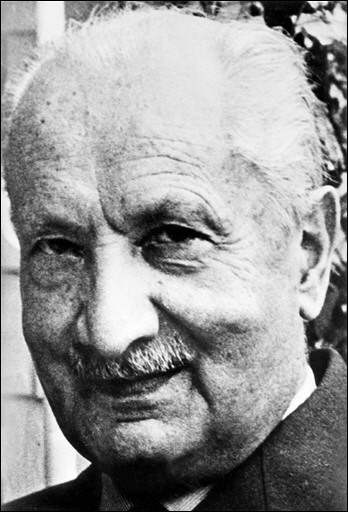
On my Kierkegaard post below, a reader (Sean) posted a great comment:
Do you side with Kaufmann or Dreyfus? To what degree is Heidegger indebted to Kierkegaard? Does it really stop at thrown-ness? Or, can you trace all of Heidegger's existentialism back to 'Religiousness A' (a secularized version)? Isn't the real distinction exactly what anxiety reveals, is it the value of finite existence, or does is reveal an infinite - a sort of flipside to finite existence - as well?
I was prompted to respond with the following, which is way-too-long--especially for a real non answer! Hopefully others have something to say besides this--which I invite you to do! Please excuse typos, etc:
As to Kaufmann or Dreyfus, I'm not so familiar with the arguments of the former relating to Kierkegaard and their opposition to Dreyfus' readings: I think Dreyfus has a great interpretation of Kierkegaard though, and though I haven't listened yet to his lectures on death, guilt, and resoluteness in the Heidegger course this semester, I plan to--they should localize at least some of these problems within the Heidegger. I will say that I think Dreyfus is a little too quick perhaps to characterize Kierkegaard as merely the "existential" influence of Heidegger, as if all of Heidegger's concern with death and guilt were to stem from a concern that is able to be distinctly separated from his more Aristotelian concern in Division I. I'm not the first to criticize him in this way though: Blattner is the best at it, though perhaps going too far in the other direction and making the concerns of temporality and finitude (finitude being really what death is all about for Heidegger), the sole organizing theme of the book. Heidegger sees being as finite, and this is probably one of the central theses of the book: furthermore, he sees Aristotle saying the same thing long ago. He must elaborate how this is able to be so--and so that leads him to posit a Division I that will merge with the concern of Division II, death etc.
Kierkegaard figures there also because he breaks with Hegel--that should be noted. Hegel is Heidegger's archenemy--so anyone able to say that there is a nothingness and a freedom in nothingness, a possibility for a finite subject to relate to infinite possibility (whether God or not), possibility en abyme (as Derrida likes to say) or, conceived probably less rigorously, as drive and repetition of desire (which Lacan says and this is how I formulate it above), would not escape him in his reading of Aristotle. A great helpful book on this is actually Levinas' God, Death and Time--it is really clear and outlines certain concerns about infinity and finiteness in Heidegger and elsewhere that you touched on. Whatever you think of him, too, reading the section on Kierkegaard in The Gift of Death by Derrida is helpful, because he outlines pretty much a standard reading of the suspension of the ethical in relationship to death and shows how at this point one can relate it to concerns of finiteness and infinity. But I'm talking too much--what do you think?
One more thing... with regard to thrown-ness... of course it doesn't stop there, but I think that's the structure that is the best to think about with all this Kierkegaard stuff (as I say in later posts, though unsuccessfully--I stopped all this because it was getting too tough to think)... the real question is how this possibility beyond possibility that is experienced in the dread of nothingness *already exists or is factical* in Dasein. How possibility or futurity (to talk about it in temporal terms) is already within Dasein so that Dasein is thrown back upon it in its existence, so that it is thrown back upon its factical existentiality in its being-existential or projecting itself forward into nothingness, how projecting oneself forward into nothingness is throwing oneself back to the fact of one's nothingness (this all takes place in some remarks on nothingness that are really weird in Being and Time and have a lot to do with Hegel)--this relay, when conceived with respect to its facticity, is the real tough thing to think. Projection is easy--thinking facticity is the real tough stuff. And to Dreyfus' immense credit (I don't know how many people congratulate him on this--but everyone taking his course or exposed to his writings probably should, it is so so vital for understanding anything in Being and Time), this is what he thinks best and why he lays so much emphasis on Division I: it's there that we get a structure that is somehow, in its being structureed that way, already there (da), albeit falling and distracted, etc. This might answer your last question--why I actually don't think that it is so much about the what anxiety reveals. It is about the nature of this revealing as such that is the key for Heidegger. Others like Levinas will change what is revealed and then go back and read it into the structure of Dasein that Heidegger elaborates and show how it cannot be that way (this is what he does in the book I referred you to--but of course not with the rest of his philosophy, which is much more thought out [precisely with regard to what facticity would then have to be] than this one lecture). But for Heidegger, finitude or infinitude would have to announce itself before it is revealed in the revealing itself--the real trick is not deciding then whether revealing that is done in Dasein is finite or infinite, but by trying to let Dasein itself point the way towards answering this, which only then will take us to what is revealed. This leads, however, to the hermeneutic circle Heidegger points out famously. But, again, this is all too much: I'll post this as a separate new post, so it might be easier to find--and also so that others can perhaps get in on what you asked!
Sunday, December 30, 2007
The thrust of The Gift of Death
 The fundamental thesis of the Gift of Death is that the experience of the apprehension of death is inseparable from an experience of responsibility. This in itself is nothing new: among the people Derrida himself discusses in his book, Patočka, Kierkegaard, and Heidegger all explicitly say the same thing. Fundamentally, the finitude of existence conditions existence itself. However, Derrida shows, using all these thinkers, that this finitude also implies a certain structure of a relation to infinitude: that is, the apprehension of death is also inseparable from responsibility because infinitude intrudes in this apprehension and in this responsibility.
 This too is not unique, though: Kierkegaard and Patočka also include this explicitly--not to mention the passages from the Bible that Derrida discusses. Where Derrida is perhaps unique is in his elaboration of this dual structure of responsibility and apprehension as a double bind: that is, as a dual structure that, extended to encompass both the implications of finitude and infinitude that split it, in fact rends it apart (i.e. makes the dual structure incompatible to itself) in its being constituted thus. In other words, Derrida rigorously thinks the space between the determining forces of finitude and infinitude qua between, qua difference. And, as he shows, in order for this difference to be rigorously sustained, it must be conceived as différance.
This différance is manifest in the trembling both before God (the infinite) and before death (the finite), in the experience of what Derrida calls a gift of death.
Wednesday, August 1, 2007
Dread in Kierkegaard continued, continued
Let's finish this up already.
We are taking the following passage relating the story of Adam's fall in Kierkegaard as indicative of a structure of dread:
The prohibition ["do not eat of the tree of knowledge"] alarms Adam [or induces a state of dread] because the prohibition awakens in him the possibility of freedom... [And yet this freedom] is a nothing, the alarming possibility of being able... Thus innocence is brought to its last extremity.
-The Concept of Dread, in Existentialism from Dostoevsky to Sartre, 103-104.
As we have established, Kierkegaard's structure of dread looks like this:
innocence → dread (occuring in ignorance) → guilt
One is brought into guilt ignorantly, and therefore--in a supreme paradox--innocently. We've also established that dread itself has a structure like this:
dread → what is dreaded
↓
what is "really" dreaded
which, because there is nothing actually being dreaded, essentially looks like this:
dread → nothing, that of which one is ignorant
↓
reality of ignorance
We said that this "reality of ignorance" that is produced by the dread of nothing--the bare fact of one's ignorance as to what is being dreaded, made infinitely more real and more "factual" through dread--points to what Kierkegaard calls possibility and freedom. If the structure of dread is as we said it was (i.e. innocence → dread (occuring in ignorance) → guilt) then it will be this access to freedom that brings one into guilt ignorantly and thus innocently.
How, then, is "possibility" accessed by one's ignorance as to what is dreaded? Well, it is clear that if something comes before someone that is and remains a nothing to them (like, in the example of Adam, the voice of God telling one something that they cannot understand), their constancy in confronting this nothing, in remaining ignorant in the face of it, gets proven. In other words, something is made explicit; something is disclosed and developed, such that it gets loosened from the realm of facts that we take for granted and becomes a fact that we can grasp. It is this disclosing that is possibility.
Let's be a little clearer about what we mean by this. When someone dreads nothing, they slowly begin to revolve around this nothing, obsessing over it in their being. In other words, they do not let go of what they dread: the thing dreaded has a particular hold over them such that it sucks them futher in to the process of dreading. Now, because the thing that is dreaded is really nothing, any attempt in one's being to get a handle on what is dreaded, to get it to be determinate, fails (we might remark that this is what Kierkegaard means when he speaks of the subject "grasping at finiteness to sustain itself"). The reality of one's inability to get a handle on this thing is brought to the fore constantly as, in fact, the only thing that remains in the face of this nothing. That is, completely sucked up into this confrontation with nothingness, with that in front of which one stands ignorant, our ability to remain unable constantly confronts us also. This ability--the last of our abilities in the face of our ignorance--shows itself most clearly. Thus it is disclosed to us, proven as that which is more real even than our what we think are our most powerful abilities--all of which crumble in the face of this thing of which we are ignorant.
This is what we meant last time in saying that what is made clear throughout dread is the constancy of one's ability to be--that is, to be ignorant. As such, we can understand it as what is synonymous with what we have been calling "the reality of our ignorance:" the reality of our ignorance as what is proven through dread is nothing over than our ability to be ignorant. We understand what we mean by "disclosing," or "becoming explicit" if we simply see that in this sentence, what was merely a process one went through before--ignorance--has become something that is not taken for granted, is a possibility--the ability to be ignorant. Expanding what we have diagramed above, then, dread looks like this:
dread → nothing, that of which one is ignorant
↓
what is really dreaded, the reality of ignorance
↓
what is proved in "really dreading," the ability to be ignorant, the ability to be unable to grasp the nothing
If we understand this, then we understand what Kierkegaard means by "possibility," and we understand how ignorance can access it. This "possibility" is essentially this ability to be in such and such a way--in this case, ignorant. Fundamentally what happens is that one sees the unalterable fact of one's situation as a possibility, as something that can be changed because it is only one way of being.
Thus, the accessing of this ignorance as possibility shows us our freedom according to Kierkegaard. This freedom is really the essential fact lying within possibility: that whatever is the situation--i.e. dread--is only a way of being, a way that can in its being be different. Now we understand the passage. When Kierkegaard says, "the prohibition alarms Adam [or induces a state of dread] because the prohibition awakens in him the possibility of freedom," we know that he means that Adam, through dreading the nothing, sees his situation as a possibility, and thereby as one in which he possesses freedom--the freedom to engage it differently, as something that is not necessitated but possible. Thus, our diagram of dread extends downward one more final step:
dread → nothing, that of which one is ignorant
↓
what is really dreaded, the reality of ignorance
↓
what is proved in "really dreading," the ability to be ignorant, the ability to be unable to grasp the nothing
↓
freedom as the essence of this ability
All this is done in the subject's complete ignorance as to what they dread, and indeed as to what is revealed or disclosed by the dread (reality, possibility, freedom). Suddenly they possess freedom. They do not know anything about where it came from--in fact it came from that which they had the least ability to know.
Now--and this is crucial--we have to also note that the passage shows us that this result--freedom--is precisely what becomes dreaded: Adam does not only dread and thereby access freedom, Adam dreads because he is free. That in the face of which one is ignorant (God, in this example) makes one access one's freedom and then dread precisely that. One's freedom is the nothing that one dreads--the nothing is essentially the necessity of the situation in which one exists, i.e. precisely non-necessity. In other words, what one cannot get a grip on is precisely the extent of one's own freedom within the situation. What we have split up again resolves itself into identity. In fact, it was never dirempted into a thing dreaded and a "real" thing dreaded in the first place. We'll show how this makes the subject guilty next time. In the meantime, it is clear that we will have to reorganize our diagram like this:
dread → nothing, that of which one is ignorant
↓
what is really dreaded, the reality of ignorance
↓
what is proved in "really dreading," the ability to be ignorant, the ability to be unable to grasp the nothing
↓
freedom as the essence of this ability
↓
nothing, that of which one is ignorant
This identity--and we will elaborate more on this next time--this identity is only a function of the belongingness of that which is disclosed by dread to dread itself. That is, this identity exists because at each point in the disclosure of the essence of dread by having "what is really dreaded" become more and more determinate, what is dreaded becomes more and more indeterminate and the ignorance with which we confront what is dreaded becomes more and more concrete. That is, throughout the unfolding of the structure we have just outlined, dread itself only heightens. The disclosure that belongs to dread only serves to enhance dread--and therefore ignorance as to what exactly is dreaded and one's innocence. We'll clear this issue up next time.
We are taking the following passage relating the story of Adam's fall in Kierkegaard as indicative of a structure of dread:
The prohibition ["do not eat of the tree of knowledge"] alarms Adam [or induces a state of dread] because the prohibition awakens in him the possibility of freedom... [And yet this freedom] is a nothing, the alarming possibility of being able... Thus innocence is brought to its last extremity.
-The Concept of Dread, in Existentialism from Dostoevsky to Sartre, 103-104.
As we have established, Kierkegaard's structure of dread looks like this:
innocence → dread (occuring in ignorance) → guilt
One is brought into guilt ignorantly, and therefore--in a supreme paradox--innocently. We've also established that dread itself has a structure like this:
dread → what is dreaded
↓
what is "really" dreaded
which, because there is nothing actually being dreaded, essentially looks like this:
dread → nothing, that of which one is ignorant
↓
reality of ignorance
We said that this "reality of ignorance" that is produced by the dread of nothing--the bare fact of one's ignorance as to what is being dreaded, made infinitely more real and more "factual" through dread--points to what Kierkegaard calls possibility and freedom. If the structure of dread is as we said it was (i.e. innocence → dread (occuring in ignorance) → guilt) then it will be this access to freedom that brings one into guilt ignorantly and thus innocently.
How, then, is "possibility" accessed by one's ignorance as to what is dreaded? Well, it is clear that if something comes before someone that is and remains a nothing to them (like, in the example of Adam, the voice of God telling one something that they cannot understand), their constancy in confronting this nothing, in remaining ignorant in the face of it, gets proven. In other words, something is made explicit; something is disclosed and developed, such that it gets loosened from the realm of facts that we take for granted and becomes a fact that we can grasp. It is this disclosing that is possibility.
Let's be a little clearer about what we mean by this. When someone dreads nothing, they slowly begin to revolve around this nothing, obsessing over it in their being. In other words, they do not let go of what they dread: the thing dreaded has a particular hold over them such that it sucks them futher in to the process of dreading. Now, because the thing that is dreaded is really nothing, any attempt in one's being to get a handle on what is dreaded, to get it to be determinate, fails (we might remark that this is what Kierkegaard means when he speaks of the subject "grasping at finiteness to sustain itself"). The reality of one's inability to get a handle on this thing is brought to the fore constantly as, in fact, the only thing that remains in the face of this nothing. That is, completely sucked up into this confrontation with nothingness, with that in front of which one stands ignorant, our ability to remain unable constantly confronts us also. This ability--the last of our abilities in the face of our ignorance--shows itself most clearly. Thus it is disclosed to us, proven as that which is more real even than our what we think are our most powerful abilities--all of which crumble in the face of this thing of which we are ignorant.
This is what we meant last time in saying that what is made clear throughout dread is the constancy of one's ability to be--that is, to be ignorant. As such, we can understand it as what is synonymous with what we have been calling "the reality of our ignorance:" the reality of our ignorance as what is proven through dread is nothing over than our ability to be ignorant. We understand what we mean by "disclosing," or "becoming explicit" if we simply see that in this sentence, what was merely a process one went through before--ignorance--has become something that is not taken for granted, is a possibility--the ability to be ignorant. Expanding what we have diagramed above, then, dread looks like this:
dread → nothing, that of which one is ignorant
↓
what is really dreaded, the reality of ignorance
↓
what is proved in "really dreading," the ability to be ignorant, the ability to be unable to grasp the nothing
If we understand this, then we understand what Kierkegaard means by "possibility," and we understand how ignorance can access it. This "possibility" is essentially this ability to be in such and such a way--in this case, ignorant. Fundamentally what happens is that one sees the unalterable fact of one's situation as a possibility, as something that can be changed because it is only one way of being.
Thus, the accessing of this ignorance as possibility shows us our freedom according to Kierkegaard. This freedom is really the essential fact lying within possibility: that whatever is the situation--i.e. dread--is only a way of being, a way that can in its being be different. Now we understand the passage. When Kierkegaard says, "the prohibition alarms Adam [or induces a state of dread] because the prohibition awakens in him the possibility of freedom," we know that he means that Adam, through dreading the nothing, sees his situation as a possibility, and thereby as one in which he possesses freedom--the freedom to engage it differently, as something that is not necessitated but possible. Thus, our diagram of dread extends downward one more final step:
dread → nothing, that of which one is ignorant
↓
what is really dreaded, the reality of ignorance
↓
what is proved in "really dreading," the ability to be ignorant, the ability to be unable to grasp the nothing
↓
freedom as the essence of this ability
All this is done in the subject's complete ignorance as to what they dread, and indeed as to what is revealed or disclosed by the dread (reality, possibility, freedom). Suddenly they possess freedom. They do not know anything about where it came from--in fact it came from that which they had the least ability to know.
Now--and this is crucial--we have to also note that the passage shows us that this result--freedom--is precisely what becomes dreaded: Adam does not only dread and thereby access freedom, Adam dreads because he is free. That in the face of which one is ignorant (God, in this example) makes one access one's freedom and then dread precisely that. One's freedom is the nothing that one dreads--the nothing is essentially the necessity of the situation in which one exists, i.e. precisely non-necessity. In other words, what one cannot get a grip on is precisely the extent of one's own freedom within the situation. What we have split up again resolves itself into identity. In fact, it was never dirempted into a thing dreaded and a "real" thing dreaded in the first place. We'll show how this makes the subject guilty next time. In the meantime, it is clear that we will have to reorganize our diagram like this:
dread → nothing, that of which one is ignorant
↓
what is really dreaded, the reality of ignorance
↓
what is proved in "really dreading," the ability to be ignorant, the ability to be unable to grasp the nothing
↓
freedom as the essence of this ability
↓
nothing, that of which one is ignorant
This identity--and we will elaborate more on this next time--this identity is only a function of the belongingness of that which is disclosed by dread to dread itself. That is, this identity exists because at each point in the disclosure of the essence of dread by having "what is really dreaded" become more and more determinate, what is dreaded becomes more and more indeterminate and the ignorance with which we confront what is dreaded becomes more and more concrete. That is, throughout the unfolding of the structure we have just outlined, dread itself only heightens. The disclosure that belongs to dread only serves to enhance dread--and therefore ignorance as to what exactly is dreaded and one's innocence. We'll clear this issue up next time.
Tuesday, July 31, 2007
Dread in Kierkegaard, continued
I felt that my last post had gotten a little messy as far clarifying Kierkegaard's structure of dread (Angst), so here we will continue where we left off after a short, clean summary of what we have already elaborated, and then continue on to show why precisely this is read by Heidegger as "thrown-ness" (Geworfenheit), as well as how the structure of dread reorients the phenomenon of the prohibition of desire.
We started out with the case of Adam, who was brought out of innocence and into guilt without knowledge of what might make him guilty--i.e. in ignorance. Kierkegaard explains that dread is what brings about this type of guilt, because it operates precisely by preserving the subject's ignorance. The key was to see how this preservation is accomplished. This is where things got a little too complicated, thanks to Kierkegaard's confusing language on this matter--although we may remark that the language is confused because it attempts to reduplicate and stay true to the very confusing and ambiguous nature of dread itself. But how it all unfolds is actually quite simple.
Dread brings one out of innocence and into guilt ignorantly--i.e. it preserves ignorance while rendering guilty--by confronting the subject with nothing that is knowable. That is, it confronts the subject with a nothing; something that is nothing to him as far as his knowledge goes. Thus the particularly uncanny nature of dread--and Heidegger brings this out more explicitly: one dreads something, but one does not know what one dreads. Something is there, and yet it is nothing to me. Why this is the case is simply because what is brought before one in this instance is not really what is important. In bringing something dreadful before a subject (i.e. a nothing), what dread accomplishes is to bring precisely the subject's own ability to dread to the fore along with this something. How? The act itself comes to be what is dreaded.
However, splitting the act up into a content and a form, as if what is dreaded is different from the act of dreading is dangerous, precisely because it covers up the depth of the interplay between the two. This is what I did in my last post, and I regret it. I should have explicated the following remark of Kierkegaard, which brings the phenomenon into complete clarity:
Innocence has now reached its apex. It is ignorance... but which precisely is dread, because its ignorance is about nothing. Here there is no knowledge... but the whole reality of knowledge is projected in dread as the immense nothing of ignorance.
-Nineteenth-Century Philosophy ed. Patrick Gardner, p. 313.
The moment of dread is the apex of ignorance. Everything revolves upon grasping the intricacies of the structure of dread at this particular point. At this moment, one is still ignorant, and is therefore still innocent--as we have often pointed out, one cannot really be held guilty regarding something one did not do knowingly. If we understand this state of the subject, we can then see that it is not only ignorant at this moment. In fact, "the whole reality of its knowledge," which is precisely its lack of knowledge, is made manifest, is "projected". One's ignorance in dread is such that it is made explicit and real. Why? Because in dread one is confronted with that which one cannot possibly know--a nothing. Nothing comes before one, and yet they dread it. This fact alone presses the ignorance of the innocent towards the most concrete state of reality. One is still ignorant, but at the same time this ignorance is made real to them, making them more suddenly than just ignorant.
Now, what is the character of this "more?" How is this new reality constituted? It is by answering this question that we can get a handle on the whole structure of dread. For it is also here, and here only, that one can begin to specify a difference between what is dreaded and dread itself. The concreteness or reality of one's ignorance is brought out in dread because, as we said, what is dreaded is precisely nothing. In saying this, we are saying two things: 1) that the subject's ignorance gathers itself together astonishingly such that we can say that it attains a level of "reality" that it did not previously possess, and 2) that reality itself is the byproduct of this gathering. It is by specifying the latter point as the real "object" of dread that we can say that it is what is "really" dreaded. This is slightly a distortion of what is happening, but only because what is happening is circular and feeds off of itself. If we wish to see what dread is, we have to break it up as this:
dread → what is dreaded
↓
what is "really" dreaded
Which, because there is nothing actually being dreaded, becomes this:
dread → nothing, that of which one is ignorant
↓
reality of ignorance
This is why we said in the last post that there was a difference between what is dreaded and dread itself--when there really isn't. It is just that the nothing in the face of which one has dread precisely engenders something that provokes the dread to confront this nothing more and more to the extent that one has to call this provocation itself that is engendered the "real" object of dread--that is, precisely because it has a consequence one has to point to it as the real thing that is dreaded. This is the real nature of the "dreamlike" state of dread--not because dread itself is like a fantasy of a particular object. The word "fantasy," and others like it ("wish," "desire") imply that one has an object that is not nothing, that there is another way that the knowledge, which merely appears as nothing to the ignorant subject, is known. This is not really what Kierkegaard is saying--though it is essentially commensurate with his structure. It is only insofar as we do not call this "different knowing" (perhaps unconscious knowing) a type of knowing at all that he will accept it however--otherwise one would still be knowing in some way, and therefore, on some level, guilty. This indeed is what Freud holds: it is the aim of psychoanalysis to confront the "different knowing" (the unconscious) precisely as the thing that is responsible and guilty in various acts and thereby to assuage its effects upon the conscious person. But Kierkegaard wants to maintain a stricter notion of ignorance (because he wants to maintain a stricter notion of guilt), and thus does not recognize any other type of knowing than knowing. I explain all this just to make the difference clear and to bring out why the usage of Freudian terms slipped its way into the last post--when terms like drive and desire are not quite accurate. Thus, what one dreads is and always will be nothing for Kierkegaard. He does not care to look behind the curtain of any subject's ignorance to see what is really there because he does not think that knowing what it is will change anything. (Here obviously Freud would disagree--an unconscious impulse to kill is a lot different than an unconscious impulse to desire something for him, and this admits of different ways for the subject to approach the unconscious. For Kierkegaard, all these ways are the same, and reduce to dread.) Kierkegaard stays on this side of subjectivity always, so that what comes to the fore is only ignorance.
Now, we have not answered our question. If the reality of one's own ignorance is what is really dreaded, what is this reality composed of if it is not a "different type of knowing?" Nothing other than the subject's own freedom, Kierkegaard says. How is this so?
Let's recap, one more time. In dreading nothing, and thereby producing the concreteness and reality of one's continual ignorance, it can be said that what is really dreaded is this reality. This reality is therefore composed of one's ability in the face of nothing to actually produce something real--even if it is only (and precisely) the reality of one's own inability to know the nothing that confronts one in dread. Thus, this ability is really what is brought out through dreading; it is really what makes up the reality of the ignorance that dread of the nothing produces. This ability Kierkegaard names the "possibility" of the subject. Thinking through what happens, we can say that it is essentially the constancy of one's ability to be--that is, to be ignorant. The bare fact that one can stay in front of nothing that one can know is what is made real for one in this moment, and this fact is of the essence of the subject.
I'll clear this up more later tonight--as of yet it is taking up too much time to explicate! No doubt this is because of my approach (as well as Kierkegaard's). There is an easier way to talk of the phenomenon of dread. Kierkegaard does it himself, and I'll leave you with that for now:
One may liken dread to dizziness. He whose eyes chances to look down into the yawning abyss becomes dizzy. But the reason for it is just as much his eye as it is the precipice. For suppose he had not looked down.
Thus dread is the dizziness of freedom which occurs when... freedom gazes down into its own possibility, grasping at finiteness to sustain itself. In this dizziness freedom succumbs... That very instant everything is changed, and when freedom rises again it sees that it is guilty (315).
We started out with the case of Adam, who was brought out of innocence and into guilt without knowledge of what might make him guilty--i.e. in ignorance. Kierkegaard explains that dread is what brings about this type of guilt, because it operates precisely by preserving the subject's ignorance. The key was to see how this preservation is accomplished. This is where things got a little too complicated, thanks to Kierkegaard's confusing language on this matter--although we may remark that the language is confused because it attempts to reduplicate and stay true to the very confusing and ambiguous nature of dread itself. But how it all unfolds is actually quite simple.
Dread brings one out of innocence and into guilt ignorantly--i.e. it preserves ignorance while rendering guilty--by confronting the subject with nothing that is knowable. That is, it confronts the subject with a nothing; something that is nothing to him as far as his knowledge goes. Thus the particularly uncanny nature of dread--and Heidegger brings this out more explicitly: one dreads something, but one does not know what one dreads. Something is there, and yet it is nothing to me. Why this is the case is simply because what is brought before one in this instance is not really what is important. In bringing something dreadful before a subject (i.e. a nothing), what dread accomplishes is to bring precisely the subject's own ability to dread to the fore along with this something. How? The act itself comes to be what is dreaded.
However, splitting the act up into a content and a form, as if what is dreaded is different from the act of dreading is dangerous, precisely because it covers up the depth of the interplay between the two. This is what I did in my last post, and I regret it. I should have explicated the following remark of Kierkegaard, which brings the phenomenon into complete clarity:
Innocence has now reached its apex. It is ignorance... but which precisely is dread, because its ignorance is about nothing. Here there is no knowledge... but the whole reality of knowledge is projected in dread as the immense nothing of ignorance.
-Nineteenth-Century Philosophy ed. Patrick Gardner, p. 313.
The moment of dread is the apex of ignorance. Everything revolves upon grasping the intricacies of the structure of dread at this particular point. At this moment, one is still ignorant, and is therefore still innocent--as we have often pointed out, one cannot really be held guilty regarding something one did not do knowingly. If we understand this state of the subject, we can then see that it is not only ignorant at this moment. In fact, "the whole reality of its knowledge," which is precisely its lack of knowledge, is made manifest, is "projected". One's ignorance in dread is such that it is made explicit and real. Why? Because in dread one is confronted with that which one cannot possibly know--a nothing. Nothing comes before one, and yet they dread it. This fact alone presses the ignorance of the innocent towards the most concrete state of reality. One is still ignorant, but at the same time this ignorance is made real to them, making them more suddenly than just ignorant.
Now, what is the character of this "more?" How is this new reality constituted? It is by answering this question that we can get a handle on the whole structure of dread. For it is also here, and here only, that one can begin to specify a difference between what is dreaded and dread itself. The concreteness or reality of one's ignorance is brought out in dread because, as we said, what is dreaded is precisely nothing. In saying this, we are saying two things: 1) that the subject's ignorance gathers itself together astonishingly such that we can say that it attains a level of "reality" that it did not previously possess, and 2) that reality itself is the byproduct of this gathering. It is by specifying the latter point as the real "object" of dread that we can say that it is what is "really" dreaded. This is slightly a distortion of what is happening, but only because what is happening is circular and feeds off of itself. If we wish to see what dread is, we have to break it up as this:
dread → what is dreaded
↓
what is "really" dreaded
Which, because there is nothing actually being dreaded, becomes this:
dread → nothing, that of which one is ignorant
↓
reality of ignorance
This is why we said in the last post that there was a difference between what is dreaded and dread itself--when there really isn't. It is just that the nothing in the face of which one has dread precisely engenders something that provokes the dread to confront this nothing more and more to the extent that one has to call this provocation itself that is engendered the "real" object of dread--that is, precisely because it has a consequence one has to point to it as the real thing that is dreaded. This is the real nature of the "dreamlike" state of dread--not because dread itself is like a fantasy of a particular object. The word "fantasy," and others like it ("wish," "desire") imply that one has an object that is not nothing, that there is another way that the knowledge, which merely appears as nothing to the ignorant subject, is known. This is not really what Kierkegaard is saying--though it is essentially commensurate with his structure. It is only insofar as we do not call this "different knowing" (perhaps unconscious knowing) a type of knowing at all that he will accept it however--otherwise one would still be knowing in some way, and therefore, on some level, guilty. This indeed is what Freud holds: it is the aim of psychoanalysis to confront the "different knowing" (the unconscious) precisely as the thing that is responsible and guilty in various acts and thereby to assuage its effects upon the conscious person. But Kierkegaard wants to maintain a stricter notion of ignorance (because he wants to maintain a stricter notion of guilt), and thus does not recognize any other type of knowing than knowing. I explain all this just to make the difference clear and to bring out why the usage of Freudian terms slipped its way into the last post--when terms like drive and desire are not quite accurate. Thus, what one dreads is and always will be nothing for Kierkegaard. He does not care to look behind the curtain of any subject's ignorance to see what is really there because he does not think that knowing what it is will change anything. (Here obviously Freud would disagree--an unconscious impulse to kill is a lot different than an unconscious impulse to desire something for him, and this admits of different ways for the subject to approach the unconscious. For Kierkegaard, all these ways are the same, and reduce to dread.) Kierkegaard stays on this side of subjectivity always, so that what comes to the fore is only ignorance.
Now, we have not answered our question. If the reality of one's own ignorance is what is really dreaded, what is this reality composed of if it is not a "different type of knowing?" Nothing other than the subject's own freedom, Kierkegaard says. How is this so?
Let's recap, one more time. In dreading nothing, and thereby producing the concreteness and reality of one's continual ignorance, it can be said that what is really dreaded is this reality. This reality is therefore composed of one's ability in the face of nothing to actually produce something real--even if it is only (and precisely) the reality of one's own inability to know the nothing that confronts one in dread. Thus, this ability is really what is brought out through dreading; it is really what makes up the reality of the ignorance that dread of the nothing produces. This ability Kierkegaard names the "possibility" of the subject. Thinking through what happens, we can say that it is essentially the constancy of one's ability to be--that is, to be ignorant. The bare fact that one can stay in front of nothing that one can know is what is made real for one in this moment, and this fact is of the essence of the subject.
I'll clear this up more later tonight--as of yet it is taking up too much time to explicate! No doubt this is because of my approach (as well as Kierkegaard's). There is an easier way to talk of the phenomenon of dread. Kierkegaard does it himself, and I'll leave you with that for now:
One may liken dread to dizziness. He whose eyes chances to look down into the yawning abyss becomes dizzy. But the reason for it is just as much his eye as it is the precipice. For suppose he had not looked down.
Thus dread is the dizziness of freedom which occurs when... freedom gazes down into its own possibility, grasping at finiteness to sustain itself. In this dizziness freedom succumbs... That very instant everything is changed, and when freedom rises again it sees that it is guilty (315).
Saturday, July 28, 2007
Dread in Kierkegaard
Dread (what we can also call anxiety) has a specific structure for Kierkegaard, a structure Heidegger elaborates as thrown-ness in Being and Time. In a footnote Heidegger indeed acknowledges that he is indebted to Kierkegaard as well as to Christian theology: "The man who has gone farthest in analyzing the phenomenon of anxiety--and again in the theological context of a 'psychological' exposition of the problem of original sin--is Soren Kierkegaard." But more important than the indebtedness is the exactitude, the meticulousness, of his understanding of what Kierkegaard says--of that structure of dread. Let's see what that structure is and how he reached this understanding.
Kierkegaard outlines the structure of dread in the following passage in The Concept of Dread, taking Adam's fall into sin as the phenomenon's most concrete instance:
...When it is related in Genesis that God said to Adam, "Only of the tree of the knowledge of good and evil thou shalt not eat," it is a matter of course that Adam did not understand this word [i.e. that he was "innocent"]. For how could he have understood the difference between good and evil, seeing that this distinction was in fact consequent upon the enjoyment of the fruit?
When one assumes that the prohibition awakens the desire, one posits a knowledge instead of ignorance; for Adam would have had to have a knowledge of freedom, since his desire was to ["freely"] use it [i.e. the distinction between good and evil]. The explanation therefore anticipates what was subsequent. The prohibition alarms Adam [or induces a state of dread] because the prohibition awakens in him the possibility of freedom... [And yet this freedom] is a nothing, the alarming possibility of being able... Thus innocence is brought to its last extremity.
-The Concept of Dread, in Existentialism from Dostoevsky to Sartre, 103-104.
Kierkegaard is saying that dread is fundamentally what allows innocence--exemplified in Adam before he ate of the tree of knowledge--to be "brought to its last extremity," or, in other words, to let itself fall into the state of sin, whose essence, Kierkegaard later says, is guilt. Let's represent this structure in this way:
innocence → dread → guilt
Some initial remarks should be made here on this and on the passage. First, in this passage Kierkegaard points out explicitly that this structure completely ignores the relevance of transgression as we normally understand it to the narrative of Adam's fall into sin. Sin is not the result of disobeying the prohibition. The prohibition doesn't matter: what matters is the relationship between innocence and guilt. He's also slyly indicating what the result of this analysis will be: understanding guilt will better allow us to rethink prohibition; the concept of prohibition is what will be re-evaluated or revalued by his analysis of how dread engenders guilt. Next, even if we are to turn to the prohibition, Kierkegaard thinks of things differently. Christian theology has often focused on the prohibition of the eating of the tree when it comes to Adam's fall in Genesis, although it has often interpreted this widely. But what actually is prohibited for Kierkegaard, is something like the desire to know. We'll specify exactly what Kierkegaard thinks is prohibited by God in this statement later (he's even more precise about it), and thus get a chance to look at what he conceives of as desire as well. But for now, the first question to put to ourselves is why he wants to bypass the issue of prohibition in the first place? How will looking at dread, and not transgression, as the origin of guilt eventually make us rethink what the concept of prohibition involves?
Because the key to understanding dread is to understand it as also bound up with knowledge. As Kierkegaard says, "when one assumes that the prohibition awakens the desire, one posits a knowledge instead of ignorance.", and this covers up the essential phenomenon of how guilt arises. Essentially, understanding prohibition as the thing that awakens desire covers up the fundamental ignorant innocence that is constitutive for the act of eating of the tree--the ignorance that is precisely what makes the story (like the story of Job) so extremely disturbing to us. Why would God punish what essentially is an act done without our ability to know that it was wrong? Positing that Adam was focused on the prohibition itself when he ate of the tree requires that he know what the tree will do when he eats of it--in short, if the prohibition awakens the desire, it is precisely because Adam would know beforehand why what is prohibited is prohibited. Obviously this is untenable: how could Adam know beforehand what the tree would give him? No, the whole instance proceeded in complete ignorance. But how, then, could Adam have become guilty of trespassing against God's word? That is where dread comes in.
Dread is what, for Kierkegaard, leads us out of innocence and ignorance and into guilt, instead of knowledge. Knowledge is not what causes the fall of Adam, but dread, and with it, freedom. Thus to the structure we outlined above, there would seem to correspond a structure that looks like this:
ignorance → dread → knowledge
But because we do not know how dread begets knowledge, this statement as yet is empty. Furthermore, if we were to try and tie freedom into this structure by representing it as the following we would be fundamentally wrong:
ignorance → dread → knowledge, freedom
Freedom is not a consequence of dread for Kierkegaard, but rather underlies it as what dread itself activates or actualizes in dread's becoming actual. Thus, we must ask, how does dread lead us out of innocence and ignorance by way of being connected with freedom for Kierkegaard?
It should be noted that all the foregoing has done is to outline the interconnected nature of two structures, the structure of innocence and guilt, and the structure of ignorance and knowledge, which we can represent by combining our previous representations:
innocence → dread → guilt
ignorance → dread → knowledge
It is also clear from the foregoing that two concepts remain to be connected to this nexus: prohibition and, most essentially, freedom. But it is not by specifying what either of these are for Kierkegaard that we get a handle on what he means by them and dread more generally. Rather, it is by proceeding with the structures that we already have outlined that we can specify their nature. In other words, though Kierkegaard has a specific nature of freedom, he does not specify what freedom is concretely and then derive his analysis of dread (not to mention his reading of Scripture) from it--this would be too abstract for him. Rather he sticks close to what he already knows and what Scripture already tells him about the transition between ignorance and innocence and guilt and knowledge. We'll do the same.
Indeed, it should be obvious by bringing the two structures we have outlined that, if we posit some other term--dread--instead of the prohibition itself as the thing that leads us out of ignorance and innocence, that this third term--dread--will be responsible for relating both ignorance and innocence. In other words, from what we have already seen Kierkegaard say, it should be obvious that dread leads us out of innocence ignorantly, and that dread leads us out of ignorance innocently. It is by analyzing these relations that Kierkegaard sticks close to what he already knows and does not give in to a pressure to cover up the disturbing nature of Adam's fall--not to mention the fall of anyone innocently or ignorantly into guilt and knowledge.
Now, if one is led out of innocence, or, as we normally call it, is guilty for some reason, and yet is led out of innocence ignorantly, he still seems innocent: indeed, this is why Kierkegaard says "he who... becomes guilty is innocent" (102)--that is, if they become guilty ignorantly. Why should this be the case? Why do we normally make this provision for guilt? Or, put differently, how can one who is guilty be innocent at the same time if they are ignorant? By our normal reasoning, we say that if an innocent person is lead to guilt ignorantly, it is something other that effectuates the guilt, not the person who was lead into guilt. "They didn't really mean it," we say, "it wasn't really their fault." Guilt must be tied up with this "something other," then. Kierkegaard simply names this "something other," "dread." That is, instead of pursuing the issue of guilt by making an exception of the case in which someone is led to guilt ignorantly, as we usually do, he analyzes it as a positive phenomenon. In other words, he is not excluding this instance from the rest of our codified ways of assigning guilt, making of it a case where the "rules don't apply in the same way:" rather, he will eventually conclude that this instance is the exemplary instance of the way guilt arises.
But let us continue--how could one be led into guilt ignorantly, if guilt essentially lies in knowingly doing something? Where is the knowledge located in this instance? If someone is guilty innocently because of ignorance, and thus has become guilty by "something other" than her or himself, and if this "something other" is dread, then we might say that it is precisely dread that effectuates the guilt knowingly. In other words, if the innocent person is still innocent after being made guilty through dread, it is not the person who is responsible for this guilty status: for how could he have known--being ignorant--whatever it was that rendered him guilty? Dread knows, somehow, or has some relationship to the knowledge of which the person is ignorant, and thus Kierkegaard continues the sentence just quoted ("he who through dread becomes guilty is innocent") by saying "for it was not he himself but dread, an alien power which laid hold of him" in the transition between innocence and guilt (102). Thus by specifying the relationship of dread to knowledge we get a handle on exactly the way someone innocent and ignorant can be led to guilt. If they are seized by dread, they are seized by something that has a relationship to a knowledge that they do not know. We might represent this the following way before we go on to analyze this relationship:
innocence/ignorance → ( dread ← knowledge ) → guilt
Notice that this gets rid of our previous schema where knowledge was somehow a product of the dread of an innocent person along with guilt, which was represented this way:
ignorance → dread → knowledge
Knowledge is intimately connected with dread, and not with ignorance. Thus it does not directly oppose and obviate ignorance itself; knowledge does not suddenly come along and wipe out innocence because it wipes out ignorance. Rather, knowledge has a direct relationship to dread, and only can effect ignorance through this mediation.
We can specify the relationship of knowledge to dread by asking what must necessarily be the essence of a knowledge that preserves ignorance. The answer to this is that it must be a fantasy, something that is not real in content but is real in its ability or possibility to be real. As Kierkegaard says, at the center of dread is that which in an innocent act could have been, that which in an act was that person's particular "I can" (104), in the sense of an ignorant "I can do this which I currently fantasize about" at the moment of one's fantasizing. This is why Kierkegaard specifies dread as a "dreaming" (101) of the spirit: the moment at which a subject dreads is the moment in which that subject indeed "projects its own reality" even though "this reality is nothing" and "this nothing constantly sees innocence outside of it" (101). The reality it projects is precisely its own ability to do whatever it is that it projects.
Now it should be obvious that by "seeing innocence outside of it," Kierkegaard means that in the particular moment of dread, what is, is only that which is for someone who is ignorant, or does not know reality, and is therefore innocent in the way we determined before. Let's penetrate deeper into this phenomenon. What is real in the moment of dread is nothing, and dread itself is thus dread "about nothing" as we usually say. But this nothing is not really nothing, as Kierkegaard says. It is only nothing insofar as what the dread is about in reality is nothing. In reality, whatever is dreaded has the constitution of a dream, a wish. But the fact that the dread occurs and is about something that is not real does not make the act of dreading itself disappear. The act of dreading is precisely everything, it is so much not nothing--it is and remains one of the most keenest and most real psychological feelings possible. We thus might represent dread as the following, making a distinction between the act of dread and what is dreaded.
dread → content, what is dreaded → nothing, dream
↓
form, the act of dreading
↓
real, reality
More appropriately, we might call the act of dread a desire, since a desire is precisely a relationship to something that is, as of yet, nothing. Indeed, if we are going to call this act a wish or a dream as well this seems legitimate. But in recharacterizing this act this way, we can see desire come into play--and it should be quite clear now that it is precisely not the desire of some particular bit of knowledge like the distinction between good and evil. What is dreaded, what is desired is something that is not, and since the act of dread or desire occurs anyway, we are left to conclude that that which it is really about is precisely unrealized possibility itself, in other words, the reality of nothing--the reality of something that, as of yet, is not real and is therefore nothing. Put differently (and perhaps more clearly), what the desire is about is (in Freudian/Lacanian terms) really the drive, the act of desiring alone. Similarly, what is dreaded is really only the possibility of the individual to realize that particular thing one dreads. Thus the above relationship can be redrawn like this:
dread → desire, what is dreaded → nothing, dream
↓
drive, what is really dreaded
↓
real, reality
This continual play on the word "nothing" Kierkegaard uses (and which we are merely reduplicating) he uses perhaps to curb the impact of the radical thesis he is putting forth here. What he is saying is that what dread is drive itself, the desire for the realization of what is unrealized and, as the desire of someone who is ignorant, is the desire of something that is not known. Desire, as dread and therefore as drive, is desire for that of which one is ignorant, that which is nothing currently. As such, it is not fundamentally that thing that is desired, but (because one does not really know that thing, the act one could have done), it is really the possibility of the realization of that thing. This is what is meant by us saying desire is desire of "the reality of nothing:" it is fundamentally the desire for the possibility to realize what is now nothing, the desire of drive. Furthermore, as a dream or wish or desire, one possesses already in dread this possibility--it is there in one's desiring of that which does not exist. This is why it is, as Kierkegaard implies, the greatest inner possibility of a subject.
Let's sum this up to be a little clearer. What is desired in dread is precisely that of which one is completely ignorant--to the subject it appears as nothing, making him say characteristically when asked what he is worried about, "it's nothing." Thus, what is desired is precisely not knowledge, because what is desired is precisely that of which one as of yet cannot actually know. However, desiring (and we should mention that we do not even know of this desire--desire is not like a willing)--desiring that of which one is ignorant is indeed desiring the possibility of knowing that which is not known--this is, as it were, the side effect of desiring precisely that which one cannot know. In desiring non-knowledge, as we might put it, we are precisely desiring the possibility not of knowing the non-knowledge itself, but of knowing our own possibility to know, our own possibility to not be as ignorant as we are now. This side-effect we call drive, or the reality of the act of dread. We might represent this structure of knowledge thusly:
dread/desire → (desire as such) that of which one is ignorant
↓ (drive)
possibility of knowing
It should be obvious that this is just a condensed version of what we have already specified. It is this downward arrow that is active: the desire for that of which one is ignorant opens up a general, indeterminate possibility of knowing anything--i.e. not just that of which one is ignorant. Rightly, Kierkegaard does not speak of this indeterminate result as genuine knowledge yet: dread brings into view only "a nothing in lively communication with the innocence of ignorance". It is "lively communication" only that is really going on here, since what is being known is precisely only the reality of the possibility of knowing (drive). Thus, one can still speak of this knowledge of a possibility of knowing as ignorance, and we will indeed do so. It is ignorance in lively communication with only the possibility of knowing, and as such, it produces no knowledge and continues to preserve ignorance itself. We can represent this thus within the larger structure of dread:
ignorance → { dread ← ( [ desire → that of which one is ignorant ] → possibility of knowing (drive)/ignorance ] ) } → guilt
This specified, we can show exactly what this type of ignorance is and does. It should be noted that grasping the role of desire has allowed us to specify the role of prohibition, but we will put this off to later when the whole phenomenon of dread comes fully into view. Now, this particular type of ignorance, this knowledge only of an open-ended possibility of knowledge this "I can," this result of a desire based in dread, Kierkegaard names "freedom." As Kierkegaard puts it, "dread is the reality of freedom as possibility anterior to possibility" (101). By "possibility anterior to possibility" Kierkegaard means that freedom is the reality of possibility itself as the reality of possibility in the nothing, in the unrealized, in that of which the subject is and remains ignorant. Thus we might rewrite our above structure as the following, having it retain the same meaning:
ignorance → ( dread ← freedom ) → guilt
Now, it is obviously this freedom that brings one from innocence into guilt. How does this occur according to Kierkegaard--especially if it is not really knowledge still? I'll save this answer for another post.
Kierkegaard outlines the structure of dread in the following passage in The Concept of Dread, taking Adam's fall into sin as the phenomenon's most concrete instance:
...When it is related in Genesis that God said to Adam, "Only of the tree of the knowledge of good and evil thou shalt not eat," it is a matter of course that Adam did not understand this word [i.e. that he was "innocent"]. For how could he have understood the difference between good and evil, seeing that this distinction was in fact consequent upon the enjoyment of the fruit?
When one assumes that the prohibition awakens the desire, one posits a knowledge instead of ignorance; for Adam would have had to have a knowledge of freedom, since his desire was to ["freely"] use it [i.e. the distinction between good and evil]. The explanation therefore anticipates what was subsequent. The prohibition alarms Adam [or induces a state of dread] because the prohibition awakens in him the possibility of freedom... [And yet this freedom] is a nothing, the alarming possibility of being able... Thus innocence is brought to its last extremity.
-The Concept of Dread, in Existentialism from Dostoevsky to Sartre, 103-104.
Kierkegaard is saying that dread is fundamentally what allows innocence--exemplified in Adam before he ate of the tree of knowledge--to be "brought to its last extremity," or, in other words, to let itself fall into the state of sin, whose essence, Kierkegaard later says, is guilt. Let's represent this structure in this way:
innocence → dread → guilt
Some initial remarks should be made here on this and on the passage. First, in this passage Kierkegaard points out explicitly that this structure completely ignores the relevance of transgression as we normally understand it to the narrative of Adam's fall into sin. Sin is not the result of disobeying the prohibition. The prohibition doesn't matter: what matters is the relationship between innocence and guilt. He's also slyly indicating what the result of this analysis will be: understanding guilt will better allow us to rethink prohibition; the concept of prohibition is what will be re-evaluated or revalued by his analysis of how dread engenders guilt. Next, even if we are to turn to the prohibition, Kierkegaard thinks of things differently. Christian theology has often focused on the prohibition of the eating of the tree when it comes to Adam's fall in Genesis, although it has often interpreted this widely. But what actually is prohibited for Kierkegaard, is something like the desire to know. We'll specify exactly what Kierkegaard thinks is prohibited by God in this statement later (he's even more precise about it), and thus get a chance to look at what he conceives of as desire as well. But for now, the first question to put to ourselves is why he wants to bypass the issue of prohibition in the first place? How will looking at dread, and not transgression, as the origin of guilt eventually make us rethink what the concept of prohibition involves?
Because the key to understanding dread is to understand it as also bound up with knowledge. As Kierkegaard says, "when one assumes that the prohibition awakens the desire, one posits a knowledge instead of ignorance.", and this covers up the essential phenomenon of how guilt arises. Essentially, understanding prohibition as the thing that awakens desire covers up the fundamental ignorant innocence that is constitutive for the act of eating of the tree--the ignorance that is precisely what makes the story (like the story of Job) so extremely disturbing to us. Why would God punish what essentially is an act done without our ability to know that it was wrong? Positing that Adam was focused on the prohibition itself when he ate of the tree requires that he know what the tree will do when he eats of it--in short, if the prohibition awakens the desire, it is precisely because Adam would know beforehand why what is prohibited is prohibited. Obviously this is untenable: how could Adam know beforehand what the tree would give him? No, the whole instance proceeded in complete ignorance. But how, then, could Adam have become guilty of trespassing against God's word? That is where dread comes in.
Dread is what, for Kierkegaard, leads us out of innocence and ignorance and into guilt, instead of knowledge. Knowledge is not what causes the fall of Adam, but dread, and with it, freedom. Thus to the structure we outlined above, there would seem to correspond a structure that looks like this:
ignorance → dread → knowledge
But because we do not know how dread begets knowledge, this statement as yet is empty. Furthermore, if we were to try and tie freedom into this structure by representing it as the following we would be fundamentally wrong:
ignorance → dread → knowledge, freedom
Freedom is not a consequence of dread for Kierkegaard, but rather underlies it as what dread itself activates or actualizes in dread's becoming actual. Thus, we must ask, how does dread lead us out of innocence and ignorance by way of being connected with freedom for Kierkegaard?
It should be noted that all the foregoing has done is to outline the interconnected nature of two structures, the structure of innocence and guilt, and the structure of ignorance and knowledge, which we can represent by combining our previous representations:
innocence → dread → guilt
ignorance → dread → knowledge
It is also clear from the foregoing that two concepts remain to be connected to this nexus: prohibition and, most essentially, freedom. But it is not by specifying what either of these are for Kierkegaard that we get a handle on what he means by them and dread more generally. Rather, it is by proceeding with the structures that we already have outlined that we can specify their nature. In other words, though Kierkegaard has a specific nature of freedom, he does not specify what freedom is concretely and then derive his analysis of dread (not to mention his reading of Scripture) from it--this would be too abstract for him. Rather he sticks close to what he already knows and what Scripture already tells him about the transition between ignorance and innocence and guilt and knowledge. We'll do the same.
Indeed, it should be obvious by bringing the two structures we have outlined that, if we posit some other term--dread--instead of the prohibition itself as the thing that leads us out of ignorance and innocence, that this third term--dread--will be responsible for relating both ignorance and innocence. In other words, from what we have already seen Kierkegaard say, it should be obvious that dread leads us out of innocence ignorantly, and that dread leads us out of ignorance innocently. It is by analyzing these relations that Kierkegaard sticks close to what he already knows and does not give in to a pressure to cover up the disturbing nature of Adam's fall--not to mention the fall of anyone innocently or ignorantly into guilt and knowledge.
Now, if one is led out of innocence, or, as we normally call it, is guilty for some reason, and yet is led out of innocence ignorantly, he still seems innocent: indeed, this is why Kierkegaard says "he who... becomes guilty is innocent" (102)--that is, if they become guilty ignorantly. Why should this be the case? Why do we normally make this provision for guilt? Or, put differently, how can one who is guilty be innocent at the same time if they are ignorant? By our normal reasoning, we say that if an innocent person is lead to guilt ignorantly, it is something other that effectuates the guilt, not the person who was lead into guilt. "They didn't really mean it," we say, "it wasn't really their fault." Guilt must be tied up with this "something other," then. Kierkegaard simply names this "something other," "dread." That is, instead of pursuing the issue of guilt by making an exception of the case in which someone is led to guilt ignorantly, as we usually do, he analyzes it as a positive phenomenon. In other words, he is not excluding this instance from the rest of our codified ways of assigning guilt, making of it a case where the "rules don't apply in the same way:" rather, he will eventually conclude that this instance is the exemplary instance of the way guilt arises.
But let us continue--how could one be led into guilt ignorantly, if guilt essentially lies in knowingly doing something? Where is the knowledge located in this instance? If someone is guilty innocently because of ignorance, and thus has become guilty by "something other" than her or himself, and if this "something other" is dread, then we might say that it is precisely dread that effectuates the guilt knowingly. In other words, if the innocent person is still innocent after being made guilty through dread, it is not the person who is responsible for this guilty status: for how could he have known--being ignorant--whatever it was that rendered him guilty? Dread knows, somehow, or has some relationship to the knowledge of which the person is ignorant, and thus Kierkegaard continues the sentence just quoted ("he who through dread becomes guilty is innocent") by saying "for it was not he himself but dread, an alien power which laid hold of him" in the transition between innocence and guilt (102). Thus by specifying the relationship of dread to knowledge we get a handle on exactly the way someone innocent and ignorant can be led to guilt. If they are seized by dread, they are seized by something that has a relationship to a knowledge that they do not know. We might represent this the following way before we go on to analyze this relationship:
innocence/ignorance → ( dread ← knowledge ) → guilt
Notice that this gets rid of our previous schema where knowledge was somehow a product of the dread of an innocent person along with guilt, which was represented this way:
ignorance → dread → knowledge
Knowledge is intimately connected with dread, and not with ignorance. Thus it does not directly oppose and obviate ignorance itself; knowledge does not suddenly come along and wipe out innocence because it wipes out ignorance. Rather, knowledge has a direct relationship to dread, and only can effect ignorance through this mediation.
We can specify the relationship of knowledge to dread by asking what must necessarily be the essence of a knowledge that preserves ignorance. The answer to this is that it must be a fantasy, something that is not real in content but is real in its ability or possibility to be real. As Kierkegaard says, at the center of dread is that which in an innocent act could have been, that which in an act was that person's particular "I can" (104), in the sense of an ignorant "I can do this which I currently fantasize about" at the moment of one's fantasizing. This is why Kierkegaard specifies dread as a "dreaming" (101) of the spirit: the moment at which a subject dreads is the moment in which that subject indeed "projects its own reality" even though "this reality is nothing" and "this nothing constantly sees innocence outside of it" (101). The reality it projects is precisely its own ability to do whatever it is that it projects.
Now it should be obvious that by "seeing innocence outside of it," Kierkegaard means that in the particular moment of dread, what is, is only that which is for someone who is ignorant, or does not know reality, and is therefore innocent in the way we determined before. Let's penetrate deeper into this phenomenon. What is real in the moment of dread is nothing, and dread itself is thus dread "about nothing" as we usually say. But this nothing is not really nothing, as Kierkegaard says. It is only nothing insofar as what the dread is about in reality is nothing. In reality, whatever is dreaded has the constitution of a dream, a wish. But the fact that the dread occurs and is about something that is not real does not make the act of dreading itself disappear. The act of dreading is precisely everything, it is so much not nothing--it is and remains one of the most keenest and most real psychological feelings possible. We thus might represent dread as the following, making a distinction between the act of dread and what is dreaded.
dread → content, what is dreaded → nothing, dream
↓
form, the act of dreading
↓
real, reality
More appropriately, we might call the act of dread a desire, since a desire is precisely a relationship to something that is, as of yet, nothing. Indeed, if we are going to call this act a wish or a dream as well this seems legitimate. But in recharacterizing this act this way, we can see desire come into play--and it should be quite clear now that it is precisely not the desire of some particular bit of knowledge like the distinction between good and evil. What is dreaded, what is desired is something that is not, and since the act of dread or desire occurs anyway, we are left to conclude that that which it is really about is precisely unrealized possibility itself, in other words, the reality of nothing--the reality of something that, as of yet, is not real and is therefore nothing. Put differently (and perhaps more clearly), what the desire is about is (in Freudian/Lacanian terms) really the drive, the act of desiring alone. Similarly, what is dreaded is really only the possibility of the individual to realize that particular thing one dreads. Thus the above relationship can be redrawn like this:
dread → desire, what is dreaded → nothing, dream
↓
drive, what is really dreaded
↓
real, reality
This continual play on the word "nothing" Kierkegaard uses (and which we are merely reduplicating) he uses perhaps to curb the impact of the radical thesis he is putting forth here. What he is saying is that what dread is drive itself, the desire for the realization of what is unrealized and, as the desire of someone who is ignorant, is the desire of something that is not known. Desire, as dread and therefore as drive, is desire for that of which one is ignorant, that which is nothing currently. As such, it is not fundamentally that thing that is desired, but (because one does not really know that thing, the act one could have done), it is really the possibility of the realization of that thing. This is what is meant by us saying desire is desire of "the reality of nothing:" it is fundamentally the desire for the possibility to realize what is now nothing, the desire of drive. Furthermore, as a dream or wish or desire, one possesses already in dread this possibility--it is there in one's desiring of that which does not exist. This is why it is, as Kierkegaard implies, the greatest inner possibility of a subject.
Let's sum this up to be a little clearer. What is desired in dread is precisely that of which one is completely ignorant--to the subject it appears as nothing, making him say characteristically when asked what he is worried about, "it's nothing." Thus, what is desired is precisely not knowledge, because what is desired is precisely that of which one as of yet cannot actually know. However, desiring (and we should mention that we do not even know of this desire--desire is not like a willing)--desiring that of which one is ignorant is indeed desiring the possibility of knowing that which is not known--this is, as it were, the side effect of desiring precisely that which one cannot know. In desiring non-knowledge, as we might put it, we are precisely desiring the possibility not of knowing the non-knowledge itself, but of knowing our own possibility to know, our own possibility to not be as ignorant as we are now. This side-effect we call drive, or the reality of the act of dread. We might represent this structure of knowledge thusly:
dread/desire → (desire as such) that of which one is ignorant
↓ (drive)
possibility of knowing
It should be obvious that this is just a condensed version of what we have already specified. It is this downward arrow that is active: the desire for that of which one is ignorant opens up a general, indeterminate possibility of knowing anything--i.e. not just that of which one is ignorant. Rightly, Kierkegaard does not speak of this indeterminate result as genuine knowledge yet: dread brings into view only "a nothing in lively communication with the innocence of ignorance". It is "lively communication" only that is really going on here, since what is being known is precisely only the reality of the possibility of knowing (drive). Thus, one can still speak of this knowledge of a possibility of knowing as ignorance, and we will indeed do so. It is ignorance in lively communication with only the possibility of knowing, and as such, it produces no knowledge and continues to preserve ignorance itself. We can represent this thus within the larger structure of dread:
ignorance → { dread ← ( [ desire → that of which one is ignorant ] → possibility of knowing (drive)/ignorance ] ) } → guilt
This specified, we can show exactly what this type of ignorance is and does. It should be noted that grasping the role of desire has allowed us to specify the role of prohibition, but we will put this off to later when the whole phenomenon of dread comes fully into view. Now, this particular type of ignorance, this knowledge only of an open-ended possibility of knowledge this "I can," this result of a desire based in dread, Kierkegaard names "freedom." As Kierkegaard puts it, "dread is the reality of freedom as possibility anterior to possibility" (101). By "possibility anterior to possibility" Kierkegaard means that freedom is the reality of possibility itself as the reality of possibility in the nothing, in the unrealized, in that of which the subject is and remains ignorant. Thus we might rewrite our above structure as the following, having it retain the same meaning:
ignorance → ( dread ← freedom ) → guilt
Now, it is obviously this freedom that brings one from innocence into guilt. How does this occur according to Kierkegaard--especially if it is not really knowledge still? I'll save this answer for another post.
Subscribe to:
Posts (Atom)