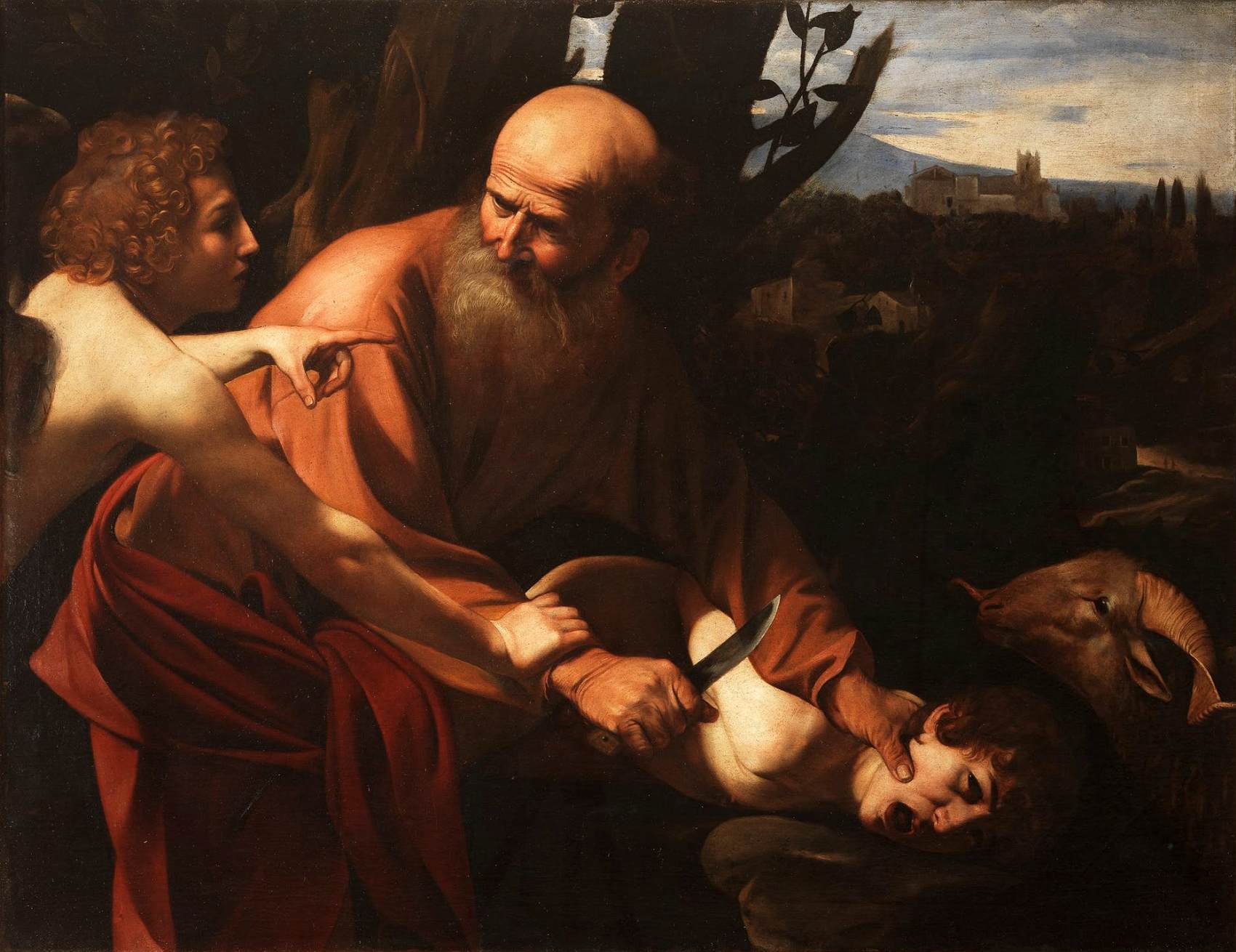
In the last section of The Gift of Death, “Tout autre est tout autre,” Derrida seems to link visibility and the sense of sight to the ethical, political, and/or religious conclusions he develops through the essay by asking a simple question: “To see in secret—what can that mean? (Voir dans le secret. Qu’est-ce que cela peut vouloir dire?)” (The Gift of Death, 88/ Donner la mort, 85) This echoes (or perhaps responds to) his own call for an explanation of the terrified, trembling, crying body that he makes in the section before—“One doesn’t know why one trembles… We would need to make new inroads into thinking concerning the body, without dissociating the registers of discourse (thought, philosophy, the bio-genetico-psychoanalytic sciences, phylo- and ontogenesis), in order to one day come closer to what makes us tremble or what makes us cry…” (55/57)—so in some sense this question about the body is just a pervading feature of the way he approaches these issues. One could say that the linkage is precisely that political, ethical, and/or religious acts of responsibility—which (and this is a central point of the text, cf. 2-7, 69-71, 108-112) take place only via secrecy—are just bodily for Derrida. But this obviously would not tell us much. This is because the force of this simple question does not revolve around either seeing or secrecy as much as it does upon meaning, upon seeing in secret remaining something questionable with respect to whether it has sense or not. And this is due to “to see in secret” being precisely that part of the phrase not written solely by Derrida, that part outside of which he partly stands and asks it his question: he phrase is from the Gospel of Matthew, as cited at the end of Kierkegaard’s Fear and Trembling, which Derrida analyses before and after this point in the text (cf. 80-1, 97-99). So our sense of a link refines itself. The body’s seeing and the secrecy in which responsibility takes place: these are for Derrida things that are questionable when linked and (thereby) forced to mean or have sense. Indeed, if we take his French more literally, what Derrida asks of “to see in secret” is whether it can be said (qu’est-ce que cela peut vouloir dire?). That is, he asks whether it does not already constitute something that would be beyond his (or anyone’s) ability to submit it to his speech as something questionable. Derrida (or anyone else) could not say, “I see in secret.” Nor could Derrida really ask it his question, as to whether it can be said. “To see in secret” would call itself already into question by itself. Thus, when it came into Derrida’s writing (precisely as the sentences as to whether it could be said), he would then not be saying it: he would already need to ask whether his writing said or meant anything (and thus he writes his sentences). The question Derrida asks not only enacts what it questions, therefore: it only enacts this because of the questionability of sight and the secret that it by itself cannot question. The sight of the body and the secrecy in responsibility: these are things that, when linked, are beyond our ability to question them while they still remain questionable. So the seeming link does not constitute itself in how and when seeing or responsibility (and their relationship) are in themselves so much as how and when, beyond our ability to question them, they are questionable.

4 comments:
Hi Mike, I am reading this now too. I am starting to notice a pattern in Derrida's later works. His conceptual apparatus, which continues to be dominated by his deconstructionism, rather automatically generates permuations of interrogative formations that remain inconclusive due their paradoxical foundations. He examines something that is given as an always already of the Western tradition. He then attempts to expose its paradoxical form, by breaking it down into micro level elements. He then tries to show how even these elements are themselves problematic, in that they require us to perform an impossible task in order to satsify its pre-established requirements. In the case you site, the injunction 'to see in secret', the elements are seeing (assuming the primacy of the visual) as the mode by which we are supposed to be able to reveal the consistency of the object by way of the senses, and secrecy as the radical interiority of the psyche andthe core that drives humans to seek out meaning, beauty, mystery, love. But Derrida leaves us there, at the boundary between the possible and the impossible. In a way, he uses a deconstructionist methodology, but adopts romanticist sensibility built upon awe in the face of that which is barely beyond reach. He gets close, and carresses the not quite of the perhaps. To the extent that he rather mutely retains this romanticist sensibility, I might suggest that he also depends upon a rather anthropocentric and westernized individualism, whereby the self as an individual is responisble for itself toward another. Based on this orientation, the self is responsible for being responsible. For me, this paradoxical frontier marks the impossibility of impossibility. Derrida arrives at a wall, and he does not shy away from acknoweldging its impenetrability. (Does this imply that Derridian ethics is an ethics of the impossibility of action?) At this point, he reaches the limit of his ability to think through, rather than against traditional constructions, around the essential pre-givens, or above the facts of the situation . When we are finally asked to be responsible for being responsbile, we find that the requirement is based on that which it requires, and we are doubly duty bound.
Your characterization is right on, I think--and especially when you say the following: "He gets close, and carresses the not quite of the perhaps."
This post here is the beginning of a longer essay, and I end up saying something similar: the link between seeing and responsibility is everywhere and nowhere.
But that doesn't mean that his ethics is an ethics of the impossibility of action, in the sense that I think you mean it.
It is an ethics that seems to establish a base-line for responsibility that is also its limit--or at least that's how I think about it. He says elsewhere in The Gift of Death that there is no front between responsibility and irresponsibility. What he means by this--and you should read The Gift of Death multiple times: it is, I would say, his greatest work and that which most resists any particular pattern--is that where there is responsibility, there only more responsibility is required. So I wouldn't so quickly say that it makes the impossibility impossible.
Its really a theory of chance. Action can only come about when we will it, and yet, if it comes about, it can actually only exist by chance. So the important "move" is less the deconstructing as the flip that occurs when something exists only by chance: this is what I try to get at in the following:
The question Derrida asks not only enacts what it questions, therefore: it only enacts this because of the questionability of sight and the secret that it by itself cannot question.
The only way Derrida is able to pose the question is by citing--by citing what is beyond his question. This is not due to the impossibility of his asking a question--indeed he asks it--so much as the fact that the question itself is asking itself through him, such that it isn't his question any more.
This is all mixed and crazy--I'm pretty sick at the moment--but I just wanted to throw out there what I've got: I'm totally sympathetic with what you say--it is extremely frustrating.
Yes, he does address the question, and temporariliy submits to the temptation to answer that it is the 'gift of infinite love'. He subsequently retreats from this temporary landing site, and perhaps experiences the veritigo of the ricochet of his renunciation. Perhaps he prefers this infinitely investigative approach to the agression of a more confrontational discourse. However, I would ask if this consistently cautious strategy might preclude him from moving beyond the archival chamber, and the evocations of the spectral emanations of its recesses. Is he destined to persist as a ghost eternally forgeting to remember its anonymous body?
I particularly like your note on the strategy by which he accomplishes the displacement of the question by way of citation. Though in this way his graphemetization of conceptual historicity could serve as a sort of defense or deferral. Have you read 'An Oblique Offering' in 'On the Name'? Derrida addresses his tendency toward oblique forms expression, and acknowledges that this habitual displacement of the nomenclature could result in refraction of signification and diffraction of responsibility. My question would be, could this result in a structural precariousness would threaten ehtical integrity? I hope you are feeling better, I am enjoying this rapport!
I'm glad to talk about Derrida too with someone--and thank you for the well wishes! I'm actually just starting On the Name--and would have been farther now if that cold hadn't intervened--so I'll let you know what I think.
But--and now that I'm better I can actually proceed with some substantial answer--I already think that you're right--the hesitance with which Derrida approaches a question can most definitely result in an abdication of responsibility... I got frustrated with that precise issue in the post below on Derrida and Spivak... But I'm wondering whether you are looking for an approach that would, just because it is a coherent approach, prevent irresponsibility--and if that isn't too high of a demand. I mean, the psychoanalyst too can be a position of evil. No doubt the big stress of Lacanians is that they try to very rigorously think about precisely that possibility by delineating the problems the analyst faces. And their big beef with Derrida is that he will always say that these problems cannot ever be wholly integrated into that subject position, even with all the complications of transference rigorously thought out. The same goes for the analysand. So if one accepts what Derrida says, well, you feel like you're completely impotent with respect to ethics. Thus you kind of just have to ignore him and try as hard as you can to integrate what he says within the psychoanalytic paradigm. And to a large extent I think this is the accomplishment of people like Zizek and even Badiou when they confront Derridians. That is, most Derridians are quite stupid and indeed unethical when it comes to confronting psychoanalysts/Lacanians--they're really dismissive--and, thus I think Lacanians are more honest and genuinely honorable than Derridians, as things stand, since they are more accommodating.
But--I just wanted to get that out there--back to the point. When you say:
Perhaps he prefers this infinitely investigative approach to the agression of a more confrontational discourse.
I think you are right on, but I think the weight of that preference needs to be felt. I don't know if you hang around in philosophy classrooms ever, but that confrontational discourse IS philosophy itself: you can see it there. And to a large extent you can see it everywhere in the academy. That is, in the places where thinking should really for sure be occurring, we think according to confrontations, to positions, and not according to what the hell is actually being written. I mean, who the hell writes papers in a philosophy department on anything other than the canonical texts--and even then, not the weird parts, but the transcendental deduction, for example... the 1000 words that are considered to matter. Derrida not only expands that canon to include marginalia, he tries to think that this is actually where the mattering is going on... I mean, that's a big change.
The upshot of all this is, however, that Derrida's work is much more suited to this academic framework, rather than out on the streets, where the battles are actually fought. It remains quite "intellectual," for all its attempts at trying to situate itself elsewhere. I think the thought of Lacan, or (my new recent obsession) Foucault is much better at thinking "on the ground" as it were. So in the end I don't think it is a matter of trying to find the one and only theory of ethics that would be the right one, so much as trying to lay out fields where certain types of thought are more efficient or somehow organize the facts more pragmatically. If there can be some unified field theory of all them, well, so be it, but I think that would in itself always remain quite academic or intellectual. The great thing about psychoanalysis is that, as an institution, it is precisely trying to combat this fact: it turns an institution into a sort of army to fight with the people. But I would be quick to add that just because it does that doesn't mean it shuts out the possibility of a "structural precariousness that would threaten ethical integrity," as you put it.
Post a Comment