When Freud's thought was first presented to a scandalized world, the recognition of unconditioned instinctual impulse which lies at its core was erroneously taken to mean that Freud wished to establish the dominion of impulse, with all that this implies of the negation of the socialized self. But then of course it came to be understood that the bias of psychoanalysis, so far from being Dionysian, is wholly in the service of the Apollonian principle, seeking to strengthen the "honest soul" in the selfhood which is characterized by purposiveness and a clear-eyed recognition of limits. The adverse judgment increasingly passed upon psychoanalysis [...] not only expresses an antagonism to its normative assumptions and to the social conformity which is believed to inhere in its doctrine, but is also an affirmation of the unconditioned nature of the self, of its claim to an autonomy so complete that all systematic predications about it are either offensively reductive, or gratuitously prescriptive, or irrelevant.
-Lionel Trilling, Sincerity and Authenticity, 56.
Showing posts with label Freud. Show all posts
Showing posts with label Freud. Show all posts
Tuesday, July 13, 2010

Thursday, February 18, 2010
Actually existing liberalism
One of the best Zizek lectures I've ever heard, from a little while ago (November of last year). I myself would get behind a lot of what is said--including the comment on Latour. The look at the contradictions in the notion of individual choice is precise. But also featured are levelheaded remarks on the artificial (biological life), the posthuman and augmented reality, Freud (materialist) and Jung, thought and modernity, and really or actually existing liberalism.
Wednesday, September 30, 2009
Suspicion and restoration
 Ricoeur's De l'Interpretation (translated as Freud and Philosophy), is famous for introducing a distinction between hermeneutics of suspicion--whose practitioners are the three bad boys of Western civilization: Marx, Nietzsche, and Freud--and a restorative hermeneutics or hermeneutics of recollection. The goal of the book is not to oppose one to the other, but to take the latter, with which he aligns both faith and phenomenology (specifically in the phenomenology of religion, the object of which is the sacred--the essence of ritual, belief, and culture), and have it pass through the former. This is not because faith is inadequate, but because the hermeneutic tradition "is at variance with itself" (27), or has already split between the two, and thus has something perhaps to bring to suspicion.
How has it split? The Aristotelian problem of semantics understands the sentence as "saying something of something," or declaring something about being, understood already as meaningful and needing clarification or rather elucidation, proclamation. Such a stance recognizes that "real meanings are indirect" because "I attain things only by attributing a meaning to a meaning" (23). Clarification here primarily revolves around circumscribing the possibility for error, for attributing meaning in a false way. But it never presumes error can be overcome: Aristotle says in the Metaphysics that "being is said in several ways" (23). However, it does not directly attempt to take up the complete range of meanings itself. This is the task of the second branch of the hermeneutic tradition. Here, we have the sentence as Scripture, introduced by the Christian community (there is a notable absence of the Rabbinical tradition in Ricoeur's account) and then as text (via the "book of nature"), as something articulated in many ways and only able to be reduced because it unfolds according to specific forms (like allegory and analogy). These must be understood in themselves to allow the sentence to be understood. In this view, the falsity of a sentence becomes not only a covering up of the true, but the creation of a new direction which leads one astray from the truth and back into the plurality of meaning--that is, the replacement of an intelligible text not with a more intelligible text (which is the goal of this criticism), but a less intelligible text. Thus the process of unfolding meaning is an attempt to get past lying and towards the authoritative version of something.
Ricoeur's goal is not, then, to reunite the hermeneutic field through some "general hermeneutics," some "universal canon for exegesis" (27; we might see Gadamer trying something like this), but rather to make this "conflict of interpretations" work for philosophy, or resolve a more total "crisis of reflection"--something I won't really get into now but is quite interesting in itself and ultimately necessary for understanding the whole of this famous distinction between the suspicious and the restorative.
Now, Freud has both the suspicious and the restorative elements in him. He always pushes his theory, though, towards the suspicious. But certain elements escape this. Ricoeur recognizes these elements lie in the connections Freud makes to culture in order to give a the psyche and its mechanisms some recognizably anthropological basis. As far as the psyche is concerned, Freud asserts we can do without them. But in his texts, they function as more than mere hypotheses. Oedipus, for example, isn't just some sort of empty structure that happens to have been represented in literature. Freud has recourse to it because it has enough thickness to give a certain character to the psychic mechanisms.
Ricoeur pushes hard on these "symbols," as he calls them, and the results are amazing: the view of Freud that he comes up with eventually accounts for so much that remains embarrassing and unexplained in early psychoanalysis, and which subsequent theories have had to scramble to make more rigorous (or more confusing). The symbolic (which we should distinguish from the Lacanian symbolic) pops up not just in these "literary" references, but in the most basic elements of the Freudian approach. Ricoeur sees even the move between the economic and the topographical as a negotiation of the symbolic--indeed this is his central concern, since such a move constitutes, for Freud, the dream-work itself, and thus (when it is itself worked upon) the process of the interpretation of dreams.
One can't convey just how novel, and how refreshing, Ricoeur's approach is. The economic/topographical distinction is of immense importance, and is too often bypassed as simply the relationship of two unconnected regions, one of which can always be reduced to the terms of the other. Ricoeur makes the distinction the center of his reading, and by connecting the 1895 "Sketch for a Scientific Psychology" to the Interpretation of Dreams, patiently shows how the solely economic considerations of the former are developed into the topographical considerations in the latter. It is through the notion that the economic constitutes a discourse of force, and the second a discourse of meaning, that we return to the distinction between a hermeneutics of suspicion and restoration. For what Freud does is interpret the second discourse in terms of the first, continually. In other words, meaning will always be seen as having its origin in force, never in another meaning. Or, more accurately, when meaning has its origin in another meaning, this process will always be seen as itself originating in the movement of forces. And it is in this way that the dream work itself will be seen as something in need of unworking, demystifying--in short, will require a hermeneutics of suspicion.
To interpret is to displace the origin of meaning to another region. The topography, at least in its static and properly topographical from, will be the pictorial representation of this movement of interpretation from the apparent meaning towards another locality of meaning. But even at this first level it is impossible to look upon Deutung as a simple relation between ciphered and deciphered discourse; it is not enough to say that the unconscious is another discourse, and unintelligible discourse. In its transposition or distortion (Verstellung) of the manifest content into the latent content, interpretation uncovers another distortion, that of desires into images...
-Freud and Philosophy, 91-2
Thus, we get a mixed discourse, which tends to conceive the unconscious as the proper object of suspicion, even as it forces meaning, the object of a restorative hermeneutic, into its service:
To say that a dream is the fulfillment of a repressed wish is to put together two notions which belong to different orders: fulfillment (Erfüllung), which belongs to the discourse of meaning (as attested by Husserl's use of the term), and repression (Verdrängung), which belongs to the discourse of force. The notion of Verstellung, which combines the two universes of discourse, expresses the fusion of these two concepts, for a disguise is a type of manifestation and, at the same time, a distortion that alters that manifestation: it is the violence done to the meaning. Thus the relation of the hidden to the shown in the notion of disguise requires a deformation, a disfiguration, which can only be stated as a compromise of forces.
-Freud and Philosophy, 92
But when Freud looks at things like typical dreams (dreams of being naked, etc.), or when he finds that certain objects or figures typically represent certain desires, he is left confused: he has to express some larger economic principle underlying these symbols. What Ricoeur does is pose the question of why indeed the dream process in its entirety has to be seen as opposed to such symbolic manifestations. For in them, what we find is a sort of relationship to otherness that is opaque and cannot easily be demystified: one has to foist upon them a certain amount of mystification which is ultimately not present in them--merely because they have already been worked upon elsewhere. They can only have their essence specified--this is what the phenomenology of religion does, for example, with symbols. And this is why the latter is a hermeneutic of restoration. It deals with meaning not by seeing in it a distortion of its own real meaning--its own authoritative truth--but rather the expression of a more general plurivocal essence that allows for all sorts of meanings, all sorts of aspects to be grasped (through the fact that their meaning is not manifest, or rather is also present somewhere other than in their manifestation, their immediate meaning). Ricoeur then proposes to reintroduce this dimension within analysis, not to undo the Freudian contribution, but to bend it back to accommodate the full range of possible meanings. I'll have to stop here, but this hopefully can serve at least as a little sketch of the whole project.
Friday, September 4, 2009
Place, or/of the fetish

Already, in “Fetishism,” the fetish will have taken place, will have arisen. That is, before we even start reading Freud’s description of fetishism, his Beschreibung des Fetischismus (GW, 316 [see the end of this post for citation information and abbreviations]), the fetish will have come up: there were fetishes, and they dominated a number of men. Freud is sure of this, even though his title (and not just his title, as we shall see) announces that in 1927, and despite even the extended discussion in the Three Essays and other places, it still remains for him to place the fetish clearly in psychoanalytic discourse, to show how the fetish takes place in psychoanalysis. Freud is sure, he announces it, despite this disappointment: "In the last few years I have had the opportunity of studying analytically a number of men whose object-choice was dominated by a fetish" (SE, 152; GW, 311). He has had this opportunity, this chance laid out (Gelegenheit) before him and, somewhere before this essay, has taken it up and studied it. Analytically. That is, in the manner that takes its proper place in the discourse of psychoanalysis, that takes place in the place of psychoanalysis. Surely, Freud announces, the fetish has been studied analytically: there has been no opportunity for him in which the fetish would not have been studied in analysis, studied in a way that is not proper to psychoanalysis, that does not make it come up right inside 19 Berggasse (a place, let us note, that is not too far away from, and thus is next to or beside the Schmerlingplatz—and thus the Rathaus and the Justizpalast). So then, here, the fetish has arisen for him, Freud asserts it, there.
That Freud begins his description asserting he has studied the fetish he has not yet theorized or described—this might seem to us so compelling that we are ready to expect it will come up again. We might almost be sure, in other words, that in the laying out of the Beschreibung, the fetish having taken place will take place again. That, in elaborating this announcement that the fetish has taken place, in the position or place of elaboration, Freud will make it arise again. That he will make this rise up out of his language, from down below or at his side—as if someone did not believe him and he were raising up his weapon in a counter-attack. Or perhaps, to put it in a less forceful way, we might expect Freud will again allow this announcement another chance to arise. That he will lay out the space in which it can appear once more—as if he were summoning or calling it up, compelling it, craftily. That, as if he were some sort of conjurer, one who split up reality with tricks and slight of hand, he will make us believe again that that which we have not seen has, indeed, happened. All this is to say we might expect his psychoanalytic description will have to show us once more that which it is announcing it is certain has taken place. As if Freud both had given into doubt and forsaken belief in what he was saying, and still preserved his belief in it.
And yet, almost in the same space as this expectation, right next to our readiness to expect all this, there is a possibility (we hesitate to call it an expectation as well) that the fetish will not have come up—again, or even, as Freud announces it, already. In other words, we cannot be so ready to expect what we expect, we cannot be so sure, since in expecting the fetish to come up again we are saying precisely that Freud is not so sure about the fetish and its having come up. As if he were expecting what we expect about him, he begins to seem like he always will have said something different, heading us off, oscillating (as he will soon say another man—one of the two brothers who had lost their father, SE, 156; GW, 316—indeed oscillates, schwankte) between the place in which we expect him and another place in which he is saying that the fetish will never come up.
Thus, in almost the same place as his first sentence (in the next two, three, or four sentences, depending on the German or English version we are reading) Freud seems to expect us, and hints the fetish is something that we should not expect to come up in analysis. “There is no need to expect that these people came to analysis on account of their fetish,” he says (SE, 152; GW, 311). He means, in short, that we need not expect that analysis will directly address the patient and his fetish. This is so not only because the fetish will have readily up in analysis, as Freud might confidently assert, but that, precisely as he indeed asserts this, uncertain and unsure, he also asserts that the fetish will only be indirectly or incidentally addressed by analysis—such that in analysis we cannot clearly say if it came up. To assert this a little more forcefully (though merely to repeat Freud’s language): Freud says that we really need not expect fetishists will be, insofar as they are fetishists, patients—and thus we need not expect that the fetish will come up in analysis. Indeed, though these people, these Männern, these Personen have obviously been patients in analysis, Freud seems uncertain about this and never throughout the entire Beschreibung actually calls them patients, Kranken or Patienten. So in almost same space as his assertion that the fetish will surely come up in analysis, he is also marking them as mere adherents, as devotees (hangers-on, Anhängern) of the fetish, and saying that they have not come to analysis for what analysis is for, like a patient would. For, he continues, these people—Freud has studied this, no doubt, es wird wohl—are not feeling the fetish as a symptom of suffering, as a Leidenssymptom, even though they recognize the fetish as an abnormality. And he thereby announces that, for the purposes of our Beschreibung here, analysis is first and foremost something for dealing with suffering patients:
There is no need to expect that these people [Personen] came to analysis on account of their fetish. For though no doubt a fetish is recognized [der Fetisch wird wohl … erkannt] by its adherents [Anhängern] as an abnormality, it is seldom felt by them as the symptom of an ailment accompanied by suffering [ein Leidenssymptom] (SE, 152; GW, 311).
Analysis is for what analysis addresses—namely, suffering—and these men will be patients insofar as analysis will address their suffering. But this means that insofar as these men will not have come to analysis for their Leidenssymptom—specifically insofar as they have come to analysis feeling happy or satisfied (zufrieden) about their fetish—analysis proper will not, except incidentally or in a subsidiary way, have provided the space in which it came up. So Freud continues:
…it is seldom felt by them as the symptom of an ailment accompanied by suffering. Usually they are quite satisfied with it, or even praise the way in which it eases their erotic life. As a rule, therefore, the fetish made its appearance […] as a subsidiary finding [eines Nebenbefundes] (SE, 152; GW, 311).
The fetish will have been a subsidiary finding—something that came to light incidentally, as another translator renders eines Nebenbefundes (F 95). Insofar as analysis addresses the fetish, the taking place of the fetish will only be an incident of analysis, a chance happening next to or beside (neben) its work of addressing suffering. And therefore the fetish will perhaps not arise, will not take place, as all English translations of Freud have added to the German, in analysis: “As a rule, therefore, the fetish made its appearance in analysis as a subsidiary finding,” the Standard Edition says (SE, 152, which merely copies Riviere [R, 204]; so too Frankland [F, 95]: “As a rule, then, their fetish came to light only incidentally during analysis,” which admits more of our stress on the incidental, but still interpolates “analysis” unnecessarily, still trying to show where the incident occurred). These are sentences that, attentive to Freud’s oscillations, we cannot yet cite wholly—translations between two places to which we cannot lend much credence. For we are seeing that in question in Freud’s words—where “in analysis” does not appear or, perhaps, even play a part, as we will see momentarily: Der Fetisch spielte also in der Regel die Rolle eines Nebenbefundes (SE, 152; GW, 311)—in question in these words is precisely the place where the fetish takes place: the subsidiary finding seems to be, precisely because it is subsidiary, exactly that which analysis did not address, something that perhaps takes place when analysis occurs but only takes place beside its proper place and proper concerns (even if analysis tries to address this place, to take place in its place). Both beside and besides analysis, can we then make Freud say that the fetish arises in analysis? Can we make this arise, when we might hear him differently? Perhaps we are seeing another reason why there is no need to expect that these people came to analysis on account of their fetish? Perhaps Freud is saying, not that we need not expect what will surely take place in analysis (despite what it usually addresses), but that, because the fetish will take place only beside analysis, only next to it, incidentally, we need not expect what will never take place? Namely, that that these people, insofar as they are fetishists, will ever come to analysis properly, will ever take their place in analysis properly, such that their fetish could properly arise? There is no need to expect—man braucht nicht zu erwarten: but, Freud makes us ask, who needed to expect this other than those who expected that the fetish would take place or arise again in analysis?
To be continued...
Note: This is from a paper I wrote for a class on Freud, taught by Diana Fuss. I’m citing the three English translations of this essay (by Joan Riviere, James Strachey [in a revised version of Riviere’s work], and the New Penguin version by Graham Frankland) while following the Standard Edition as close as possible, as well as the German. I use the following abbreviations: GW, “Fetischismus” in Gesammelte Werke. Bd. XIV, Werke aus den Jahren 1925-1931. Frankfurt: Fischer Verlag, 1991. p. 311-317; R, “Fetishism,” tr. Joan Riviere. In Sexuality and the Psyhology of Love. ed. Philip Rieff. New York: Simon and Schuster, 1963. 204-209; SE, “Fetishism,” ed. and tr. James Strachey. The Standard Edition of the Complete Psychological Works of Sigmund Freud, Volume XXI. London: Hogarth, 1961. p. 153-7; F, “Fetishism,” tr. Graham Frankland. in The Unconscious. ed. Adam Phillips. London: Penguin, 2002. 93-100. I’ll also be more freely quoting from “The Splitting of the Ego in the Process of Defense,” in the Standard Edition (cited above), Volume XXIII, 271-278, and “Die Ichspaltung im Abwehrvorgang,” in Gesammelte Werke, (cited above) Bd. XVII, 59-62.Tuesday, August 25, 2009
Best of... Freud and psychoanalysis
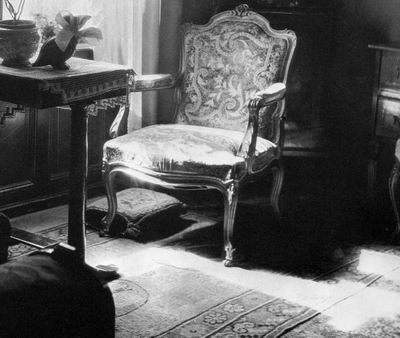 So I have been trying to collect together a few sets or series of posts that I have done on this blog around various topics or themes that have come up. A "Best of" collection. So far, I we have Derrida and Heidegger. Today, Freud and Psychoanalysis. In the future, we'll probably have Merleau-Ponty and Phenomenology. Look for them on the sidebar, where I'll put a more permanent link to the sets. Now, on to Freud:
Freud, philology, associations: I try to read an interesting remark in The Joke and its Relation to the Unconscious, and reflect on the difference between psychoanalysis and philology.
Anticipated normal path of development: I look closely at a crucial passage in the Schreber case that has been misread, making Freud's theories of development much more normative (in one respect) than they really are. Such cheap points against Freud usually are trying to push you into a false choice: either Freud is normative or he isn't. If you want to defend Freud against the sciolism (to borrow a great word of Coleridge's), you have to prove the impossible. For of course Freud is going to give you some sort of normativity. The real issue is where exactly he is normative--and it usually isn't where you expect.
Vicissitudes: A little reflection on this interesting Freudian (or, rather, Stracheyian) word.
Drives and primal repression: My attempt to work through the two theoretical essays "Instincts and the Vicissitudes" and "Repression."
Looking at drives: Basically, how drives work. I should say, though, Freudian drives, which are odd things.
Lacan and repetition: My reading of Lacan's "Tuchê and automaton."
Place, or/of the fetish: the beginning of a paper on "Fetishism," the splitting of the ego, and place in Freud and psychoanalysis.
Saturday, March 21, 2009
Tenor, vehicle, transference
 I.A. Richards on psychoanalysis:
A "command of metaphor"--a command of the interpretation of metaphors--can go deeper still into the control of the world that we make for ourselves to live in. The psycho-analysts have shown us with their discussions of "transference"--another name for metaphor--how constantly modes of regarding, of loving, of acting, that have developed with one set of things or people, are shifted to another. They have shown us chiefly the pathology of these transferences, cases where the vehicle--the borrowed attitude, the parental fixation, say--tyrannizes over the new situation, the tenor, and behavior is inappropriate. The victim is unable to see the new person except in terms of the old passion and its accidents. He reads the situation only in terms of the figure, the archetypal image, the vehicle. But in healthy growth, tenor and vehicle--the new human relationship and the family constellation--co-operate freely; and the resultant behavior derives in due measure from both. Thus in happy living the same patterns are exemplified and the same risks of error are avoided as in tactful and discerning reading.
-The Philosophy of Rhetoric, 135-6
This interesting reflection, made way before there were Lacanians (Richards delivered these lectures in 1936 at Bryn Mawr, pictured above), is made really specific and useful through the use of the tenor/vehicle distinction which Richards introduces earlier in the lecture.
This distinction, one of those many unbelievably handy tools that Richards in particular and the New Critics in general gave us, runs like so: metaphor is often described as the comparison (roughly speaking) of two things, one through the other (or, as we also often say, by substituting itself for the other). But we can specify those things, the one and the other--through which the one is compared. Tenor is the original thing (the one) which, through the introduction of another (the other) thing, the vehicle, gets related to that new other thing in a meaningful way. In other words, the vehicle is that which modifies the tenor and in doing so establishes a relation which is meaningful (it creates a new meaning) and is called metaphor (the new meaning is metaphoric). So in the old lines Johnson quotes,
O could I flow like thee, and make thy stream
My great exemplar as it is my theme!
Though deep, yet clear; though gentle, yet not dull;
Strong without rage; without o'erflowing, full.
The flow of the mind of the person to whom the poem is addressed ("thee") is the tenor--it is the original thing, the one thing--and the river (or "stream") is the vehicle--it is the other thing through which the original gets compared (cf. Philosophy of Rhetoric, 120-121).
The tenor and vehicle, insofar as they share some commonality or resemblence, can be said to have a ground, and it is in the shifting of this ground (by the transfer between tenor and vehicle) that is effected by the establishing (through the introduction of the vehicle) of a relationship. Meaning is the effect of this shift, and metaphoric meaning can only be said to take place when both tenor and vehicle are present. In other words, if either tenor and vehicle are not there, or if one can't establish where both are taking place, then there is no metaphor, and there is no metaphoric meaning being produced.
Thus in the above, what happens is that there is an overemphasis upon one of the two aspects of the metaphor, preventing the copresence of tenor and vehicle, and thus no understanding of the shift happening in the metaphor, or an adequate ability to engage in healthy transference.
I don't think I've brought this all out adequately insofar as it bears on the amazing quote above. But part of this is that the remark on psychoanalysis occurs close to the end of a huge, huge effort of Richards which is not easy to reconstitute. But this gets at a problem concerning Richards in general: his sensibility is so subtle, and his conception of the function of literature so refined and, while not abstract in the least, is so hard to easily capture--in fact, precisely because he sees literature and language working so dynamically, and at the same time in such a determinable and determinate way (not unlike Nietzsche, whose forces are dynamic and at the same time very specifiable if one has the right way to get at them)--that it isn't easy to really summarize a point of his without reference to the real intuitive sense of language that he gives you. This is part of the reason why he in particular, as well as the New Critics I think in general, are so maligned now, or at least have largely been forgotten: the sense of the work of literary language is more intuitive than able to be expressed, and unless one really spends time with them, anything they say can be easily and pointlessly dismissed. The best refutation of the New Critics in my mind is Raymond Williams', but this is only because literature for Williams is almost equally complex and subtle and dynamic--in other words he has such a rich and comparably acute sense of what it is. In other words, New Criticism is first and foremost a practice before it is a theory, and so dismissing it as a theory (or even theoretically summarizing it) is doomed to have too shallow a conception of what the New Criticism is doing. This doesn't mean New Criticism isn't profoundly wrong in certain respects, but merely that it has to be addressed as a practice, as a sort of vague sense of what literature is doing and how to address it.
Tuesday, March 10, 2009
Rationality
 It strikes me, reading Habermas, that his achievement is (among many, many things) not so much the linkage of critical thought to empirical inquiry, nor the theorization of a rich notion of communication, but the recuperation of a field of rationality that remains less decidable than many thinkers (postmodern especially) would like to believe. Or rather, he understands that if you take their word for it, rationality (in its Enlightenment form) is so overarching, so massive in its effects, and so singularly responsible for the worst fictions about acting subjects and their world that one would think real discerning, responsible uses of it are few, or at least very hard to find--and affirms that this is the case. In other words, Habermas on a certain level restores meaning to reason by affirming what anti-Enlightenment thinkers say about reason: that a genuine use of it is very hard to find, even though it is everywhere. He then allows one to say that what we need is not to focus on how reason is ubiquitous and responsible for all atrocities, but on what a real genuinely responsible use of reason might actually look like.
It's not that we should brush off the effects of rationality. It's that, after reading something like Dialectic of Enlightenment, or Heidegger's accounts of reason, you lose all sense of the specificity of reason, and therefore any way (rational or irrational) of turning reason back towards the cultivation of a responsible function. As should be clear from my hesitant parenthesis here, this view also trades in a not unwarrented concern that any correction of reason will itself have to be rational--Freud in particular helped us see (and still helps us see) just how hard it is to think of something truly beyond reason, or that won't use reason against itself precisely in the effort to think reason's limits.
For me, Habermas gets a little too odd when he begins to say that the relative invisibility of genuine acts of reason means, not that they are rare, but that they are indeed everywhere: that certain aspects of practical action are themselves expressions of a certain form of rationality. This leads him to start to outline the amazing notions of the public sphere and discourse ethics. But I would rather he deemphasized the rationality of practical action and thought it more purely as mere action which may occasionally have a rational dimension. This would stay truer to the insight I'm outlining above: that reason is not as ubiquitous as we might think it is. This of course precisely means that reason isn't elevated into any particular good in itself, but that it remains just like any other specific (that is, not practical or pragmatic, as in Habermas) form of action that we engage in. It has its own specificity, and its own determinate or (at least) determinable force.
But in the end what we see is that there is a realm which thinking that is anti-Enlightenment and anti-reason overlooks when it understands rationality in its particular sense: the realm in which the extension of reason, its genuine deployment, remains undecidable as to its effects (Derrida, for his part, will theorize precisely this undecidability of reason, and it is in this that he is most powerful, I think--attempting as he is the project of Freud sketched above, but with greater rigor). In the anti-rationality model, it could either prop up various forms of technical and political domination, or it could allow liberation. What Habermas continually emphasizes (and Heidegger does this too, to his great merit, though with different motivations) is that the either/or here is way too rigid and is itself an effect of the ideology of those dominant forces, as well as the aspects of the liberatory forces which counter-productively rely on their opposition to the dominant. Rationality is only operative in the space at which it is extending itself or distributing itself further and further, such that it can be appropriated by both sides. This means that the use of reason isn't inherently, just because it is reason, going to fall into the hands of either. Again, I don't think that this space is as sustained in forms of practical and pragmatic action as Habermas does (I think it takes place in smaller spheres, like the classroom), but I do think he's right when he says that the cultivation of a sort of mastery of--or at bottom at least some ability to redirect--this space is what is crucial, and is what is left out in many accounts of reason. If one understands reason like Habermas does, one can begin to think about what its place should be--which is more than any mere denunciation of it (or an account of it that merely adds up to a denunciation of it) can really do.
Thursday, January 8, 2009
More on translating "Fetishism"
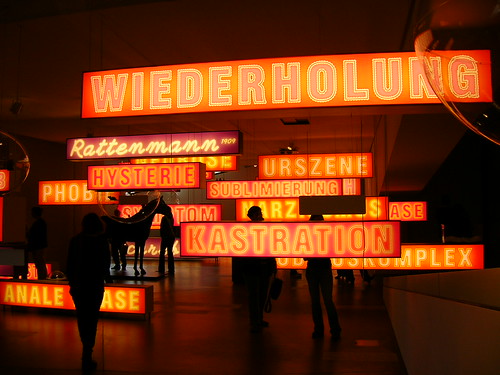 So I finally got a copy of Graham Franklin's new translation of "Fetishism" for the 2002 volume of the New Penguin Freud, The Unconscious. I gotta say, while it improves somewhat grammatically over the previous versions--by Joan Rivere and James Strachey--it duplicates a lot of the errors in those versions and sometimes makes new mistakes I would have never thought possible. All in all, it's a missed opportunity for opening up what in German is a really striking verbal performance. Here I'll just go through and list the problematic points.
The whole rendering of the first paragraph is off, first and foremost. But what really irks me is that Franklin continues in the tradition of Rivere and Strachey in all three versions in botching the last sentence horribly. Freud says:
Der Fetish spielte also in der Regel die Rolle eines Nebenbefundes.
Which I'd translate roughly as:
As a rule, the fetish therefore plays the role of a incidental finding
Pretty simple, no? Well, Rivere says this (in the International Journal of Psycho-analysis, which you can find now in the handy volume edited by Rieff called The Psychology of Love):
As a rule, therefore, the fetish made its appearance in analysis as a subsidiary finding.
Strachey copies this in the Standard Edition version:
As a rule, therfore, the fetish made its appearance in analysis as a subsidiary finding.
And, to top it all off, there is Franklin:
As a rule, then, their fetish came to light only incidentally during analysis.
Why do all the English versions available get rid of the theatrical metaphor? Odd. It could be because I've got my grammar wrong, and somehow the verb (spielte) is working differently than I think it is... but that doesn't seem right. And why the addition of "in analysis" in all these versions? Both these moves seem to me unncessary, though Franklin actually quite nicely got himself out of the problem of trying to convey what a "Nebenbefundes" is--and this perhaps was a good choice.
Then there is the very crucial sentence about the penis' narcissism:
Nein, das kann nicht wahr sein, denn wenn das Weib kastriert ist, ist sein eigener Penisbesitz bedroht, und dagen sträubt sich das Stück Narzißmus, mit dem die Natur vorsorglich gerade dieses Organ ausgestattet hat.
Rivere, which despite his grammar distortions I like, because he is spirited:
No, that cannot be true, for if a woman can be castrated then his own penis is in danger; and against that there rebels part of his narcissism which Nature has providentially attached to this particular organ.
Strachey:
No, that could not be true: for if a woman had been castrated, then his own possession of a penis was in danger; and against that there rose in rebellion the portion of his narcissism which Nature has, as a precaution, attached to that particular organ.
Franklin:
No, this cannot be true, because if women have been castrated, then his own penis is in danger, and the piece of narcissism, with which nature providently equips this very organ, recoils at the thought.
What!! The penis is thinking!
Or, let me put it differently: everything in this sentence revolves around the "sträubt sich." In an effort to again dilute the resonances of this word, or perhaps convey these resonances in a different sense than Rivere and Strachey have--they have given it what is, I think, given the events in Red Vienna in 1927 (like the burning of the Palace of Justice)
 a sort of political valence--Franklin has made it into a sort of colloquial phrase: "recoil at the thought." Even if recoiling is a bit better at communicating the sort of revulsion that verb implies, including "thought"--which is nowhere in the German--cancels out any progress that is thereby made. And "providently," on top of all this, is just unforgivable. "Providentially" is the only acceptable form of that word--otherwise Freud just sounds like he's a snooty Brit. I think Strachey is a bit better in rendering "vorsorglich" as "as a precaution," though this might be a bit more heavy and erase the type of agency that Freud is attributing to Ms. Natur. Nature acts with foresight, but also with care here. I'd render it as the following:
No, that can't be true, because if the woman is castrated, then his own penis is threatened, and counter to this there rioted that part of the narcissism with which nature has preventatively equipped exactly this organ.
But "preventatively" doesn't even really cut it. There's got to be a better solution, and Franklin just looks like he either tried too hard or not enough. I think if you play up the military metaphor--politics runs through this piece, as an essay of mine which you'll see here soon will try and show--and maybe say that Nature did not just "equip" the penis but in fact "outfitted it" (which also has the benefit of playing upon the clothing and performative register that we saw earlier at work), we could then perhaps make the "vorsorglich" a bit more mild, loving, caring: "which nature has, with foresight, outfitted exactly this organ"--or something to that effect. I'll also note there is huge confusion on "das Weib," and I think that Franklin's decision to go with just "women" is bold, especially because he doesn't (like any of the other translations) seem to get the tense right of the verb: what I (following my translating authority Sand Avidar-Walzer) think is "if the woman is castrated" becomes "if women have been castrated." I might in the end be convinced to go with the plain "woman" if Franklin changed the verb to "is."
I'll end up on a good note, though: Franklin has the best rendering in English of one of the most complicated sentences I think exists in all of Freud:
Der Hergang wer also der, daß der Knabe sich geweigert hat, die Tatsache seiner Wahrnemung, daß das Weib keinen Penis besitzt, zur Kenntnis zu nehmen.
I have this roughly as the following, which is just dry:
So what happened was that the boy refused to grasp his knowledge of the fact that he apprehends that the woman does not possess a penis.
Rivere tries his best:
What had happened, therefore, was that the boy had refused to take cognizance of the fact perceived by him that a woman has no penis.
Strachey follows this and ends up with something just as ugly:
What happened, therefore, was that the boy refused to take cognizance of the fact of his having perceived that a woman does not possess a penis.
And Franklin with unbelievable elegance solves the problem with a comma (and a colon, which is a bit much), which both duplicates the unsettledness the German creates but also keeps it just as clean:
What has happened, then, is this: the boy has refused to acknowledge the fact that he has perceived, that women have no penis.
Thursday, December 25, 2008
A Charlie Brown Christmas
 It's been said a lot that the adventures of Charlie Brown are existentialist in nature. No doubt that's right on, but I just want to reflect a little on some other aspects that make A Charlie Brown Christmas such a successful and appealing existentialist vision of Christmas. Apologies in advance for inconsistencies: I've had a bit of nog.
I look here at the Christmas special not only because it's Christmas Eve, but because ultimately I find it more interesting than the comic strips--as good as they are. And I do this because I think others feel the same way. Why, though? I think it is because the extended narrative allows Charlie Brown to come into focus more than he can in the strips. The plot revolves so intensely around what Charlie Brown is, what he is about, that it becomes much more intriguing and hilarious than if it remained as disconnected and jokey as the strips are. What I'm getting at is that this Christmas special, which has captivated people for so long, is so interesting because it has enough room to make its narrative identical to the life of a character. Or rather, since comic strips do this already, playing characters off of each other, the specials allow a character's life to become narrative.
But here is the crucial thing. The special does this not by making the Charlie someone in need of development, as is so common in larger narrative structures (think of Dickens' Scrooge), but by making him a void, a nothingness, that pulls through the story and fundamentally stages its having no basis. That is, the narrative reduplicates the problem that will be eventually attributed to Christmas but which is really one of the transfer from a comic strip to a more life-like (because more narrative, more flowing, more progression-based, more cinematographic) medium: why make the transition? Why, that is, not just remain disconnected? Why try to achieve coherence? Things have no intrinsic meaning, so why search for them out there? What is gained? There is no meaning to it, at bottom, and its progression, its life-likeness, is only one that can be based on this fact!
What I'm saying is that the narrative is ironic--it has some distance to itself, and this is caused by its inserting a void in the middle of it. Taking away its own basis for being, it is. The movie then dramatizes this ungrounding of its own unfolding: first and foremost by encountering psychoanalysis. The scene at the doctor's booth with Lucy is infamous, of course. But what is less remarked about is how actually helpful Lucy's advice is. I mean the first advice, before she suggests "involvement." This advice is labeling the problem: "if you have a problem, we can label it," she says. Now, one can hear this mockingly: all psychoanalysis or therapy in general does is give you a name for something--it pretends to give you something more than a name but it just leaves you empty-handed. But what this does not factor in is how a name can be precisely without content, and therefore allow you to deal with structuring your experience rather than engaging with it directly--exactly what Charlie Brown needs, since he approaches experience from this ironic distance. In other words, a name can serve to structure what you feel might, in the end, either have or not have an essence, a meaning behind it: it structures this indeterminacy itself by giving you something that you can approach it with, instead of having your indecision about it infect everything you are doing. Charlie refuses to compartmentalize in this way, of course. But I have not heard any better description of the theraputic value of structuralism than what Lucy says here.
Next is the play. What is interesting here is that one really does begin to identify with the other characters: Charlie brown does look like an annoying idiot in his reading out of the "director's signs" or whatever they are. One understands more acutely that the problem he has is not just one of depression, but one of ideals: there is nothing left to do properly, since it is all meaningless--and yet he denies that anything can be done about this indeterminacy except substituting other meanings. He doesn't see, that is, the structuralist way out of this problem. He doesn't have to take this route that we're forcing on him, of course--and indeed his denial keeps him tied more honestly to his sense of being a void. But here, at the play, you see suddenly and more viscerally than before the consequence of this: what you see is that this squanders the real excitement everyone has for Christmas, even if they do not understand its meaning or lack of meaning, even if they remain noncommittal or ambivalent to it when pressed hard. One sees that the search for meaning, even when carried out ironically, can overlook some things, which might indeed have more value than the plight of your tiny ego (no matter how big your round head is). In short, holding on so seriously to this search can make you a blockhead.
Then there is the selection from 2 Luke of Linus, at the point at which the play totally breaks down for Charlie:
And there were shepherds living out in the fields nearby, keeping watch over their flocks at night. An angel of the Lord appeared to them, and the glory of the Lord shone around them, and they were terrified. But the angel said to them, "Do not be afraid. I bring you good news of great joy that will be for all the people. Today in the town of David a Savior has been born to you; he is Christ the Lord. This [hoc] will be a sign [signum] to you: You will find a baby wrapped in cloths and lying in a manger." Suddenly a great company of the heavenly host appeared with the angel, praising God and saying, "Glory to God in the highest, and on earth peace to men on whom his favor rests."
It's interesting: I always found this part of the movie a bit heavy handed, mostly just because of the fact it was from the Gospel in general--in a movie that's already a bit too Christian. But over the last year or so, when I've seen it, I've been much more intrigued about the choosing of this particular passage rather than any other. What's odd to me is that Linus doesn't quote anything more definite, since he seems quite content in his belief. But on a certain level, the passage makes sense: interpreted quickly, is precisely about non-meaning and belief, the being terrified in front of an event, and yet the continuance on in spite of the terror towards worship. It is precisely about terror in the face of what should be believed, precisely because it should be believed, and the grace that enduring this moment restores to you in the form of a sign. The angel gives a sign, and it gives one in return for merely standing in front of it, enduring its presence. Thus meaning comes out of non-meaning, in the end: this is the meaning of the appearance of the host, which then basically figures how everything becomes seen in terms of the sign, the sign that is now belief. (It's a real question to me how deep this belief goes: whether one needs yet another sign of something in a religion proliferating with signs--Christianity--seems questionable. Freud investigated this in Moses and Monotheism: signs in Christianity have the function of restoring the minor and animistic gods in pagan religions to monotheism. So they essentially remain superfluous, extra, when compared with the core of the religion, which has a few master-signs in which real representation is at issue: the cross, for example. One could derive the significance of the birth of Jesus from this master-sign--he will end up being the crucified Savior--but that derivation is precisely the proliferation of the sign that restores the pagan and weakens both the sign and the belief that the diluted sign calls into question. More on this later.)
Thus the phrase that sticks in Charlie Brown's head is not one of belief in dogma (although this, like much in Christianity and as I've just noted, becomes dogma thereby), but the bit about a sign--again, nothing intrinsic, nothing that is not arbitrary or ungrounded. For the sign itself has no real referent, I think. One can say that in "For this will be a sign to you," the "this" refers to Jesus, or, at one remove, the "great joy." But the this, the hoc, isn't really clarified enough to say this definitely. And this reduplicates what is going on in the passage: allowing this non-determinate non-meaning to appear, allowing it to appear despite one's disbelief in it, or terror in front of it, foregrounds the belief itself and then imbues everything with proper meaning. And indeed this is what happens to Charlie when he recalls the phrase, even though the word "sign" still doesn't refer to anything. The arbitrariness is made to function for belief precisely in its arbitrariness. (I'll clarify this more in a few days.)
But then this all collapses when the tree falls over. And indeed, it would be too neat if things were just in terms of this interpretation. What has to happen is that this personal narrative must become social: this is the real meaning of the end, in which they kids dismantle the decked-out house and then put it all on the fallen tree. For me, though, this doesn't really remain a positive call for social change, a sort of wide acceptance of what in essence is Christian, even in an existential way. What is more interesting to me is the failure of this individual adventure of Charlie Brown in terms of his feeling like he knows the arbitrariness of the "sign." That is, what I think we get at the end is not a call for everyone to find out their own relation to Christmas like Charlie Brown did--which is, I think, Schulz's intention--but a real refiguring of how even the form we think the sign will take can be mistaken. The form of the sign, for Charlie Brown, was not something individual: it was not something personal, as he said before he decorated the tree, now expecting it to give him meaning out of its non-meaning ("Linus was right, I'll show them it can be a beautiful tree" or something to that effect). The meaning will end up, unexpectedly, being a social one--that's the form (one unexpected form) the sign can take. So the upshot is not that we have to all undergo this existential journey, conquering the meaninglessness by seeing it itself as meaningful, but by figuring out how prolific, how expansive the other forms this meaningfulness can be--in short, how we can't expect them, and how primarily they can be in the form of the people looking out for one of its members.
Again, apologies for the nog-writing, but I'll clear this up in the next few days. These points have been made often, of course, but I just wanted to direct them in certain ways, in case this was interesting. Also perhaps in a little bit I'll put something up about Festivus! Regardless, Happy Holidays!
Friday, December 19, 2008
Freud, philology, associations
 I realize after reading a bit of The Psychopathology of Everyday Life that I've been a bit loose in my use of the word "association," when I am speaking in a Freudian context. That is, I thought I could admit a certain phenomenon without reserve into the category that Freud designates as "association." Actually one needs to narrow down this phenomenon heavily before doing so. That phenomenon is the play on words: word play is not, strictly speaking, associative for Freud, unless one has a specific understanding of what we mean here by each term used here. And, significantly I think, Freud is able to give us this understanding in Psychopathology by distinguishing psychoanalysis from philology.
In chapter five, Freud famously is looking at slips of the tongue. In doing so he makes reference to the work of Rudolf Meringer, a philologist. What Meringer does is look at slips of the tongue precisely in their word-play aspect. That is, he looks at them from the perspective of what is going on linguistically, and tries to show that the rules of the play are inherent to language. According to Meringer, then, in the sort of play going on when someone says "Vorschwein" instead of "Vorschein," or, to take a less famous but equally informative example, when someone says, instead of "Ich fordere Sie auf, auf das Wohl unseres Chefs antossen" (I ask you to toast our leader), "Ich fordere Sie auf, auf das Wohl unseres Chefs aufzustossen" (I ask you to belch to the health of our leader), what is determinative for the slip are the elements of language themselves. The tonal similarity between antossen and aufzutossen is more key for the mechanism of the slip than something like the fact that the person toasting might not like the leader. In other words, the slip--and to the extent that we're concerned with the mechanisms behind what we say, even the personal experience behind it, since it only serves to inform the slip--the slip can be reduced to the logic of language: language itself then becomes a the motor behind the slip. (Concomitantly, the aspects of language itself which slip are those which are similar--i.e. the particular material that this motor takes up is suited for this task because of its mimetic capabilities.)
Freud is wary of this, saying rightly that it's a conclusion "such as a linguistic scholar would hope to gain from studying the phenomenon" (Psychopathology of Everyday Life, New Penguin Edition, 55-6). In fact, he sounds a lot like Paul de Man: he is wary of reducing what happens in language to an expanded (because also including tones, etc. etc.) grammar. Unlike de Man, however, in Freud's case this is because this grammar would merely be a sort of logic.
Nevertheless, Freud is extremely aware that what he does--psychoanalysis--looks a lot like tracking down this logic within the workings of language:
It will be obvious that study of the "wandering" verbal but subliminal structures which were not meant to be uttered, together with a demand to know what the speaker was thinking about [i.e. looking at personal experience], approximate the conditions of my own analyses. I too am in search of unconscious material, and indeed I go about it in the same way... (57, tr. modified--Anthea Bell is closer than Strachey to the grammar but is weird and annoying sometimes).
So, Freud himself is saying that psychoanalysis looks sometimes a lot like philology. Not only in what it does, but in the value it attributes to the role of language in life and as something that can help interpret or unlock phenomena. But, he continues:
I too am in search of unconscious material, and indeed I go about it in the same way, except that, using a complex series of associations, I have to trace a longer route from the ideas of the person I am questioning to the discovery of the disruptive element (57).
A "longer route." A route that, according to Freud, goes "outside" the "context intended" for a word (56, tr. modified), as he explains later:
I do not, therefore, think that those instances of obvious or subtler speech disturbances which can ... be subsumed under "slips of the tongue" are mainly due to the influence of phonetic contacts; I believe that such slips derive from ideas outside what the speaker intends to say, which are sufficient to explain the slip (78).
He qualifies this, but in doing so makes it a bit clearer how we have to take this longer route into "more remote" regions:
I do not mean to imply any doubt of the phonetic laws causing sounds to modify each other, but they do not seem to me strong enough to impair correct speech by their own influence alone. In those cases that I have studied closely and of which I can claim some understanding, they merely represent an existing mechanism that can easily be used by a more remote psychic motive without its binding itself to the sphere of influence of those connections (78-9).
I emphasize the distance metaphor because it seems to show that Freud regarded language as a more familiar and invisible thing when compared to philology's view of it. Or at least that he thought the distance philology possessed with respect to its object was really only a form of proximity when compared with where he needed to go to explain that same object.
This is crucial because what is even clearer is that Freud seeks, in explaining these slips of the tongue, to get beyond just the context intended by a phrase--i.e. that which "should have been said in this situation." We shouldn't have to reference this in order to explain the slip up. Or, more rigorously put, the split between that which should have been said and that which was said can't be seen as internal to language: language does not generate this split. There can be a sphere where linguistic factors aid in the splitting, but a more remote psychic motive is where the splitting takes place, as it were. (We begin to see that mimesis, or the similarity of the words becomes less and less an aspect that can qualify language for the disturbance: if the disturbance comes from elsewhere, it does not matter as much whether it takes up what is similar or not. So two words don't get mixed up, for Freud, depending on whether they are similar or not--you can track this emphasis of his throughout the chapter.)
 But the consequences of all this are even more radical: Freud doesn't just want to get beyond a sort of reference to an intention internal to language, he wants to get beyond intent itself in thinking about these mistakes: he wants to think about the substance of language itself as being free from intent. In other words, we shouldn't even have reference to language as something that intends to say something and then does not when, sometimes, it actually does not. In other words, it isn't just that the intent in language takes place in some extra-linguistic space. Pointing this out doesn't tell us enough. For you will never be able to find this place, if you consider it as a place. That is the point: the place in which there is the irruption of the extra-linguistic into the linguistic only takes place in the linguistic--but in such a way that it is never reducible to a linguistic essence.
Now, this is where we see that it is no accident a delay, a spacing, a detour or a distance is used to illustrate what he is talking about. Because what this figure of distance allows is a way to figure the mistakes within language as precisely the irruption of this region as a non-region occuring sometimes within language. The gaps and mistakes in language are just this region in effect.
For it is only thus that they could be motivated in the sense that Freud is getting at when he talks here about a "psychic motive" right alongside "intention" (and its derivative here, "influence"): these slips are motivated, precisely, without intention--that is, without reference to a linguistic context or logic, even as they occur in language and take the form of precisely mistakes in this logic. This is the only way they can be motivated because if the slips or splits in language occured completely outside of language, they could never come into language, and they could never disrupt the psyche such that it would mess up the significance, the meaning of what we are trying to say. That is, they could never remain in accord with the nature of that psychic element of which they are: the unconscious, which "is" just motivation pure and simple, here.
This is the full sense in which we must take what Freud says immediately following his remark on linguistic laws "merely represent[ing] an existing mechanism that can easily be used by a more remote psychic motive without its binding itself to the sphere of influence of those connections:"
In a great many substitutions, a slip of the tongue occurs quite regardless of such laws of phonetics (79).
That is, the "regardless" must be precisely heard as implying the sort of "distance" we were talking about: it is an injunction to go back and trace what is going on, because though it occurs as if by chance, the verbal slip is pure motivation. In other words, the description here of the slip uncannily like how Derrida describes the aporia, which "couldn't care less" about us:
...One is never through with aporias worthy of their name. They wouldn't be what they are--aporias--if one saw or touched their end, even if there were any hope of being done with them. It is thus necessary to treat them differently, and decide otherwise, where they couldn't care less about our decision, and to let go, leaving ourselves in their hands... (On Touching--Jean-Luc Nancy, 4).
So Freud is not a philologist. But that only makes clear is that he has "to go about it in the same way." Only this way is "a longer route," one that treats of distances, delays, disruptions in language precisely by tracing them, or retracing them, reenacting them (insofar as this takes time), in the distance from language that they themselves, as motivation, remain:
I too am in search of unconscious material, and indeed I go about it in the same way, except that, using a complex series of associations, I have to trace a longer route from the ideas of the person I am questioning to the discovery of the disruptive element (57).
And we see here, precisely, association as this longer route: the route along which he goes, the route considered not from the perspective from philology but psychoanalysis is precisely that of "a complex series of associations." This makes associations irreducible to word play as a merely linguistic phenomenon, since essentially what we are saying here is that language, for Freud, is not a merely linguistic phenomenon. Instead, associations are words that, however much they play, are motivated, in the sense that we now understand all these words. They are--if we can speak of anything actually being anymore, which is a different post--simply language from the perspective of psychoanalysis along which we can search for unconscious material. Associations are language that spans itself across this distance, across this longer route. They are also what describe the relationship--or non-relationship--between psychoanalysis and philology.
Friday, December 5, 2008
A tribute to Slavoj Zizek
 I have been a bit harsh to Slavoj Zizek on this blog here, but I want to sort of take a step back and note that my harshness only comes from a deep belief that I think he is one of the best people that we have thinking today. In the end, my quibbles with him are with the particular directions that I see him going, never ones regarding the core of what he is doing and what he stands for. I actually think he is perhaps one of the most responsible intellectuals we have around. I want to outline here why I think this is so, and also why I think it is important to defend him against the ridiculous, uninformed slander that appeared a couple days ago in The New Republic about him.
This utterly disgusting denunciation of Adam Kirsch's--a young, unqualified, almost uneducated, unbelievably arrogant hack who works as a quote book critic unquote for the eminent literary journal that is the New York Sun--tries to pose as a review of Zizek's two latest books, Violence and In Defense of Lost Causes, but basically uses tired, pathetic arguments to try and remain as deaf as possible to anything Zizek has written. First, it says Zizek's 2007 article on the prevalence in the US of quite indifferent (but not scientific) discussions of torture--an amazing article, I think--is a trick Zizek pulled just to look good. It presupposes that he is a celebrity academic and that people are willing to read him because he is fashionable. Zizek would then be just trying to sell more books by acting like the good guy who denounces torture (see the article). In short, he'll say anything. Second, it claims that he is a jet-setting professor who poses as a rebel. This presupposes that what he says is dishonest or ineffective because of his position as an academic--and that the academy is disconnected with and ultimately hostile to reality (as if this article, this periodical, and this author wasn't). Third (and perhaps the most vomit-inducing) it makes him out to be un-American. In short, it presupposes that his Slovenian worldview is too restricted and inherently prejudiced against the US and capitalism.
Now, I think it is important to resist this slander because--as you can see from these presuppositions--all these points are the most banal but most prevalent ways people can dismiss him rather than engage him rigorously. I like to think that we're past this view of him--the view of him as a celebrity, as a provocateur, as a foreigner. This stupid image of him, I think, has shown itself just to be uninformative when we actually pick up his writings. He writes in the most calm, perspicuous philosophical English and is willing to engage the most analytic of philosophers in serious debate. This should be enough to convince us that what troubles the little imp here and makes him want to put Zizek down is actual philosophical language, proffered to us in the spirit of discussion--the kind of language you aren't exposed to as a feted Harvard undergraduate (Kirsch's only qualifications) because complaining to your wealthy parents and your connections is usually enough to make the problem (language that makes your tiny brain actually work) go away. "You can talk about these things?! Gasp! I thought capitalism, morals, ethics couldn't be discussed!" For this imbecile, this snot, a discussion leads to thinking, to questioning. This can't be allowed: either you're with us or against us--that is, the unprofessional, unintellectual, staggeringly stupid, yet wealthy, connected white male aesthetes.
But if these presuppositions hang on a bit even in our circles--and like I said, I don't know how much they do, but I'd like to kill them off for good here--it might be because of that fundamental feeling we get from the subject matter of his writing: that is, its inflammatory content, produced by astonishing reversals. Now, Zizek is inflammatory--but, quite frankly, I think he just shows us how little we know how to regard the tradition that he works in: that of (primarily Lacanian) psychoanalysis. For is it really for shock value that he talks about these things? Or is he really just trying to make sense of aspects of our life that are, indeed, tied intimately to the unconscious?
I could go further: so what if he was indeed trying to shock sometimes? Don't we know by now that this is precisely the effect of using what psychoanalysts called constructions? Or, to put it in more modern terms, don't we know by now that this is precisely the effect of the process that Lacan called "traversing the fantasy?" We perhaps display, that is, a fundamental naivete with regard to this Freudian and Lacanian post-hermeneutical process, a naivete which is typical of our thinking in the United States. The fact that something the analyst says to us--and Zizek is most certainly that, a critical analyst or producer of a cultural symptomatology--shocks us does not have to issue from the fact that what is said is shocking. Rather, our shock is the release of affect that comes with hitting something that makes our fantasy--our stable vision of the world--look just as constructed as what the analyst says. In short, the shock is part of the function of the interpretation that Zizek gives us. This means that the interpretation is not a mere commentary, but something that is mobilized in order to do something other than what it says. If it is said just to shock, what this really means is that it is said to try and bring about some change in relation to the fantasy that our unconscious produces and sustains. The point is then to bring us into a healthier relation with respect to the possibility of culture to build fantasies--that is, to be able to begin to live with an unconscious.
In short, Zizek shows us, like Freud did, that we are prudes. Not prudes with respect to sexuality, depravity, and the like, perhaps, but prudish with respect to dirty or indirect arguments: we don't want them to function any different than by meaning. Once we understand that what Zizek says perhaps has a function besides meaning--namely, traversing the fantasy--then our relationship to its shocking content becomes more mature. Of course, this doesn't mean that loses its ability to shock--and we begin to understand that we wouldn't want it to. For what is crucial to note here is that this non-meaningful function of traversing the fantasy takes place precisely through meaning: that something means when it is said is the precise thing that Zizek takes up and fiddles with--he thereby uses the fantasy against itself to try and shift the way the unconscious constructs it. So what I'm claiming is not that we are prudes because we are shocked by what Zizek says: indeed, what he says is sometimes rough to take. What I'm saying is that we are prudish because we are not open to the fact that the meaning can take on something that our unconscious gives it, and that perhaps its functioning, if altered, can be different. (Of course we would not be open at first--this fact here is repressed--but, afterwards, we might have a more open and mature relation to what happened when the repressed returned in this way. This is what we lack. In other words, we can't be prepared for what Zizek is saying, but we can, after he says it, be more committed to understanding why and, more importantly here, how it was said. This would produce genuine discussion--with disagreements--with less dismissal in front of a particular topic... fisting, for example. This would also allow us to think more about how to understand how Zizek can be wrong, or mislead--something I'm still not sure how to talk about without my prudish dismissal.)
So when this idiot quotes Zizek and tries to get the better of him with arguments any imbecile can make, we understand that, beyond the bankruptcy of the anti-intellectualist and xenophobic remarks, there is also a fundamental misunderstanding, and prudishness, at work that makes him take what Zizek says at face value. Really, is irony--which here I'll define positively as the capability of a discourse (whether theoretical/analytic or not) to function other than by direct reference--still that tough to comprehend? Perhaps, yes, to know, since what we are dealing with is a process that works back towards the unconscious and actually uses the fact that what is said gets its irony precisely from meaning... but knowing is not the same as comprehension, or a basic grasp of the importance of openness, not unlike the openness of a patient to analysis that she or he exhibits in just showing up.
But enough of this disgusting essay: I want to outline what I think is so eminently valuable about Zizek in more of my own terms.
For me, first and foremost, and as I've remarked before, a notion of the unconscious as closer to the sublime of Kant, which ultimately bridges the tradition of psychoanalysis with the tradition of phenomenology and the tradition of German Idealism, all at one go. It makes the unconscious able to be looked at through many more lenses more quickly.
It should be immediately said after this that this is another unbelievably valuable trait: the willingness to find a set of concepts that can function as a meeting-point for several discourses at once and thereby allow a clearer explanation of what is going on. Zizek is unparalleled in this respect, I think, both on this side of the Atlantic and on the Continent. He is, hands down, the best explainer we have. Like Anglo-American philosophers, he is still so willing to use examples, which I appreciate immensely. But he also thinks of concepts as things like examples--as structures that can, in their working, be ranged alongside each other and chosen for use based on whether they will allow more or less phenomena to be explained by them clearly. Thus the functioning of the sublime, above. If one really reads Zizek's summary of the concept of the sublime, one will be disappointed and find all sorts of inaccuracies. But--again this discourse functions as well as means--if one realizes that the concept is doing more work than just what it did in Kant, that it is something like a priveliged concept that can join together both experience and other discourses, well, Zizek becomes much clearer, and you will be able to disagree with him on more substantial issues.
This brings me to the next virtue of his work, which is what I disagree with him least about: his strident opposition to populism. For me, some of his best articles are those that resist Ernesto Laclau's recent work. This is not because they promote a sort of anti-democratic and anti-identity politics (after all, populism is arguably, as a response to trends in existing democracies, both of these). Rather, it is because he wants to see democracy differently but not take the easy way out of the problem that populism is. In short, he wants more government, not more people--and this is not anti-democratic. At the very least once could say that he wants to find ways that having a more substantial governmental role is amenable to the principles and the freedoms that democracy cherishes. This, for me, is precisely a response against what is most nihilistic, most pragmatic about populism: the idea that freedom will just sort of consolidate itself with more voices involved. Zizek thinks the tough political thought--but it is also one that has deep roots in Freudianism--that the people perhaps do not know what is best for them. In doing this, he takes up the most basic of political problems and affirms it against something that would dissolve this. While perhaps he takes this thought too far, I think that he is perpetuating something important and allowing us to see what it opposes, which is crucial for us.
Finally, there is the affirmation of the absurd and the disgusting as an important part of psychic life--as something that makes up a substantive part of psychic life that we do not want to throw away. At the end of a recent lecture, he said something about what he wants out of a loving relationship--it was something close to being able to be humiliated but almost indifferently... I think it was being shit on, as some sort of fetishistic gesture. While indifference can always be pursued too far--and Zizek always goes as far as possible, perhaps too far--I think indifference is something we have to understand that we inhabit, particularly after the atrocities of the 20th century and its machines of mass death. Part of this understanding is thinking about the fact that in the space of the indifferent, in the absurd, we can still have meaningful and valuable relationships. While we may not want to risk entering into them, broaching that area for thought is, right now, crucial I think for adjusting ourselves to a more techno-scientific, hyper-rational society, in which humiliation for another is sometimes just the effect of one's existence. To think about our own indifference and its more happy possibilities might allow us to undo aspects of it that we have imposed upon others.
Saturday, November 29, 2008
On difficulty: psychoanalysis or deconstruction
 In his excellent book Troubling Confessions and elsewhere, Peter Brooks explains psychoanalysis as a method or technology for producing "difficult" truth. That is, it is a technique for producing confessional statements of truth but which gain their status of truth by way of the technique's placing a stamp of complexity on them: what emerges from the analysand in psychoanalysis is not simple, is not something that is taken at face value--or even if one attends to the face value of the statements, its truth lies on another, more substantial and complex plane of meaning than it would appear at first sight.
Now, I don't want to get into the hermeneutical issues at work here (i.e. whether what this describes is a hermeneutics of suspicion or something similar), precisely because I think Brooks is trying to avoid these issues too by recasting the problem (not unlike Eve Sedgwick with her "paranoid reading") in a different way. For indeed, "difficulty" is something in terms of which we interpret: not only because we approach words and phrases to give them a certain literary merit or not based on their difficulty--the classic debates over highbrow and lowbrow that people interested in modernism have to deal with: i.e. Joyce is good because his difficulty is a sign of richness--but because difficulty is something that intrinsicly affects our reading experience at the most basic level of how we receive or interpret the particular truth claims a phrase makes. (Now, I don't mean to say that the highbrow/lowbrow issues aren't precisely about this truth-aspect--I just want to isolate this particular issue and look at it). In other words, "difficulty" often provokes a different set of interpretive practices on our part as readers: considering a statement's truth claim as a complex one, rather than something simpler, will tend to make one interpret what is said differently, often in a manner that reproduces the difficulty that is perceived to be at work.
Thus, Brooks' point: you can't so quickly blame psychoanalysis' interpretations of a particular case (Dora would be the heated example), because you have to understand that it itself is concerned with inscribing the statements that make up this case in a particular logic of truth. In other words, you can't counter psychoanalysis by a different regime of truth without undoing the work that psychoanalysis does--which means taking up its claims to truth on some level. In Brooks' case, this other regime is the law--and this is what motivates Brooks to be hesitant about the law's increasing admission of data gathered from therapy into trial, or, in an even more extreme manner, in the turning of a trial into therapy, as victims' rights advocates risk doing. But this could also be extended to philosophy or literary interpretation or even just popular discourse: in order to analyze the truth-claim of a statement that takes place in psychoanalysis, whether you are writing on Freud as a philosopher or just talking about Freud in the street ("He doesn't have anything repressed--that's psycho-babble--he just needs to get over it..."), in order to analyze it legitimately, you can't just reject Freud outright. Psychoanalysis has to take over your discourse and make it "difficult."
Now, I have not yet really outlined what "difficulty" here means, but before I do, I want to note something else: we'll sketch out this something else and then return, with perhaps an even richer perspective, to what difficulty actually is. What I want to note is the following: what I've just said about the truth-claim of psychoanalysis might sound a lot like the status of the trace, and what I've just said about legitimately negotiating it, the work of deconstruction. (Or, rather, since the trace can be said to provoke deconstruction--deconstruction is what it brings about, as if deconstruction will have been its consequence, I might just say that I sound like I am talking about deconstruction.) Now, it wouldn't totally be wrong to hear what I've said in this way: both deconstruction and psychoanalysis, because of the status of their truth-claims, infect, as it were, other discourses. No doubt Derrida would like to say that it is the deconstructive aspect of psychoanalysis that does this (as he does with Marxism in Specters of Marx, for example), and not the other way around. But I think on some level he might also be amenable to suggesting that this is the psychoanalytic aspect of deconstruction.
Now I immediately have to hesitate when I say this, because it really doesn't say anything at all, since deconstruction isn't exactly presumed to exist like psychoanalysis is, and therefore can't be psychoanalytic any more than it can be anything whatsoever. (The phrase, then, really only says its converse, and this is why Derrida always says it the other way.) But, if we understand that it is a sort of wrong-headed phrase that tries to sketch out a texture of deconstruction in terms of what we know about psychoanalysis, it remains an interesting formulation, so I'll leave it. This is at least what Alan Bass does in a sort of autobiographical essay of his, "The Double Game," in the amazing little volume Taking Chances: Derrida, Psychoanalysis, and Literature.
He does so not only in just trying to see deconstruction (as his various books have also done) in terms of what it does to psychoanalysis, but because it is here that the sort of infection we see as the pivot or hinge between these two discourses appears as the infection of difficulty that Brooks is talking about--and that we are calling similar (at least) to deconstruction. It is the difficulty of what Derrida is up to that makes Bass take up the monumental task of translating Derrida, he claims:
[Upon reaching France in the junior year of college], I immersed myself in "structuralism," studied music, wrote plays, worked for a theater troupe, made friends. Daniel, the normalien in whose apartment I was living, helped by recommending books to read, and indicated that his teacher at the Ecole Normale, Jacques Derrida, was also someone to know about. Daniel passed along his copy of the acts of a colloquium on Genesis and Structure that contained Derrida's small essay on Husserl entitled "'Genesis and Structure' and Phenomenology." I will never forget my first attempts to read it: compared to this Lévi-Strauss and Foucault were writing popular novels. All I got from this first attempt was a vivid memory of the red circles on the book cover... I still think that for anyone not familiar with Husserl the essay is mainly impenetrable, and its first paragraph is monstrous.
-"The Double Game: An Introduction," 68
This is quite honest in its sort of arrogant naivete. Or rather, this is an instance of arrogance and naivete being honest: "Compared to this Lévi-Strauss and Foucault were writing popular novels." The first reaction to this is one of revulsion: why would a comparison such as this matter at all? Unless you were just out to appear the smartest, why would this difficulty of Derrida even be something that comes up as a thought? Even Bass seems to recoil in front of what he has just said (even though he was ventriloquizing!): he takes up this difficulty that so trumps the work of Foucault and Lévi-Strauss and recasts it in terms of how much one would need to know about Husserl.
But instead of doing this--though we will return to it in a minute--I want to stay with the sentence and look at what is so distressing, almost shameful about it for us. For this is, I think, the locus of its honesty...
(More to come...)
Thursday, November 20, 2008
"Anticipated normal path of development"
So, in my Freud class we've been using the phrase "anticipated normal path of development," usually to describe some sort of normative aspect of what Freud is thinking: that is, he posits some normal developmental path of the psyche and reads the diseases or problems as deviations from that path. Or at least that's what I've been hearing in our usage of this phrase.
But I was rereading the Schreber case, and it looks as if this phrase can be read in a different way. I just thought I'd outline how this other reading may be possible, just in case anyone else was confused like I was.
The phrase comes up in the rather schematic (but actually very, very delicately handled--just note the work quotes are doing) summary of repression which occurs in the third part of the case ("The Mechanisms of Paranoia"). This is where Freud splits repression into three phases, which we went over in class. Our phrase, though, occurs in the first of these--the fixation of the instincts (or drives). Freud says the following:
The first phase consists in fixation, which is the precursor and necessary condition of every "repression." Fixation can be described in this way. One instinct or instinctual component fails to accompany the rest along the anticipated normal path of development, and, in consequence of this inhibition in its development, it is left behind at a more infantile stage. The libidinal current in question then behaves in regard to later psychological structures as though it belonged to the system of the unconscious, as though it were repressed.
-Three Case Histories, 170
The original translation here doesn't really help in all the ways it should. Here's the German, to which I'll return:
Die erste Phase besteht in der Fixierung, dem Vorläufer und der Bedingung einer jeden "Verdrängung." Die Tatsache der Fixierung kann dahin ausgesprochen werden, daß ein Treib oder Treibanteil die also normal vorhergesehene Entwicklung nicht mitmacht und infolge dieser Entwicklungshemmung in einem infantileren Stadium verbleibt. Die betreffende libidnöse Strömung verhält sich zu den späteren psychischen Bildungen wie eine dem System des Unbewußten angehörige, wie eine verdrängte.
-Studienausgabe, Werke aus den Jahren 1909-1913, 303-4.
So, here are the two ways to read the phrase. First, as we've summarized above, one could read it like this:
Fixation goes like this: One instinct fails to become more sophisticated along with the rest of the instincts as the psyche is becoming an adult. As a consequence, the instinct is left behind in its child-like state: it is inhibited, it can't mature like the others. So the fixation is a point in the psyche where the instincts haven't taken on more adult aims. They keep perpetuating, abnormally, what normally only occurs in the child.
Though it might have ways it is correct, this might be a case of misreading, in the end. Perhaps Freud is relying less on normativity as he does here. And perhaps--here is the other way to read it--he is talking not about the development of the instincts of the child into the instincts of an adult, but about the development of the instinct itself, that is, the process of its seeking out of an object and trying to satisfy itself that he describes, for example, in "Instincts and their Vicissitudes." One would then read the phrase in this other way:
Fixation goes like this: One instinct fails to undergo the same process that we can expect of most instincts--welling up in the psyche from some point of origin in the body, choosing an object, directing itself towards the object or taking up an aim, and satisfying itself in the object (see "Instincts"). Instead, along the way towards satisfying itself, along this process or development of itself, its movement gets regularly inhibited. This repeatedly leaves the instinct at the stage of unfulfillment, where it just keeps trying to prepare itself for fulfillment. This stage, then, behaves towards other psychological structures which appear as time passes (the formation of other instincts, perhaps), in the same way as it did at the time it formed--it just keeps trying to fulfill itself as it did. So the fixation is where the instinct doesn't get satisfied, and so stays at a stage that is more infantile than the rest of the psyche.
Now, reading it this way doesn't get rid of the normative: in saying that Freud perhaps relies less on normativity as he did in our first reading, what I meant was that Freud perhaps relies on normativity differently. And here, we see what this difference could be: Freud in this second reading sees abnormality as an effect of the instinct's repeated frustration. When he uses the word "normal," in other words, he is not talking about normativity. He is talking about what we reasonably expect about instincts: that they will progress in a certain way and cultivate the tendency to do so. Now, you can call this normative, but that's much more of a reach than it was before, because Freud is really saying that the normative comes in as a result of all this--in the way the frustrated or inhibited instinct ends up acting in the same way towards its object, while other instincts keep getting formed. It is left at an infantile stage because it still can't find the right way to repeatedly satisfy itself--not because it doesn't follow some preset schema that just constitutes the "normal." So what Freud is saying in the phrase "anticipated normal path of development" is really "the regular tendency towards fulfillment we can generally expect from instincts"--though again, the normative is still an effect of the frustration of this process, or its becoming fixated. To put it another way, one can read the passage in the first, normative way I outlined only if we read it, before this, in this second way.
Does this make the difference clear? While I could give support for the second reading in some other works, like the Three Essays, "Instincts," or "Repression," I'd rather stick with this passage, which makes this much clearer in the German. Before we turn to that, however, we can see two aspects already in the English that provide evidence. Both turn on the understanding of "development," which in the above I have been trying to call "process" or "tendency towards fulfillment" to bring it away from the notion of child development or maturation.
Now, I haven't been doing this because "development" is the wrong word but because considering it in the sense of "child development" makes it sound like it is not the development of the instinct that is at issue. The psyche in general comes into focus instead. And--this is the crucial part--this is what makes the "anticipated normal path" sound normative. For if what is normally anticipated is not the sort of cultivation of a way to go about repeatedly satisfying a sexual instinct, say, but the progression of instincts along the paths that are laid down in normal children as they become adults--well, what is presupposed is some general notion of what the normal mind's maturation should look like. And while Freud has this notion, it only forms itself as a result of seeing instincts repeatedly find certain ways of satisfying themselves.
So, here is evidence for regarding "development" as the development of the instinct and not of the mind in general.
1) "In consequence of this inhibition in its development..." Freud is clearly saying that the "development" here is not the development of the psyche but the development or unfolding of the instinct. That is, the inhibition here is not an inhibition of development in general, but is an inhibition of the instinct's development.
2) The reference to "later psychological structures." If one wants to talk about maturation in general, and thus of normativity, this is where it gets done. The later psychological structures are the mature ones towards which the fixated development of instinct behaves in an infantile manner.
But now I can turn to the German. There is, first and foremost, the minor problem of "Entwicklung" being translated as "path of development" rather than just as "development"--I think this was an effort to try and avoid the precise problem we're looking at. Modifying the phrase will produce, then, "anticipated normal development." This will help us in a minute. In the meantime, we encounter more significant problems with "anticipation." I think this might be better understood in the sense of "expected." This would make the phrase under consideration something like "expected normal development." Finally, of course, there is "normal." Now, in the English, the placing of it makes it crucially appear to modify "development" without being connected in any way with "anticipated" or "expected," so what we hear is not something like "development that normally occurs, the development that we can expect" almost as if the two were interchangable. Instead, we get something like "the development of the normal is what we are expecting." Obviously I'm stretching a bit here, but I just want to make the difference clear. So I'd suggest moving things around to be "the normal, expected development," letting the "expected" sort of qualify "normal." There's probably better, other ways to do this, but let's move on and finish this up.
The other really problematic word is "accompany," to which is added the really unnecessary "the rest." To say that what is at issue is the instincts "failing to accompany the rest" makes it sound as if all the instincts get together in a group and don't have different, individual paths of their own. That is, to put it this way makes it sound as if what is at issue is the instincts getting together with the rest of the normal instincts, rather than each instinct taking an individual course of one's own that, normally, in a regular way we can expect, other instincts undergo. So when Freud says "daß ein Treib ... die Entwicklung ... nicht mitmacht," he is saying that an instinct doesn't participate in its development, not that one instinct doesn't somehow group itself together with the development of others, which the English rendering admits.
But I was rereading the Schreber case, and it looks as if this phrase can be read in a different way. I just thought I'd outline how this other reading may be possible, just in case anyone else was confused like I was.
The phrase comes up in the rather schematic (but actually very, very delicately handled--just note the work quotes are doing) summary of repression which occurs in the third part of the case ("The Mechanisms of Paranoia"). This is where Freud splits repression into three phases, which we went over in class. Our phrase, though, occurs in the first of these--the fixation of the instincts (or drives). Freud says the following:
The first phase consists in fixation, which is the precursor and necessary condition of every "repression." Fixation can be described in this way. One instinct or instinctual component fails to accompany the rest along the anticipated normal path of development, and, in consequence of this inhibition in its development, it is left behind at a more infantile stage. The libidinal current in question then behaves in regard to later psychological structures as though it belonged to the system of the unconscious, as though it were repressed.
-Three Case Histories, 170
The original translation here doesn't really help in all the ways it should. Here's the German, to which I'll return:
Die erste Phase besteht in der Fixierung, dem Vorläufer und der Bedingung einer jeden "Verdrängung." Die Tatsache der Fixierung kann dahin ausgesprochen werden, daß ein Treib oder Treibanteil die also normal vorhergesehene Entwicklung nicht mitmacht und infolge dieser Entwicklungshemmung in einem infantileren Stadium verbleibt. Die betreffende libidnöse Strömung verhält sich zu den späteren psychischen Bildungen wie eine dem System des Unbewußten angehörige, wie eine verdrängte.
-Studienausgabe, Werke aus den Jahren 1909-1913, 303-4.
So, here are the two ways to read the phrase. First, as we've summarized above, one could read it like this:
Fixation goes like this: One instinct fails to become more sophisticated along with the rest of the instincts as the psyche is becoming an adult. As a consequence, the instinct is left behind in its child-like state: it is inhibited, it can't mature like the others. So the fixation is a point in the psyche where the instincts haven't taken on more adult aims. They keep perpetuating, abnormally, what normally only occurs in the child.
Though it might have ways it is correct, this might be a case of misreading, in the end. Perhaps Freud is relying less on normativity as he does here. And perhaps--here is the other way to read it--he is talking not about the development of the instincts of the child into the instincts of an adult, but about the development of the instinct itself, that is, the process of its seeking out of an object and trying to satisfy itself that he describes, for example, in "Instincts and their Vicissitudes." One would then read the phrase in this other way:
Fixation goes like this: One instinct fails to undergo the same process that we can expect of most instincts--welling up in the psyche from some point of origin in the body, choosing an object, directing itself towards the object or taking up an aim, and satisfying itself in the object (see "Instincts"). Instead, along the way towards satisfying itself, along this process or development of itself, its movement gets regularly inhibited. This repeatedly leaves the instinct at the stage of unfulfillment, where it just keeps trying to prepare itself for fulfillment. This stage, then, behaves towards other psychological structures which appear as time passes (the formation of other instincts, perhaps), in the same way as it did at the time it formed--it just keeps trying to fulfill itself as it did. So the fixation is where the instinct doesn't get satisfied, and so stays at a stage that is more infantile than the rest of the psyche.
Now, reading it this way doesn't get rid of the normative: in saying that Freud perhaps relies less on normativity as he did in our first reading, what I meant was that Freud perhaps relies on normativity differently. And here, we see what this difference could be: Freud in this second reading sees abnormality as an effect of the instinct's repeated frustration. When he uses the word "normal," in other words, he is not talking about normativity. He is talking about what we reasonably expect about instincts: that they will progress in a certain way and cultivate the tendency to do so. Now, you can call this normative, but that's much more of a reach than it was before, because Freud is really saying that the normative comes in as a result of all this--in the way the frustrated or inhibited instinct ends up acting in the same way towards its object, while other instincts keep getting formed. It is left at an infantile stage because it still can't find the right way to repeatedly satisfy itself--not because it doesn't follow some preset schema that just constitutes the "normal." So what Freud is saying in the phrase "anticipated normal path of development" is really "the regular tendency towards fulfillment we can generally expect from instincts"--though again, the normative is still an effect of the frustration of this process, or its becoming fixated. To put it another way, one can read the passage in the first, normative way I outlined only if we read it, before this, in this second way.
Does this make the difference clear? While I could give support for the second reading in some other works, like the Three Essays, "Instincts," or "Repression," I'd rather stick with this passage, which makes this much clearer in the German. Before we turn to that, however, we can see two aspects already in the English that provide evidence. Both turn on the understanding of "development," which in the above I have been trying to call "process" or "tendency towards fulfillment" to bring it away from the notion of child development or maturation.
Now, I haven't been doing this because "development" is the wrong word but because considering it in the sense of "child development" makes it sound like it is not the development of the instinct that is at issue. The psyche in general comes into focus instead. And--this is the crucial part--this is what makes the "anticipated normal path" sound normative. For if what is normally anticipated is not the sort of cultivation of a way to go about repeatedly satisfying a sexual instinct, say, but the progression of instincts along the paths that are laid down in normal children as they become adults--well, what is presupposed is some general notion of what the normal mind's maturation should look like. And while Freud has this notion, it only forms itself as a result of seeing instincts repeatedly find certain ways of satisfying themselves.
So, here is evidence for regarding "development" as the development of the instinct and not of the mind in general.
1) "In consequence of this inhibition in its development..." Freud is clearly saying that the "development" here is not the development of the psyche but the development or unfolding of the instinct. That is, the inhibition here is not an inhibition of development in general, but is an inhibition of the instinct's development.
2) The reference to "later psychological structures." If one wants to talk about maturation in general, and thus of normativity, this is where it gets done. The later psychological structures are the mature ones towards which the fixated development of instinct behaves in an infantile manner.
But now I can turn to the German. There is, first and foremost, the minor problem of "Entwicklung" being translated as "path of development" rather than just as "development"--I think this was an effort to try and avoid the precise problem we're looking at. Modifying the phrase will produce, then, "anticipated normal development." This will help us in a minute. In the meantime, we encounter more significant problems with "anticipation." I think this might be better understood in the sense of "expected." This would make the phrase under consideration something like "expected normal development." Finally, of course, there is "normal." Now, in the English, the placing of it makes it crucially appear to modify "development" without being connected in any way with "anticipated" or "expected," so what we hear is not something like "development that normally occurs, the development that we can expect" almost as if the two were interchangable. Instead, we get something like "the development of the normal is what we are expecting." Obviously I'm stretching a bit here, but I just want to make the difference clear. So I'd suggest moving things around to be "the normal, expected development," letting the "expected" sort of qualify "normal." There's probably better, other ways to do this, but let's move on and finish this up.
The other really problematic word is "accompany," to which is added the really unnecessary "the rest." To say that what is at issue is the instincts "failing to accompany the rest" makes it sound as if all the instincts get together in a group and don't have different, individual paths of their own. That is, to put it this way makes it sound as if what is at issue is the instincts getting together with the rest of the normal instincts, rather than each instinct taking an individual course of one's own that, normally, in a regular way we can expect, other instincts undergo. So when Freud says "daß ein Treib ... die Entwicklung ... nicht mitmacht," he is saying that an instinct doesn't participate in its development, not that one instinct doesn't somehow group itself together with the development of others, which the English rendering admits.
Subscribe to:
Posts (Atom)