Showing posts with label Spivak. Show all posts

Sunday, October 4, 2009

Derrida, de Man, materialism

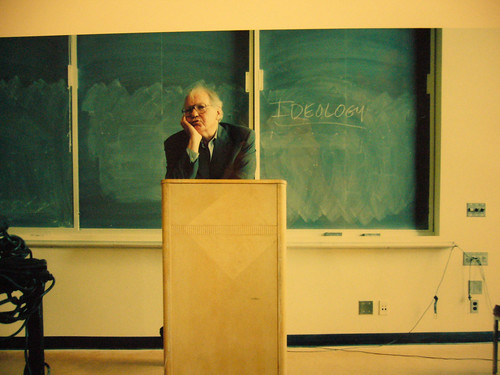
Photo by Hendrick Speck

In Memoires for Paul de Man, Derrida somehow claims that de Man's assertions about the materiality of language constitute "an original materialism:"

There is a theme of "materiality," indeed an original materialism in de Man. It concerns a "matter" which does not fit the classical philosophical definitions of metaphysical materialisms any more than the sensible representations or the images of matter defined by the opposition between the sensible and the intelligible. Matter, a matter without presence and without substance, is what resists these oppositions. We have just placed this resistance on the side of thought, in its strange connivance with materiality.
-Memoires, 52

The last sentence, which summarizes de Man's position, is accurate. But I might claim roundly (despite various problems here: "matter" might also have resonance with Sache; "original" obviously also refers to how this "connivance" is immediately afterward said to relate to history, 53) that Derrida just can't be sure whether de Man's notion of matter "does not fit the classical philosophical definitions of metaphysical materialisms." This is not because de Man's concept of materiality is somehow redolent of a particular metaphysical materialism. Rather it is because the strange connivance with materiality is not an assured connivance in de Man. Or rather, it is only that, a connivance--which takes place only because de Man is indeed so assured about it. And this can't be overlooked merely because de Man's definition of matter, while it might not fit the classical definitions of materialisms, also does not fit "any more than" what we might call one of those definitions (but not necessarily merely one of them--Derrida is reserving the possibility for the sensible/intelligible opposition to be articulated otherwise) which it may or may not resemble. (Derrida is working too hard here to allow himself a way out from de Man's claims. We can't let that act in itself constitute what he also is doing, which is trying to inflect de Man differently, to deconstruct de Man's text.)

In short, we might say that, even if de Man's materialism isn't a materiality of the signifier, it is a materiality of the mark or the letter. And for Derrida, there should be no way that this mark is material, if we're going to be in any degree respectful of, or at least responsible for, the history of that word (which is how deconstruction proceeds--in a manner I might even call too historical for my taste, despite the old inane charge of ahistoricicity brought by the historicists).

For Derrida--just to go over some basics, and in too simple a language--the mark is empirical, and to the extent that the empirical is said to grasp the material (which is already not assured), the mark is therefore material. But any time this mark is taken up, it submits itself to a power of repetition, an iterability, which is ideal and which actually disturbs any notion of materiality or empiricity that we have attributed to it. For when the mark becomes capable of repetition--indeed in proportion to the increase in that power of repetition--it its history is marked in turn as already capable of repetition. And this double marking, this marking prior to it becoming a mark, means that it has already been a trace of itself, and has indeed been capable of repetition otherwise than how it is repeated in being taken up, in being assumed, we might say. As such, the mark remains, in its "materiality," always already participant in some ideality. And the trace itself, the marking of the mark, has itself only to be the possibility of materiality, and is as such "ideal." I put quotes around this because it is, qua ideal, also and only barely ideal, if I can say this: Gayatri Spivak uses the phrase "minimal idealization," and Judith Butler uses the word I've already employed, "ideality"--each of which I think describes this trace in this context of the material/ideal opposition quite well. That is, the trace is ideal to the extent that in this context) we respect the fact that it cannot be empirically determined, and thus is not material, unless of course we conceive empiricism differently--which means, of course, conceiving matter and materialism differently. This, by the way, is how that empiricism can indeed be "radical" in Derrida--in a sense in which I alluded to in my comments to a previous post, and which underlies what I say in another post on Derrida and science (though I critiqued this notion of "radicalism," which I think can be thought differently). Or rather this is how empiricism can knock away metaphysics (presupposing this latter concept is taken in a rough Heideggerian manner). The point is that this "ideal" aspect of the trace, this ideality, can also equally be described by Derrida as a "nonideal exteriority" (Positions, 65): it disrupts the notion of the ideal that we have. But what is important here is that while the trace is a nonideal exteriority, it is also, therefore, not at all material.

In no way then, can the trace, as what disturbs classical philosophical definitions of matter, be said itself to be material in any assured way (nor, then, can the mark--if these are marks of violence, we precisely have to think how far materiality as a concept allows us to think such violence). It has to remain, on some level, minimally ideal (such that it can always also be said to be nonideal). So this means that when we try to think a materialism differently (which, as I've tried to stress, is also is tied to the project of thinking empiricism differently--but which can also involve rethinking dialectical materialism, say, where the material is not so linked to the empirical but rather to the opposition to the ideal qua Geistlich), and come up with a notion of matter that is "without presence and without substance," this matter has ideality, because it is a trace, the possibility or impossibility, of such a matter. In de Man, however, because the trace has ideality we have to say that it is material ("the only word that comes to mind is that of a material vision," "Phenomenality and Materiality in Kant," 82). And in no way should we say that this constitutes a materialism: it is in fact, precisely an idealism which Derrida, by insisting on ideality (a nonideal exteriority which cannot yet be said to be material), resists.

One should also add that Derrida takes up these de Manian issues again in "Typewriter Ribbon: Limited Ink (2)," inflecting them through his attempt to think materiality and spectrality together--that is, to think materiality otherwise, in Specters of Marx. His remarks there (which give body precisely to what he means by "nonideal") are much more adequate and interesting. I would say though, that to pull Derrida's nonideality more in the direction of the ideal can't really be insisted upon enough in America, where the trace is too often thought of as material--given the influence of de Man. In fact, what I'd say is that everything in the following passage on "materialism" and "matter" needs to be replaced with "idealism" and the "ideal," to also understand the particular type of materiality Derrida is talking about and how it would resist a de Manian materiality:

If have not very often used the word "matter," it is not, as you know, because of some idealist or spiritualist kind of reservation. It is that the logic of the phase of overturning this concept has been too often reinvested with "logocentric" values, values associated with those of thing. [...] This is why I will not say that the concept of matter is in and of itself either metaphysical or nonmetaphysical. This depends on the work which it yields, and you know that I have unceasingly insisted, as concerns the nonideal exteriority of writing, the gram, the trace, the text, etc., upon the necessity of never separating them from work, a value itself to be rethought outside its Hegelian affiliation.
-Positions, 64-65

Thursday, October 1, 2009

Critique and revolution

In what I won't hesitate to say is the single best essay I've read on Derrida, "Marx's Purloined Letter," Fredric Jameson says (I paraphrase) that Derrida committed himself early on to the idea that systemic change was the only change there could be, and yet that this change could itself not be brought about by any existing system. This makes his work resolutely political in a strange, irresolute way: it seems more about preserving the possibility for change than bringing about change itself, as if on the one hand he wanted to freeze in time that ("magic" I think Badiou recently called it) moment between 1960 and 1968, after the post-war philosophies and before the post-68 micropolitics, and on the other, constantly found new ways to unfreeze this possibility in surprisingly relevant ways even into the 21st century. His project is then extremely consistent because it focuses itself on a type of change that has that sort of afterlife within (or before?) its life. This also makes the sort of change it protects extremely (and, for many, frustratingly) hard to realize.

Zizek recently (in In Defense of Lost Causes) characterized current postmodernist discourse as the result of a crisis of Leninism. To me, he's beating a dead horse, more than surprising us with something we should have already known. At most, that is, he's bringing this crisis home to the most ignorant, those who have the most secret sympathies with postmodernism despite allegedly breaking with it long ago, and haven't realized this was true twenty years ago. Sometimes that's necessary of course. But it seems old to me because Derrida seems to see this from the get-go. Thus there is not only explicit resistance to the Leninism of his interviewers in Positions, but also a resistance to giving them any very stable alternative. The alternative is, indeed, that of "overturning and displacement," which he calls a strategy. What I'd like to suggest is that this move here, as well as that of founding an impossible science of grammatology (among other things) are indeed part of an effort to rethink revolution in a way that both resists the classical Leninist position, as well as the more populist-leaning plans one will find after '68, though Derrida has, I think, more sympathy with them. What people often called his resistance to Marxism was indeed a resistance to vanguardism--and, I'd say, to the way vanguardism can creep into postmodern attempts to bypass it.

Spivak said once that Derrida wanted to write a book on Gramsci, but assembling the fragments was so demanding he never got around to it. I have a feeling that the book would indeed be about socialist strategy, but wouldn't quite resemble Laclau and Mouffe's writings. Gramsci indeed offers the alternative to revolution, but not so much by abandoning class, as they say. Acting as if purifying Marxism of class will be a major factor in overcoming the Leninist vanguardism--which Laclau and Mouffe don't entirely do, but which ends up being the postmodern position in general, often using their theses as justification--really only just keeps vanguardism rumbling underground. It is only dispersed into micropolitics of various sorts, pockets of local resistance which we can only add up, or agglomerate. And this only preserves the idea that in the end it is revolution that is the goal.

What Derrida does politically, from the beginning, is challenge any notion that revolution can occur through such local struggle. At the same time, he affirms that what we can see, what we can adequately deal with, will always be local struggle--or will manifest itself only in those terms. So this cuts off the additive connection, and makes us think always about that particular "short-circuit" (to use a Zizekian word) between the local and the totality (and the other way around--how total struggle strikes to form local contradictions). This doesn't exclude reform as a possibility (to pick up the old opposition). Rather, because his position makes reform something less subordinate to revolution, something different than the failed revolution or total change, his position encourages it. The point, though, is that we lose any notion of direction, of leading, and of the agglomeration of small groups of whatever sort that would ultimately end in an overturning of the present order.

Thus there is an intimate connection between revolution and globalization in Derrida: the revolution of the circle does not exclude, but rather encourages, the notion that if we expand our horizons (rigorously excluding what falls from above or rises from below, the Zufall), if we expand our world, we will all, ultimately, be connected and lead together through some great change. In this way, thinking globally and acting locally becomes indistinguishable, at a certain point, from thinking locally and acting globally. Both these propositions pass into each other, but what we find out is that at this moment, each has lost its meaning--as one can see in various aspects of the "go green" "movement" which Zizek (I think rightly) finds disgusting, along with the other perverse attempts act as if multinational capitalism can be fought through consumption itself (though one shouldn't entirely condemn reform--that follows from what I said above concerning separating it from revolution). Somewhere the system, the totality, has been missed. And this is why Derrida wants us to think revolution differently, in terms of something like strategy which opens onto total effects which it cannot anticipate on a horizon (what he calls the invention of the other).

Now, this also means intense reading of the local--that is, activities that are usually involved in something like critique. Derrida wishes to get beyond critique (thus deconstruction continually opposes itself to criticism), but he isn't against reading (as should be obvious). This, perhaps, hasn't actually been stressed enough: too quickly he was seen as precisely a critic (see Foucault's famous remarks on him at the end of History of Madness, which accuse him of justifying something like infinite explication in old philosophy classrooms--which are weirdly affirmed in the U.S. as what "saves the text" by Paul de Man), that somehow was against the normal way of reading. Everything about this view must be reversed. Meanwhile, one can wonder (with Zizek and many others) whether, at this point, it is actually at the other end of the spectrum that we should be working: thinking, that is, on the level of totalities. The only thing that Derrida did in this area is something Zizek thinks is particularly postmodern: he thought that the experience of thinking a totality had to be something like Benjaminian weak messianism. Perhaps this is indeed postmodern (approaching something like worship of a God without being). But if you tie it back into the thinking of revolution, and the rethinking of vanguardism, we see its origins, at least, are different. Zizek would rightly say that we don't need anything weak right now. But what I'd stress is that Derrida gives us a weakness that is, when perceived against this background, something more productive than what Zizek and various Lacanians have their sights set on (that postmodern religion and religiosity--which I agree can be interesting, but is a weird and suspicious turn for things to take). And what this means is that he offers us a way where elements of the local, which take over the interpretive aspects of the critical, can be retained to fight something like the crisis of Leninism--which indeed ends up in that precise fatalist sort of religiosity (our local struggles can't do anything, our thinking of the global can only be weak, so we just have to keep doing what we're doing, which is emptily criticizing both the local and the whole system at once). For too quickly the call to think new total systems sees itself as opposed to not only criticism, but the activities involved in criticism--like reading and interpretation. What I'd argue is that this can end up being just another form of criticism, now empty of all of its content. Derrida gives us a notion that we can pull away from criticism by modifying its elements, precisely by making the total system bear upon them. If we have now discovered this also means thinking the totality has a relationship to these elements (partially because, with Derrida, we have blinded ourselves to the inner dynamics of institutions, the possibilities of reform within them that are not ultimately directed towards revolution, and focused continually on their forms of founding violence--the other side of the naive recognition that they are, indeed, organized organizations), and perhaps a more important role than this strategic activity, this is perfect--we're not then really claiming that we're giving up all that reading that is involved in making visible, and rendering strategic, the local changes (in other words that the changes will have, for us, local effects). Don't get me wrong: it's not that interpretation and reading are something really great in themselves. But I just want to make clear that there is a danger in renouncing them. This would be to continually convey, in writing and through reading, that giving up writing and reading means we're going to immediately start thinking the totality. And this, I'd claim, might only be the other side of a certain postmodernism (which, people don't seem to remember, specifically militated against interpretation--i.e. Foucault and his historicists), and it tends to creep into certain discourses now that suspiciously lay all the blame on critique, on hermeneutics of suspicion.

Tuesday, September 1, 2009

Problems

One interesting thing that I find deconstructionists do is reduce differance to an epistemological problem. This is so in both de Man and Spivak, though they both well know that this epistemological problem is also an ontological problem. Or rather, they know it isn't even that, since it is a pre- or post-ontological problem. In each case, we're trying to say that we've hit a sort of epistemological problem that is deeper than any epistemological problem, but actually can best be characterized or envisioned epistemologically, in an manner analogous to how we can deconstruct metaphysics by looking at philosophical texts--which at first sight looks absurd. Thus, it is the question of "epistemology," in quotes, or doubled, different. And in the case of texts, it is the question of how much, in each case, we are to provisionally generalize textuality. The latter question is the real one being interrogated, I think, in these issues regarding "epistemology," and insofar as it still remains interrogated, is not exactly a mistake or misinterpretation of Derrida. The real issue is whether transferring the problem of generalizing textuality--which I'll repeat, is the fundamental problem deconstruction faces--encourages us to dissolve the problem and presume it solved. (I'll mention that in my view de Man does indeed do this, to the extent that he almost does misinterpret Derrida by virtue of this alone, while Spivak doesn't.) Derrida often sticks to texts precisely for this reason. Whether his resulting insistence on the problems of textuality really does encounter that problem, well, that's a another (and indeed pressing) question. But unless one understands that this is what Derrida is up to, his reading of texts of philosophy will seem very odd, not unlike how Heidegger's reading of texts from the tradition (the most amazing of which is, of course, the book on Kant) will also seem odd. I think, however, a legitimate objection would be to why this process of reading went on so continually and so consistently, almost as if expanding the amount of reading in philosophy and its nearest neighbors would indeed insist on the problem of textuality (even though his claim is always that these texts are singular). In this case that other question I spoke of just now (the "pressing question" of how far an insistence on the problem of textuality encounters the problem, which is not unrelated to the problem of transferring the problem of textuality, as one can see in Spivak, who than rather going de Man's route does this), indeed arises.

Monday, August 17, 2009

Blindness, continued

Here's another (perhaps simpler) way to put what I was getting at a couple days ago concerning "The Rhetoric of Blindness."

De Man's criticism of Derrida is correct. Derrida, in Of Grammatology, ties the figural language in one or two passages in Rousseau's Essai, most famously the passage where early man calls other men giants, to a literal referent, fear (See Of Grammatology, 275-280: it is an extremely complex moment that needs to be reconstituted in full, not reduced to a paragraph or two as de Man does, and the most simplistic logic). For de Man, this involves a failure to recognize the figurativeness, the rhetoricity, of the figure Rousseau is talking about. But this criticism is only right from the perspective of someone who is invested in figural language as de Man, the literary critic, is. In other words, the criticism is only right from within the sphere of the literary, or is only right insofar as deconstruction will is seen as a discourse with effects and implications that are specifically (indeed, almost solely) literary. In other words, this is only right as long as you are going to speak of deconstruction as literary criticism, and deconstruction's effects as the effects of literary criticism when it encroaches on other discourses.

Why? Because figural language--or ultimately the rhetorical and fictional character of literary discourse that mobilizes figures--suspends reference, or rather requires reference to occur without a corresponding semantic effect, the production of a definitive meaning that you can say is true (or false) of the discourse. In short, it is what makes you talk about Elizabeth Bennett or Oliver Twist as real people, as entities with meanings, despite the fact you know them to be fictional, lacking any correspondence in reality--and what makes you wrong for doing so. Now, I'd be the first to insist on the unreality of these characters and the way that a metaphoric meaning, say, does not just take the place of a literal meaning. But I do so because this is what establishes a science of literature, or gives specificity to literary discourse as a discourse that is able to move past this complication and say something about the fictional or rhetorical discourse involved (in fact, it also allows me to situate a particular literary text historically, or refer it to reality, even more rigorously: when I actually do refer it to reality, I situate where the fiction takes place, instead of trying to talk about how literature refers to real events). I do it, that is, because this insistence on the undecidability of literary discourse with respect to its truth allows me to be more precise about the discourse that I analyze. I don't insist on this unreality because I believe it to be productive of the same thing that deconstruction brings about.

Deconstruction, in other words, is not the same thing as the insistence upon a difference between reference and meaning, or rather it doesn't assume this insistence will produce the entirety of what decontruction produces. Deconstruction might, when it approaches the province of literature, involve itself in this insistence (as Derrida does in Demeure: Fiction and Testimony, in a reading of Blanchot), but (and this is even the case in Demeure), it does not have to respect this distinction between the figural/fictional and the referential in the way that de Man says it should.

For de Man putting forth the distinction involves eventually "isolating" rhetoric "from its epistemological function," ("Epistemology of Metaphor," 49), or that indecision between the true and the false, and does so such that the distinction itself, if pressed, then actually resists this isolation. But this resistance, as it were, need not come solely from this distinction. This is why Derrida continually tries to pull the word "trope" from de Man's discourse and use it differently, most notably as a turning (not only of phrase). Seen in this light, the criticism of de Man seems is not as concerned with deconstruction but with literature, and thus, instead of deconstructing, "verges on establishing a metaphysics of rhetoricity," as Frances Ferguson puts it (Solitude and the Sublime, 53, note 8).

This is at once to recognize the immense achievement of the de Manian appropriation of Derrida: it suddenly gives you a mode of achieving critical effects that align with the project of deconstruction which are specific to the study of literature. That is, they don't have to start using the same concepts as Derrida, and looking for dissemination in King Lear. This is the origin of the 1975 battle between Joseph Riddell and J. Hillis Miller (see the latter's review of the work of the former, "Deconstructing the Deconstructors," and the former's reply to the latter, "A Miller's Tale," in the summer and autumn issues of Diacritics). Both Riddell (who writes against de Man) and Miller (who writes for him) miss the point and refuse to recognize de Man's achievement.

At the same time, it is to recognize that these effects are indeed an appropriation that, as I said last time, get at the same thing as Derrida, but precisely by seeing it as the same thing, as something that is not (as it is for Derrida) a continual problem calling for different inflections, or rather (as it is not for Derrida) a problem that stabilizes itself quite easily. (However, I should say that sometimes, when de Man says "Derrida's thesis" is "precisely" "asserting the priority of language over that of presence," I have my doubts the same thing is even being got at, since this like a huge misreading of what Derrida is doing. See "The Rhetoric of Blindness," 119.)

This is what Gayatri Spivak was getting at when she said (in a class I attended, and probably in others) that Derrida is whoever you want him to be. If you are a psychoanalyst, he is a critic of Freud. If you are a critic of Mallarme, god save you, he is the best of those critics. It is an insightful comment because it lets you recognize there is a world of difference between this statement and what de Man himself says, which is that Derrida is blind, as a critic, to Rousseau's text and misunderstands it, while, at the same time, "Derrida's version of this misunderstanding comes closer than previous version to Rousseau's actual statement because it singles out the point of maximum blindness the area of greatest lucidity: the theory of rhetoric and its inevitable consequences" ("The Rhetoric of Blindness," 136). And it makes me revisit a statement of hers that I criticized a while ago but of which I now approve, if it is understood as applicable only within the problematic that I am here trying to sketch (as it is not always, I think, by Spivak):

The aspect of deconstructive practice that is best known in the United States is its tendency towards infinite regression. The aspect that interests me most, however, is the recognition, within deconstructive practice, of provisional and intractible starting points in any investigative effort...
-Gayatri Spivak, "Draupadi" in In Other Worlds: Essays in Cultural Politics, 246.

It goes on to talk about these starting points as recognized "complicities" ("...intractible starting points in any investigative effort; its disclosure of complicities where a will to knowledge would create oppositions...") and there I do believe my criticisms apply--in fact for the same reasons that I am outlining here with respect to de Man. Derrida at that point becomes a political thinker, or appropriated to political discourse as it is articulated in the project of critical theory, just as for de Man he becomes a literary critic or literary theorist. This fate of Derrida, to be appropriated--and most oddly now appropriated by philosophy--isn't so much because his ideas get perverted or misunderstood (indeed, as I'm saying, de Man is understanding them and getting at the same thing), it is just that what is continually a problem for Derrida keeps getting solved. Now, this doesn't mean it is unsolvable. It in fact means that efforts to assert it is unsolvable end up solving it--while for Derrida (most of the time: he too succumbs to this) they don't.

Monday, February 9, 2009

The cultivation of irony

In my last post I was basically saying, underneath it all, that one of the most important things literary criticism can do is serve as the chief locus for the cultivation of irony (by which I mean, very broadly speaking, the general experience of things as having more than one meaning, or saying something different than what they say--which can mean, even more generally, possessing a little distance from the sincerity and literalness of what one says when one says it). But this presupposes something else: that the cultivation of irony itself is one of the foremost ethical demands in our society. And I pretty much firmly believe this: one of the big things we have seen in the last thirty or so years, after the rise of a certain theoretical criticism that privileged irony (and was the expression of a more ironic attitude in America as a whole, after the 60's), is that irony is actually something that is very hard to sustain.
Year after year, we keep hearing that the end of irony has come, and this announces not so much that irony is dead, but that our ability to sustain it and its constant demand to achieve a little healthy distance from a situation is something we've grown very tired of and would rather just put away. The last few years indeed have seen a huge preference for wholesome, dangerously serious discourses that people can just consume and be done with: Republican patriot rhetoric of the Bush years and (to a lesser extent, especially when it is seen as the rising up of a minority which brings irony back into it) the Obama rhetoric. What happens then is not so much that we get a set of people with staunch beliefs that won't talk to each other (fundamentalism) but that when these people do indeed talk to each other they lose the ability to also actually express what these beliefs entail: in short, they paradoxically lose their ability to demand something of the other person--especially without being backhanded or resentful (slavish, in Nietzsche's sense) in doing so. (This talking together, I should note, also happens much more often than those who too quickly make belief into fundamentalism would like to think--Stanley Fish being one of them, however much he seems to champion "belief").
So sustaining irony, keeping one's commitment to it, making it something that is cultivated (and indeed this is a most Nietzschian task--cultivating that which precisely and as such resists cultivation) and able to reassert itself steadily--this is what we in reality need more of, precisely after the 80's and such (also because it is so present not just in elite circles, but, more generally wherever there is this belief that I'm talking about). For what I'm saying is that what we see in our being tired of irony is really a growing ability to take irony as serious--which is counterproductive and in fact dangerous because it exploits irony while attacking it (Republicans have increasingly become masters of this--but also theorists, as we'll see). In other words, this doesn't take irony seriously as irony, but transforms irony into seriousness. It folds back what was a difference into precisely the discourse that it has achieved its distance from (unlike the folding back of close reading that I talked about).
In criticism, this manifests itself in the horrible move that is precisely that folding back of the speaker into the position from which he speaks, so as to show how he is complicit in what he speaks about (its a trademark of serious discourse that it takes things--here, even the mechanism of turning irony into seriousness--too literally). This is generally a very de Manian and deconstructionist-Marxist move, but it can happen everywhere (so Fish will fold back a speaker into his disciplinary position, which will always contradict whatever the speaker says). You know what I'm talking about. So in a class the other day we were discussing Derrida and political activism, and someone said that Derrida's discourse, which questions the possibility of activism rather than engages in it pure and simple was a nice thing, but could only happen because Derrida himself was a comfy professor, without any need to get in the streets and fight. What makes Derrida radical as concerns activism can therefore only be accomplished by being someone who doesn't need to know a thing about activism. You see what's going on--besides the remark being false (as the professor pointed out). The sort of ironic position of Derrida (who I'm just using as an example), which is to take up activism by questioning its possibility in the first place, is folded precisely back into a secure and stable notion of what activism is, and, as a result, what happens is that one takes Derrida's ironic position as a serious position. What is the result of this move? You expose the person as a hypocrite! Ooh, interesting--but pointless, because what you see is that they are still hypocrites only on your terms, which are precisely terms that have no sense of irony.
I hope it's clear that I'm not talking so much about Derrida here, but that something that needs to be understood in terms of irony is understood in terms of seriousness--which of course will expose the irony as contradictory, complicit, and hypocritical, because it precisely resists the notion (and practices) of serious discourse. Frankly, a better example is Frederic Jameson, who always, always takes an ironic discourse in terms of how serious it is. The noble thing about Jameson--and the thing that really makes his mode of meta-critique something to keep, rather than, like so many other instances of this same move, something that should be totally, remorselessly, given up--is that he does not do this in order to expose or show anyone to be a hypocrite. That has to be kept in mind--one really can't understand Jameson without knowing this (and I think many of these serious people--Spivak is one of them, cf. her remarks on Jameson on her Critique of Postcolonial Reason--read him this way and find in him confirmation of what they do). It is indeed what makes his discourse deserve the name of a dialectic. But the thing is that the move he makes to bring this about is something that essentially, as it is constituted, does not need to be deployed with these aims: this is evident in precisely the sorts of misreadings it often produces--which work in the context of the books he is writing, but which as readings totally misrepresent whoever they are talking about. So he reads what Deleuze and Guattari say about anti-hermeneutics as precisely something hermeneutical. This would be fine perhaps if it acknowledged the irony of what D&G say, but the mode of the folding back, of the establishment of complicity, does not allow Jameson to do this. So we get what D&G say as something without the possibility of irony, as something that is totally serious, which will in fact ensure the success of the move of folding back that Jameson effectuates:

From the present perspective... Deleuze and Guattari's proposal for an antiinterpretive method (which they call schizo-analysis) can equally well be grasped as a new hermeneutic in its own right. It is striking and noteworthy that most of the antiinterpretive positions enumerated... have felt the need to project new "methods" of this kind.
-The Political Unconscious, 23, note 7

This may be right, but you see that what is lost is any force that the quotes around "method" can have: the putting in abeyance of this term, which precisely seeks to account for the ironic status that any hermeneutic would indeed have in D&G, is a totally empty gesture. This is because it already takes their standpoint as complicit in an interpretive enterprise--in short, as serious. It's done simply to be accurate (consistent to a model that is already interpreted as a serious model, as something that needs consistency). The gesture that irony uses perhaps most--the putting in quotes--is turned itself into something serious. This you will find all throughout recent theoretical discourse, and it contributes, I think, to the real shabbiness and real nonpertinence that theory in particular is suffering from. (A look at this in particular would have really proved my point, since it is this sort of gesture of folding back and complicity condensed: its like seriousness-from-concentrate.) A whole generation of theorists puts things in quotes seriously--and that this is so announces such a gigantic failure of theory in particular to live up to what its possibilities were that it should concern itself henceforth with the sole task of annihilating (by the invention of new pedagogical tools) this little move that establishes complicity everywhere it appears and reestablishing the force behind the quotation marks. But this entails our discipline generally recognizing that these possibilities, however, were not the sole province of theory, but are ones that reach across the whole of literary criticism, and have their foundation in the possibility of cultivating irony.
(I should mention a merit of irony: that it isn't self-consciousness. This is what makes it, actually, very compatible with belief. But at the same time it opens up belief to self-consciousness. It is as if irony is a sort of middle-ground between the reflexiveness of self-consciousness on the one hand and shame on the other. But it's significant that current theorists of trauma and shame--Sedgwick, Leys, others--don't move towards irony: it seems that they want to in fact kill off irony and self-consciousness in the same gesture, which is establishing a very serious discourse which can account for ironic self-distance in terms of unreasoned violence and affect. This might be interesting, but it conveniently forgets that irony also implies an affective state of perplexity, frustration, and embarrassment that is not unlike shame. It might be more important for them--for both genuinely ethical and facetiously moralistic reasons--to keep the focus on serious violence.)
(I should also note that my mention of Marxism specifically above is a bit bitter, no doubt. But this is because Marxism is perhaps the most gravely serious and moralistic of discourses in the academy. Nevertheless, what is interesting is that it also contains the most condensed form of the move of folding-back a speaker into the position he speaks from. This is precisely why Jameson does it: he is a Marxist. And what this means then is that Marxism has the most to gain from cultivating its irony. Please don't take my remarks above as a blatant call to throw away Marxism, then: in fact, this is what many in the academy are doing. Rather, we need to cultivate a distance to Marxism as Marxists: what I would call for here then is a resurgence of the role of Marxism in the academy, but precisely one that learns how to make this move that it makes into the ironic principle of its operation and not its mere tool for resentment. An ironic Marxism: that would be the most profitable element in the work to cultivate irony, and it should be a part of our future.)

Monday, January 5, 2009

Against the New Aestheticism

Perhaps one of the biggest things we're suffering from now in Anglo-American literary criticism is how little we know how to handle a post-hermeneutic mode of interpretation. That is, as we gather more and more of an idea of what post-hermeneutical criticism would actually look like, we are, at the same time, losing a sense of how older critical devices can be turned towards this new form of criticism (or how we can invent new devices out of old ones). In other words, it doesn't take as much effort as some people might think to use a device in a post-hermeneutical way. So what is betrayed is not a lack of knowledge about what interpretation would be like without hermeneutics, but a lack of knowledge about how this new interpretation really is already at work in many ways in what we do already.
We generally know now, I think, that there are several forms this post-hermeneutic interpretation would look. The clearest example--that is, the one that is easiest for us to wrap our head around as far as how its post-hermeneutic operations look--is a sociology of literature: here what is at issue is nothing about the meaning of a text, but how that text fits into a system that produces that meaning as an effect of its (the system's) operation. It does this little switcharoo, however, without trying to say that the system is any more viable a source of meaning than the text: this is what makes it less hermeneutically invested--it doesn't try to find a real sphere where meaning originates. The post-hermeneutic act of interpretation, then, is in the laying out of the system. Franco Moretti gives us some very clear examples of what this work of elaboration can involve: making graphs or maps of data (how many copies sold, where, how, etc.) or just simply the explanation of the paths between these pieces of data.
What Moretti doesn't tell you, though, is that we do this already, sometimes, in hermeneutic interpretation. We just don't emphasize it, or really work on it for its own sake. When I write an essay about a book, I organize whatever I find out about it. A lot of the work of my hermeneutic effort depends on this organization. But I eventually use it for hermeneutic ends. And because I do so--and here is why my hermeneutic effort will look a lot different than Moretti's--I confine myself to the work that exposes sites of meaning. And these tend to be internal to the text (or intrinsic, to use the old term). And even when they are extrinsic (sales figures, etc.), they tend not to extend themselves out into networks that aren't subordinated to the intrinsic work of the book. They therefore don't give us a wide ranging study of the networks themselves--studies like Pascal Casanova's.
But this presence of the post-hermeneutic in the hermeneutic should be kept in mind, I think. For what happens when this isn't recognized is you get post-hermeneutic critics trying to just pick up the hermeneutic devices without caring about how they have to modify them to be post-hermeneutic. In other words, they just use all the old devices and say they are not unlocking meaning with them--and in a lot of cases, we just have to take them on their word that they are doing this. This is how that odd phenomenon that I will call the New Aestheticism--a phenomenon that is catching on--works. New Aestheticist critics (I have Michael D. Hurley in mind, but also bits of Stanley Fish and even Eve Sedgwick) use certain ambiguous but old and commonsense categories like "feeling" or "pleasure" (as in, how does that poem make you feel?) to try and 1) integrate these maligned phenomena back into the work of interpretation (which is laudable) and 2) make these phenomena into a sort of unmeaning excess that is the only point of the text. Not only does the second aim completely undo what would have been the laudable aspects of first (it effectively maligns affect yet again--and I think this is pretty unforgivable, because at the same time these people act as if their crusade in the name of affect makes them a morally justified), the second point really misunderstands what post-hermeneutic interpretation is about. That is, the second point proceeds as if post-hermeneutic interpretation is only the act of pointing out that the only meaning of a text is a non-meaning. In other words, the Aestheticists think that if you come up with a sort of moment where what is at work is something vague (unelaborated) like a pleasure (individual or collective), and then say that all the text does is produce this, you've canceled out any particular hermeneutical work you've done along the way--and that this cancelling out is the goal of post-hermeneutic discourse. But it's evident that this isn't really talking about pleasure (it's talking about meaning) and it isn't really post-hermeneutic, because it doesn't--like the graphs do--use any devices as post-hermeneutic devices. It uses them as hermeneutic devices and then tries to subtract their work.
The real problem would be precisely finding out how these old hermeneutic devices look when they operate in a post-hermeneutic way--and how they have to maintain themselves to keep working, i.e. what demands they make or compromises they have to bring about on the part of the critic. This is what I find in the work of some (and only some) deconstruction: in this area, we have close reading without its hermeneutic goal--close reading that doesn't bring out any meanings but instead organizes a text differently than before. To think about the micro-elements that make up this work of reorganization, and how they must work if they themselves do not produce meaning--this is what deconstruction is, and what makes it a neat site of (still pretty intrinsic, unfortunately) criticism that tries to negotiate these problems, not run away from them.
Or rather, act like it is too in the right to deal with them. For the real bad thing is these New Aestheticists have the gall to attack other post-hermeneutic modes of criticism: they yell at the New Formalism, which has these post-hermeneutic tendencies (especially when it becomes Derridian), and against the sociology of literature people. This is partially because the New Aestheticism becomes merely intrinsic again, shutting itself off from a lot of "statements about society," as it might call the result of these other forms of interpretation--while modestly claiming that it wouldn't presume that it was able to say anything with that weight (when it is in reality presuming twice as much and is half as moral). Most often, though, they yell at "theory." Theory--and what to them is its sidekick, cultural criticism--was nothing other than the subordination of post-hermeneutical efforts (the work of Derrida, Foucault, Lacan, etc.) to hermeneutic ends. Theory is the mistake that the New Aestheticst's approach will reverse by focusing on more traditional, but more overlooked (in the recent years of theory's wildness, particularly due to its fascination with politics) elements of the text.
I'd contest the idea that theory worked this way, however. This seems only to describe bad theory--which is just bad literary criticism in general. Theory might have worked precisely as a way for people to organize their ideas in a post-hermeneutic way. It did this not by actually carrying out what the post-hermeneutic authors that were its progenitors (Derrida, etc.) were saying, but it sort of met them half way by deploying something similar of its own.
For when we talk theory, we are usually describing something we could talk about in a different way. Theory is a sort of shorthand, in most cases, for concepts of interpretation that are often different than those of old (those of the New Criticism). I might say that the particular moment in this text reminds us of Lacan's mirror stage, which I would then outline... and this would be a theoretical remark. I can even use one theorist and then another: the mirror stage can be imbued, here, in this textual instance, with a sort of Foucauldian power... This is the way theorists often talked, and often confused ideas--as the New Aestheticists would say. I'd say instead that while this was a confusion, it was doing something more as well. This sort of shorthand allowed one to proceed more and more without reference to meaning insofar as it originated in the text itself. One could be led, then, from theorist to theorist--submitting the text to the play of this sort of parallel interpretation that was going on. For what happened was the theorists would be elucidated with respect to each other, fit together in new and interesting ways. Or at least one theorists ideas, reified by this process, would be made to work in odd ways that perhaps, if they were submitted to some ideal of systamaticity (or even to the rules of organic, philosophical thought, which theory does not follow), or even to the rest of the system from which they originated, would not have occurred to anyone. In other words, what happened was that the text got related and referred to a discourse that was developing alongside it. And what this did was pry away the interpretive effort from the hermeneutical effort in the first place. This is what theory did, I think, and it is the only way that a more rigorously post-hermeneutical discourse can now (in the Anglophone world) be taken up. Theory, then, was a post-hermeneutical modification of one of the basic tools in the hermeneutical toolkit: the reference to an authority, usually philosophical. This work of reference was made to work in and of itself, and forgo its capability for elucidating the text. The authority would then merely cohabit the interpretive essay with the text, and at this point--though it also was sustained by a huge academic regime, and this I would say was a very bad step--would be working out what interpretation was like without opening up a meaning in the text.
So far from being a mistake, theory was what makes the discourse of the New Aestheticists possible, and may have even operated in a similar way to other forms of post-heremeneutic criticism. What it didn't do, though, was make the post-hermeneutic use of interpretive devices seem easy, which is practically the only thing the New Aestheticism does (although I'd say this only of some theory, in the end: theory also did this, and thus actually made possible the New Aestheticist fascination with canceling out its hermeneutical work--just look at Spivak and her fascination with writing under-erasure and you will see this is the real goal of that erasure). The focus on pleasure, the focus on the excessive feeling that a text gives you, when this is considered as non-meaning, does not give us anything in itself. As I said, it even erases what is left of any conception of pleasure that we have--and it is dependent upon preserving the ambiguousness and thus the maligned and ostracized status of pleasure. (So to the idea of pleasure or feeling that this criticism employs must be opposed, precisely, Raymond Williams' idea of structures of feeling--an idea that has affinities with a sociology of literature.)
Allowing a mere descriptive work of interpretation, a phenomenology without a point (phenomenology's strength is that it invokes the ideal, the invisible), this New Aestheticism should be avoided. Above all, it forgoes the need to explain more what is theoretically advantageous about its conception of pleasure, or even to look into its origins (Hurley, for one, is completely anti-scientific and would resist this project). Without a more elaborated notion of what pleasure is, about what will be cancelled out by the work of the New Aestheticist criticism--and, for that matter, the work of cancellation itself, which is merely effected by the reference to a vague notion of pleasure now--all we have in the end is one of those old vague analyses of style, or, even worse, something like a book club. It is not that literary criticism has to be submitted to the rigors of scientificity--and this is really what the New Aestheticism rejects, not hermeneutics (but passes its opposition for the former off for opposition to the latter). It is just that what this idea of scientificity allows is rational discourse, discourse that is sustained by discussion and by the articulation of points. And this is not in opposition to a post-hermeneutic project. The idea that it is, that we can only have a discussion that operates post-hermeneutically if it is not submitted to the rigors of articulated discourse--this is what is at the heart of this turn back to the excess of (this made-up and unstructured conception of) pleasure, of feeling.

Sunday, September 21, 2008

The status of his writing

I’m interested in the recent language that we have been using to introduce Derrida, to make beginnings into explanations of him. It rarely describes what he does. Rather, we are introduced to a set of statements about reality—a point of view, in a word. Rarely do we actually start with something about his writing—unless it be either something about style or difficulty, interesting topics in themselves (though I think we’ve also seen a recoil even from this question of style, which once seemed a more popular topic). At most we might get something like, “Derrida produces a reading of a text.” To write like Derrida would produce a reading—of a philosophic tome, of a political situation, of whatever. But what does this mean? Well, then we get into statements about what the reality of the situation of reading is, which becomes a discussion of the historical subordination of writing under speech, etc. etc. Very rarely do we get a really cogent introduction to Derrida that just tries to tackle the problem of the status of his writing, such that it could say—and I mean say significantly, not just something about how you want to sound—you can write, you can analyze, perhaps, like this. No doubt this is because starting with writing would much be too abyssal a beginning—our conception of it is so determined by Derrida himself (and so disruptive of the notion of "status") that you wouldn’t be able to say anything about it with any sort of critical or even explanatory distance (not to mention accuracy). But what concept or word in Derrida is not like this? And how many introductions begin like this anyway? And so why not begin here?
Maybe this was how things were introduced in the 70’s and 80’s, I don’t know. This of course is the great understanding of Derrida’s writing as a method—deconstruction. But even then, it is hard to see even this idea of deconstruction as saying something about a mode of writing, as a set of remarks with a certain singular status. If deconstruction was mistaught as a method, as the story goes, why do we still have trouble describing the status of the remarks that it produces? Why do we so quickly go towards what it does to the texts it rips apart or inverts or whatever? Doesn't this lend credence to the idea that this misunderstanding was also an attempt to get at what we're also failing to get at now?
This brings me back to the best description I have of this status of Derrida's remarks. Gayatri Spivak said (and she has told this, I'm sure, to many students) working like Derrida is “acting as if you are writing the text you’re reading.” This doesn’t tell me so much about how to go about this as it does about the state of the analysis. All the weight falls on the “as if.” What would it be to write as if you were the writer of the document you are looking at? This means obviously that you write both as this writer and not as this writer—you’re somewhere in between the thing you are analyzing and the position of the reader that you imagine you are in. But it also means that this "in between" is the nature of the words themselves that you produce: the writing you make is only this “as if.” It is only this "as if you are writing the text you are reading:" it doesn't seek to be either a writing about what you are reading or a writing that is a direct extension of what you are reading. In other words, your writing is purely this odd relation to the object that is not coming from your position as a subject: it has no source and no destination, and yet it is both emerging from somewhere and heading somewhere. Thus, it has the status (or non-status) of an inscription: a reading that is also a writing, a rewriting, or what Derrida called a long time ago "the difference of a hermeneutical effort" ("Violence and Metaphysics," in Writing and Difference, 80).

Monday, September 15, 2008

Against "complicity:" or, theory after criticism


The aspect of deconstructive practice that is best known in the United States is its tendency towards infinite regression. The aspect that intersts me most, however, is the recognition, within deconstructive practice, of provisional and intractible starting points in any investigative effort; its disclosure of complicities where a will to knowledge would create oppositions; its insistence that in disclosing complicities the critic-as-subject is herself complicit with the object of her critique; its emphasis upon "history" and upon the ethico-political as the "trace" of that complicity...
-Gayatri Spivak, "Draupadi"

Everything in this remark needs to be opposed. It is not that the aspect of "deconstructive practice" that Spivak brings out here is not an aspect of what Derrida is constantly talking about--that is, the remark does not need to be opposed because it is a misinterpretation of what Derrida said (a useless fiction, especially in this case). It needs to be opposed because it takes what Derrida says and grafts it onto a logic of complicity. Before we get into what "complicity" means here, we have to remark that even the graft is not in itself bad: this is not a logic that is foreign to "deconstructive practice," indeed (as many remarks of Derrida himself testify). However, it is clear that the logic of complicity is one that relies upon concepts that this practice from the get-go disrupts. In short, Spivak wants to act as if this graft works only one way--for her it is the "positive" aspect of "deconstructive practice." But in grafting this practice to this logic, the logic is necessarily disrupted by the practice. Complicity is not the end-all, be-all of this "practice." It is, therefore, precisely what cannot be totally "disclosed," what can work as a "starting point" for analysis.
But what is this logic of complicity? Why does it contain that which this "deconstructive practice" disrupts? Well, we can see what Spivak says: the complicity is like a point, a point "where a will to knowledge would create oppositions." It is that which her practice (I'll refer to "deconstrutive practice" this way, indirectly, as Spivak's practice, since I find the phrase awkward and misleading) discloses. But shouldn't we be suspicious of any assertion that said Derrida was trying to effectively disclose something? Or even that what he did in effect, as a byproduct, disclosed something? Disclosure in Derrida is interrupted as soon as it begins. Now, Spivak is saying that we should pay attention to the trace of this disruption--this is what is amazing about her practice to her, and what constitutes that point, that "provisional" "where" with which to begin furthering her practice along. And this would be right, except that she thinks of this trace as a trace of complicity. And here everything goes awry. Again it is not an issue of whether this is wrong--Spivak is usually always technically right, which is why she is hard to criticize (and so resistant to criticism)--but about how the particular way this being-right is colored, such that, if it were taught or disseminated or overheard--and here is the crucial point, the crucial point in the history of the interpretation of Derrida in the United States--it would be misunderstood. One can say this is just moving the accusation of misunderstanding one step back. Perhaps this is right. But that would be precisely to overlook what is historically significant about the transmission of Derrida in the United States: the fact that it was taught precisely as what could allow students to find in texts points where Western discourse was complicit in atrocities. In short, it is what allowed his theory to become criticism.
Now, I am saying that we need to oppose complicity as a logic with which to interpret this theory of Derrida's (one that is not even totally a theory, and what I say only has a weak relationship to other theory--however, I keep calling it this because the conclusions here might indeed apply to theory in general in the US). I don't personally assert this, either: it is where the theory is already going in America as we speak. Doesn't this mean extracting and extricating the theory from criticism, then? In the end, I would say, yes. The theory has to cease its critical function, which is precisely a pragmatic function of finding complicities. Only then can it become theory--that is, a theory of those complicities, whatever they may be. And insofar as this is the case, it is only the case for criticism understood in the most boring, colloquial sense of the word: that is, as a statement with negative value judgement implied. Insofar as this is an argument for theory after criticism, it is also an argument for criticism after criticism.
This is not to say that this theory or criticism would be a discourse free of complicity: it means, however, that theory would not become, as it has in Spivak's case--and, I would argue, Zizek's (though he is getting better--one might summarize this whole effort of opposition I am arguing for under his motto, "forget, but never forgive") as well as Stanley Fish's (also Laclau, in a big way)--theory would not become primarily the effort to avoid those complicities. One can fight to free theory from criticism and move it towards the realm of description (which is what I'll call theory sans complicity for now), without it also extricating it from any complicity it might participate in. The difference is, however, that this description does not confuse what it describes as something that is "disclosed," or "recognized." In short, it does not make the mistake of thinking that the only form of working against a bad situation--whether this opposition be ethical, political, or whatever--is looking for and pointing out its complicity. Political opposition, for example, without this pragmatism would be precisely that criticism which we are saying is after or beyond criticism.
Perhaps most important, this description would not see what is described as a "starting point"--opposed, that is, to something that isn't. We would get the feel for how what Derrida says is precisely a trace that allows no pragmatic way of orienting oneself to it. With respect to "deconstructive practice," this means rediscovering in it precisely that "tendency towards infinite regression" that Spivak dismissed. It remains, I think, to be felt in the US--we have been too busy with historicist studies and politics. History and politics, as well as ethics, might only be able to really be addressed if we make this felt or at least widely and in a dim way sensed.

Sunday, August 3, 2008

"Not less, but more theory:" Jameson and pragmatism

Fredric Jameson has an excellent article in the Spring (2008) issue of Critical Inquiry which I just got around to reading, and it makes a lot of points that I have been trying to orient myself towards accepting here on this blog. While the article "How Not to Historicize Theory" responds mainly to Ian Hunter, its concerns actually never leave that of Jameson's continuing task: trying to extend the theses advanced in his work on postmodernism and utopia into the most pressing concerns of theory at this moment. This culminates in an amazing look at Bourdieu and a clear-headed rebuttal of the impetus behind pragmatism (which is anything but pragmatic).
If I have been hard here occasionally on people like Spivak and deconstruction, on the one hand, and, on the other, people like Jerome McGann or Stanley Fish and historicism (and the people don't exactly have a direct relationship to the movements here--as I will explain), it is because they all end up arguing from within theory for less of it, a position that Jameson shows here to be quite wrongheaded. This position is not wrongheaded because it is contradictory or hypocritical, as I have (I now see somewhat mistakenly) put it. It is wrongheaded because it makes theoretical endeavors attempt to do away with the types of conversation that theory valuably has started. In other words, this position is pragmatic, if not nihilistic. Now, I don't mean that pragmatism is nihilistic--far from it (I think its one of the most idealistic discourses). I mean that pragmatism--which can be summed up crudely as an effort to find and work within limits, to refine discourse by disabusing its pretensions to truth as correctness--too quickly gets confused with a nihilistic bent which is not pragmatic that nevertheless underwrites pragmatism's efforts. To be a bit clearer: what is desired by people like Spivak or Fish is, at the same time, to set an effective limit for discourse beyond which it is fanciful and has no relation to forceful, meaningful activity (including its own), and to somehow counteract the tendency in theoretical discourse to extend itself out into those fanciful areas. The first effort is pragmatic, the second is nihilistic. And while it is not necessary at all that the second effort occurs at the same time as the first--Rorty is a good example of someone who rigorously keeps the two separate--it usually, in the area of theory, does. It is no mistake that all these recent conferences on "The Death of Queer Theory" or "The Death of Post-Colonialism," in seeking primarily to limit a discourse healthily cannot do so except by talking about its being over with, its being ineffective--and not in the sense of being simply inaccurate, but somehow not even worth anyone's letting it exist anymore. Jameson distinguishes between these two well I think by calling this pragmatism conspiracy theory, and this nihilism cynical reason. The two have a methodological commonality, which is a hermeneutics of suspicion: they think that the effort of interpreting actions or documents or whatever boils down to looking for the pretension to truth at work. This pretension is what gets limited by conspiracy theory or taken away to be killed off by cynical reason.
The threat that makes these people and these discourses do this, as Jameson makes clear, is historicity, or what he calls historicizing. This should be rigorously distinguished from historicism, which tends to be in Jameson's eyes (but does not have to be, like deconstruction) one of those pragmatic conspiracy theories. When a discourse becomes capable of having its conversation recede into the past, and has to confront the fact that it has contributed to the larger structures of the institutions and fields that constitute the position from which it speaks--that is, when it begins to have to take into account how it ensures for itself the right to a discourse, it becomes very skeptical as to whether it can still remain pure. What is problematic for both historicism and deconstruction is that their purity was ensured by their anti-intellectual stance--that is, their critique of the continuous and homogenous narratives and knowledges that dominated their discipline before they arrived. Historicism's solution to this is to generally fall back upon the disciplinary framework itself--which usually makes it appear less cynical or nihilistic than it is--while deconstruction's solution is to insist more and more on the rigor of its method or the radical nature of its politics--which is the same thing as falling back upon the disciplinary framework. Now, this isn't as simple as merely claiming that these discourses are getting a taste of their own medicine--which is to say, that they are confronting the fact that they as discourses only have impetus because they are founded on what they oppose. It is showing that faced with a contradiction, both these discourses don't think that expanding their theoretical practice more and more would produce anything worthwhile--namely, a collective discussion. In short, Jameson's claim is that both these positions have the effect of advocating a sort of resurgence of the individual intellectual, the scholar-hero, the expert. Now, there is nothing wrong with being an expert, except that in the effort to diligently become one, the expert or hero sacrifices the collective interest, the fact that scholarship is also about discussion. That is, what is advocated by these positions is that each of us recede back into our own projects and confront each other when we are done with them, which is, in Jameson's view (and I agree with him wholly here), precisely what is not needed in scholarship that will have to confront the 21st century and its demands. What we need is some sense that we are all speaking, as a discipline, some similar language. What both of these discourses--and mostly these people at the front of them (we should be sensitive to the fact that at this level there are so many exceptions to anything anyone says that the generalizations are usually always unfair--though I don't think this renders them illegitimate, precisely for the reasons I'm outlining now)--what both of these discourses advocate is stepping back into our own private vocabulary.
And this is what is really confusing about them as positions and what makes them more than just instances of hypocrisy or self-hating or getting-a-taste-of-one's-own-medicine. For these discourses started out closer to the pragmatism of conspiracy theory. As such, they usually took the form of identifying large collective interests at work in individual decisions or in the determination of the individual. What this allowed was some sense that there were larger forces at play in all our actions. Thus, there was a hope at least that one could work at the level of this larger collective interest to make things better. The exposure of a collective interest was made in the spirit of changing collective interest. What happens in the sort of cynical use of pragmatism is that we think that we can critique these collective interests by ourselves. Indeed, these acts of exposure (deconstruction, historicism) were, it is now clear to us, not themselves disinterested. So why not face up to the fact that the best work we can do is going to be on the level of individual interest, dictated by the demands of the profession we have now--alas--shaped in our direction? This is what Jameson is describing in his conclusion:

Insofar as conspiracy theory celebrates... collective dynamic and seeks to replace the categories of individual agency with collective ones, it marks the first imperfect step in that direction. Cynical reason, meanwhile, while seeming to strip acts and events of their appearance of disinterestedness, might well pave the way for some ultimate awareness of collective self-interest as such.
-"How Not to Historicize Theory," Critical Inquiry, Spring 2008, 582.

This is not a happy prospect. It describes a crisis. For we should not have to recede back into our own individual works of scholarship in order to see that, in the end, what we really need is some sense of collectivity. This is why we need more theory, precisely in the time in which theory itself is being historicized. We can discuss, together, the historicization, which would give us a sense of where we are. The idea that theory is confused is probably a myth still perpetuated by cynics: it has an immense vocabulary to deal with all sorts of novel ideas--and if there is confusion, why can't it be discussed? Or at least, why not risk that this is the case? We have to dispel, perhaps, first and foremost the idea that theory is muddled. That it is not rigorous, that it is not a legitimate way to think about things. It presupposes precisely that we are all speaking languages no one else can understand. Or at least these misunderstandings, this muddledness itself, would not be able to take place collectively and prove to be useful. The time of wondering whether theory is legitimate or rigorous--of finding ways of making it seem so--has been long over with. To dispel this myth that we're muddled and to rid ourselves of this fear of becoming muddled seems actually more in the spirit of pragmatism, in fact, as well as in the spirit of anti-professionalization--one that does not take up at the same time a crass anti-intellectualism or a discourse against the university itself or indeed the (very) beneficial aspects of professionalization. It would be in fact, as Jameson says, more of a rebellion of professionalization against the commodification of knowledge that the sciences have suffered and yet continued to collude with--that is, the joining of research to R&D departments of businesses--and, which, in the future, will surely pose a threat to all intellectual life at the university whatsoever (who will look justified then?). Ultimately, what is not needed is the idea that theory is done with and we now need to wait for the next new approach to research and writing that will unify us. The unification must be brought about by us--and probably is easier to accomplish than everyone thinks since, actually, most of us are already on the same page.

Saturday, July 19, 2008

Hesitancies

I have expressed quite often a certain hesitancy with regard to various interpreters of Derrida, especially those that, over the years, have taken it upon themselves to maintain a privileged relationship with Derrida's writings, especially in English speaking countries. By "privileged" I mean the following: they have, either, prior to saying something about Derrida, translated a text of Derrida's, directly allowing his French to enter the English-speaking world, and usually in doing so (or prior to doing so) have consulted Derrida himself; or have taught Derrida constantly, and done so as his thought developed over the years, following and anticipating its course all the way. In both cases there is privilege, because--whether they wanted this or not--these interpreters have ended up representing his thinking, and done so to an extent not able to be performed by just anyone (qualified, that is) who talked about Derrida.
Now, this hesitancy is not necessarily a hesitancy revolving around the old problem of the "reception" of Derrida in the United States. Let me be clear: I don't caution against certain remarks of these interpreters because I believe that something has gone horribly wrong in the way Derrida's thinking has been represented (although many do make the case for this, preferring to call it deconstructivism rather than deconstruction--more on this later). In most cases, the interpreters I am referring to--one might cite John Caputo as well as John Sallis as particularly great examples--have recognized the necessity to respond to a thinking as important as Derrida's. Their interpretations (a word I am using very loosely, of course: one might also say explanations, teachings, translations, even asides), even if they are off the mark, are not off the mark because they mean to be, but because in the effort to teach, appropriate and ultimately think beside an important contemporary thinker, one is on a path that is still developing and extremely uncertain.
Rather, the hesitancy revolves around the particular dynamics of power and influence that come with these privileged positions: that is, their active ability to guide interpretation into the future simply because of these positions. Indeed, it is an issue of authority. But it is not one that argues against authority per se. It is one that simply asks for a level playing field (or something approximating this) with respect to a very contemporary thinker. Essentially, all that I worry about, and here urge others to worry about, is whether Derrida is distant enough from us to be able to think about him and alongside him in such a way that the discourse produced would, in turn, produce its own authority: Derrida, in short, would be someone to discuss, to study, rather than someone who could be used only in various dynamics of power on the part of students or "followers" of someone representing Derrida (which I would say is currently the case here). This would only be to take stock of the fact that Derrida is indeed discussed everywhere. In short, I think we are not yet at the point (in English-speaking countries, this I don't think applies to France, which has various points of view on Derrida, many very rich) where several Derridas can emerge, the way there are certain Kants (that is, certain established readings of or "takes" on Kant and also the various individual works of Kant). Part of this is due, I think, to the remarkable consistency of Derrida's project--something I have remarked about earlier (alongside Frances Ferguson, who makes this point well in a recent essay against Richard Rorty), and will expand upon later. But it is probably mostly due to this power dynamic, which I think would generally occur around any significant thinker (it definitely occurred with Husserl, for example, as well as Hegel, to go further back). (I would not, I'll add, simply reduce the reasons for this to that of "time" and not enough of it having passed yet. This presupposes--and I have expanded and will expand upon this extensively--that it "takes time" to understand a thinker, which itself presupposes that with time, with reading slowly, and not in a quick and fast and even mechanical or technical manner, a manner exceeding the "organic" power dynamics many of these people representing Derrida would impose upon the university, a manner that reads only bits and pieces of essays, but perhaps lots of them, with a certain regularity, as much of the reading of Derrida is done today in America--this presupposes that if one does not read in all these ways, one then, necessarily, comprehends.)
This could be said to be an argument for the "academicization" or "institutionalization" of Derrida--something people might say is not quite in the spirit of what Derrida wished. But--and here is my point--that institutionalization has, with these representatives of Derrida, already occurred. Some, indeed, have profited enormously by making it seem as if they are rebels within the institution because they precisely occupy the position of a representative of Derrida--someone who supposedly resists institutionalization, discussion, teaching. The hypocrisy (which I would say is something other than irony) has already gone that far. I think the challenge has always been how to incorporate Derrida into an academic discourse when he already has been incorporated there--not how to use Derrida to undo this discourse. Indeed, this I think would be the only way to understand precisely how to undo the incorporation, to force the acts by which a thinking is appropriated by a discourse into a different way of operating.
In arguing this, I explicitly am resisting the tendency in philosophy departments to appropriate Derrida as if there were a certain undiscovered and fresh version of him, untainted by (chiefly) American literary criticism's decimation of his ideas. This would be a move that renders what was called deconstruction into a school of literary criticism that should properly be called deconstructivism: in short, it was a bad reception of Derrida that made what he advocated--deconstruction--into a parody of what it really was. Not only does this move presuppose that Derrida is at home more in a philosophical tradition (something that I don't necessarily deny), indeed more of a phenomenologist than a critic or something of the like, but it also assumes that we can simply erase the thinking done around Derrida in other fields than philosophy over the last few decades, even the fact that it was indeed done in these other fields. What is even more indicative that this view is wrongheaded is that it can easily become a view of some literary critics: all it amounts to is an effort to try and level the playing field all at once and without any responsibility. Thus, while it seems to be a version of what I'm talking about here, I think it is really a pragmatic (and I don't use this term in a flattering way) and ultimately nominalistic shortcut.
This view does recognize something important, however: deconstruction was thought about as a hermeneutic, another mode of interpreting the world. If anyone has read even the first few pages of Grammatology, for example, it would be clear to them that this gesture is absolutely not what Derrida was talking about. Thus, there needs to be a serious rethinking of what deconstruction is. I would say this is generally being realized especially in literature departments, as they try to rethink the last few decades and all of the discipline's twists and turns. But what is absolutely lost by the people who are quick to say what deconstruction isn't, and relegate certain ideas about Derrida to the realm of "deconstructivism" (and the person under discussion in the next few paragraphs is definitely one of these, even though she is seen as belonging to the field of literary criticism), is that though deconstruction isn't a hermeneutic, it is absolutely critical that it always risk becoming one. And this, I would argue, is why one can't simply dismiss the past few decades and the people who have indeed represented Derrida in this time.
Now, as I've hinted, all these points most definitely apply to Gayatri Spivak and her work on and with Derrida: the work is very accurate, done in order to elucidate Derrida, and has its faults, when it has them, mainly because it is trying to think alongside someone who also does not have everything together in his thought.
And yet, particularly with Spivak's work, this hesitancy I have is the most strong, and I feel most forcefully the need to oppose the mode of representation of Derrida that Spivak has cultivated over the years with this "academicization" or "institutionalization" of Derrida I spoke about. It should be noted that Spivak has indeed contributed to this, holding many classes on Derrida over the years. But I would say that "institutionalization" in the manner I spoke of it above was not the result of this effort. And I would claim that the reasons for this can be seen if one takes the class, but also, in a more generally accessable manner, if we look back at her "Translator's Preface" to Of Grammatology.
Now, it should be clear that this preface was written in he early 70's, and doesn't obviously represent her thinking about Derrida fully now (for something closer to this now, see her appendix to A Critique of Postcolonial Reason and many of the remarks on Derrida throughout that book). But indeed a corrected edition of Grammatology went out in 1997, and one wonders whether the remarks here couldn't have been changed or corrected as well. Because they don't seem to be changed in any highly significant way, one is invited to see the remarks as "still valid" to a certain extent. However, to exactly what extent they are doesn't really matter to me here. What is more important to me are the particular ways of phrasing certain aspects of what Derrida is trying to communicate that pepper this preface and that orient even certain changes in phrasing in the most recent work of Spivak (which nevertheless are pretty minimal in my opinion, but like I said this is a different matter). And all I wish to do here is articulate them and what they, together, seem to say about Derrida and how to approach him. Hopefully this will warn people to be hesitant about them in the manner I suggested above. Of course this doesn't mean they are necessarily "wrong:" but unless they are pointed out, currently we don't usually get a chance to think about whether their correctness (if they are correct) has some kind of flexibility to it, whether the approach these ways of putting things allow may be accomplished differently.
I'll try and be brief. Here, in my view, are the particular "tics" in the phrasing:

First, a particular progressivism that is quite dangerous: Spivak situates Derrida rightly alongside the efforts of Nietzsche, Freud, Heidegger and structuralism--a gesture correct in and of itself, and indeed merely one that reduplicates the gesture of Derrida in his essay "Différance," as well as "Structure, Sign, and Play"--but in such a way that we range all these thinkers around the thinking of différance and "how far" they go in thinking it. Not only does this presuppose that Derrida thinks différance as such, something that in itself is impossible and that Derrida repeatedly says is impossible, but that all the other thinkers in this tradition are able to be yoked together like this around Derrida merely because of they are thinking something similar. In this act we can see the future of literary theory and its willingness to move from Bataille to Heidegger to Leibniz in the blink of an eye, without wondering what precisely allows these moves: a thinking that generally critiques mimesis presupposes almost always a certain resemblance between the content of the thought of (or at least the general orientation inhabited by) various thinkers. When Derrida ranges these thinkers around a thinking of différance, not only is he trying to outline how a thought seems to be similar to that of others and perhaps even be inherited from them (something that Spivak is trying to reconstitute) but he is is also referring to three main members of a philosophical discourse in France at that time. In fact, one could argue that he does more of this reference than constitute a genealogy: since he is referring specifically to his papers which think these thinkers individually and at length, the point is not that a thinking of différance has been more or less accomplished over the years by various people, but that the philosophical resources that France (or, more specifically, a specific set of French thinkers) in particular has at its disposal at the time (in the moment in which we are, Derrida says, and we cannot let this "'we'"--which is itself in quotes--become indeterminate, at the risk of missing its strategic constitution: "...I am starting, strategically, from the place and the time in which 'we' are...", Margins of Philosophy, 7) are precisely those that merit a thinking towards (if one can say this) différance. No doubt Derrida too succumbs to the desire to occasionally range thinkers along a certain line which led up to a thinking of différance--this was most the case (and to many people's outrage, Spivak among them) it seemed in Specters of Marx. But I would argue that this is mistaken and incompatible with most of what he says: when Derrida says particular thinkers are not yet accomplishing a deconstruction of metaphysics or what have you (most importantly, I think, when he says this of Heidegger), we must not interpret this to mean that these thinkers, as Spivak says of the structuralists, "have stopped short" in any way (Of Grammatology, corrected edition, lix). There is no stopping short, because there is no way for them to go further: elsewhere (in "The Supplement of Copula") Derrida critiques Benveniste for applying this quantitative measure to knowledge or thought (without totally transforming, a la Nietzsche or Freud, the idea of thought into something more commensurate with being quantitatively determined), a critique or a reprimand that could be directed towards Spivak as well and, as I suggest, even towards Derrida himself. Structuralists do not come up short of a thinking of différance or of anything that Derrida himself might think. Neither does Freud, Nietzsche, or Heidegger, even when Derrida himself says something crudely like the following: "This is perhaps what Nietzsche wanted to write..." (Of Grammatology, 143: all the emphasis must be put upon the "perhaps" here, which would suspend the timeline that one would construct). No one should follow Spivak's tendency to simply think of things in the following manner, even if she tries to cancel out what she says by putting it all under erasure (sous-rature) or in quotes: "Nietzsche, Freud, Heidegger... All three proto-grammatologues... It was for Derrida to 'produce' their intrinsic power and 'discover' grammatology, the science of the 'sous rature'" (Of Grammatology, l). What is in question here is, again, a tic in the phrasing that betrays a whole orientation or possible orientation in approaching Derrida--one that we should be hesitant about.

Next, an overemphasis upon the phrase "desire for presence:" Derrida uses this phrase often, but unless one completely rethinks what the word "desire" means, it risks being used precisely as Spivak uses it: as an equivalent, however qualified, for "mere prejudice," something that could be dismissed, cured, done away with, even if this were to require an immense effort or purging. It is what precisely makes it seem to be a longing, a nostalgia, but in the colloquial and not, again, in a completely transformed way: "it is a longing for a center, an authorizing pressure, that spawns heirarchized oppositions" (lxix). This is too simple, and one can tell precisely by the use of the word "spawn:" this word, linked metaphorically to production in the sense of phusis, of reproduction, of growth, is inappropriate here because it is being applied to what has already grown or reproduced--what is spawned here has already been spawned by the time that Spivak says it is spawned. Indeed, this is what makes it an opposition in the first place. Regardless, the point is that the desire for presence is not a desire in the sense of a baseless prejudice: it is, as Derrida particularly in Of Grammatology ceaselessly emphasizes and chiefly is attempting to articulate (this is the entire purpose of the second essay on Rousseau), a logic. This desire is logic itself. And it is only in this sense that it is baseless: this desire is logic itself as a baseless prejudice. And unless this thought is, logically, impossible, one hasn't conceived of what is meant by the word "desire" with enough rigor. At issue is the transit between the colloquial sense of "desire" and a desire that would be this impossibility of logic (in all the senses of this phrase, with the emphasis on the double genitive). Spivak moves too quickly between them, precisely because she is trying to find out a way to signify what Derrida is getting at--alongside Derrida who also is trying to find a way to signify what he is getting at. But in "Structure, Sign, and Play," for example, where this language of nostalgia gets its most thorough use (besides Grammatology), we find it very thoroughly qualified. To use it as often as Spivak does makes it seem, again, as if various thinkers' desire for presence were something that could be used to arrange them along a line leading up to Derrida, who, as she says, "seems to show no nostalgia for a lost presence" (xvi). The simplicity of the thinking here becomes explicit, precisely in the word "show:" by what standard of visibility is Derrida being judged alongside these other philosophers? It would seem to have to be a standard that relied upon a particular visible--that is, verifiable, commonly held, colloquial--understanding of desire and nostalgia, deriving from an idea of want, of lack, of need: not one that has a logic, or is simply logic itself.

Next, a pragmatist interpretation of Derridian ethics: this last point obviously indicates that any thought of a transformation somehow brought about by a deconstruction would have a quality too close to a production (in the colloquial sense of this word too), or something like a dispelling of an illusion. Underlying this is an idea of what deconstruction gives us. Spivak is uncomfortable, it seems, with this notion: it seems to be, as Stanley Fish recently concluded, nothing at all. The question is elaborated along the lines (or line) of filiation that we have already questioned: what makes Derrida different from Nietzsche, after all? We see here the internal inconsistency of Spivak's argument, even if she is attempting to try and follow Derrida in making it: of course if you situate Derrida alongside Freud, Heidegger, and Nietzsche, and interpret them proleptically as proto-thinkers of deconstruction, one will have to come back to the telos one has established (Derrida, only real, authentic thinker of deconstruction) and see if one can squeeze out of the circle that one has thus made for oneself. Spivak doesn't really seem to make it out, either. But again, it is also a matter of what deconstruction gives us that a general, and sometimes devastating, critique of metaphysics--of the manner of Freud, Nietzsche, or Heidegger--doesn't. It is, once again, a questioning of what differentiates deconstruction from destruction or disassembling or desedimentation. Here is Spivak's answer: "Perhaps the entire argument" (and the whole purpose of my discussion here is to question whether the indeterminacy here in the word "argument" is, at bottom, only a matter of one person trying to represent and speak for another: it is not clear whether "the entire argument" regarding how Derrida moves past a critique of metaphysics and into deconstruction of it, is Spivak's or Derrida's, and Spivak, it seems, would keep having this slippage work, simply because it obviously works in her favor, allows her to represent with a bit more authority)-- "perhaps the entire argument hangs on who knew how much of what he was doing. The will to knowledge is not easy to discard. When Derrida claims for himself that he is within yet without the clôture of metaphysics, is the difference not precisely that he knows it at least?" (xxxviii). At issue here is not whether one is in or out of metaphysics. It is how Derrida knows he is on the border between them--a border that cannot be crossed without coming back, without being rebounded back into metaphysics--where Nietzsche, Freud, and Heidegger, who were on this same border constantly, did not know it. Now this word "know" is seriously qualified by Spivak. But it becomes clear later that, again, what is meant is "simply a matter of attitude" (lxxiv): "Simply to recognize that one is shaped by differance, to recognize that the 'self' is constituted by its never-fully-to-be-recognized-ness, is enough" (xliv). This is, according to Spivak, what Freud taught Derrida, against Nietzsche: Nietzsche would have us somehow take over différance and use it against metaphysics, when Freud realizes that it is being used all the time. But the phrase comes to have a bit of an authority of its own throughout the text of Spivak here: what it says seems to govern precisely what makes deconstruction different from destruction, or a critique. In other words, it is precisely what makes, on the one hand, deconstruction different than something violent and extremely active, something with a very visible effect upon metaphysics, and, on the other hand, something that is not too passive, something that, in its very slow and delicate work with texts, combined with its insistence upon impossibility and the unconditional, merely looks like a change in point of view, a very weak passivity with little or nothing to actually do to metaphysics. Now, what is in question here, for me, is not whether this is a wrong characterization of deconstruction: I think this balance between passivity and activity is precisely what is at stake in it. What is wrong is the idea that the balance is achieved precisely through a recognition that is unlike that of Nietzsche or Freud or Heidegger: as if, presented with the various theses of Derrida (which were, no doubt, precisely what Nietzsche, Freud, or Heidegger, would have said, were really trying to get at all along), they would balk at them, reject them outright, whereas Derrida, without nostalgia for presence, accepts them wholeheartedly. For what is at issue is the fact that, indeed, deconstruction doesn't do much. It in fact shouldn't do anything: it is precisely the broaching of a limit that rebounds one back to where one was, a stepping forward that steps back, a mere opening up of what can be perceived to alterity, and alterity that is different than any perceivable alteity. It is simply the response to the coming of the infinitely other, a response which precisely allows this other to come. As such, it has nothing to say: all that occurs if something is deconstructed (if that is possible) is the opening up of a possibility. Now, Spivak knows this, but she characterizes it precisely as an act, as a recognition, as something that is not, as an act, impossible--is not an opening up of the possible precisely by impossibility. Instead of stressing the impossible, she stresses the possible: but because she in fact almost gets rid of the impossible in the same gesture, the action of deconstruction seems to look like it is actually possible when, in fact, it is doomed from the start. In the face of being doomed, in short, she removes its oppressiveness. And because this oppressiveness is remove, she can say that Derrida has somehow acquiesced to something Nietzsche, Freud, or Heidegger, didn't see or want: it was too impossible a thought for them, when, for Derrida, it is precisely possible. Thus we get odd sentences that Derrida seems to be "more effectively" questioning metaphysics, as if the difference were something that Derrida could actually do, recognize, take over or accept (l). We suddenly get the notion that everything is about acceptance--pop psychology at its worst. And what this betrays is, to return to the topic or tic at hand here, a fatalistic pragmatism: faced with the fact that deconstruction is all about calculating the incalculable or the impossible, of redoubling one's efforts to try and force the breakdown of one's own actions, that it is, in a way, all about making one's possibilities into impossibilities, Spivak tries to make it seem as if what we should do is simply face up to the fact that all our possibilities are impossible. As if facing up to the fact was a possibility. As if, that is, we should only (although this is not an "only" for Spivak in the sense of "merely") approximate as best we can a deconstruction that, of course, we can't be sure will happen. Now, this isn't questionable in fact: an approximation is, according to Derrida, how things will usually end up, as we can't indeed be sure an act will indeed open up alterity. But this is most definitely false in principle--and yet this is what deconstruction is all about for Spivak; this is what it gives us: the "should" in the sentences above. In other words, for her, deconstruction is all about trying to face up to something that one has some vague sense is right, but ultimately one can't get to unless one tries to approximate it as best one can. And it isn't that this is totally off the mark: it is just the idea of approximation, which seems to guide most of her political thinking (try and construct a politics that will approximate, as best as possible, what is impossible or totally transformative), is fatalistic: one thinks one sees the ends of all one's actions before one carries them out. This, I would say, is not necessarily what Derrida is getting at: it is a sort of pragmatism that feels good about making compromises if what is achieved is somewhere around the ideal. Ultimately, it makes deconstruction sound something like a regulative idea, except without any of the rigor that Kant gave this notion (Derrida, furthermore, himself critiques the regulative idea in Rogues). For Derrida, even this approximation, this compromising, would already be impossible, or only possible, that is, by virtue of an impossibility. And this impossibility is not something that one could be fatalistic in front of: one takes a stand on it, or is marked by it, even before one could possibly resign oneself to it and hope for something approximately near it.

Next, an interpretation of alterity that reduces its infinitude: in short, this is the interpretation of alterity that sees it as abyssal but doesn't know how to articulate it. This interpretation then, precisely to try and articulate it, then makes it into something total or homogenous, when, for Derrida, alterity is a sort of iterability, a sort of repetition of the other within the other to carry the other beyond the other. This point has much to do with the last--simply because opening up oneself to the other qua infinite alterity is the impossibility I spoke of--and, as I spent a lot of time with that, and have the hardest time articulating it (for I think it goes to the deepest foundations of Spivak's interpretation of Derrida), I won't say much more. The point, however, is that when one talks of the "totally other," what one designates by alterity already is itself becoming other. This, I think, is not emphasized enough by Spivak throughout the preface: it is what leads her to talk about the text as if it were "made up" of traces. For what is at stake here is an interpretation of the trace and its relationship to différance. Unless one reifies différance, the only way one can conceive of it is as a trace. Différance itself is a trace (if one can say this). Thus, nothing gets "made up" of the trace: like différance, whatever leaves traces or is "made up" of them would itself be a trace. So when Spivak explains a signifier, for example, and its relation to alterity, and does so by saying that it is already inhabited by the trace of alterity--well, alterity itself here is already a trace "itself:" alterity is not something that is related to, except when "relation" is conceived as an opening onto infinite repetition, to an alterity that is already different than the alterity that one relates to. Something similar can be seen to be at work in the following, which talks about how to read in a Derridian way:

If a metaphor seems to suppress its implications, we shall catch at that metaphor. We shall follow its adventures through the text and see the text coming undone as a structure of concealment, revealing its self-transgression, its undecidability. It must be emphasized that I am not speaking simply of locating a moment of ambiguity or irony ultimately incorporated into the text's system of unified meaning but rather a moment that genuinely threatens to collapse that system (lxxv).

It is clear that Spivak is, indeed, talking about locating a moment of ambiguity here, all her qualifications aside. For what is at stake is only a vague notion of how that moment of ambiguity is indeed "genuinely" threatening the system. She cannot, at this moment, specify what makes it genuine precisely because she does not have a concept of alterity that is clearly more other than merely, totally, and ultimately just genuinely other. The alterity that one opens up in the text at this moment is therefore homogenous: even though it seems to be more than just other, it is still too determinable because it is not infinitely recursive, or en abyme, as Derrida often likes to say. No doubt it is not this because--and here is where the pragmatism comes in again--one would not be able to see how the text always "seems to suppress its implications:" it goes without saying that it is not localizable in a crude way (one cannot pick at a point in a text that one sees is infinitely other) but one cannot suspect it either, catch at what seems to suppress its implications, without running into impossibility already, as soon as one thinks one sees something seeming a certain way. This is what it means for a moment of alterity in the text to be totally other: one precisely cannot be pragmatic in the face of it and somehow try and recognize it, try and approximate it, working with hunches or what seems to be the case, if only because the point is that one is always only working this way, even when one thinks one knows something clearly. Indeed, this approximation will have to be the result of the action, but that does not mean it should be the action's aim: for Spivak, this is the case, and this is why her ethics and politics is so strange. It confuses cause and effect and then calls them by a different name.

Finally, an idea that Derrida is always playing, in Of Grammatology in particular: Of Grammatology is a pretty straightforward text. We would not be mistaken to regard it as Spivak does, that is, as a text that, "denying the uniqueness of words, their substantiality, their transferability, their repeatability... denies the possibility of translation" (lxxxvi). That is, as a text that not only denies translation in its theses, but also, as she effectively goes on to say, in its form, its exposition: "each twist of phrase becomes at the same time 'significant' and playful when language is manipulated for the purpose of putting signification into question" (lxxxvi). The implication here is that this is happening in the book she is translating, De la Grammatologie. But I would say that this play is not as pronounced as it is in something like Glas, and that this should have been recognized by Spivak more at length, rather than resisted (as it had to be) by playing up the play sometimes at work in Of Grammatology. Why? Simply because the difference between these two texts (Glas and Grammatology) is indeed a difference. One can change this difference, defer it, but why would one do this in the direction of trying to establish, yet again, a filiation between them? Why this way and not the other? Grammatology is a lot more like the book on Husserl: it presents its arguments in a pretty straightforward manner, trying to adjust the philosophical discourse which it uses to deal with its problem, which lies, perhaps, beyond this discourse. When it transgresses this discourse, if it does, it does not do so in the same manner as Glas: or at least the similarity is not of the type that a mere emphasis upon "play" in the abstract, as Spivak seems to be bringing about, would produce. One could call the text more "philosophical," but I think this is too simple. No doubt Spivak was aware of this problem, but I think she opted for the more exciting solution: that here was a person who was not just presenting an argument, but changing the way arguments are made. But this is, again, too pragmatic: it is making Derrida's work, when it transgresses philosophy, precisely into another way to do philosophy. The significant thought should be, rather, the opposite: that one can bring about, somehow, with a seemingly philosophical, rational, calculated discourse, something that renders this discourse other. Thus we get a fetishization of play in the abstract (which is ultimately more empirical, more determinate, more perceivable: play is determined as play upon words--again we see the reduction of alterity at work) at the expense of the real play that is going on: the transgression of words by writing.

I hope that the overall picture Spivak gives us of Derrida has, through these various points, become clear. One could also emphasize that this Derrida is made into someone easy to defend: Spivak becomes one of the first in English to get on the side of her Derrida against certain others by calling them violent or "virulent" (lxi). She does this with Foucault, but also with Heidegger here in this introduction, who is dismissed too quickly--indeed, Derrida's ties to Heidegger are, though not of the order of an explicit inheritance, much more close than Derridians (and perhaps Derrida himself, though he is often good at marking this) would like to think. It is in the discussion of Foucault especially that the tone and manner of defense comes through: it is a certain self-righteousness that comes with the close reading of texts: precisely what Foucault, in the section that Spivak quotes in order to condemn him, tries to get at:

Today Derrida is the most decisive representative of a [classical] system in its final glory... It is a historically sufficiently determined little pedagogy which manifests itself most visibly. A pedagogy that tells the pupul that there is nothing outside of the text, but that within it, in its interstices, in its white paces and unspokennesses, the reserve of the origin reigns... A pedagogy that conversely gives to the voice of the teacher that unlimited sovereignty which permits them to read the text indefinitely (from the History of Madness, qtd. in lxi-lxii).

Spivak says that this should "give you a taste of the hostility towards the threat of the 'sous rature,'" (lxi) but in the end, it seems merely to give us an idea of what Spivak herself seems to be doing in quoting this: glorying in the fact that Foucault has not read Derrida closely enough, spent enough time with him, or realized that, indeed, texts are to be read in minute careful ways, in white spaces and unspokennesses, and indefinitely. Now, it must be asserted that Foucault is not exactly on the mark here when he says Derrida is authorizing the indefinite reading of texts--and Spivak herself in effect (I have to say this because she has thought it self-evident enough and so doesn't explicitly say) does indeed assert this. But we say that she indeed glories in the fact that Derrida is someone who authorizes unending reading because, in her efforts to correct Foucault, together with all the various tics that I've outlined above, she seems to be saying: so what if we do get to read indefinitely? Isn't that rigorous? Isn't that more rigorous than what you are doing? In short, Derrida is, for Spivak, an interpreter: if you haven't read like him, approximately, you are probably (like Foucault) not reading close enough or long and hard enough. To deny this, moreover, is hostility. This is virulence. It is, indeed, violence. It is what it would be not to read. You, you who oppose my Derrida, whenever you oppose my Derrida, do not read--if you read, you would not oppose him. A not unjustified claim in some cases (maybe even this one), but one that seems to try and be extraordinary and spectacular--not to say logically unfounded and universalist--precisely to cover up how everything in this idea of Derrida needs to be reversed: what Derrida perhaps accomplishes is not interpretation, is not close reading, is, as I have argued before, precisely something more like distant reading--if one can even still call it reading in the sense in which Spivak understands it. What is being consolidated here is precisely a dynamic of power of the type I am talking about (Spivak is on the side of Derrida, which means, somehow, she is in the position of being able to be on the side of him, which means she is representing him), and it is happening in the place of a justification why we should accept that dynamic or even why it is, here, necessary to establish. Violence and virulence in the abstract will always be put in service--in this type of defense that I am talking about--to cover this up, and, moreover, to try and appropriate Derrida against someone else--which reduces what Derrida advocates into something able to be appropriated (which by definition it isn't).
What is ultimately the goal of provoking, with all the remarks above, this hesitancy that I keep talking about? Trying to free Derrida from a certain dynamic, a certain filiation to a set of interpreters. The result would risk "academicization," but the point is to make Derrida approachable, to prepare people to enter into a thinking alongside him, if that's possible. This may indeed risk having too much faith in the possibility of discussion, but as it is I think the situation is horrible: people are mostly reading Derrida by themselves, becoming confused, and have no where to turn. When they encounter others, they simply assert that "that was not what Derrida was trying to get at:" the atmosphere becomes combative. This is why a certain hesitancy with respect to the "Translator's Preface" is necessary, I think: we currently are discussing Derrida less than reading him, and this preface here--in its scope and its ambition, as well as its renown, not to mention the mere fact that it is there right in front of the book, so we turn to it first when we turn to our Derrida in our self-righteous solitude and silence--has a particularly privileged position, even now. For many, it remains one of the main things that orients their approach to Derrida--if not in their view of him, in the way that this approach has taken place. This is not something that we should get rid of or expunge. It is simply something we should discuss more, out in the open, with less at stake in the particular handling of a proper name, despite the radical nature of the texts it is written under.

Note: This risk of "academicization" is precisely that--a risk. It should be recognized that Derrida's writings still challenge precisely that acadmicization. Unless we remember this, and read him accordingly, we will be erasing precisely that call not to erase the possibility of a discourse other than that from which we speak. It should be especially remembered that what Derrida says is indeed non-philosophy: attempts to seize him and place him under the banner of a particular department (as we have already seen with literature in the U.S.) must fail, especially when he is being appropriated by philosophy (along similar lines, it is also problematic for the French even begin to claim him as French, as they seem poised to do). However, we should also remember that Derrida is not simply non-philosophy: he does not share a relationship to philosophy which is that of simple opposition. But Derrida is not a philosopher, just as much as he is not a literary critic.
One more remark, which I perhaps should have been more clear about all throughout the above: I should note that several of these tendencies in Spivak are tendencies of Derrida as well. Thus in Positions, for example, he describes a "theoretical regression" (65), which seems too linear a view of the history of thought--exactly in the manner of Spivak that I hinted at. Helpfully, it is usually Spivak who points this out, especially in her work in the late 80's and throughout the 90's.