I often recall this statement of Fredric Jameson whenever the dissolution of the Left becomes too much to bear:
The critique of totalization in France goes hand in hand with a call for a “molecular” or local, nonglobal, nonparty politics: and this repudiation of the traditional forms of class and party action evidently reflects the historic weight of French centralization (at work both in the institutions and in the forces that oppose them) as well as the belated emergence of what can very loosely be called a “countercultural” movement, with the breakup of all the old cellular family apparatus and a proliferation of subgroups and alternate “life-styles.” In the United States, on the other hand, it is precisely the intensity of social fragmentation of this latter kind that has made it historically difficult to unify Left or “antisystemic” forces in any durable and effective organizational way. Ethic groups, neighborhood movements, feminism, various “counter-cultural” or alternative life-style groups, rank-and-file labor dissidence, student movements, single-issue movements—all have in the United States seemed to project demands and strategies which were theoretically incompatible with each other and impossible to coordinate on any practical political basis. The privileged form in which the American Left can develop today must therefore necessarily be that of alliance politics; and such a politics is the strict practical equivalent of the concept of totalization on the theoretical level. In practice, then, the attack on the concept of “totality” in the American framework means the undermining and the repudiation of the only realistic perspective in which a genuine Left could come into being in this country. There is therefore a real problem about the importation and translation of theoretical polemics which have a quite different semantic content in the national situation in which they originate, as in that of France, where the various nascent movements for regional autonomy, women’s liberation and neighborhood organization are perceived as being repressed, or at least hampered in their development, by the global or “molar” perspectives of the traditional Left mass parties.
-The Political Unconscious, page 54, note 31.
Looking back on the last decades of the 20th century, where we saw the rise of a neoliberalism (which translates to the rise of an effectively Libertarian Right, a Left that is often anti-Labor, and a far-Left that threatens to desert the Democratic Party [remember Bush got elected because so many defected to Nader, thinking him greener (!) than Gore] more than it compromises with a more moderate Left politics)--a neoliberalism that, we now plainly see, has utterly destroyed this country's infrastructure (and if it isn't plain to you, you need to look around), you have to wonder why theorists who prided themselves on their politics didn't pay more attention to statements like this. And you really have to wonder why Jameson got so much flack in the U.S. for making them at the time, from people who claim to recognize the force of his critique of the critique of totality, but who nevertheless go on to stick him in a long line of totalizers.
Because it is basically right on every single point. Getting behind people like Deleuze in the late 20th century without really adapting them to the American context made no political sense in the U.S. whatsoever. The only way it even seemed to make sense was precisely because of the state of the forces that Jameson here outlines: you denied the narrative was valid from the perspective of your particular group, concluded this meant the only valid totality was non-totality, multiplicity, a proliferating pluralism--and thereby subscribed to that narrative.
Of course, everything turns on what counts as a valid "adaptation." What I like about the quote is that it sets the bar for this so low: all Jameson asks for is some sensitivity to the resonance of the words, rather than what we might call their grammar: that is, their ability to cohere and build up a (non-totalizing) political ontology of whatever sort. But people in those days were better humanists than they thought they were, apparently, and loved their system-building: they argued, effectively, that merely "using" these theorists (as it was called) was precisely a mode of adapting them. Thus the popularity of Foucault: he's easier Deleuze.
But it is no accident that smarter theorists (Judith Butler is a good example) affirm the correctness of this Jamesonian narrative with very few reservations, because--well, a lot of them spent some time in France, and have some familiarity themselves with the resonance of the terms. To put Jameson's demand in a different way, all he is asking people to do is familiarize themselves a bit with the contexts in which these statements are made. It isn't even a demand that people familiarize themselves with the "original" context of the statement (just as it isn't the ideas of Deleuze or any of the Frenchies that Jameson is here indicting): it isn't translation, but simply reading the rhetoric (another word for this sort of resonance, which you would think would have resonance here, where Yale School ideas were popular) of the texts that is necessary, and picking up on the fact that that they come from, and address, a different situation.
In short, what I like about this quote is that is basically comes from experience, though it does not require that experience to be forceful: it doesn't take much to see that certain political concepts developed in France are meant to address a certain political state of things, and while plurality might work there, its near-inevitable result would be to further fragment a country where there has been nothing like a significant (post-Depression) Communist Party, where social issues have always been thoroughly divorced from economic ones because of the inexistence of a history of a landed aristocracy and the subsequent tenuousness of any class distinctions (a situation which is unfortunately changing today, as the lower-middle "class" of tax-paying baby-boomers screwed over by Wall Street bankers starts to develop something like the first serious class-consciousness in America since before the Depression), and groups and interests face nothing like the centralization in France.
Or, to put it more mildly--for I can't say this fragmentation didn't also provide a beneficial sort of shift of the situation in some ways (while the Labor and the Women's Movements were, however, both slaughtered in the 80's and 90's)--imported along with the ineffective political theories was a suspicion of centralization which had no practical application at all in the U.S., except as a way to protest the Vietnam War or something like the "corruption" (something so vague and unbounded it now hovers over things as banal and routine as occasional government overspending) of the Nixon administration. The repression of various groups, and a lack of means for forms of this repression to become visible, wouldn't end with the dismantling of this centralization--which, after all, has its roots in policy and could have been corrected or (but you never heard anything of the relation of theory in general to policy except by feminists and Marxists, though in the early 90's things started to turn more generally that direction under the pressure of events) retheorized.
It seems like a history of thoroughly short-sighted people: people who concluded that a sort of pluralistic local-government politics was the natural outgrowth of everything that started in the 60's, and so anything that seemed theoretically to push in that direction, or further develop that idea, was deemed useful. And there seemed no threat of losing various federal guarantees that created and sustained the environment in which such ideas could be fostered (it is especially depressing now to hear older academics remember the ample funds sluiced into universities in the 60's). But as the forces opposing everything that politics stood for grew and grew, and even used its ideas to oppose it (still happening: again, prior to an election, Republicans are making the Democrats into the politically-correct and pluralistic, concluding that the much vaunted "respect for the other" also means love of terrorists)... well, you have to be glad that things (at least in the humanities) seem to be turning in other directions: critical theory is dissolving, or rather expanding, into more focused, concrete endeavors, which nevertheless posit genuine totalizing concepts (the media of media-studies is one of them). Which also means Deleuze's rhetoric--and many other rhetorics--might finally be read, after all these years.
Showing posts with label Jameson. Show all posts
Showing posts with label Jameson. Show all posts
Wednesday, August 25, 2010

Thursday, August 19, 2010
Self-reference and metafiction (and realism)
There's a distinction to be made between self-referential stories and metafictional stories. While self-reference rolls itself up into a ball, seeking to disappear in indexicality, metafiction sprawls, unfolds, and interrogates the consequences of self-reference and parody more than it engages in either. In metafiction is room for development, where self-reference aims for merely a more pithy postmodern version of the modernist paradox Frederic Jameson describes so well: resolution in paradox, fragmentation that effectively means closure--all of which announces the inflexibility of form at the same time as it mourns the loss of an unironic formal achievement. Of course, modernism can't be reduced to just that, but this is precisely the reduction postmodernism accomplishes in order to turn this fatalism into a weird schizophrenic joy, closing off all the utopian modernist alternatives in order to elaborate, rather than change, this relation to form. So the pithiness here comes from the sense that metafiction can be dissolved into a series of instances of self-reference (otherwise known as allegory), or the sense that in instances of self-reference, we are getting all that metafiction allows.
But the overturning of this relation between the two has itself to be overturned, set back on it's feet. Instead of narratives like that of "Seinfeld," which rigorously--and wonderfully, in its last episode, though everyone hated precisely this fact--stuck to its self-referential pseudo-closure, we need more stories like "It's Garry Shandling's Show," which is a wonderful example of the possibilities of meta-fiction. Where "Seinfeld" constantly got laughs because it was a parody of the sitcom's premise, a show about shows and so really "about nothing"--or, to put it more accurately, referring (via its plots mostly) constantly to its own status as merely plausible--"It's Garry Shandling's Show" allows Shandling the metafictional possibility of actually commenting upon the way the show will unfold, and motivating this moment of self-reference into a drama: plots often involve Garry trying to avoid having to do an upcoming scene, and all self-reference actually dissolves into a fiction that is actually about fiction. Rather than making fiction's status as merely probable the beginning and end of the story, the status actually motivates a story about fiction.
The difference is subtle (I have a little difficulty bringing it out here), but the effect is a completely different sort of tale: while "Seinfeld" maintains the division between fiction and reality and exploits it, "It's Garry Shandling's Show" has no use for such self-consciousness of fictionality, and spills over into reality, blurring it's lines. This produces, basically, realism's brand of fiction (it's this more than anything like the science fiction of which Latour speaks). Garry maintains the notion that you can actually come over to his show, and often invites the audience in for dip: the point is not that the show is accounting for it's status as a show, but rather that you don't know where the fiction begins or ends. Garry is a guy who can be on a stage and be fictional--fiction is something different than acting, in other words, or it is only that. The odd doubling-over that Latour describes so well as the point of a dualistic notion of reference--this is just another event in reality, and can interact with it only because reality is really not as opposed to fiction as we thought it was.
Another way of making the distinction is to say that the opposition of fiction is not reality but history, not in the sense that fictions are ahistorical (though this actually does apply in some ways), but that fictions are negated by an idea of reality that claims to be objective and different than the narratives we tell about it. Fiction has no problem dealing with reality, but when it meets the claim that the people it deals with are not historical persons (and, as Michael Wood explains, especially when they are real people who are embellished through fiction, like the heroes of Homer Aristotle has so many problems with), it then has all sorts of problems. It's only when we believe reality has anything to do with history in this sense that reality then becomes opposed to fiction in such an austere way. Otherwise, like Latour says, the world interprets itself: what's crucial is that meta-fiction tries to restore this state of things, while self-reference or the restricted play between allegory and irony, comes from that despairing state of things just described, and will preserve the distinction between historical reality and fiction at all costs.
A final note: I had a little trouble distinguishing between the self-referential and the metafictional above, partly because "Seinfeld" is only explicitly self-referential in its form, and this actually makes it less visible (thus the disappointment with the last episode came from people mistaking the show's form for something else that involved the sort of everyday comedy that was its subject, something that would be about something). A cleaner example might be a reality show, especially one about trying to get on TV: Kathy Griffin's reality show is a good one, while "The Comeback" is pretty much a perfect example, because it takes the premise of reality TV (something lurking behind both Shandling and Seinfeld's ventures, but not really crystallized yet) to the max, and shows it to be precisely this sort of infinite self-reference. But that's still too formal, even if it shows just how dead and boring postmodernism is when it's view of things really hits TV. A more direct example can just be taken from "It's Garry Shandling's Show," since it uses self-reference to get to the plane of metafiction. The direct reference in the scene above to the monologue that opens the show is self-referential, while what it implies in terms of action is metafictional: Nancy has to stop what she's doing to wait for Garry to finish the monologue, because it's a monologue, something that, in fiction, has a particular shape and has to be traversed in a particular fashion--and not just because Garry refers to the show and what he is doing in general, in the abstract. What's funny is the waiting, and then the fact that she realizes that because the monologue is this particular object (I think like the realists we might call it an "object," or at least that's my take on how to turn people like Harman towards narrative, via their excellent reflections on what is involved in aesthetics) she can go do something else while Garry finishes--it's this that's funny, not the reference. You can also probably distinguish between them if you look at the great theme song, though things get hazy when you try to distinguish between types of utterance, as Derrida a long time ago (and this realist possibility of metafiction is, in my reading of him, what he tries to preserve here) showed with Austin:
This is the theme to Garry's show,
The theme to Garry's show,
Garry called me up and asked if I would right his theme song,
I'm almost halfway finished,
How do you like it so far,
How do you like the theme to Garry's show.
This is the theme to Garry's show,
The opening theme to Garry's show,
This is the music that you hear as you watch the credits,
We're almost to the part of where I start to whistle,
Then we'll watch "It's Garry Shandling's Show."
This was the theme to Garry Shandling's show.
"This is the theme to Garry's Show" is self-reference, while the amazing, hilarious turn "I'm almost halfway finished," picks up the narrative potential in "Garry called me up" and starts something metafictional, which doesn't take the plausibility of fiction for granted, and doesn't try to shore it up, but explores it, makes it spill out into and merge with reality.
Wednesday, January 20, 2010
David Harvey again
From Marxism 2009 last year. Though I'd heard of him and his excellent work before, I only really started to read some of Harvey when I was writing on Raymond Williams (Harvey has the single best piece on Williams--in Spaces of Capital--thinking through Williams' problematic "militant particularism"). I'm liking him a lot. Again, if you haven't seen the Reading Capital course, check that out. It's a good way to get through that book, which is one of those no one ever reads all the way through unless it's assigned (not unlike anything by Hegel). That's not always a bad thing, of course (certainly in Hegel, though only reading the master-slave passage in the Phenomenology or the beginnings of the greater Logic and thinking the dialectic is "therefore" necessary to "overcome" is pushing this way too far). I'm planning on going all the way through Capital 2 and 3 shortly (I've only really gotten through the beginning of 2 and the end of 3), so it's a great refresher and a good way to pick up those parts of the first book (especially part 7) I never made it through. I never touched anything really after the chapter on the working day (except some pieces of the machinery chapter and the amazing part on primitive accumulation), even when I reread it for exams last summer: in literary studies, due to Derrida and his specters, the focus is still on the first three chapters on use and exchange value (though not confusing the labor theory of value with the value theory of labor has enough attendant complications), often to the detriment of the theory of surplus value as a whole.
One more thing. Harvey above (and in a recent paper) talks about a transition from capitalism to socialism--revolution--taking just about as long (or at least involving as much complexity and work) as the transformation from feudalism to capitalism. This is a welcome comment (obviously drawn from Marx's sense of things itself) when revolution has always had the connotation of radical, instantaneous breaks on the one hand, and on the other has been conceptually discredited by the theoretical left itself in the US for about forty years in favor of micropolitical models of change (or a a dour sort of pragmatism, which turns quickly into a fatalism, rightly thrust to the fore for critical inspection at Planomenology--though one should also point out Zizek too often trades in this pessimism). To this, I would also just add a pragmatic remark about the relation of revolution to violence by by Fredric Jameson:
What is always at the bottom of the quarrel about the term [revolution--MJ] is the conception of revolution as violent, as a matter of armed struggle, forceful overthrow, the clash of weapons wielded by people willing to shed blood. This conception explains in turn of what may be called demotic Trotskyism, that is, the insistence on adding the requirement of "armed struggle" to whatever socialist proviso is at issue: something that would seem both to substitute effect for cause and unnecessarily to rase the ante on salvation. Rather, this proposition needs to be argued the other way around: namely that the other side will resort to force when the system is threatened in genuinely basic or fundamental ways...
-"Actually Existing Marxism," in Valences of the Dialectic, 388
Then I would follow that up with how he shows, pointing rightly at Allande's Chile, just how plausible the beginnings of such a long revolution (Raymond Williams' term) actually are:
Left electoral victories are neither hollow social-democratic exercises nor occasions in which power passes hands definitively: rather, they are signals for the gradual unfolding of democratic demands, that is to say, increasingly radical claims on a sympathetic government which must now, in obedience to that development, be radicalized in its turn, unless it sells out to the appeal for order. The revolutionary process in this sense is a new legal dispensation in which repressed popular groups slowly emerge from the silence of their subalternity and dare to speak out--an act which can range, as in Allende's revolutionary Chile, from the proposal of new kinds of laws to the seizure of farm lands [which right now we find in Venezuela--MJ]; democracy necessarily means that kind of speaking out, which can also be identified as the truest form of the production of new needs (as opposed to consumerism).
-"Actually Existing Marxism," in Valences of the Dialectic, 391
So new laws, new freedoms, new regulations, alongside the building of new economic infrastructures under the emerging new state:
The legislature was passing the laws of eco-economics [...] They directed co-ops [...] to help the newly independent metanat local subsidiaries to transform themselves into similar cooperative organizations. This process, called horizontalization, had very wide support, especially from the young natives , and so it was proceeding fairly smoothly. Every martian business now had to be owned by its employees only. No co-op could exceed one thousand people; larger enterprises had to be made of co-op associations, working together. For their internal structures most of the firms chose variants of the Bogdanovist models, which themselves were based on the cooperative Basque community of Mondragon, Spain. In these firms all employees were co-owners, and they bought into their positions by paying the equivalent of about a year's wages into the firm's equity fund, wages earned in the apprentice programs of various kinds at the end of schooling This buy-in fee became the starter of their share in the firm, which grew every year they stayed, until it was given back to them as pension or departure payment. Councils elected from the workforce hired management, usually from outside, and this management then had the power to make executive decisions, but was subject to yearly review by the councils.
-Kim Stanley Robinson, Blue Mars, 296-7
And one more thing: this sort of conception of revolution concretely situates any cultural or discursive struggle--struggle on that level is only of finite use, and takes place at that level. Cultural politics is only politics (often just politicization, often just micropolitics) unless it also hits at or ties into economic levels--as Jameson (who some might call a mere cultural Marxist) never gets tired of saying.
But then again it is also necessary to register (with Harvey--see this lecture of his for an elaboration of his point about Ch. 15, footnote 4 in the short piece above--and Jameson) that there are many levels of struggle, and that no one who seriously is engaged in cultural Marxism believes they can turn the world around just at that level. No, it's often a micropolitical model that believes that--along with people who dismiss cultural Marxism as a safe or partial form of commitment. The dismissive sense of that last word shows that its positive sense--that indeed, as applied, it is a piece in a larger situation--isn't available from this perspective, one that also believes with the micropolitics of Foucault especially (and tendencies in critical theory in general) that institutions (the "academy") are what is big and bad, and moreover are what determine and compromise the situation of cultural anti-capitalist critique (rather than capitalism, which is precisely much larger--and smaller--than any institution).
My point is that "the production of new needs" is what cultural criticism is about (finite, because representational, demands and Utopian possibilities), but is about this alongside other--indeed partial--sorts of activities and commitments that are by no means incapable of this sort of production (Jameson's phrasing here is precisely calculated to emphasize the fact that these needs can be and are produced at these other levels--even especially at economic ones). Significantly, it is precisely the cultural level (or the level of everyday life) that is most engaged by the recent statements of Zizek, Jameson, Harvey, Badiou and others to think hard about what communism might be, to imagine Utopias, to speak up out of subalternity and present alternative experiences of the world, and, indeed, to think about revolution: "carving out autonomous spaces," as Paul Ennis recently calls it, in various ways (he talks about what Badiou thinks is necessary, against Zizek, but I think Zizek too thinks this Utopian--and I use this word in an approving, Harveyian, Jamesonian sense that too few share--enclave-production occurs or is at least pragmatically necessary). And it is this cultural level that is most misunderstood by people unfamiliar with that level and what it involves (including the sacrifices that I don't think we can just say are nonexistent--unless we keep thinking all cultural Marxists are just "humanists" in a disturbing new sense). That, however, means education is necessary (both of yourself and the misinformed, as Harvey insists upon above: part of the problem is that this stuff isn't taught, or only gotten through someone like Zizek), and repeated reconnection of this level to others (an act that cultural criticism and recent ideology critique has learned to do in perhaps the most adept and tactical way).
And indeed, cultural Marxism is great at this too: what is culture but a way to reconnect while recognizing that separation of levels, rather than try and construct a one-off sort of immanent metaphysical level at which every microelement just is or is not political? I don't even think you can say cultural Marxism has gone too far--which is what the reactionary consensus in the US (indeed increasingly in literary studies) seems to be. We need more cultural studies, not less. As these studies make their way into departments dealing with urbanism, architecture, media theory and design--where some of the most radical Marxist work is now being done--I think they become more concrete and produce more connections and reconnections, perhaps, than they did when this study was done primarily in literature and film (or philosophy). But that's a development and transformation, which is also probably a shift made in accordance with changes in the system studied and the new forms reconnection to other levels is imagined to take.
Wednesday, December 30, 2009
Triangulation
A great parenthesis:
(Nietzschean relativism and fictionality is thus most productively used as a mode of triangulation or of the deployment of parallaxes, rather than as some idle flight from "linear history" or "old-fashioned" notions of causality that are themselves in reality mere narrative forms.)
-Fredric Jameson, "Actually Existing Marxism" in Valences of the Dialectic
Saturday, December 12, 2009
Star Trek
So I finally saw the new Star Trek last night. For various reasons I just couldn't make it to the theater over the summer--though one of those reasons was that when I could, my ambivalence over the whole thing kept me from going. You see, I'm a bit of a devotee (i.e. fan!). TNG has always been my favorite series, since I prefer its more hard-sciencey sort of focus and the more thorough concentration on the issues of managing the flying space city that the Enterprise has become (a focus that we see throughout Galactica, for instance). It's space opera become a problem--I like that. Plus it makes social issues come into focus on a wider scale, and the encounter with "new life and new civilizations" much more representable (instead of just sticking in an alien here and there, as in Star Wars or, actually, in this new movie, you get a focus more on cultures, collectives). Of course, this was also possible because of the money pumped into its special effects, but the storytelling was also usually pitched at that level. Like any good science fiction program on TV, it tended to wobble away from that if a better, weirder, more thought-provoking situation came up and could be explored--in a way not unlike many of the original series episodes, which occasionally seem more like The Twilight Zone's great one-off thought-experiments. So while I liked TNG, the original series, was still great, since it had solid stories, solid characters, and was often true in spirit to the inventive, pulpy, and indeed literary mode American SF, even if it could only build its worlds on a smaller scale (the recent reissue of the original series, with its suped-up special effects [and wonderfully remastered sound] tries to undo this and wonderfully fails, though it allows us to focus away from what is most obtrusive and lends to parody--in a way that makes one realize, as we did in a negative way watching the horrible new Star Wars movies, that the stories are what produce the need for representation of this future reality).
So I had Trekkie issues. But it wasn't so much that I thought the old characters should be forbidden to be taken up again, or indeed the whole canon itself forbidden to be messed with, as much as I was worried about the remake becoming only what it indeed turned out to be: an action movie. Now, TOS was, let's be honest, not always the more cerebral political meditation that one found in TNG (best exemplified in the unbelievable episodes on torture) or Deep Space 9 (which, by the way, is underrated). And TNG (especially in the movies) certainly had its share of pure action. But maybe it'd be good to distinguish between action and adventure, and say that in the original series, regardless of all its fights, it remained closer to the latter. It never made that leap towards the pure action film without some serious loss: it never turned into, however thin the plot was, that typical action-movie form where story becomes merely an excuse tying together pure spectacle, choreography, or violence (which is why the fight scenes--the best being, of course, with the Gorn--are often laughable for their length more than their low quality).
This has huge ramifications, I think, when it comes to the representation of space itself, as we'll see in a moment, but adventure turning into action was what I feared and what the movie actually did. Maybe another turn of the screw is appropriate, though: what we found in the new movie was not action purely, but adventure, become action, now trying to become adventure again. So it's not a pure opposition, but something like the the action movie trying to regain its roots (something that happens--with typical nostalgia for WWII times--in Indiana Jones, say).
It's sad, though, to see that this effort has so limited the resources with which such a revival could be accomplished to the postmodern high formalism J.J. Abrams lives and breathes (there's certainly another sort of postmodern content--anxiety about recursiveness and hallucination as such, which we find in the new excellent remake of The Prisoner--a content that, to defend it, is much more rich... but this is always less appealing to Abrams, unless it is the effect of a formal problem). For it's this formalism that we find, I think, in the old characters themselves: not so much a pleasure in their new content as some sense that their slots have been filled--or the fetishization of the fact that they can be filled at all and their story can be different. I'll get to Spock in a second (perhaps the only exception to this--but even then this is only accomplished through the most bare formal pressures), but you see that indeed this logic is so impoverished it actually has to take the most expansive form of the clunky plot itself, with its time travel and alternate universe production. Never mind the fact that it tries to push the burden of its clunkiness on the ties of the series to science in the first place, in the overcomplicated explanation future Spock (Nimoy) gives to Kirk in an ice cave--which I think just amounts to an insult, playing off notions that the series, because it just was SF in general, was therefore overcomplex and intellectual (early in the movie, Kirk's use of the word "syntax" is depressingly used as a code for deep learning). Never mind that: what's disturbing is that this also makes the whole movie into an allegory for the marketing-like dilemma the re-creators faced in the first place (and which some of them obviously didn't sweat about so much that it would prevent them from shoving a Nokia phone into the beginning): can we make anything different than the original, with these poor characters and this overburdened series, when the original is actually still doing so well? The dilemma becomes one of rebranding when it's not even necessary. Now, it's not that I don't like anything different done with the characters--though that's precisely the insulting sort of false-problem the movie produces for Trekkies and which it would love them to fume over (while they document each new technical change made to their beloved universe) while it rolls in the cash (Why don't you want anything different done? You were supposed to love these characters! You just don't want them shared with anyone other than yourselves!--suchlike phrases/overtones even became a way to market the film... and I think the anger of Trekkies is usually about this having nothing to say back to this more than anything). No, that's not my problem. It's that, when this inversion is transferred to the level of the plot itself, the movie ends up evacuating itself of anything different it really could have done, difference now simply having become newness and vice versa (a problem Jameson rightly sees as central to postmodernism). This is what makes me happy they are doing another movie, where the question of difference can actually be pursued in terms of a less-formal and auto-referential plot (getting its motivation not even from the bad guy, whose superfluity is so extreme that I think he becomes relevant again, in that he gets stuck in there precisely to draw our focus away from the real center--the time-travel dilemma--and its turning in place). Though this is exactly the minimal affirmation, minimal hope, such an empty formal work desires to produce.
Form become content, then, our attention is shifted back to the cinematic medium itself--which indeed has been filled with all sorts of thickness that the plot and the characters (again excepting Spock--but actually I think he's just a form too, as we'll see at the end) are lacking. Here, indeed, is something genuinely fascinating and which strikes out in a genuinely new direction. The profusion of light in the movie, that complete inversion of noir which is so striking when it comes to the bridge of the Enterprise, when projected onto space turns it into another animal altogether. While on the Enterprise, indeed, it remains a great homage to the smallness of the original show: light comes in to delete the space of all those old props, and represent the expansiveness of the original vision which it couldn't actually pull off with its gray cardboard-like consoles and bleep-bloop blinking computer buttons (which again, I think, represents another moment where SF ties to technology get seen as over-intellectual, doomed to become obsolete [not in function but in representation, in look, not feel--but that's a difference symptomatically passed over here], and therefore able to be eliminated altogether--along with their ties to futurity itself and its even more futuristic afterlife, which, let us remember, is again what the whole "plot" is meant to accomplish!). Where there is finally some representation of this old hulking ship, the great tubes, canisters, vats code it wonderfully (and comically) as steampunk--what happens when SF meets pastness itself. This is welcome, but besides the tubes (which crisscross in a weirdly unsmooth fashion that jars a bit with the rest of the movie sleek surfaces--though because these surfaces are ultimately thick and fleshy, as I'll show in a moment) this like the light takes a form subtracted from the visual by its addition, which is that of the wonderful static, crackling sound of transportation (the single best thing in the film, I thought) and the pop of warp speed. All this produces an unbelievable non-nostalgia for 60s-ness (or even late-50s-ness): in the space of the 60s (which, reaching its climax in in Kubrick was full of light--and remember 2001 was hugely ripped off by the first Star Trek movie), it gives us some other feel (non-Kubricky), which is welcome because makes us think hard about what it could be at the same time as it allows us to understand the 60s-feel as such differently, perhaps more thoroughly. Since the association of Star Trek with this old technological code is what the film is perhaps most intent on preventing (another purely negative goal--accomplished by so much being left out and only the crudest associations with primitive elemental forces [water, metal, electricity] put back in), or because this non-nostalgia is so pervasive, the movie doesn't push far in the latter direction.
But back to space, where the payoffs, I said, were the greatest. Space in the movie becomes thick, fleshy, multilayered: the Enterprise itself must keep floating through debris, being shrouded in the light of the warp speed (like on the poster), or emerging out of the bath of Titan's atmosphere (which is dwelt upon almost too long, so that we even feel something like the touch of space, its caress, and everything becomes vaguely sexual). No longer is space a void, an emptiness, a vast beyond: rather it envelops us. We are all Star Children, but precisely because space isn't black anymore: it's yellow, green, blue, anything but that stark black or the hardly different purple--which, represented in the new film, takes on associations with bruises before it seems like any cloud of space-dust. The most striking shot of the film brings this home (you can find some of it here): the Enterprise blasting itself out of the black hole by dropping the warp core (old trick, I think used once in TNG), being chased for a moment by an expanding cell membrane made of blue light which comes to push it on and or absorb it... this shows us the camera has become a microscope and we have completely passed into the realm of biology, of Innerspace, rather than the physics space of old. Space is body in this film, embodied, and while it'd be relevant here to bring up Fredric Jameson's discussion of the body as the real horizon of postmodern thought, I'll do that more in detail at a later time. Needless to say this applies here: we wonder at our bodies in this movie and their disintegration, not at space in any classic sense, and while this might represent something of a progression, something that makes space something closer to the more pliable realm SF has always seen it as (and the physical universe in general, nature itself), because it is a device for producing that reinvestment of action with adventure (and not the other way around) it seems to me a bit regressive. I'll be more specific: physics-space causes wonder, while the biology space of this movie is still sheer spectacle, since space is evacuated of its limitlessness, or made (however wide the shot) only so big, while none of the problems of this swath of light's management (what makes it alien, hard to deal with) emerge (we find in it only sheer enjoyment, or sheer terror). Moreover, given this body, it isn't filled with anything, anything like people, ships, space stations and devices or what have you, despite the appearance of one in the beginning. This space isn't the space of technology and people, of possible civilization, but something like weak nature, which peoples you more than you people it. Again, maybe that's an advance: it's certainly an aesthetic advance, mirrored more on the most unbelievable pictures we get from the Hubble or the orbiters of Mars, and makes possible a new representation of futurity as full of wild being, as it once was called by Merleau-Ponty, full of light and warmth, half-glimpses of stars and worlds (which could be interesting if it were pushed back into technology: we would get less of an on-board experience of journeying--and we don't really get this 19th century naval experience here, which is so prevalent in TNG--and the man-made would flit by with a less visible, though light-filled, tactile pressure and pull than the current visual explosiveness, tending towards the anarchy of Transformers or the obsessively over-detailed Star Wars, that we sometimes still see here and which still relies on simple equivalence between personal perception and the third person objective camera). But, put to the ends of this movie, it all tends to merely mirror our act of gazing at our (nonalien) bodies more than it does any sort of encounter with nature itself (which is why at the end, all the rest of the universe can just be gone through in a series--star system after star system impeccably modeled and chaotic rolling by merely with the credits), and make humanity less of a blip in the cosmos as the natural inhabitant of the universe (space merely as atmosphere)--taking it over without thinking (it's interesting how quickly Starfleet itself is coded as a military organization--like the Air Force, to keep going with the space-to-atmosphere reduction--more than an interstellar forum for diplomacy with an academic institution as its training academy: and while Kirk's final exam has always been seen as a sort of daring mixed with smartness, here the movie tries to code it as the lower class breaking a big bureaucratic intellectual institution through--not even cockiness, but pure assholery [the sign that it'd rather not represent lower class intellect at all, or see it merely as the frat-boy behavior it isn't]).
It's interesting on this point that the movie is so casual with things like planets and civilizations themselves, despite the use of Saturn: no fundamental break is seen between humanity on Earth and humanity in space, between the stars. And this brings me, finally, to Spock and black holes themselves--the real enemy of the movie. These puncture space and take away representation (though they also weirdly--because the plot needs to begin--seem to allow passage from the alternate Trek universe... such clunkily inconsistent physics doesn't even pose a problem for the movie but seems all the more to tie things together without really doing so--the typical formal postmodernist move), and they only work if space has become so very thick and bodily such that we can see this as threatening, sad, or profound. So back on the level of content (that is, form), within the plot, this is precisely what gives Spock himself something new, something only somewhat interesting: trauma. While this makes Spock into a different character altogether, this seems to me to be the most hackneyed way of doing so, since the non-representation of the death of of six billion people and their entire civilization in all its rich complexity seems more a formal requirement of the film--given its pure aim to be different--than anything really thought-provoking for either the character or us. Or maybe it provokes some thought, but this thought is about representation itself rather than any of the more substantial things (legacy, memory, social structure, the alien--remember, Vulcan was the first alien contact humans had, according to the canon) that might appear in further movies (and again, this minimal affirmation is all that the movie is after here). Here, they seek to give new meaning to the old Vulcan dilemma itself, as if it weren't rich enough (with all its racial overtones) beforehand, and this makes such a complex exploration of what this all means take the mere form of yet another prelude to action (big statues, once signifying something, are more interesting because they come crashing down on a poor figure as Spock rescues the Vulcan High Council).
In the end, if you think that this overcomplication does indeed invest the movie with some less formal content, you might be right. It certainly ends up, through all these maneuvers used to extricate itself without extricating itself from the canon and series, as perhaps a more complex meditation on revisiting older aspects of franchises than some of the more recent comic book restart movie-epics. But then again, it also doesn't, in some sense, since this is again all tied up much too neatly: one has to ask whether one wants this affirmation to be so minimally and formally represented--and there only by absence--rather than played out in a richer plot integrating the achievements at the level of the medium itself. And this not in a future film, but in the future of this present one.
So I had Trekkie issues. But it wasn't so much that I thought the old characters should be forbidden to be taken up again, or indeed the whole canon itself forbidden to be messed with, as much as I was worried about the remake becoming only what it indeed turned out to be: an action movie. Now, TOS was, let's be honest, not always the more cerebral political meditation that one found in TNG (best exemplified in the unbelievable episodes on torture) or Deep Space 9 (which, by the way, is underrated). And TNG (especially in the movies) certainly had its share of pure action. But maybe it'd be good to distinguish between action and adventure, and say that in the original series, regardless of all its fights, it remained closer to the latter. It never made that leap towards the pure action film without some serious loss: it never turned into, however thin the plot was, that typical action-movie form where story becomes merely an excuse tying together pure spectacle, choreography, or violence (which is why the fight scenes--the best being, of course, with the Gorn--are often laughable for their length more than their low quality).
This has huge ramifications, I think, when it comes to the representation of space itself, as we'll see in a moment, but adventure turning into action was what I feared and what the movie actually did. Maybe another turn of the screw is appropriate, though: what we found in the new movie was not action purely, but adventure, become action, now trying to become adventure again. So it's not a pure opposition, but something like the the action movie trying to regain its roots (something that happens--with typical nostalgia for WWII times--in Indiana Jones, say).
It's sad, though, to see that this effort has so limited the resources with which such a revival could be accomplished to the postmodern high formalism J.J. Abrams lives and breathes (there's certainly another sort of postmodern content--anxiety about recursiveness and hallucination as such, which we find in the new excellent remake of The Prisoner--a content that, to defend it, is much more rich... but this is always less appealing to Abrams, unless it is the effect of a formal problem). For it's this formalism that we find, I think, in the old characters themselves: not so much a pleasure in their new content as some sense that their slots have been filled--or the fetishization of the fact that they can be filled at all and their story can be different. I'll get to Spock in a second (perhaps the only exception to this--but even then this is only accomplished through the most bare formal pressures), but you see that indeed this logic is so impoverished it actually has to take the most expansive form of the clunky plot itself, with its time travel and alternate universe production. Never mind the fact that it tries to push the burden of its clunkiness on the ties of the series to science in the first place, in the overcomplicated explanation future Spock (Nimoy) gives to Kirk in an ice cave--which I think just amounts to an insult, playing off notions that the series, because it just was SF in general, was therefore overcomplex and intellectual (early in the movie, Kirk's use of the word "syntax" is depressingly used as a code for deep learning). Never mind that: what's disturbing is that this also makes the whole movie into an allegory for the marketing-like dilemma the re-creators faced in the first place (and which some of them obviously didn't sweat about so much that it would prevent them from shoving a Nokia phone into the beginning): can we make anything different than the original, with these poor characters and this overburdened series, when the original is actually still doing so well? The dilemma becomes one of rebranding when it's not even necessary. Now, it's not that I don't like anything different done with the characters--though that's precisely the insulting sort of false-problem the movie produces for Trekkies and which it would love them to fume over (while they document each new technical change made to their beloved universe) while it rolls in the cash (Why don't you want anything different done? You were supposed to love these characters! You just don't want them shared with anyone other than yourselves!--suchlike phrases/overtones even became a way to market the film... and I think the anger of Trekkies is usually about this having nothing to say back to this more than anything). No, that's not my problem. It's that, when this inversion is transferred to the level of the plot itself, the movie ends up evacuating itself of anything different it really could have done, difference now simply having become newness and vice versa (a problem Jameson rightly sees as central to postmodernism). This is what makes me happy they are doing another movie, where the question of difference can actually be pursued in terms of a less-formal and auto-referential plot (getting its motivation not even from the bad guy, whose superfluity is so extreme that I think he becomes relevant again, in that he gets stuck in there precisely to draw our focus away from the real center--the time-travel dilemma--and its turning in place). Though this is exactly the minimal affirmation, minimal hope, such an empty formal work desires to produce.
Form become content, then, our attention is shifted back to the cinematic medium itself--which indeed has been filled with all sorts of thickness that the plot and the characters (again excepting Spock--but actually I think he's just a form too, as we'll see at the end) are lacking. Here, indeed, is something genuinely fascinating and which strikes out in a genuinely new direction. The profusion of light in the movie, that complete inversion of noir which is so striking when it comes to the bridge of the Enterprise, when projected onto space turns it into another animal altogether. While on the Enterprise, indeed, it remains a great homage to the smallness of the original show: light comes in to delete the space of all those old props, and represent the expansiveness of the original vision which it couldn't actually pull off with its gray cardboard-like consoles and bleep-bloop blinking computer buttons (which again, I think, represents another moment where SF ties to technology get seen as over-intellectual, doomed to become obsolete [not in function but in representation, in look, not feel--but that's a difference symptomatically passed over here], and therefore able to be eliminated altogether--along with their ties to futurity itself and its even more futuristic afterlife, which, let us remember, is again what the whole "plot" is meant to accomplish!). Where there is finally some representation of this old hulking ship, the great tubes, canisters, vats code it wonderfully (and comically) as steampunk--what happens when SF meets pastness itself. This is welcome, but besides the tubes (which crisscross in a weirdly unsmooth fashion that jars a bit with the rest of the movie sleek surfaces--though because these surfaces are ultimately thick and fleshy, as I'll show in a moment) this like the light takes a form subtracted from the visual by its addition, which is that of the wonderful static, crackling sound of transportation (the single best thing in the film, I thought) and the pop of warp speed. All this produces an unbelievable non-nostalgia for 60s-ness (or even late-50s-ness): in the space of the 60s (which, reaching its climax in in Kubrick was full of light--and remember 2001 was hugely ripped off by the first Star Trek movie), it gives us some other feel (non-Kubricky), which is welcome because makes us think hard about what it could be at the same time as it allows us to understand the 60s-feel as such differently, perhaps more thoroughly. Since the association of Star Trek with this old technological code is what the film is perhaps most intent on preventing (another purely negative goal--accomplished by so much being left out and only the crudest associations with primitive elemental forces [water, metal, electricity] put back in), or because this non-nostalgia is so pervasive, the movie doesn't push far in the latter direction.
But back to space, where the payoffs, I said, were the greatest. Space in the movie becomes thick, fleshy, multilayered: the Enterprise itself must keep floating through debris, being shrouded in the light of the warp speed (like on the poster), or emerging out of the bath of Titan's atmosphere (which is dwelt upon almost too long, so that we even feel something like the touch of space, its caress, and everything becomes vaguely sexual). No longer is space a void, an emptiness, a vast beyond: rather it envelops us. We are all Star Children, but precisely because space isn't black anymore: it's yellow, green, blue, anything but that stark black or the hardly different purple--which, represented in the new film, takes on associations with bruises before it seems like any cloud of space-dust. The most striking shot of the film brings this home (you can find some of it here): the Enterprise blasting itself out of the black hole by dropping the warp core (old trick, I think used once in TNG), being chased for a moment by an expanding cell membrane made of blue light which comes to push it on and or absorb it... this shows us the camera has become a microscope and we have completely passed into the realm of biology, of Innerspace, rather than the physics space of old. Space is body in this film, embodied, and while it'd be relevant here to bring up Fredric Jameson's discussion of the body as the real horizon of postmodern thought, I'll do that more in detail at a later time. Needless to say this applies here: we wonder at our bodies in this movie and their disintegration, not at space in any classic sense, and while this might represent something of a progression, something that makes space something closer to the more pliable realm SF has always seen it as (and the physical universe in general, nature itself), because it is a device for producing that reinvestment of action with adventure (and not the other way around) it seems to me a bit regressive. I'll be more specific: physics-space causes wonder, while the biology space of this movie is still sheer spectacle, since space is evacuated of its limitlessness, or made (however wide the shot) only so big, while none of the problems of this swath of light's management (what makes it alien, hard to deal with) emerge (we find in it only sheer enjoyment, or sheer terror). Moreover, given this body, it isn't filled with anything, anything like people, ships, space stations and devices or what have you, despite the appearance of one in the beginning. This space isn't the space of technology and people, of possible civilization, but something like weak nature, which peoples you more than you people it. Again, maybe that's an advance: it's certainly an aesthetic advance, mirrored more on the most unbelievable pictures we get from the Hubble or the orbiters of Mars, and makes possible a new representation of futurity as full of wild being, as it once was called by Merleau-Ponty, full of light and warmth, half-glimpses of stars and worlds (which could be interesting if it were pushed back into technology: we would get less of an on-board experience of journeying--and we don't really get this 19th century naval experience here, which is so prevalent in TNG--and the man-made would flit by with a less visible, though light-filled, tactile pressure and pull than the current visual explosiveness, tending towards the anarchy of Transformers or the obsessively over-detailed Star Wars, that we sometimes still see here and which still relies on simple equivalence between personal perception and the third person objective camera). But, put to the ends of this movie, it all tends to merely mirror our act of gazing at our (nonalien) bodies more than it does any sort of encounter with nature itself (which is why at the end, all the rest of the universe can just be gone through in a series--star system after star system impeccably modeled and chaotic rolling by merely with the credits), and make humanity less of a blip in the cosmos as the natural inhabitant of the universe (space merely as atmosphere)--taking it over without thinking (it's interesting how quickly Starfleet itself is coded as a military organization--like the Air Force, to keep going with the space-to-atmosphere reduction--more than an interstellar forum for diplomacy with an academic institution as its training academy: and while Kirk's final exam has always been seen as a sort of daring mixed with smartness, here the movie tries to code it as the lower class breaking a big bureaucratic intellectual institution through--not even cockiness, but pure assholery [the sign that it'd rather not represent lower class intellect at all, or see it merely as the frat-boy behavior it isn't]).
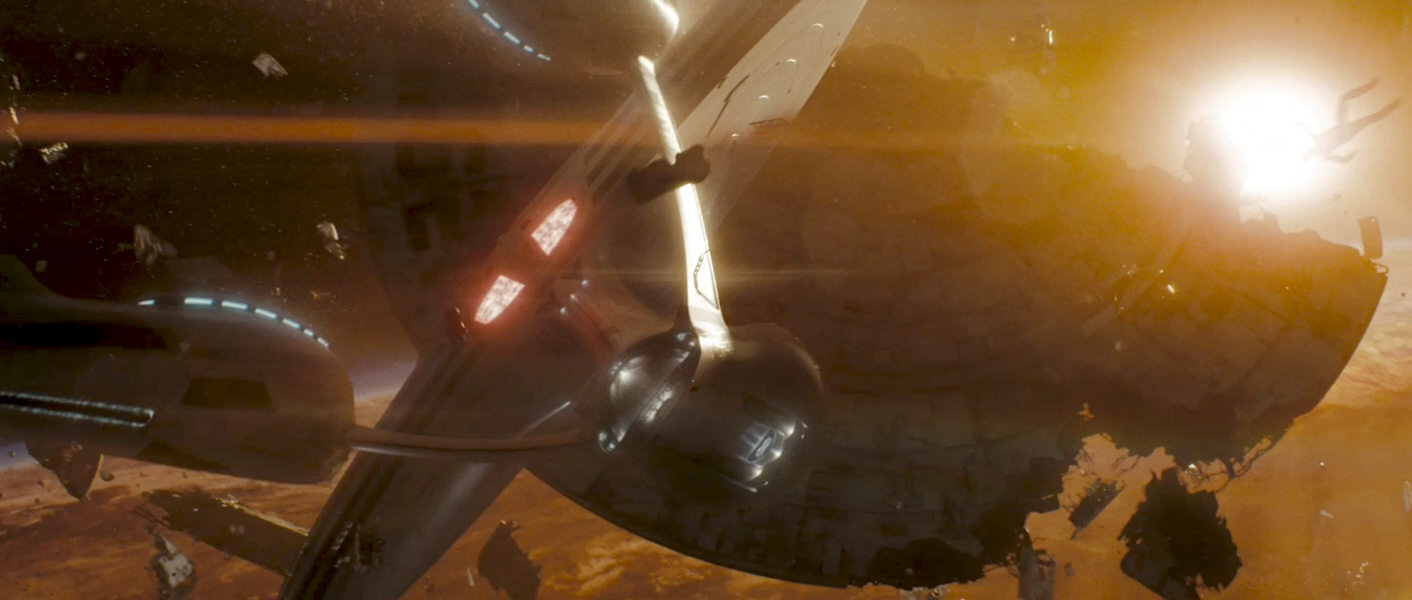

It's interesting on this point that the movie is so casual with things like planets and civilizations themselves, despite the use of Saturn: no fundamental break is seen between humanity on Earth and humanity in space, between the stars. And this brings me, finally, to Spock and black holes themselves--the real enemy of the movie. These puncture space and take away representation (though they also weirdly--because the plot needs to begin--seem to allow passage from the alternate Trek universe... such clunkily inconsistent physics doesn't even pose a problem for the movie but seems all the more to tie things together without really doing so--the typical formal postmodernist move), and they only work if space has become so very thick and bodily such that we can see this as threatening, sad, or profound. So back on the level of content (that is, form), within the plot, this is precisely what gives Spock himself something new, something only somewhat interesting: trauma. While this makes Spock into a different character altogether, this seems to me to be the most hackneyed way of doing so, since the non-representation of the death of of six billion people and their entire civilization in all its rich complexity seems more a formal requirement of the film--given its pure aim to be different--than anything really thought-provoking for either the character or us. Or maybe it provokes some thought, but this thought is about representation itself rather than any of the more substantial things (legacy, memory, social structure, the alien--remember, Vulcan was the first alien contact humans had, according to the canon) that might appear in further movies (and again, this minimal affirmation is all that the movie is after here). Here, they seek to give new meaning to the old Vulcan dilemma itself, as if it weren't rich enough (with all its racial overtones) beforehand, and this makes such a complex exploration of what this all means take the mere form of yet another prelude to action (big statues, once signifying something, are more interesting because they come crashing down on a poor figure as Spock rescues the Vulcan High Council).
In the end, if you think that this overcomplication does indeed invest the movie with some less formal content, you might be right. It certainly ends up, through all these maneuvers used to extricate itself without extricating itself from the canon and series, as perhaps a more complex meditation on revisiting older aspects of franchises than some of the more recent comic book restart movie-epics. But then again, it also doesn't, in some sense, since this is again all tied up much too neatly: one has to ask whether one wants this affirmation to be so minimally and formally represented--and there only by absence--rather than played out in a richer plot integrating the achievements at the level of the medium itself. And this not in a future film, but in the future of this present one.
Thursday, December 10, 2009
Notes on what literary theory does
Tuesday I sat down with other people to discuss literary theory (which, remember, is not critical theory) with one of our more prominent professors. I agreed a lot with what he had to say--and even more with the jovial way he said it, with genuine seriousness appended as he focused on describing how using literary theory feels. I share some of my notes here, however, because regardless of agreement they offer at least another perspective on what to do with literary theory--or rather, what it's good for--at this stage in the game.
He began by saying that the age where you had to be either for or against theory has completely passed (and this, I'll just say, is certainly true: it might be the case elsewhere that people are trying to breathe life into theory, but we're here all more focused on what you do with it now that it's over, or how you restructure things around a new and more interesting situation). Surely no one has to do it. But, then, he also stressed that in a way no one in an English department was really ever a full blown theorist to begin with--nobody ever really did it. Northrop Frye-like figures were indeed theorists, because they ultimately gave up reading to work out the system. Philosophers might be called theorists because they don't usually bring to bear what they have to say on literature. But for everyone else, in literature, it's always a matter of practical criticism, usually, or judgment and analysis--reading. Why? Because theory is not a method, he said: it gives you insight, in a way that he came back to explain, but it isn't something you can apply. So basically even in the heyday of theory people wrote practical criticism that was "in favor of having some theory" as he put it (and I'd agree, except that I'd also add the crucial missing link: when we do think we're theorists, we're really only doing methodology, and I'd try to see that perhaps as an opportunity, or as perhaps implying no only).
Literary theory usually can't be applied because it is more formative than a method: it sort of changes your whole tack towards an issue. Or allows you to grasp it at a certain angle. But the timeframe here is huge. You really get a theory over the span of a year, or something like that, he said. On that note, he said always to read the primary texts. Never read intros. And he blasted Terry Eagleton in the same way I did not so long ago: Eagleton just turns the theorist into a caricature... one after another after another. And this should not be an introduction to any of them, because it's not the primary text. Read the primary, even if you don't understand it, he said.
He used the example of Lévi-Strauss. He wrote a book on film based on Lévi-Strauss and myth. But it wasn't any sort of application. He just thought Lévi-Strauss' sense that a myth was the resolution of a social conflict was interesting. And then watching films, he started to see these sorts of figures and scenes--representations, mini-narratives--repeating themselves. Like the lone ranger riding into the sunset. Why does this occur? He took it as a myth--but by then it had already been quite a long time, and the theory was bent, as it were, so that it really didn't quite resemble where it came from. On this point, he said he didn't in fact cite Lévi-Strauss anywhere except footnotes. The best theory, he thought, was this sort of absorption of the theorist to that point... not to the point that you can rattle off his or her whole "system," and articulate how your project fits into that system, but in terms of having consumed and integrated it all and made it come out the other side, as it were, as something else, something bearing upon your object, or such that your object's fate is its fate in some mysterious way, back across the gap that the theory has since traveled. He told a story of using Marcel Mauss and then some anthropologists admiring how he did it--and he going away with some minor minor sense that he had altered a little bit of anthropology by just pulling it off. It wasn't that he used Mauss right out. It's just that he saw a problem where Mauss would be good to bring up--and the anthropologists like it, precisely because it's never something they would have done with him and probably should never have done. The disciplinary issues then were coming up: he said you shouldn't think of using a theorist as interdisciplinary work so much as the opposite, something like differentiating-disciplinary work. You show the specificity of your discipline with what you do with the others.
But back to theory, via this: he basically had the myth example and then an example with deconstruction. In the first, this was an example where he found the theory useful. In the second, he found something like a dissatisfaction with an aspect of the theory, as it was philosophically being articulated and of course picked up at Yale etc. It's "elegant pessimism"--a phrase I loved--especially at the end of whatever narrative it is reconstructing. Anyway, so he brought the theory to bear on a particular object (basically the double inscription of the mystery text in less genre-specific work), and this actually was to address a theoretical incapacity. Again, the terms in which this was done were not pure, were not theoretical--they were trying to "have some theory," or have some more coherent, interesting theory--to make an intervention through his object and its dynamics. Now, as far as technical terms go, he's for using them, but also for thinking of similar sorts of words that might cue up something like the theoretical framework, but which really bear more on your project. It's almost as if he is for writing a project where you use a vocabulary that, if you didn't really cite that theorist in footnotes, people might accuse you of ripping her or him off, or, say, thinking you were onto something original when it was exactly what Heidegger, for example, said. He wants you to toe that line, because it makes you think first and foremost about your project, not the theory, and articulate everything in a vocabulary nuanced enough to bring out your object.
Here's some quotes: when I use theory, it doesn't sound like the theory I got it from. But on the other hand, there's a certain necessity to my use of it. Also, theory is good for skepticism, in the sense that it makes you always ask--what's the upshot of this project, and never rest content with, say, history: with a description of the history or a development only. Also, find the person who is doing what you don't want to do, either as a theorist or on the project level. You'll run into them somewhere, and when you do, you will finally probably know what you want to to, because you ran into her or him when you didn't know you didn't want to do it that way so very very viscerally.
Ultimately, he concluded that theory was a good way of "seeing the consequences" of a thought. It was a little vague what this meant, though I thought it similar to the notion of the theory ceiling which I worked out a while ago, though taken in a more positive way in terms of what the ceiling or cap produces for you. I gathered what he meant in particular, though, was that you pick up a theory and follow it at a specific stage in your argument because it forces you to stop taking for granted the story you're telling and push it towards the level of upshots, payoffs--assuming, however, the theory has been sort of internalized in the way described above. The moment of theory, I took him to say, and to be theoretical, was a moment of negation, of that closure Jameson (and Greimas) talks about: you push the argument forward and then allow it to enter another series of moves, a series where perhaps another different theorist/theory might be useful. I said I was finding Jameson's eclecticism wonderful--and he said this was a sort of extreme (in that you are sort of carpetbombed with theories), but also a pretty exact, example of what he liked, where the theory is still subordinate to the matter at hand at the same time as it also is not applied, and carries argumentative force by forcing some closure, some coimplication of the object's fate and the theory's fate.
This, I'll just say in conclusion (and as a way of working a post I promised a while ago into all this) is why we don't think up the idea ourselves: literary theory is often accused of just culling together other great ideas. But, first, we transform those ideas, according to what I said above, and we show how they work, what they feel like in use. Second, we turn to these other ideas in the first place because they do argumentative work through this transformation above and beyond the analysis we're already doing, work that we don't think we should be doing alone since (like I say in the post on the theory ceiling) it is on a more general level. This means taking thinkers into a realm which used to be called aesthetic--but, since Coleridge, who first did this seriously, really can't be considered such, as this makes the issues only philosophical. I doubt many philosophers feel their work is too small in scope or in import, but this is what literary theory says is the case especially as their work bears upon art (and I tend to agree with this notion, though perhaps not for the same reasons). And it bears repeating that this doesn't mean a widening of issues into some conceptual jungle--philosophers know first and foremost how changing a framework can produce a slimmer, more focused set of problems. Perhaps this change is put best, though, if we say it's a matter of opening up the analysis of art to other areas than philosophy, seeing art as not only a philosophical problem. And we do this alongside what we also primarily do, which is refuse to see art solely as a problem of appreciation. We also perform this alongside literary history, which is another way to accomplish the dissolution of aesthetics.
I should also note this doesn't preclude some dismissal of the arguments and the texts that make up aesthetics (as I think some people sometimes believe): theorists study aesthetics very hard, but just refuse to use the texts in that limited way. One can justify this more positively with a reference to the importance of language over sense and perception, but, with my sympathies to phenomenology (including Derrida, though this might seem paradoxical unless you actually understand these people--and stop listening to the Yale school deconstructionists), I've never felt the need to do so.
Wednesday, November 25, 2009
Coming up...
-A post on Marshall McLuhan vs. Raymond Williams.
-A post on why literary theory doesn't deal with aesthetics (often perplexing to those outside literature).
-A post on the dividual in Deleuze and notions of community, via a nice passage from Red Mars.
-A post on Jameson's deep notion that postmodern theory ends up thinking (only) the body.
-Another post on Addison, with special guest Addison.
And, of course, lots over a the Latour blog. We're reading a bunch of essays now, and revisiting the amazing Aramis.
I'm a bit all over the place lately, no? Oh well--it's post-examination time, and all I'm doing is trying to expand ideas before locking down that dissertation proposal.
Friday, November 6, 2009
Three names
 I've been wanting to write a post on Jameson for a while, since wading through his immense corpus is basically all I've been doing over the last month or two. This won't be that post. Rather, I just want to give a little review of a few chapters of his new book, Valences of the Dialectic, which came out Sunday, the first of the month.
The first essay or introduction (it borders on both), "Three Names of the Dialectic," is hard reading. Harder, I think, than Jameson usually is. Things get a much better in the two following chapters on Hegel, and the last chapter (or two) on Ricoeur is a masterpiece, over much quicker than you expected, like a good movie. That said, "Three Names" does excellently what many have tried and few have actually accomplished: a full-on characterization of what dialectic is about. This is, no doubt, why it is so tough, for Jameson is not concerned just with the Hegelian dialectic, but all of it--indeed, when he allows himself the luxury of just confining his analysis to just Hegel, things get more concrete (and that's saying something, as you'll soon see). Where Jameson particularly succeeds though is in showing, not how this diversity reduces to one particular thing we can clearly grasp--the dialectic, which is only the first name of the dialectic in this first chapter--but just how diverse this old thing really is. By spraying dialectic around, then sluicing it in certain directions--indeed showing us many dialectics (dialectic prefaced with the indefinite article is the second name) the whole thing seems much richer, more expansive, more exciting, than the old definitions we carried in our heads before picking up the book.
If this doesn't sound like what philosophy does, well, that's because this isn't philosophy. But that doesn't mean it is unhelpful, or that the account ends up being the lyric meditations of some novice (or that philosophers couldn't learn from the account). Jameson knows what he's talking about, as is evident from the chapters on Hegel, but chooses to do something different--something particularly Sartrean--with this knowledge. I'd characterize this as follows: Jameson gives an overbalance of reality to what otherwise would remain a knowable, but ultimately impoverished, conception. Many people (including me) are finding Sartre useful in particularly this way, and Jameson himself has long valued the Critique of Dialectical Reason especially (though of course he has fondness for all of Sartre) for this particular performance.
One shouldn't however, confuse this performance with the effects of style. And, as usual, Terry Eagleton's crassness has to be just as crassly rejected as it encroaches on this issue, for it causes him to do precisely this. His recent essay in the New Left Review, "Jameson and Form," starts off with some nice observations. Eagleton has always lived off of the supposed aptness or incisiveness of these: they're certainly the only reason, really, to read Literary Theory: an Introduction, even if you have to throw most of them away when you actually start thinking about the figures mentioned. Here, we find the following:
One shouldn't however, confuse this performance with the effects of style. And, as usual, Terry Eagleton's crassness has to be just as crassly rejected as it encroaches on this issue, for it causes him to do precisely this. His recent essay in the New Left Review, "Jameson and Form," starts off with some nice observations. Eagleton has always lived off of the supposed aptness or incisiveness of these: they're certainly the only reason, really, to read Literary Theory: an Introduction, even if you have to throw most of them away when you actually start thinking about the figures mentioned. Here, we find the following:
-"Jameson and Form," NLR 59 (September-October 2009), p. 124
But we might say this is right, not because it is good stylistics--as Eagleton thinks it is--but because it starts to create that "overbalance" that Jameson too creates. The difference between pure style and style that functions, or that thickening we find in Sartre, should now become a bit clearer, and we can just dismiss the rest of what Eagleton tries to wring out of what is no longer an "apt" but a functional characterization. This is the following: because we can see Jameson has a style, and because this style resists the moral and even the political insofar as it resists the empirical or really simply is style (you can't talk about the facts if you have linguistic energy), Jameson's writing should therefore be deemed, alas, "problematic," while at the same time, alas, rewarding. Everything, as usual with Eagleton, gets tied up by that that nice New Critical bowtie that is irony or paradox: the sense that there is, in this whole, success only because it is fraught with conflicting parts, that there are benefits only because their are costs; essentially what Irigaray once mockingly called the use of the second law of thermodynamics in criticism, which only serves really to give the illusion of a stable system, to give us some notion there really is some whole at work here--a Jamesonian corpus as rich and varied and deep as "The Canonization," which, yes, exists (no "producing the concept" here, since there's production of the... empirical!). It's all basically a repeat of The Ideology of the Aesthetic, which was once somewhat illuminating but now gains its force only because Jameson actually has explicitly taken anti-empiricist and anti-moralistic stances.
These positions are indeed reiterated in Valences, because it is Jameson's conviction (following Hegel) that dialectic itself has, on the one hand, the function of destabilizing Verstand, commonsense understanding which would indeed suppose a non-totalized empirical world (just stuff, no system), and, on the other, the function of suspending empty moralistic condemnation where the analysis can be extended, a richer vision of things can be obtained by tarrying with the negative, and less superficial condemnations generated (this ultimately leads him to see Utopian elements in Wal-Mart in chapter 16 of this book--though he also says nothing good can come from this institution). Indeed, Jameson's reply to Eagleton regarding his corpus might be simply, "it's dialectical!" (the phrase he uses to give us the third name of dialectic, the adjective), something that would probably be lost anyway on someone who thought good Marxism means merely a commitment to empirical (as history itself: it's plain as day to Eagleton that Jameson's "always historicize!" is refuted by the question "Does this include geometry?"--and lest you think I'm joking, I quote directly page 135) and empty moralistic outrage (it's clear to Eagleton that Jameson's writing is "constructed... to distance personal feeling," 137--or rather, as I'd claim, to distance affective caricatures that some take for feeling).
So if we refuse this notion that what Jameson is doing is purely stylistic, what really is involved in this "overbalancing of reality," as I've called it? We might say it involves the "thickening" I mentioned earlier, by which Jameson takes a thought and turns it into what he likes to call a "thought-mode." Take--not a description out of context--but a simple remark at the end of a discussion of Hegelian "categories" (the various structures we find in the text, like Quality, Becoming, etc.):
As for Kant, not yet being a Habermassian or feeling the sway of any structuralist or postmodern doxa about the primacy of language and communication, he sticks to the mind itself and grasps the categories as so many "concepts of the understanding" which operate both judgments and those perceptions understood to be mental "syntheses of representations." Still, he disposes of some fairly recognizable traditional "space"--the mind--in which, as in Aristotle's "speaking" [just discussed], the categories can comfortably be housed and find their field of efficacy. Whatever Hegel thinks about mind or language, those are not the "places" in which his categories evolve: and to call this last Spirit or even Objective Spirit is to beg the question, insofar as it is precisely the space of the categories which will be called on to define Spirit in the first place. So they seem relatively placeless and disembodied (Valences, 78).
Basic stuff, yes (we're still at the beginning of the essay "Hegel and Reification"), and while there's a somewhat humorous remark to kick it off (which might be approached more accurately and more philosophically in terms of the history of philosophy), and some nice talk about "places," basically everything's just good old thinking (and good thinking) until we get to that last sentence. It is here that we find something thickening, just in this offhand remark: there's no real purpose except to explain, not even how we feel reading Hegel (he'll come to that later, on page 80-1), but the sorts feelings that shape the contours of Hegel's thinking when we follow it. In this seeming placenessness and disembodinedness there is something like the aesthetic projected by this aspect of Hegel, and pinpointing this aesthetic not only give us a better hold on him, but also shows what sort of field Hegel feels his conceptions work within. There is an effort, in short, to connect whatever is in question to experience--though not necessarily "our" experience.
Jameson then is able to seize on this, and perform, precisely, dialectical reversals:
...So they seem relatively placeless and disembodied: they are not the thoughts of a Mind, even a transcendental one (since for one thing, they are not yet even thoughts as such): Absolute Spirit may be, or however Hegel's combination of Substance and Subject may be understood, it is not an omniscient and anthropomorphized narrator of some sort. In fact, I tend to think it would be better to imagine the "space" of Hegel's categories in the absence of all such modern container notions of subjectivity or of element, in a kind of spacelessness. This makes the categories in Hegel far more situation- or event-specific; all the while acknoledging the evident fact that whatever "space" or "context" may be invoke, it will always also itself be precisely one of those categories it was alleged to have governed or contained. Thus once again here we confront the well-known paradox of the "class which is a member of itself," something "solved" by the attempt to imagine a state of things--or better still a type of discourse--itself free of such representational homogeneity, and able to accommodate a series of "events" without a frame or background. Add to this the characterization of these moments as somehow related to pensée sauvage in that the Logic effectuates the construction of local universals out of particulars in a situation in which universals do not yet exist, and we have an even more paradoxical approach to hegel opening up before us (Valences, 78-9).
The aesthetic, given overpresence I might even say, allows a certain leap by which we're able to say that we have to basically suspend our belief (and not disbelief, for once with Hegel!) in Absolute Spirit. All of which involves a project of seeing "Hegel's Marxism" (as Jameson puts it, 100), a project that he picks up back in "Three Names," rather than line things up in the regular order.
Indeed, back in "Three Names," we find positions Jameson has held for some time elaborated more explicitly: Verso's book jacket says Jameson moves towards the "innovation" of a "spatial dialectic," but this is old news, really. Jameson--and this is why, primarily, I like him (and why I like Derrida)--doesn't innovate. All his concepts are tied together and slowly grow, inflecting each other. Often (much more than in Derrida, who struggled for consistency much harder than was, for anyone other than him, productive) there are local eruptions of something completely new and weird, but then the rest of the web comes to meet it by stretching itself over some abyss. This is the work of producing closure that I've stressed was essential to understanding Jameson in a previous post (in which I basically tried to anticipate what Jameson might say in such an introductory chapter as this one)--and it's important to distinguish it on the other hand from the production of a system, which can be just as productive of "innovations." Indeed, this sort of language of what we might call the "theory industry" is parasitic on theory itself, and it is this structure--which I wouldn't say is necessarily organic, and rather involves something like what long durations of concept-formation can produce faster than thought (whether of advertisers or of lesser-experienced thinkers) itself, in a sort of short-circuit that "innovation" precisely misdescribes--that seems to resist such an industry. This is, at least, what I would add to how Jameson describes theory, which is indeed very concerned with the "theory industry:"
The persistence of the proper name in theory, indeed--as when we identify various texts as Derridian, Althusserian, or Habermassian--only serves to betray the hopelessness of the nonetheless unavoidable aim of theoretical writing to escape the reifications of philosophy as well as the commodifications of the intellectual marketplace today (Valences, 9).
Again, he's held this position for some time (see my old post from last year on this, though the position is even older). What is new is the presentation, and of course the particular "thickenings." We see an even more incisive characterization of Derrida in these pages ("it is as though the dialectic moves jerkily from moment to moment like a slide show, where deconstruction dizzily fast-forwardds like a film by Dziga Vertov," 26, a thickening of what has essentially become my view, which we find in Jameson's Archaeologies of the Future, that Derrida "unlike Adorno [...] refuses any positive or substantive concept of its own negative method, and indeed of method as such," 180), as well as a striking and more explicit take on what's wrong with Foucault (his thought is not non-dialectical but "too dialectical:" "Foucault attributes the positive valorization of Enlightenment to his deluded bourgeois readers and positions it as an error which the new narrative of paranoia and conspiracy is to correct: whereas from a dialectical perspective both narratives are correct and both narratives are equally in error," 52), and a thought-provoking characterization of Adorno and Zizek (the latter producing paradoxes not to undo the stupid first impression that it is indeed paradoxical, but rather "to undo that second moment of ingenuity which is that of interpretation [...]: the paradox is of the second order; what looked like a paradox was in reality simply a return to the first impression itself," affirming the "objective appearance," 59--and if this is true my reading of Zizek in that earlier post is faulty, but I still distrust Zizek more than Jameson does). What's also promising and somewhat more explicit than in previous works are the readings of Capital and some of its most visible dialectic moments--a subject Jameson will tackle more in a more focused manner in yet another book.
Also more explicitly formulated is the notion of "neutralization" as it relates to the dialectic, which was worked out perhaps most visibly in Archaeologies of the Future, but also has been around basically since Jameson began considering Greimas. Here, though, like everything else, it gets a bit more thorough treatment, due again to this clean though perhaps too formalistic presentation that divides up the dialectic into its three names: the dialectic, a dialectic (or many dialectics), and dialectical (it's dialectical!). The first makes the case that the dialectic, whether Marxist or Hegelian, has to be seen as not a claim to unity but a presentation that is an aspiration to totality (this mirrors the rejection of the Absolute Spirit we saw above). It passes over into its opposite, which actually is the most fruitful albeit complex section of this first chapter, where we see the dialectic at work in what were antinomies and binarisms of all sorts (the large thread running through this--again worked out more explicitly than in other works--is that structuralism is dialectical in a Sartrean sense, despite what Lévi-Strauss said at the end of La Pensée Sauvage; however many good and unexpected examples appear here). The basic move (which we saw in the analysis of Foucault, above) is made as explicit as it could be: Foucault's work, and anti-dialectical work like it (a topic picked up in the third chapter on "Hegel's Contemporary Critics"),
should seem to generate a situation in which power has no opposite (or is its own opposite). I believe that this seeming impasse can at least be clarified by the suggestion that this particular type of opposition is to be grasped as the superposition of at least two binary systems: a purely logical opposition between essential and inessential or center and margin. Here the "negation" lies in the differentiation between the initial equivalents, while its ideological investment--the very content of domination itself--derives from the way in which this second opposition reappropriates the first one. The force of negation is then transferred from the latter to the former (Valences, 21).
This is clean and openly didactic--more typical of this particular essay than most of Jameson's work. Nevertheless, it is indeed good to have out there when dialectical reversal is indeed harder to grasp for most people than it perhaps should be. Or so Jameson claims in the next section, where he considers the adjectival form (dialectical), and how (following Sartre) the dialectic "will always be its own illustration or example; that any exercise of it wil already be its own presentation," and thus is always difficult to grasp, since "you have to be grappling with a dialectical reality reality in order to be able to show" (and perhaps we might add see) "what the dialectic is" (50). We can close on this note, which brings us to the most essential aspect of the dialectic that--as I said in a previous--always has been the most imperative to bring into overpresence, or deepen:
[F]or the present it is the contagiation of the dialectic, rather than its structure, that we are out to catch a glimpse of: some essential restlessness or negativity that fastens onto our thinking at those moments in which we seem arrested and paralyzed by an antinomy--for, as has been observed above, the relationship between antinomy and dialectic is a crucial one in the contemporary period, where the antinomy has taken the place of the contradiction, expressing intractability rather than energy or construction (or indeed incommensurability rather than relationship).
What happens in moments like these--at least when the dialectic unexpectedly proposes itself, and when it suddenly crosses our minds that "it's dialectical!"--is that the problem itself becomes the solution, and that the opposition in which we are immobilized like a ship in the ice must itself now become the object of our thinking... (Valences, 50-51).
Friday, October 30, 2009
Weak theory
I said last time that while I find Eve Sedgwick's position in her essay "Paranoid Reading, Reparative Reading" extremely problematic--largely because of her unquestioning (and, indeed, last ditch) commitment to close reading, her authoritative, hyper-moralistic, and accusatory tone, and her general feeling that "big thoughts" are really irrelevant--I'm confident one suggestion of hers is extremely valuable. This is that theory needs to become what she calls "weak theory," following Silvan Tomkins.
Tomkins opposes weak theories to "humiliation theories," or "strong theories." He uses the word "humiliation" because a strong theory tries to account for every relevant phenomenon that pops up and might contradict its claims, thereby continuously anticipating its own failure. To counter this, the theory grows even more expansive, trying to explain and connect more and more extant cases and demonstrate how other theories are insufficient. The theory humiliates because it tries to stave off being humiliated.
Sedgwick explains:
As this account suggests, far from becoming stonger through obviating or alleviating humiliation, a humiliation theory becomes stronger exactly insofar as it fails to do so. Tomkins's conclusion is not that all strong theory is ineffective--indeed, it may grow to be only too effective--but that "affect theory must be effective to be weak."
-"Paranoid Reading, Reparative Reading," in Touching Feeling, 134
The point is that affect theory, which seeks to recognize more than just the cardboard-cutouts that are the simply positive and simply negative affects (love, hate), must have done its work on the theorist in order for any alternative to strong theories to present itself. That is, we must have cultivated a more sophisticated relationship to feeling, must have diversified our experience of emotion, in order to be able to create theories that do not constantly humiliate and end up humiliated.
This important for Sedgwick not only because she thinks that criticism at this juncture works too easily off of negative affect--stirring up bad feelings in order to use bad feelings against what makes us feel bad--but also because she believes theory can anticipate other things than failure all of the time.
This, I think, is an extremely useful thought, even if I also believe that Sedgwick's sense of what is indeed possible with theory remains extremely narrow, and that this in turn causes her to (unsuccessfully) try to humiliate D.A. Miller. Miller's expansive and truly excellent study, The Novel and the Police, is, along with Judith Butler's pathbreaking Gender Trouble, Sedgwick's exemplary paranoid critical text. And, when it comes time to stop accusing it of being paranoid, and praise Miller's work for what it anticipates besides the failure of its own project, Sedgwick only points to generally aesthetic aspects of the theoretical text:
I don't suppose that too many readers--nor, for that matter, perhaps the author--would be too surprised to hear it noted that the main argument or strong theory of The Novel and the Police is entirely circular: everything can be understood as an aspect of the carceral, therefore the carceral is everywhere. But who reads The Novel and the Police to find out whether its main argument is true? In this case, as also frequently in the case of the tautologies of "sexual difference" [her description of what Judith Butler does in Gender Trouble] the very breadth of reach that makes the theory strong also offers the space--of which Miller's book takes every advantage--for a wealth of tonal nuance, attitude, wordily observation, performative paradox, aggression, tenderness, wit, inventive reading, obiter dicta, and writerly panache. These rewards are so local and frequent that one might want to say that a plethora of only loosely related weak theories has been invited to shelter in the hypertrophied embrace of the book's overarching strong theory.
-"Paranoid Reading, Reparative Reading," in Touching Feeling, 135-6
It should be obvious that not only does this description damn by faint praise, as well as turn Miller's main argument into a joke, but also end up portraying Miller's lengthy readings of Collins, Dickens, Trollope, and others (the majority of the book) basically as filler. These readings, in the end, are only good for their production of what Sedgwick later calls a "glue" forming between their many words, made up "of surplus beauty, surplus stylistic investment, unexplained upwellings of threat, contempt, and longing" ("Paranoid Reading," 150).
Now, yes, it perhaps is also seems reductive to describe Sedgwick's interest in this surplus of feeling, skill, and beauty as interest in the merely "aesthetic" aspects of Miller's text, as I have done. But, when isolated from the involved and important arguments that make up the book, this glue is aesthetic, and even the feelings themselves are made into mere contributions to readerly enjoyment. For Sedgwick, the weak elements of Miller's text do not just resist the anticipation of his theory's failure--they confine themselves to anticipating nothing except the end of theory itself (and I'd read this phrase in the most expansive way) in pure writerly creation. Against this, can't we see how Miller's theories might be anticipating something different? And indeed, something that, seen against what the book is actually arguing, isn't as humiliating?
Now, I take the time to point out this (attempted) humiliation of Miller because I think there is a crucial place for negativity in criticism: when someone is doing something wrong, we should point it out, explain it, and oppose it. Negativity especially has its place in the inflection of explanation and opposition: it produces a movement which allows the unfolding of the position in question to produce one's distance from that position, thereby making room for a thicker--not thinner--account of what gets opposed (which might not even be the position itself, but what it entails). And here, considering Sedgwick's reading of Miller, where there is the temptation to enact her positive alternative that is being theorized in order to prove the validity of that alternative, and where the questioning of so many key aspects of theory itself occurs, I think it is especially important to show where Sedgwick is also going wrong, rather than accept such a characterization of Miller. I'm being so negative, in short, because being negative can help us preserve what is positive here--and indeed make the realm of the positive more expansive than Sedgwick is here making it.
For, as we said, positive affects, when aligned to weak theory, don't just involve that "wealth of tonal nuance," or indeed that "glue of surplus beauty, surplus stylistic investment." In fact, they might also involve what Sedgwick later calls "nonce taxonomies:"
There are important phenomenological and theoretical tasks that can be accomplished only through local theories and nonce taxonomies...
-"Paranoid Reading, Reparative Reading," in Touching Feeling, 145
And these, most importantly, don't produce rewards that, in their authotelic, aesthetic perfection are only "local and frequent." Nonce taxonomies can, in other words, outlive their immediate present. Thus I think we can use what Jameson says about how we should judge the political effectivity of Utopias--
In the case of Utopian texts, the most reliable political test lies not in any judgment on the individual work in question so much as in its capacity to generate new ones...
-Archaeologies of the Future, xv
--and also apply to judging the theoretical yield of weakness--instead of Sedgwick's aesthetic test. For when a weak theory remains weak, and yet also can proliferate by an process where its local use is unexpectedly displaced into another locality (as I am doing with Jameson right here), it becomes a nonce taxonomy twice over. In other words, instead of judging the yield of weak theory by itself, as we would a (individual, high-modernist, Proustian--all qualifiers that enthralled Sedgwick) artwork, we should perhaps think its potential differently. That is, we should consider its potential as more than in its its ability to resist, by the self-confining gesture of rolling into a ball of pure "panache," any and all diffusion beyond the local, any and all spilling over the borders of feeling and the realm of beauty into an area of writing that expands, connects, and attempts to account for various cases--like argument (on this point, I think it is extremely significant that Tomkins distinction is about scientific theories: in English, our theories have never been that strong, and Sedgwick's need to think that they are makes her opposition to the expansive and totalizing almost seem phobic). In other words, we should see that if weak theory can anticipate something other than its own failure, this means that a theory could anticipate its success precisely in its expansion and expandability in a way similar to these "nonce taxonomies"--and thus all theoretical expansion cannot simply equatable with a process of becoming strong, as Sedgwick, by making the only other possibility of anticipation a local and aesthetic one, would have it.
It's in this way that even a dialectical criticism--surely something that involves "big thoughts"--might become weak or weaken, perhaps precisely through that process of pushing towards closure that, following Jameson, I described last time.
Tuesday, October 27, 2009
Reversals
Always historicize? What could have less to do with historicizing than the commanding, atemporal adverb "always"? It reminds me of the bumper stickers that instruct people in other cars to "Question Authority." Excellent advice, perhaps wasted on anyone who does whatever they're ordered to do by a strip of paper glued to an automobile!
-Eve Sedgwick, Touching Feeling, 125
I've always thought this remark of Sedgwick's demonstrates most concretely the misreading of "Jameson's Imperative" so very prevalent wherever his work is considered. The phrase "Always historicize!" is to be taken dialectically, as is clear from the opening of The Political Unconscious in which it first appears:
Always historicize! This slogan--the one absolute and we may even say "transhistorical" imperative of all dialectical thought--will unsurprisingly turn out to be the moral of The Political Unconscious as well.
-The Political Unconscious, 9
One is tempted, in the end, to rewrite Jameson's "we may even say" the other way around. For what gets missed by someone like Sedgwick is that this imperative is also "the one absolute." This means that we have to read such a statement as already expressing a contradiction. Thus the "always" is not to be seen as atemporal, and blindly used as "proof" that the motto's inconsistency is fatal to its integrity. Yet you see that this is what Sedgwick does, planted firmly as she is in the stance of reflection. Indeed, if we view things rightly, we see that Jameson calls it an imperative only in order to anticipate his anti-dialectical readers precisely on this point, to try and get them to actually think the contradiction (this is also why he uses transhistorical, in quotes). Instead, they bastardize the contradiction and act as if Jameson is accountable for it.
There's good reason, however, for this situation. One doesn't point at an inconsistency in the dialectic and say "Gotcha!" just because one takes it reflectively. Rather, it comes from a distrust in general concerning what we might call the dialectical reversal--that shift in emphasis caused by the turning of things into what they weren't supposed not to be. This reversal is, for Jameson, never an instance of something local multiplying relations, inflecting things slightly differently--however quietly it may occur. The tortuous paths that Hegel traces while turning quality into quantity may seem to involve extremely small points (how did we end up discussing gravity?), but these points never reverse things because they are local. Rather, the reversal occurs when something larger comes to force things to put up or shut up, to move towards definite closure--as Jameson always excellently puts it.
It is an intolerance of this sort of pressure from closure, of the totality bearing down on the instance, that then makes us avoid the reversal. Or, as Jameson would rather describe it, a general jadedness with respect to such massive structures--a belief in their irrelevance and even a feeling that they are not interesting, or only are interesting to moralists (who love their generalizations). Indeed, a sense that Jameson's writings are always heavyhanded, that they carry their lesson, seems to float around in discussions of him. We certainly see this in the quote from Sedgwick, who sticks him on that bumper. Personally, I find Jameson much lighter in tone than that.
It's rather those with the unconditional regard for the local who seem to me to couch things in moralistic terms (respect the particular!), in order to emphasize how something can ever have effects beyond the local context. Thus, it's no accident that Sedgwick invokes close reading at the end of that essay where she dismisses historicizing and advocates, instead, weak theory (a promising notion that I'll return to sometime):
What could better represent "weak theory, little better than a description of the phenomena which it purports to explain," than the devalued and near obsolescent New Critical skill of imaginative close reading?
-Touching Feeling, 145
There's the moralistic insistence that the focus which never goes beyond its immediate context is, paradoxically, obsolescent, tougher to do than it sounds, nearly impossible. It's no matter that close reading has from the beginning been "devalued," or rather an attempt to make such attention virtuous (as D.A. Miller rightly argues). Seen beside the dismissal of Jameson's "always," we see that close reading ends up as something like a mere refuge for those who distrust that total shift of emphasis.
At the same time, though, I wonder whether the reversal merits this distrust when dialectic becomes identified with something like what Zizek does. For while everyone seems to worry whether Zizek does violence to the object by ramming it through the dialectic, I'd rather take a Jamesonian stance and wonder whether the victim of Zizek's dialectic is the dialectic itself. Why? Though it reverses things, the dialectic doesn't take up whatever it finds and proceed to turn it around. Such a maneuver may be necessary to get the wheels going, but it amounts to the same thing, really, as "imaginative close reading" and stems from the same overemphasis on the particular--or inability to see the totality. The Frankfurt School did much to widen the gap between the local and the total, and provide many intermediaries--such as constellations--that could allow you to move more carefully from one to the other: Zizek would benefit from using them, because rather than imposing too much of something external on the content, his moves simply are not formal enough. This is why Jameson explains dialectic as something like forcing a closure--the reversal has to come from elsewhere and the effort to get there. And this is also why it doesn't resemble a shock or short-circuit (as Zizek calls it) so much as a different emphasis.
Subscribe to:
Posts (Atom)