So I finally saw the new Star Trek last night. For various reasons I just couldn't make it to the theater over the summer--though one of those reasons was that when I could, my ambivalence over the whole thing kept me from going. You see, I'm a bit of a devotee (i.e. fan!). TNG has always been my favorite series, since I prefer its more hard-sciencey sort of focus and the more thorough concentration on the issues of managing the flying space city that the Enterprise has become (a focus that we see throughout Galactica, for instance). It's space opera become a problem--I like that. Plus it makes social issues come into focus on a wider scale, and the encounter with "new life and new civilizations" much more representable (instead of just sticking in an alien here and there, as in Star Wars or, actually, in this new movie, you get a focus more on cultures, collectives). Of course, this was also possible because of the money pumped into its special effects, but the storytelling was also usually pitched at that level. Like any good science fiction program on TV, it tended to wobble away from that if a better, weirder, more thought-provoking situation came up and could be explored--in a way not unlike many of the original series episodes, which occasionally seem more like The Twilight Zone's great one-off thought-experiments. So while I liked TNG, the original series, was still great, since it had solid stories, solid characters, and was often true in spirit to the inventive, pulpy, and indeed literary mode American SF, even if it could only build its worlds on a smaller scale (the recent reissue of the original series, with its suped-up special effects [and wonderfully remastered sound] tries to undo this and wonderfully fails, though it allows us to focus away from what is most obtrusive and lends to parody--in a way that makes one realize, as we did in a negative way watching the horrible new Star Wars movies, that the stories are what produce the need for representation of this future reality).
So I had Trekkie issues. But it wasn't so much that I thought the old characters should be forbidden to be taken up again, or indeed the whole canon itself forbidden to be messed with, as much as I was worried about the remake becoming only what it indeed turned out to be: an action movie. Now, TOS was, let's be honest, not always the more cerebral political meditation that one found in TNG (best exemplified in the unbelievable episodes on torture) or Deep Space 9 (which, by the way, is underrated). And TNG (especially in the movies) certainly had its share of pure action. But maybe it'd be good to distinguish between action and adventure, and say that in the original series, regardless of all its fights, it remained closer to the latter. It never made that leap towards the pure action film without some serious loss: it never turned into, however thin the plot was, that typical action-movie form where story becomes merely an excuse tying together pure spectacle, choreography, or violence (which is why the fight scenes--the best being, of course, with the Gorn--are often laughable for their length more than their low quality).
This has huge ramifications, I think, when it comes to the representation of space itself, as we'll see in a moment, but adventure turning into action was what I feared and what the movie actually did. Maybe another turn of the screw is appropriate, though: what we found in the new movie was not action purely, but adventure, become action, now trying to become adventure again. So it's not a pure opposition, but something like the the action movie trying to regain its roots (something that happens--with typical nostalgia for WWII times--in Indiana Jones, say).
It's sad, though, to see that this effort has so limited the resources with which such a revival could be accomplished to the postmodern high formalism J.J. Abrams lives and breathes (there's certainly another sort of postmodern content--anxiety about recursiveness and hallucination as such, which we find in the new excellent remake of The Prisoner--a content that, to defend it, is much more rich... but this is always less appealing to Abrams, unless it is the effect of a formal problem). For it's this formalism that we find, I think, in the old characters themselves: not so much a pleasure in their new content as some sense that their slots have been filled--or the fetishization of the fact that they can be filled at all and their story can be different. I'll get to Spock in a second (perhaps the only exception to this--but even then this is only accomplished through the most bare formal pressures), but you see that indeed this logic is so impoverished it actually has to take the most expansive form of the clunky plot itself, with its time travel and alternate universe production. Never mind the fact that it tries to push the burden of its clunkiness on the ties of the series to science in the first place, in the overcomplicated explanation future Spock (Nimoy) gives to Kirk in an ice cave--which I think just amounts to an insult, playing off notions that the series, because it just was SF in general, was therefore overcomplex and intellectual (early in the movie, Kirk's use of the word "syntax" is depressingly used as a code for deep learning). Never mind that: what's disturbing is that this also makes the whole movie into an allegory for the marketing-like dilemma the re-creators faced in the first place (and which some of them obviously didn't sweat about so much that it would prevent them from shoving a Nokia phone into the beginning): can we make anything different than the original, with these poor characters and this overburdened series, when the original is actually still doing so well? The dilemma becomes one of rebranding when it's not even necessary. Now, it's not that I don't like anything different done with the characters--though that's precisely the insulting sort of false-problem the movie produces for Trekkies and which it would love them to fume over (while they document each new technical change made to their beloved universe) while it rolls in the cash (Why don't you want anything different done? You were supposed to love these characters! You just don't want them shared with anyone other than yourselves!--suchlike phrases/overtones even became a way to market the film... and I think the anger of Trekkies is usually about this having nothing to say back to this more than anything). No, that's not my problem. It's that, when this inversion is transferred to the level of the plot itself, the movie ends up evacuating itself of anything different it really could have done, difference now simply having become newness and vice versa (a problem Jameson rightly sees as central to postmodernism). This is what makes me happy they are doing another movie, where the question of difference can actually be pursued in terms of a less-formal and auto-referential plot (getting its motivation not even from the bad guy, whose superfluity is so extreme that I think he becomes relevant again, in that he gets stuck in there precisely to draw our focus away from the real center--the time-travel dilemma--and its turning in place). Though this is exactly the minimal affirmation, minimal hope, such an empty formal work desires to produce.
Form become content, then, our attention is shifted back to the cinematic medium itself--which indeed has been filled with all sorts of thickness that the plot and the characters (again excepting Spock--but actually I think he's just a form too, as we'll see at the end) are lacking. Here, indeed, is something genuinely fascinating and which strikes out in a genuinely new direction. The profusion of light in the movie, that complete inversion of noir which is so striking when it comes to the bridge of the Enterprise, when projected onto space turns it into another animal altogether. While on the Enterprise, indeed, it remains a great homage to the smallness of the original show: light comes in to delete the space of all those old props, and represent the expansiveness of the original vision which it couldn't actually pull off with its gray cardboard-like consoles and bleep-bloop blinking computer buttons (which again, I think, represents another moment where SF ties to technology get seen as over-intellectual, doomed to become obsolete [not in function but in representation, in look, not feel--but that's a difference symptomatically passed over here], and therefore able to be eliminated altogether--along with their ties to futurity itself and its even more futuristic afterlife, which, let us remember, is again what the whole "plot" is meant to accomplish!). Where there is finally some representation of this old hulking ship, the great tubes, canisters, vats code it wonderfully (and comically) as steampunk--what happens when SF meets pastness itself. This is welcome, but besides the tubes (which crisscross in a weirdly unsmooth fashion that jars a bit with the rest of the movie sleek surfaces--though because these surfaces are ultimately thick and fleshy, as I'll show in a moment) this like the light takes a form subtracted from the visual by its addition, which is that of the wonderful static, crackling sound of transportation (the single best thing in the film, I thought) and the pop of warp speed. All this produces an unbelievable non-nostalgia for 60s-ness (or even late-50s-ness): in the space of the 60s (which, reaching its climax in in Kubrick was full of light--and remember 2001 was hugely ripped off by the first Star Trek movie), it gives us some other feel (non-Kubricky), which is welcome because makes us think hard about what it could be at the same time as it allows us to understand the 60s-feel as such differently, perhaps more thoroughly. Since the association of Star Trek with this old technological code is what the film is perhaps most intent on preventing (another purely negative goal--accomplished by so much being left out and only the crudest associations with primitive elemental forces [water, metal, electricity] put back in), or because this non-nostalgia is so pervasive, the movie doesn't push far in the latter direction.
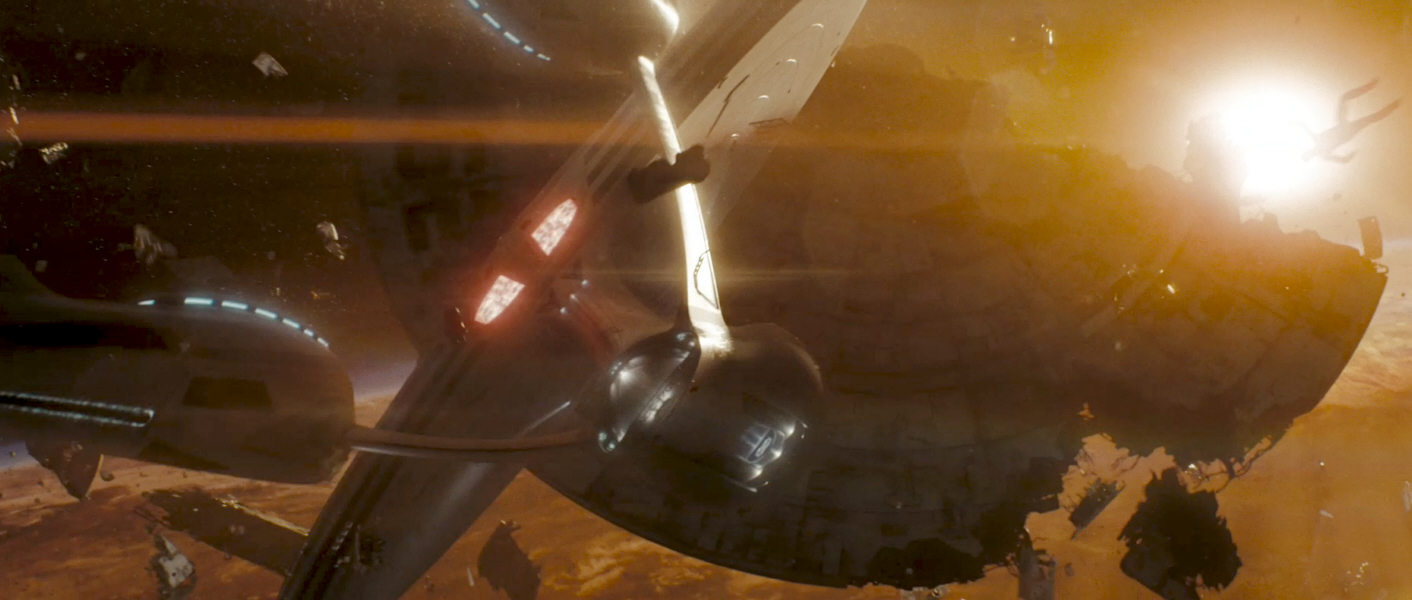
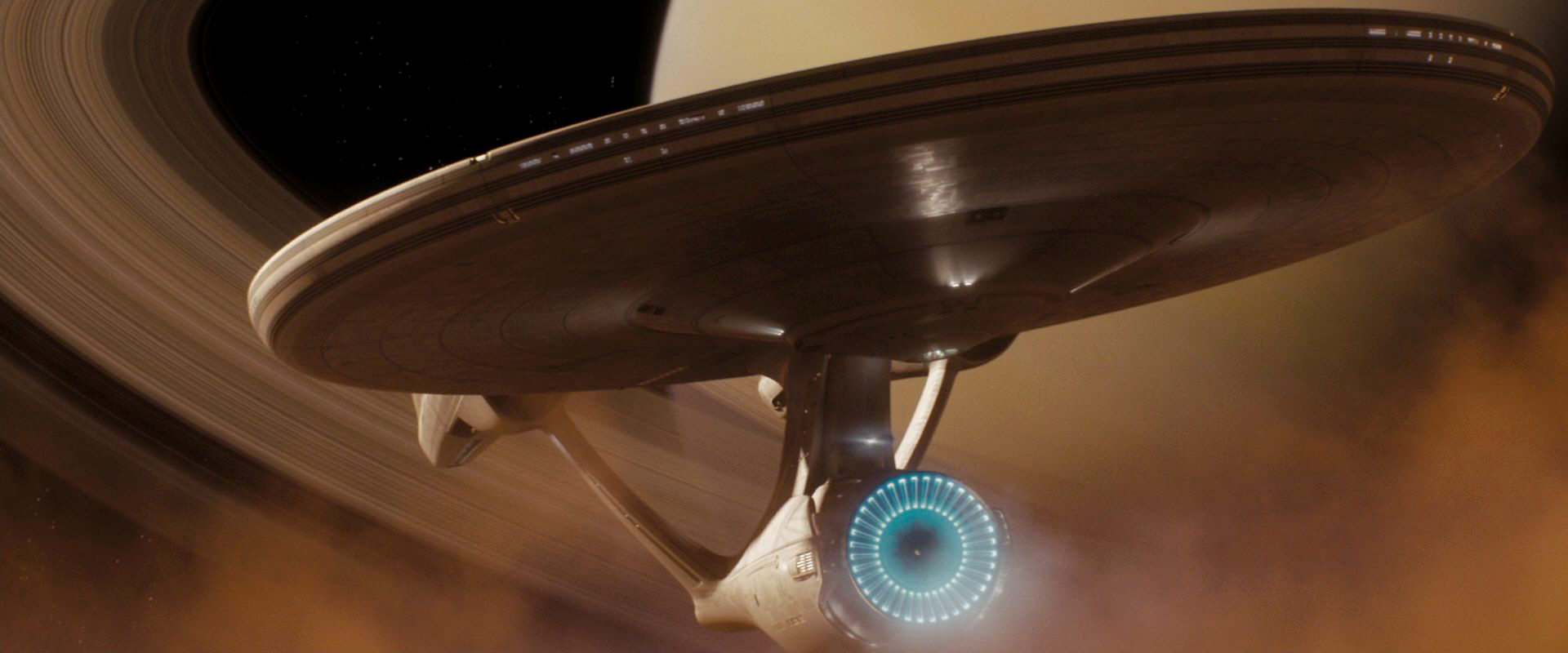
But back to space, where the payoffs, I said, were the greatest. Space in the movie becomes thick, fleshy, multilayered: the Enterprise itself must keep floating through debris, being shrouded in the light of the warp speed (like on the poster), or emerging out of the bath of Titan's atmosphere (which is dwelt upon almost too long, so that we even feel something like the touch of space, its caress, and everything becomes vaguely sexual). No longer is space a void, an emptiness, a vast beyond: rather it envelops us. We are all Star Children, but precisely because space isn't black anymore: it's yellow, green, blue, anything but that stark black or the hardly different purple--which, represented in the new film, takes on associations with bruises before it seems like any cloud of space-dust. The most striking shot of the film brings this home (you can find some of it here): the Enterprise blasting itself out of the black hole by dropping the warp core (old trick, I think used once in TNG), being chased for a moment by an expanding cell membrane made of blue light which comes to push it on and or absorb it... this shows us the camera has become a microscope and we have completely passed into the realm of biology, of Innerspace, rather than the physics space of old. Space is body in this film, embodied, and while it'd be relevant here to bring up Fredric Jameson's discussion of the body as the real horizon of postmodern thought, I'll do that more in detail at a later time. Needless to say this applies here: we wonder at our bodies in this movie and their disintegration, not at space in any classic sense, and while this might represent something of a progression, something that makes space something closer to the more pliable realm SF has always seen it as (and the physical universe in general, nature itself), because it is a device for producing that reinvestment of action with adventure (and not the other way around) it seems to me a bit regressive. I'll be more specific: physics-space causes wonder, while the biology space of this movie is still sheer spectacle, since space is evacuated of its limitlessness, or made (however wide the shot) only so big, while none of the problems of this swath of light's management (what makes it alien, hard to deal with) emerge (we find in it only sheer enjoyment, or sheer terror). Moreover, given this body, it isn't filled with anything, anything like people, ships, space stations and devices or what have you, despite the appearance of one in the beginning. This space isn't the space of technology and people, of possible civilization, but something like weak nature, which peoples you more than you people it. Again, maybe that's an advance: it's certainly an aesthetic advance, mirrored more on the most unbelievable pictures we get from the Hubble or the orbiters of Mars, and makes possible a new representation of futurity as full of wild being, as it once was called by Merleau-Ponty, full of light and warmth, half-glimpses of stars and worlds (which could be interesting if it were pushed back into technology: we would get less of an on-board experience of journeying--and we don't really get this 19th century naval experience here, which is so prevalent in TNG--and the man-made would flit by with a less visible, though light-filled, tactile pressure and pull than the current visual explosiveness, tending towards the anarchy of Transformers or the obsessively over-detailed Star Wars, that we sometimes still see here and which still relies on simple equivalence between personal perception and the third person objective camera). But, put to the ends of this movie, it all tends to merely mirror our act of gazing at our (nonalien) bodies more than it does any sort of encounter with nature itself (which is why at the end, all the rest of the universe can just be gone through in a series--star system after star system impeccably modeled and chaotic rolling by merely with the credits), and make humanity less of a blip in the cosmos as the natural inhabitant of the universe (space merely as atmosphere)--taking it over without thinking (it's interesting how quickly Starfleet itself is coded as a military organization--like the Air Force, to keep going with the space-to-atmosphere reduction--more than an interstellar forum for diplomacy with an academic institution as its training academy: and while Kirk's final exam has always been seen as a sort of daring mixed with smartness, here the movie tries to code it as the lower class breaking a big bureaucratic intellectual institution through--not even cockiness, but pure assholery [the sign that it'd rather not represent lower class intellect at all, or see it merely as the frat-boy behavior it isn't]).
It's interesting on this point that the movie is so casual with things like planets and civilizations themselves, despite the use of Saturn: no fundamental break is seen between humanity on Earth and humanity in space, between the stars. And this brings me, finally, to Spock and black holes themselves--the real enemy of the movie. These puncture space and take away representation (though they also weirdly--because the plot needs to begin--seem to allow passage from the alternate Trek universe... such clunkily inconsistent physics doesn't even pose a problem for the movie but seems all the more to tie things together without really doing so--the typical formal postmodernist move), and they only work if space has become so very thick and bodily such that we can see this as threatening, sad, or profound. So back on the level of content (that is, form), within the plot, this is precisely what gives Spock himself something new, something only somewhat interesting: trauma. While this makes Spock into a different character altogether, this seems to me to be the most hackneyed way of doing so, since the non-representation of the death of of six billion people and their entire civilization in all its rich complexity seems more a formal requirement of the film--given its pure aim to be different--than anything really thought-provoking for either the character or us. Or maybe it provokes some thought, but this thought is about representation itself rather than any of the more substantial things (legacy, memory, social structure, the alien--remember, Vulcan was the first alien contact humans had, according to the canon) that might appear in further movies (and again, this minimal affirmation is all that the movie is after here). Here, they seek to give new meaning to the old Vulcan dilemma itself, as if it weren't rich enough (with all its racial overtones) beforehand, and this makes such a complex exploration of what this all means take the mere form of yet another prelude to action (big statues, once signifying something, are more interesting because they come crashing down on a poor figure as Spock rescues the Vulcan High Council).
In the end, if you think that this overcomplication does indeed invest the movie with some less formal content, you might be right. It certainly ends up, through all these maneuvers used to extricate itself without extricating itself from the canon and series, as perhaps a more complex meditation on revisiting older aspects of franchises than some of the more recent comic book restart movie-epics. But then again, it also doesn't, in some sense, since this is again all tied up much too neatly: one has to ask whether one wants this affirmation to be so minimally and formally represented--and there only by absence--rather than played out in a richer plot integrating the achievements at the level of the medium itself. And this not in a future film, but in the future of this present one.

1 comment:
Only a brief comment--but heartfelt: I had only dimly wondered why I resisted This-Latest-Star-Trek, and why I never remedied the fact that I only saw two-thirds of it ("On Demand"). Having read this entire post, the dimness is now in stark relief, that my being-in-the-world is suffused with Star Trek proper and TNG, and only pain can result from turning space into something comfy that younger viewers imagine. Heidegger and Merleau-Ponty can mean little to us sixties/seventies kids when confronted with a minimization of space's vast, impersonal vacuum of warmth. Bravo! Since my current kick is that childhood stories (TV, of course, rampantly included) are a part of my equipmental totality serving the in-order-to care for our continuity generally (still speaking genX here), your comments were a gift of understanding I did not knew I lacked in the face of my self-protecting numbness to That Movie.
Post a Comment