There's a distinction to be made between self-referential stories and metafictional stories. While self-reference rolls itself up into a ball, seeking to disappear in indexicality, metafiction sprawls, unfolds, and interrogates the consequences of self-reference and parody more than it engages in either. In metafiction is room for development, where self-reference aims for merely a more pithy postmodern version of the modernist paradox Frederic Jameson describes so well: resolution in paradox, fragmentation that effectively means closure--all of which announces the inflexibility of form at the same time as it mourns the loss of an unironic formal achievement. Of course, modernism can't be reduced to just that, but this is precisely the reduction postmodernism accomplishes in order to turn this fatalism into a weird schizophrenic joy, closing off all the utopian modernist alternatives in order to elaborate, rather than change, this relation to form. So the pithiness here comes from the sense that metafiction can be dissolved into a series of instances of self-reference (otherwise known as allegory), or the sense that in instances of self-reference, we are getting all that metafiction allows.
But the overturning of this relation between the two has itself to be overturned, set back on it's feet. Instead of narratives like that of "Seinfeld," which rigorously--and wonderfully, in its last episode, though everyone hated precisely this fact--stuck to its self-referential pseudo-closure, we need more stories like "It's Garry Shandling's Show," which is a wonderful example of the possibilities of meta-fiction. Where "Seinfeld" constantly got laughs because it was a parody of the sitcom's premise, a show about shows and so really "about nothing"--or, to put it more accurately, referring (via its plots mostly) constantly to its own status as merely plausible--"It's Garry Shandling's Show" allows Shandling the metafictional possibility of actually commenting upon the way the show will unfold, and motivating this moment of self-reference into a drama: plots often involve Garry trying to avoid having to do an upcoming scene, and all self-reference actually dissolves into a fiction that is actually about fiction. Rather than making fiction's status as merely probable the beginning and end of the story, the status actually motivates a story about fiction.
The difference is subtle (I have a little difficulty bringing it out here), but the effect is a completely different sort of tale: while "Seinfeld" maintains the division between fiction and reality and exploits it, "It's Garry Shandling's Show" has no use for such self-consciousness of fictionality, and spills over into reality, blurring it's lines. This produces, basically, realism's brand of fiction (it's this more than anything like the science fiction of which Latour speaks). Garry maintains the notion that you can actually come over to his show, and often invites the audience in for dip: the point is not that the show is accounting for it's status as a show, but rather that you don't know where the fiction begins or ends. Garry is a guy who can be on a stage and be fictional--fiction is something different than acting, in other words, or it is only that. The odd doubling-over that Latour describes so well as the point of a dualistic notion of reference--this is just another event in reality, and can interact with it only because reality is really not as opposed to fiction as we thought it was.
Another way of making the distinction is to say that the opposition of fiction is not reality but history, not in the sense that fictions are ahistorical (though this actually does apply in some ways), but that fictions are negated by an idea of reality that claims to be objective and different than the narratives we tell about it. Fiction has no problem dealing with reality, but when it meets the claim that the people it deals with are not historical persons (and, as Michael Wood explains, especially when they are real people who are embellished through fiction, like the heroes of Homer Aristotle has so many problems with), it then has all sorts of problems. It's only when we believe reality has anything to do with history in this sense that reality then becomes opposed to fiction in such an austere way. Otherwise, like Latour says, the world interprets itself: what's crucial is that meta-fiction tries to restore this state of things, while self-reference or the restricted play between allegory and irony, comes from that despairing state of things just described, and will preserve the distinction between historical reality and fiction at all costs.
A final note: I had a little trouble distinguishing between the self-referential and the metafictional above, partly because "Seinfeld" is only explicitly self-referential in its form, and this actually makes it less visible (thus the disappointment with the last episode came from people mistaking the show's form for something else that involved the sort of everyday comedy that was its subject, something that would be about something). A cleaner example might be a reality show, especially one about trying to get on TV: Kathy Griffin's reality show is a good one, while "The Comeback" is pretty much a perfect example, because it takes the premise of reality TV (something lurking behind both Shandling and Seinfeld's ventures, but not really crystallized yet) to the max, and shows it to be precisely this sort of infinite self-reference. But that's still too formal, even if it shows just how dead and boring postmodernism is when it's view of things really hits TV. A more direct example can just be taken from "It's Garry Shandling's Show," since it uses self-reference to get to the plane of metafiction. The direct reference in the scene above to the monologue that opens the show is self-referential, while what it implies in terms of action is metafictional: Nancy has to stop what she's doing to wait for Garry to finish the monologue, because it's a monologue, something that, in fiction, has a particular shape and has to be traversed in a particular fashion--and not just because Garry refers to the show and what he is doing in general, in the abstract. What's funny is the waiting, and then the fact that she realizes that because the monologue is this particular object (I think like the realists we might call it an "object," or at least that's my take on how to turn people like Harman towards narrative, via their excellent reflections on what is involved in aesthetics) she can go do something else while Garry finishes--it's this that's funny, not the reference. You can also probably distinguish between them if you look at the great theme song, though things get hazy when you try to distinguish between types of utterance, as Derrida a long time ago (and this realist possibility of metafiction is, in my reading of him, what he tries to preserve here) showed with Austin:
This is the theme to Garry's show,
The theme to Garry's show,
Garry called me up and asked if I would right his theme song,
I'm almost halfway finished,
How do you like it so far,
How do you like the theme to Garry's show.
This is the theme to Garry's show,
The opening theme to Garry's show,
This is the music that you hear as you watch the credits,
We're almost to the part of where I start to whistle,
Then we'll watch "It's Garry Shandling's Show."
This was the theme to Garry Shandling's show.
"This is the theme to Garry's Show" is self-reference, while the amazing, hilarious turn "I'm almost halfway finished," picks up the narrative potential in "Garry called me up" and starts something metafictional, which doesn't take the plausibility of fiction for granted, and doesn't try to shore it up, but explores it, makes it spill out into and merge with reality.
Showing posts with label TV/Film. Show all posts
Showing posts with label TV/Film. Show all posts
Thursday, August 19, 2010

Thursday, July 1, 2010
Emma adapted

I personally think that of all the Emma's out there (excepting Clueless), the 1996 Douglass McGrath version (with Gwyneth Paltrow and Jeremy Northam) is the best, because, besides keeping a lot of the language, I think it takes a big risk and makes the Knightley-Emma relationship much more playful, much less severe than the most common interpretation of the book, in an effort to make the whole thing feel a bit more like Pride and Prejudice (the black sheep in the Austen canon, not the typical Austen novel we think it is), tends to make it. You know the interpretation I mean: the one where Emma is put in her place for being wrong all the time, which is best represented by the Andrew Davies' version (but with a sort of irony). It makes you think that what people really don't want to see is a powerful opinion or judgment expressed confidently by a woman. The easy way to change this would be to simply show how Knightly, if you look closely, gets things wrong just as often: he is wrong about Frank, about Harriet, and even in certain respects about Elton.
But McGrath goes further, perhaps on the hunch that what people really might not want to see here (though it is no less involved in sexism) is any judgment at all without prejudice. He thus doesn't change the rightness or wrongness of Knightley or Emma, but changes the dynamic of the relationship everywhere to involve the correction, rather than the admonishment, of statements that are neither right nor wrong but simply correct or incorrect. And while this makes the movie lighter (tamer, some who hate the big Hollywood versions of Austen might say), I find this is actually how Emma's and Knightley's judgments are in the book: indeed, Knightley doesn't even say that Emma is wrong on Box Hill, really, but only that "I cannot see you acting wrong, without a remonstrance." All the emphasis is upon the latter half of the sentence, on the remonstrance he is performing, since what he is doing in making it is really making it a bit easier to swallow:
"Emma, I must once more speak to you as I have been used to do: a privilege rather endured than allowed, perhaps, but I must still use it. I cannot see you acting wrong, without a remonstrance. How could you be so unfeeling to Miss Bates? How could you be so insolent in your wit to a woman of her character, age, and situation?—Emma, I had not thought it possible."
In short, "I cannot see you acting wrong, without a remonstrance," is actually just correct statement about what is happening. "Wrong" only really means wrong in a heavy or strong sense--the sense in which something wrong is inherently wrong, almost wicked or evil--only insofar as there is a remonstrance occurring, and, crucially, we aren't even sure it is occuring with all the sweet-coating that going on. But this is because what is much worse than acting wrong is what Knightley goes beyond remonstrance to actually yell about: that "It was badly done, indeed!":
"Oh!" cried Emma, "I know there is not a better creature in the world: but you must allow, that what is good and what is ridiculous are most unfortunately blended in her."
"They are blended," said he, "I acknowledge; and, were she prosperous, I could allow much for the occasional prevalence of the ridiculous over the good. Were she a woman of fortune, I would leave every harmless absurdity to take its chance, I would not quarrel with you for any liberties of manner. Were she your equal in situation—but, Emma, consider how far this is from being the case. She is poor; she has sunk from the comforts she was born to; and, if she live to old age, must probably sink more. Her situation should secure your compassion. It was badly done, indeed!—You, whom she had known from an infant, whom she had seen grow up from a period when her notice was an honour, to have you now, in thoughtless spirits, and the pride of the moment, laugh at her, humble her—and before her niece, too—and before others, many of whom (certainly some,) would be entirely guided by your treatment of her.—This is not pleasant to you, Emma—and it is very far from pleasant to me; but I must, I will,—I will tell you truths while I can; satisfied with proving myself your friend by very faithful counsel, and trusting that you will some time or other do me greater justice than you can do now."
What went on in the whole insult to Miss Bates ("it") was a poor performance of the act of judgment, failing to factor in everything that would make it correct and, moreover, proceed exemplarily (as "many... would be entirely be guided by your treatment of her"): "wrong" is said in the way we say something malfunctioning feels wrong, is out of place or broken down--that is, only when "right" means merely okay, functioning, normal. "Wrong" isn't the opposite of "right" here, but the opposite of "true" ("I will tell you truths while I can"), and however unpleasant the truth is to hear, hearing it is not the same as being shamed. And it is actually more unpleasant than not being in the right, as it holds close to the contours of the incorrect action itself, and demands its readjustment or realignment. We can easily excuse someone for their prejudice, since it is either excusable or not: what becomes painful there is not the process of excuse but everything in one's attachments and situation that prevents it. But what Emma is about is the difficulties that arise when when we are in a way only accountable for our actions, the things that foster prejudices but which can always be done differently, done better than badly.
Interestingly, Sandy Welch's new version takes the first approach I already outlined, and makes Knightley wrong from the get-go--about his brother and Isabella, no less. And though it's about as rough as the approach to the language, it's a start, and puts it close to McGrath's version in my mind. But what really makes it a rewarding experience is this sort of solid work of interpretation is combined with an effort to include everything in the book. I wonder indeed if it is the closest thing to a full Austen novel that we have, besides of course Andrew Davies' massive, amazing P&P. All the characters are there! How refreshing! Even, indeed, Mr. John Knightley, who never causes so many problems in the movies as he does in the book!
Most importantly, because the new Emma can include so much, it can stress one of the most fundamental--but often missed--aspects of the novel. This is the fact that all the characters (excepting Knightley and Elton) have to deal with a huge blow to their family--a blow that has the effect of radically isolating them, almost orphaning them. Not literally, of course, but Frank Churchill and Jane Fairfax and Harriet Smith are moved into different families, and a strange, almost foundling-like plot lurking behind each of these creatures. It is this that the first reviewers perhaps noticed first, when they called the book "plotless": what we are given in all three (and only Emma herself really has the smarts to see it) is the promise of a plot that never delivers. No other version really sketches this out, while the new adaptation puts it first. No where else do we have such pressure put on this part of the book, though this version seems to use it to show why exactly Emma is so entitled, rather than why she is so powerful or commanding (thus the motif of sunlight hits this home a little too much).
There is much more to say (and I will say it), but the whole thing is just overflowing with so many elements of the novel that are never usually picked up, together making Emma even after it's many adaptations more like Sense and Sensibility before the latter was filmed: that is, something whose fuller dimensions are never really grasped by many people. But this isn't for the same reasons: the irony of Sense and Sensibility is much more present, and so it is tough to convey without a narrator or really selective direction (as in Ang Lee's masterful work), while the world of Emma is just so full--and so full because it seems plotless--that it just can't all make it up there on the screen. The effort of adaptation involves giving Emma what seems like the plot it needs (and the closer to P&P--as always--the better), and so there's no time for other characters. Here, things are different, and though they threaten to actually make these half-plots into stories at the same time as pushing the
Tuesday, December 29, 2009
Well, almost everything: Avatar
Let's just say (and without any spoilers), Avatar does a lot right that I said Star Trek does wrong. I was a little off in saying the movie does everything right, as I did in an overexcited tweet a couple days ago after seeing the movie. Star Trek might be the most lengthy popular meditation on what it means to stay within a world created by an SF series--and for that it deserves some serious credit, even if, by the cheap postmodern device of trauma (cheap, that is, when made formalistic--not when it appears as content) it often reduces this world to what is called a "franchise." Avatar instead is a mashup of all sorts of (properly) SF and fantasy devices (I mean to imply that trauma is not a generic-specific device, but one that typically disrupts things all across the board), from "unobtainum" to the concept of the avatar itself.
This doesn't mean at all that the movie is a ripoff--SF and fantasy, like any genre, work in this self-reflexive way (a way I don't think many commentators on the movie so far have really recognized, which is odd). I hesitate to call this way "intertextual," because that horribly vague concept precisely overlooks everything specific about genre (and more specifically form, but that's another post) which needs to be brought to bear upon any consideration of such works. Indeed, condemnations of the film as racist have to proceed as if it did not occupy any particular generic space. Thus, "Avatar is just Dances With Wolves" is the equation through which this critique makes its first steps, while it is only in reflecting upon that generic space (making allowances of course for the fact that it is pop-SF, or "scifi"--perhaps even "syfy"--that we're considering here, though that also opens up a question of genre from the inside as it were) that a condemnation really would gain its force. Of course, there are simply discursive codes that are racist, and there isn't any need to be more specific about them (one of the ways to remove the problems of racism is to suggest the accusation is only superficial): but the point is that the concept of code (when it remains only at the level of a wide-ranging discourse, and nothing more specific, like a filmic or even SF/fantasy code) may dissolve the presence of different racist elements in the work--and especially emerging elements, ones that don't fall into codified pattern.
Thus, what seems racist about the film is not the general portrayal of the Na'vi as othered in typical ways, but, I'll contend, the particular logic at work in their bodies as they intersect with the device of the avatar. The most important line of the film, for me, was the throwaway one which made this explicit: "I had to trust my body," the protagonist says. And is the properly SF situation that makes such a statement really weird and interesting and problematic: what does "my" mean when that is actually the body of something or someone else (the thing/person status of the avatar itself--a body grown for another--is really quite uncanny and disturbing when, even with the use of a pronoun, one begins to restore to it something like the capacity for its own control of itself)? Once we see that the whole colonial problem that is the main focus of the film emerges here in this scene of education in appropriation, the problems provoked by the presence or absence of racist codes have to transform.
But it isn't just appropriation that is at issue here, and this is the first way that the transformation occurs. What is almost more important than the question of who controls this body, or who is proper to this body in any vague sense (the sense in which postmodern theory stretches Heideggerian themes to sometimes foreclose less seemly questions of who owns this body--a question I'll just leave on the table, or take up later), is the way the body works in the film. The new motion capture cameras invented to shoot the picture most definitely come into play here--as well as the fact that it really a film made for 3D (I really recommend you see the film in 3D: if I saw it in 2D I think it would just be somewhat ordinary). It'd be crude to read the whole avatar concept, as deployed, as an allegory for this new motion capture technology (de Manian allegory is always a reduction of content to form masquerading as an opening of form--which mysteriously turns into language itself via a mystification of rhetoric--to content), but if this can give you a sense of the connectedness between the film's use of this technology and the issues central to the story and its development, then it might be worth suggesting. The technology quite simply signals the death of Jar-Jar, allowing for the seamless transition between closeups and full-body CG rendering of action, and then from CG to non-CG shots of the actors. The CG characters thus lose their CG-ness, and I'm actually quite certain that reports of the uncanny-valley experience still being made by people who have seen the film are really just mistaken registrations of the uncertainty produced by the concept of the avatar itself--in other words registrations of the plot. With the introduction of this technology, the valley frankly has been crossed, though of course by a sort of cheating--you are, through the CG, watching actual faces after all--which actually betrays the fact this isn't a technological "advance" (as it is being characterized and marketed, in a typical determinist manner) so much as a proper displacement of the old problem into an area where it now opens up new avenues (think of what the rumored Ghostbusters 3 would be like if it used aspects of this technology for ghosts!). And what this all allows is first and foremost--and finally!--a subordination of your interest in the CG-ness of the characters to your genuine concern with their activity. No longer, that is, do we care about the fact that a character is more or less "realistic." This is important because the suspension of the question about reality lets in fiction itself (and which makes possible something so far only really attempted by Pixar and others with natural scenery --vraisemblance).
When this is combined with the fact that the film is made for 3D, the effect is to make the problem of the body distinguish itself from the problem of any sort of representation of that body. For in these elaborately built 3D spaces, full of palm fronds, vines, waterfalls and bugs in the foreground that your eye avoids, and backgrounds of stars, planets, or huge mechanical spaces into which you are drawn--in a spatial sense, almost on the level of basic motility (these spaces are brought closer to you, one critic rightly said)--the avatar body can move and interact and refuse to sit there as a spectacle. In other words the 3D aspect of the film stratifies or complexifies the environment against which the body is moving as much as the new motion capture deals with the body's most important surface aspects, such that both become something you deal with rather than look at (as you would deal with a landscape as opposed to a landscape painting: there are multiple points of entry into the former, say, while the latter--even if painted in the picturesque tradition--only attempts to give you those). This differentiation achieved, the problems in the representation of the body can return as part of the problems raised by those bodies.
Thus, within your experience of these bodies on-screen, you begin to notice that the avatar body, and the alien species of which it is a modification, take on problematic shapes. Besides the fact--way, way underutilized--that the Na'vi are about twice as big as humans, they remain somewhat boringly humanoid, except for their little neural hook-ups that connect them to the planet eco-network (but I won't get too specific). This is different with the animals, which are simply the most amazing things in the film because they blend SF and fantasy so well: they remain sufficiently alien while they also behave almost like magical companions--and yet the balance always is tilted in favor of the alien (it can only be tamed through work, not through immaterial communion with it) but without the easy move of making the animal into a monster. One gets the sense--and it is the real achievement of this film--that the creatures work in many different and interesting ways. I think Cameron wanted the Na'vi to be something similar: thus their larger catlike ears, eyes, and, of course, nose (the most significant sign of differentiation), and their tails. But the film seems to founder here: a culture has to be built, and that seems to do the work of erasing the animal in them. Or, more probably, a vitalism and spiritualism--to which we'll return--comes in to take over the animal aspect, and dissolve whatever was interesting about it in the bodily realm.
And now is when we begin to notice that the aliens all remain exceedingly fit, slim, and trim--there's not a pudgy one in sight. And it is here that I think a critique can be levied--now that we have also hit a terrain also familiar to feminism: fitness is allied with race here in a weird way, to do the work of making this alien body alien. In the place of something like a completely different anatomy (always a possibility, though it is perhaps the easiest--and indeed it is explored with the animals themselves), or any other qualitative difference, we have some implication that the aliens experience their bodies more. And this sheer quantitative differentiation does not produce any significantly different "trust" of the body--which is what, I think, would be required here for a genuine experience of the alien as opposed to what it can always (and too easily) be dissolved into: race and sex. The film tries to balance this (along a technology/nature binary) by setting up the colonizers as fit and powerful (something like a different kind of fitness)--even to the extent that they make the protagonist's body get a little flabby the more time he spends as his (increasingly fit) avatar--but it's not really convincing when we gawk at sweaty seething flesh moving rhythmically in ritual (like in Riefenstahl's weird and obsessive late photos). Everything gets leveled to some sort of bodily experience aligned with a re-discovered naturalness (that is, artificiality--or rather the artificial flow between them which can magically partake of both) and then to sexuality, which--besides lacking any gender differentiation or play (women are either reduced to Amazons [i.e. men] or lusty nubile objects)--offers less bodily possibilities precisely as we're meant to think it offers more (and in a way that seems similar to how many theorists talk about "the bodily," taken as a site of pure, uninterrupted or uncitational production).
But, these problems now have to be routed through plot, insofar as the real subordination made possible by the new technology's subordination of spectacle to action is that of all the visuals to the story. What I thought was really lamentable in Star Trek was that this relationship to plot was never set up. Characters were there only, surrounded by a really interesting visual experience. And while characters can generate plot (the best example being Arrested Development), Star Trek decided to turn in circles with the most minimal story--that of trauma. In fact, it even subordinated the most interesting character to this story, as if the character himself wasn't interesting enough: we become familiar with Spock through his trauma, as if the only real relationship with a character that we could have is that of a shared and ultimately minimal void... While this perhaps cleanly avoids issues of race that the alien brings up by draining all of those problems--remember, Spock is an alien--into a trauma that is apparently pan-species (an old, and typical, postmodern displacement of humanism: the "everybody's trauma" or formalistic/constitutive trauma of Cathy Caruth) I'd frankly rather risk an encounter with that (and isn't the possibility of that encounter precisely constitutive of SF itself as a genre?) to see a genuine story--or something, at least, that will make issues out of all these minimal markers. While the plot of Avatar might be a bit too old and oversimple (Cameron himself admits as much), this is what the movie achieves. The real feeling of an "advance" in the technology I think stems from this: that now the CG people and the actors can be on the same team for once, and try to tell a story together through the technical setup. It's in this sense that Jar-Jar is really dead (along with, perhaps, Shrek and Nemo: animation itself can now go down a really interesting route that rotoscoping perhaps only really traveled on seriously before).
So when it comes to plot, the problematic racial relation to the body is solved by a disturbing ending, that affirms the pleasures of conversion into this avatar body rather than make it interesting. Here religion (into which fantasy elements easily slip, though--like in Harry Potter--they don't have to) come back to interrupt whatever was properly sci-fi about the whole situation (though religion and science fiction are also not opposites: see VALIS for the most amazing, if perhaps too soft-SF and self-reflexive, example). And, more than that, they make us question what was scifi to begin with about the various biological neural "networks" that connect the whole planet together: the scientific explanation only really becomes science-fictional when it loses its ties to empty spiritualism. And while the whole movie provides an immersive ecological experience that is sure to drive the importance of biodiversity home to anyone who sees it (and counter cynical religious anti-science drivel), unless it provides something more than an optional scientific explanation for relations between the Na'vi body and its environment--for that is how it is presented--we regress. Something like a real experience of this relation (which is what is required) is, indeed, brought home right before the ending--in the planet-wide rebellion against the colonizers (I try to remain vague so as not to spoil), on a scale that is large enough to render nature itself alien (again). But then the ending kills that off and makes these relations spiritual and familiar.
Wednesday, December 23, 2009
Yule Log
Speaking of TV, I've always been amazed at the transformation of the device into a fireplace each Christmas. Yet another reminder that content steadfastly refuses to remain content on a TV, as Grant points out ("The Form of Content Delivery"): here something like reference, or even indexicality, brings the device back into the realm of mere depiction, and yet also fills out the space of the gadget (in a way typical of media, yet perhaps ne'er so well expressed) to make it add to the very architecture of your apartment (the transformation remains determined by its place of origin: most New York City apartments don't have fireplaces). Through the looping in particular of the representation, the device is set back into a larger lived space to a radical degree, and one dwells beside it--indeed almost moves through the new space it has created.
Saturday, December 12, 2009
Star Trek
So I finally saw the new Star Trek last night. For various reasons I just couldn't make it to the theater over the summer--though one of those reasons was that when I could, my ambivalence over the whole thing kept me from going. You see, I'm a bit of a devotee (i.e. fan!). TNG has always been my favorite series, since I prefer its more hard-sciencey sort of focus and the more thorough concentration on the issues of managing the flying space city that the Enterprise has become (a focus that we see throughout Galactica, for instance). It's space opera become a problem--I like that. Plus it makes social issues come into focus on a wider scale, and the encounter with "new life and new civilizations" much more representable (instead of just sticking in an alien here and there, as in Star Wars or, actually, in this new movie, you get a focus more on cultures, collectives). Of course, this was also possible because of the money pumped into its special effects, but the storytelling was also usually pitched at that level. Like any good science fiction program on TV, it tended to wobble away from that if a better, weirder, more thought-provoking situation came up and could be explored--in a way not unlike many of the original series episodes, which occasionally seem more like The Twilight Zone's great one-off thought-experiments. So while I liked TNG, the original series, was still great, since it had solid stories, solid characters, and was often true in spirit to the inventive, pulpy, and indeed literary mode American SF, even if it could only build its worlds on a smaller scale (the recent reissue of the original series, with its suped-up special effects [and wonderfully remastered sound] tries to undo this and wonderfully fails, though it allows us to focus away from what is most obtrusive and lends to parody--in a way that makes one realize, as we did in a negative way watching the horrible new Star Wars movies, that the stories are what produce the need for representation of this future reality).
So I had Trekkie issues. But it wasn't so much that I thought the old characters should be forbidden to be taken up again, or indeed the whole canon itself forbidden to be messed with, as much as I was worried about the remake becoming only what it indeed turned out to be: an action movie. Now, TOS was, let's be honest, not always the more cerebral political meditation that one found in TNG (best exemplified in the unbelievable episodes on torture) or Deep Space 9 (which, by the way, is underrated). And TNG (especially in the movies) certainly had its share of pure action. But maybe it'd be good to distinguish between action and adventure, and say that in the original series, regardless of all its fights, it remained closer to the latter. It never made that leap towards the pure action film without some serious loss: it never turned into, however thin the plot was, that typical action-movie form where story becomes merely an excuse tying together pure spectacle, choreography, or violence (which is why the fight scenes--the best being, of course, with the Gorn--are often laughable for their length more than their low quality).
This has huge ramifications, I think, when it comes to the representation of space itself, as we'll see in a moment, but adventure turning into action was what I feared and what the movie actually did. Maybe another turn of the screw is appropriate, though: what we found in the new movie was not action purely, but adventure, become action, now trying to become adventure again. So it's not a pure opposition, but something like the the action movie trying to regain its roots (something that happens--with typical nostalgia for WWII times--in Indiana Jones, say).
It's sad, though, to see that this effort has so limited the resources with which such a revival could be accomplished to the postmodern high formalism J.J. Abrams lives and breathes (there's certainly another sort of postmodern content--anxiety about recursiveness and hallucination as such, which we find in the new excellent remake of The Prisoner--a content that, to defend it, is much more rich... but this is always less appealing to Abrams, unless it is the effect of a formal problem). For it's this formalism that we find, I think, in the old characters themselves: not so much a pleasure in their new content as some sense that their slots have been filled--or the fetishization of the fact that they can be filled at all and their story can be different. I'll get to Spock in a second (perhaps the only exception to this--but even then this is only accomplished through the most bare formal pressures), but you see that indeed this logic is so impoverished it actually has to take the most expansive form of the clunky plot itself, with its time travel and alternate universe production. Never mind the fact that it tries to push the burden of its clunkiness on the ties of the series to science in the first place, in the overcomplicated explanation future Spock (Nimoy) gives to Kirk in an ice cave--which I think just amounts to an insult, playing off notions that the series, because it just was SF in general, was therefore overcomplex and intellectual (early in the movie, Kirk's use of the word "syntax" is depressingly used as a code for deep learning). Never mind that: what's disturbing is that this also makes the whole movie into an allegory for the marketing-like dilemma the re-creators faced in the first place (and which some of them obviously didn't sweat about so much that it would prevent them from shoving a Nokia phone into the beginning): can we make anything different than the original, with these poor characters and this overburdened series, when the original is actually still doing so well? The dilemma becomes one of rebranding when it's not even necessary. Now, it's not that I don't like anything different done with the characters--though that's precisely the insulting sort of false-problem the movie produces for Trekkies and which it would love them to fume over (while they document each new technical change made to their beloved universe) while it rolls in the cash (Why don't you want anything different done? You were supposed to love these characters! You just don't want them shared with anyone other than yourselves!--suchlike phrases/overtones even became a way to market the film... and I think the anger of Trekkies is usually about this having nothing to say back to this more than anything). No, that's not my problem. It's that, when this inversion is transferred to the level of the plot itself, the movie ends up evacuating itself of anything different it really could have done, difference now simply having become newness and vice versa (a problem Jameson rightly sees as central to postmodernism). This is what makes me happy they are doing another movie, where the question of difference can actually be pursued in terms of a less-formal and auto-referential plot (getting its motivation not even from the bad guy, whose superfluity is so extreme that I think he becomes relevant again, in that he gets stuck in there precisely to draw our focus away from the real center--the time-travel dilemma--and its turning in place). Though this is exactly the minimal affirmation, minimal hope, such an empty formal work desires to produce.
Form become content, then, our attention is shifted back to the cinematic medium itself--which indeed has been filled with all sorts of thickness that the plot and the characters (again excepting Spock--but actually I think he's just a form too, as we'll see at the end) are lacking. Here, indeed, is something genuinely fascinating and which strikes out in a genuinely new direction. The profusion of light in the movie, that complete inversion of noir which is so striking when it comes to the bridge of the Enterprise, when projected onto space turns it into another animal altogether. While on the Enterprise, indeed, it remains a great homage to the smallness of the original show: light comes in to delete the space of all those old props, and represent the expansiveness of the original vision which it couldn't actually pull off with its gray cardboard-like consoles and bleep-bloop blinking computer buttons (which again, I think, represents another moment where SF ties to technology get seen as over-intellectual, doomed to become obsolete [not in function but in representation, in look, not feel--but that's a difference symptomatically passed over here], and therefore able to be eliminated altogether--along with their ties to futurity itself and its even more futuristic afterlife, which, let us remember, is again what the whole "plot" is meant to accomplish!). Where there is finally some representation of this old hulking ship, the great tubes, canisters, vats code it wonderfully (and comically) as steampunk--what happens when SF meets pastness itself. This is welcome, but besides the tubes (which crisscross in a weirdly unsmooth fashion that jars a bit with the rest of the movie sleek surfaces--though because these surfaces are ultimately thick and fleshy, as I'll show in a moment) this like the light takes a form subtracted from the visual by its addition, which is that of the wonderful static, crackling sound of transportation (the single best thing in the film, I thought) and the pop of warp speed. All this produces an unbelievable non-nostalgia for 60s-ness (or even late-50s-ness): in the space of the 60s (which, reaching its climax in in Kubrick was full of light--and remember 2001 was hugely ripped off by the first Star Trek movie), it gives us some other feel (non-Kubricky), which is welcome because makes us think hard about what it could be at the same time as it allows us to understand the 60s-feel as such differently, perhaps more thoroughly. Since the association of Star Trek with this old technological code is what the film is perhaps most intent on preventing (another purely negative goal--accomplished by so much being left out and only the crudest associations with primitive elemental forces [water, metal, electricity] put back in), or because this non-nostalgia is so pervasive, the movie doesn't push far in the latter direction.
But back to space, where the payoffs, I said, were the greatest. Space in the movie becomes thick, fleshy, multilayered: the Enterprise itself must keep floating through debris, being shrouded in the light of the warp speed (like on the poster), or emerging out of the bath of Titan's atmosphere (which is dwelt upon almost too long, so that we even feel something like the touch of space, its caress, and everything becomes vaguely sexual). No longer is space a void, an emptiness, a vast beyond: rather it envelops us. We are all Star Children, but precisely because space isn't black anymore: it's yellow, green, blue, anything but that stark black or the hardly different purple--which, represented in the new film, takes on associations with bruises before it seems like any cloud of space-dust. The most striking shot of the film brings this home (you can find some of it here): the Enterprise blasting itself out of the black hole by dropping the warp core (old trick, I think used once in TNG), being chased for a moment by an expanding cell membrane made of blue light which comes to push it on and or absorb it... this shows us the camera has become a microscope and we have completely passed into the realm of biology, of Innerspace, rather than the physics space of old. Space is body in this film, embodied, and while it'd be relevant here to bring up Fredric Jameson's discussion of the body as the real horizon of postmodern thought, I'll do that more in detail at a later time. Needless to say this applies here: we wonder at our bodies in this movie and their disintegration, not at space in any classic sense, and while this might represent something of a progression, something that makes space something closer to the more pliable realm SF has always seen it as (and the physical universe in general, nature itself), because it is a device for producing that reinvestment of action with adventure (and not the other way around) it seems to me a bit regressive. I'll be more specific: physics-space causes wonder, while the biology space of this movie is still sheer spectacle, since space is evacuated of its limitlessness, or made (however wide the shot) only so big, while none of the problems of this swath of light's management (what makes it alien, hard to deal with) emerge (we find in it only sheer enjoyment, or sheer terror). Moreover, given this body, it isn't filled with anything, anything like people, ships, space stations and devices or what have you, despite the appearance of one in the beginning. This space isn't the space of technology and people, of possible civilization, but something like weak nature, which peoples you more than you people it. Again, maybe that's an advance: it's certainly an aesthetic advance, mirrored more on the most unbelievable pictures we get from the Hubble or the orbiters of Mars, and makes possible a new representation of futurity as full of wild being, as it once was called by Merleau-Ponty, full of light and warmth, half-glimpses of stars and worlds (which could be interesting if it were pushed back into technology: we would get less of an on-board experience of journeying--and we don't really get this 19th century naval experience here, which is so prevalent in TNG--and the man-made would flit by with a less visible, though light-filled, tactile pressure and pull than the current visual explosiveness, tending towards the anarchy of Transformers or the obsessively over-detailed Star Wars, that we sometimes still see here and which still relies on simple equivalence between personal perception and the third person objective camera). But, put to the ends of this movie, it all tends to merely mirror our act of gazing at our (nonalien) bodies more than it does any sort of encounter with nature itself (which is why at the end, all the rest of the universe can just be gone through in a series--star system after star system impeccably modeled and chaotic rolling by merely with the credits), and make humanity less of a blip in the cosmos as the natural inhabitant of the universe (space merely as atmosphere)--taking it over without thinking (it's interesting how quickly Starfleet itself is coded as a military organization--like the Air Force, to keep going with the space-to-atmosphere reduction--more than an interstellar forum for diplomacy with an academic institution as its training academy: and while Kirk's final exam has always been seen as a sort of daring mixed with smartness, here the movie tries to code it as the lower class breaking a big bureaucratic intellectual institution through--not even cockiness, but pure assholery [the sign that it'd rather not represent lower class intellect at all, or see it merely as the frat-boy behavior it isn't]).
It's interesting on this point that the movie is so casual with things like planets and civilizations themselves, despite the use of Saturn: no fundamental break is seen between humanity on Earth and humanity in space, between the stars. And this brings me, finally, to Spock and black holes themselves--the real enemy of the movie. These puncture space and take away representation (though they also weirdly--because the plot needs to begin--seem to allow passage from the alternate Trek universe... such clunkily inconsistent physics doesn't even pose a problem for the movie but seems all the more to tie things together without really doing so--the typical formal postmodernist move), and they only work if space has become so very thick and bodily such that we can see this as threatening, sad, or profound. So back on the level of content (that is, form), within the plot, this is precisely what gives Spock himself something new, something only somewhat interesting: trauma. While this makes Spock into a different character altogether, this seems to me to be the most hackneyed way of doing so, since the non-representation of the death of of six billion people and their entire civilization in all its rich complexity seems more a formal requirement of the film--given its pure aim to be different--than anything really thought-provoking for either the character or us. Or maybe it provokes some thought, but this thought is about representation itself rather than any of the more substantial things (legacy, memory, social structure, the alien--remember, Vulcan was the first alien contact humans had, according to the canon) that might appear in further movies (and again, this minimal affirmation is all that the movie is after here). Here, they seek to give new meaning to the old Vulcan dilemma itself, as if it weren't rich enough (with all its racial overtones) beforehand, and this makes such a complex exploration of what this all means take the mere form of yet another prelude to action (big statues, once signifying something, are more interesting because they come crashing down on a poor figure as Spock rescues the Vulcan High Council).
In the end, if you think that this overcomplication does indeed invest the movie with some less formal content, you might be right. It certainly ends up, through all these maneuvers used to extricate itself without extricating itself from the canon and series, as perhaps a more complex meditation on revisiting older aspects of franchises than some of the more recent comic book restart movie-epics. But then again, it also doesn't, in some sense, since this is again all tied up much too neatly: one has to ask whether one wants this affirmation to be so minimally and formally represented--and there only by absence--rather than played out in a richer plot integrating the achievements at the level of the medium itself. And this not in a future film, but in the future of this present one.
So I had Trekkie issues. But it wasn't so much that I thought the old characters should be forbidden to be taken up again, or indeed the whole canon itself forbidden to be messed with, as much as I was worried about the remake becoming only what it indeed turned out to be: an action movie. Now, TOS was, let's be honest, not always the more cerebral political meditation that one found in TNG (best exemplified in the unbelievable episodes on torture) or Deep Space 9 (which, by the way, is underrated). And TNG (especially in the movies) certainly had its share of pure action. But maybe it'd be good to distinguish between action and adventure, and say that in the original series, regardless of all its fights, it remained closer to the latter. It never made that leap towards the pure action film without some serious loss: it never turned into, however thin the plot was, that typical action-movie form where story becomes merely an excuse tying together pure spectacle, choreography, or violence (which is why the fight scenes--the best being, of course, with the Gorn--are often laughable for their length more than their low quality).
This has huge ramifications, I think, when it comes to the representation of space itself, as we'll see in a moment, but adventure turning into action was what I feared and what the movie actually did. Maybe another turn of the screw is appropriate, though: what we found in the new movie was not action purely, but adventure, become action, now trying to become adventure again. So it's not a pure opposition, but something like the the action movie trying to regain its roots (something that happens--with typical nostalgia for WWII times--in Indiana Jones, say).
It's sad, though, to see that this effort has so limited the resources with which such a revival could be accomplished to the postmodern high formalism J.J. Abrams lives and breathes (there's certainly another sort of postmodern content--anxiety about recursiveness and hallucination as such, which we find in the new excellent remake of The Prisoner--a content that, to defend it, is much more rich... but this is always less appealing to Abrams, unless it is the effect of a formal problem). For it's this formalism that we find, I think, in the old characters themselves: not so much a pleasure in their new content as some sense that their slots have been filled--or the fetishization of the fact that they can be filled at all and their story can be different. I'll get to Spock in a second (perhaps the only exception to this--but even then this is only accomplished through the most bare formal pressures), but you see that indeed this logic is so impoverished it actually has to take the most expansive form of the clunky plot itself, with its time travel and alternate universe production. Never mind the fact that it tries to push the burden of its clunkiness on the ties of the series to science in the first place, in the overcomplicated explanation future Spock (Nimoy) gives to Kirk in an ice cave--which I think just amounts to an insult, playing off notions that the series, because it just was SF in general, was therefore overcomplex and intellectual (early in the movie, Kirk's use of the word "syntax" is depressingly used as a code for deep learning). Never mind that: what's disturbing is that this also makes the whole movie into an allegory for the marketing-like dilemma the re-creators faced in the first place (and which some of them obviously didn't sweat about so much that it would prevent them from shoving a Nokia phone into the beginning): can we make anything different than the original, with these poor characters and this overburdened series, when the original is actually still doing so well? The dilemma becomes one of rebranding when it's not even necessary. Now, it's not that I don't like anything different done with the characters--though that's precisely the insulting sort of false-problem the movie produces for Trekkies and which it would love them to fume over (while they document each new technical change made to their beloved universe) while it rolls in the cash (Why don't you want anything different done? You were supposed to love these characters! You just don't want them shared with anyone other than yourselves!--suchlike phrases/overtones even became a way to market the film... and I think the anger of Trekkies is usually about this having nothing to say back to this more than anything). No, that's not my problem. It's that, when this inversion is transferred to the level of the plot itself, the movie ends up evacuating itself of anything different it really could have done, difference now simply having become newness and vice versa (a problem Jameson rightly sees as central to postmodernism). This is what makes me happy they are doing another movie, where the question of difference can actually be pursued in terms of a less-formal and auto-referential plot (getting its motivation not even from the bad guy, whose superfluity is so extreme that I think he becomes relevant again, in that he gets stuck in there precisely to draw our focus away from the real center--the time-travel dilemma--and its turning in place). Though this is exactly the minimal affirmation, minimal hope, such an empty formal work desires to produce.
Form become content, then, our attention is shifted back to the cinematic medium itself--which indeed has been filled with all sorts of thickness that the plot and the characters (again excepting Spock--but actually I think he's just a form too, as we'll see at the end) are lacking. Here, indeed, is something genuinely fascinating and which strikes out in a genuinely new direction. The profusion of light in the movie, that complete inversion of noir which is so striking when it comes to the bridge of the Enterprise, when projected onto space turns it into another animal altogether. While on the Enterprise, indeed, it remains a great homage to the smallness of the original show: light comes in to delete the space of all those old props, and represent the expansiveness of the original vision which it couldn't actually pull off with its gray cardboard-like consoles and bleep-bloop blinking computer buttons (which again, I think, represents another moment where SF ties to technology get seen as over-intellectual, doomed to become obsolete [not in function but in representation, in look, not feel--but that's a difference symptomatically passed over here], and therefore able to be eliminated altogether--along with their ties to futurity itself and its even more futuristic afterlife, which, let us remember, is again what the whole "plot" is meant to accomplish!). Where there is finally some representation of this old hulking ship, the great tubes, canisters, vats code it wonderfully (and comically) as steampunk--what happens when SF meets pastness itself. This is welcome, but besides the tubes (which crisscross in a weirdly unsmooth fashion that jars a bit with the rest of the movie sleek surfaces--though because these surfaces are ultimately thick and fleshy, as I'll show in a moment) this like the light takes a form subtracted from the visual by its addition, which is that of the wonderful static, crackling sound of transportation (the single best thing in the film, I thought) and the pop of warp speed. All this produces an unbelievable non-nostalgia for 60s-ness (or even late-50s-ness): in the space of the 60s (which, reaching its climax in in Kubrick was full of light--and remember 2001 was hugely ripped off by the first Star Trek movie), it gives us some other feel (non-Kubricky), which is welcome because makes us think hard about what it could be at the same time as it allows us to understand the 60s-feel as such differently, perhaps more thoroughly. Since the association of Star Trek with this old technological code is what the film is perhaps most intent on preventing (another purely negative goal--accomplished by so much being left out and only the crudest associations with primitive elemental forces [water, metal, electricity] put back in), or because this non-nostalgia is so pervasive, the movie doesn't push far in the latter direction.
But back to space, where the payoffs, I said, were the greatest. Space in the movie becomes thick, fleshy, multilayered: the Enterprise itself must keep floating through debris, being shrouded in the light of the warp speed (like on the poster), or emerging out of the bath of Titan's atmosphere (which is dwelt upon almost too long, so that we even feel something like the touch of space, its caress, and everything becomes vaguely sexual). No longer is space a void, an emptiness, a vast beyond: rather it envelops us. We are all Star Children, but precisely because space isn't black anymore: it's yellow, green, blue, anything but that stark black or the hardly different purple--which, represented in the new film, takes on associations with bruises before it seems like any cloud of space-dust. The most striking shot of the film brings this home (you can find some of it here): the Enterprise blasting itself out of the black hole by dropping the warp core (old trick, I think used once in TNG), being chased for a moment by an expanding cell membrane made of blue light which comes to push it on and or absorb it... this shows us the camera has become a microscope and we have completely passed into the realm of biology, of Innerspace, rather than the physics space of old. Space is body in this film, embodied, and while it'd be relevant here to bring up Fredric Jameson's discussion of the body as the real horizon of postmodern thought, I'll do that more in detail at a later time. Needless to say this applies here: we wonder at our bodies in this movie and their disintegration, not at space in any classic sense, and while this might represent something of a progression, something that makes space something closer to the more pliable realm SF has always seen it as (and the physical universe in general, nature itself), because it is a device for producing that reinvestment of action with adventure (and not the other way around) it seems to me a bit regressive. I'll be more specific: physics-space causes wonder, while the biology space of this movie is still sheer spectacle, since space is evacuated of its limitlessness, or made (however wide the shot) only so big, while none of the problems of this swath of light's management (what makes it alien, hard to deal with) emerge (we find in it only sheer enjoyment, or sheer terror). Moreover, given this body, it isn't filled with anything, anything like people, ships, space stations and devices or what have you, despite the appearance of one in the beginning. This space isn't the space of technology and people, of possible civilization, but something like weak nature, which peoples you more than you people it. Again, maybe that's an advance: it's certainly an aesthetic advance, mirrored more on the most unbelievable pictures we get from the Hubble or the orbiters of Mars, and makes possible a new representation of futurity as full of wild being, as it once was called by Merleau-Ponty, full of light and warmth, half-glimpses of stars and worlds (which could be interesting if it were pushed back into technology: we would get less of an on-board experience of journeying--and we don't really get this 19th century naval experience here, which is so prevalent in TNG--and the man-made would flit by with a less visible, though light-filled, tactile pressure and pull than the current visual explosiveness, tending towards the anarchy of Transformers or the obsessively over-detailed Star Wars, that we sometimes still see here and which still relies on simple equivalence between personal perception and the third person objective camera). But, put to the ends of this movie, it all tends to merely mirror our act of gazing at our (nonalien) bodies more than it does any sort of encounter with nature itself (which is why at the end, all the rest of the universe can just be gone through in a series--star system after star system impeccably modeled and chaotic rolling by merely with the credits), and make humanity less of a blip in the cosmos as the natural inhabitant of the universe (space merely as atmosphere)--taking it over without thinking (it's interesting how quickly Starfleet itself is coded as a military organization--like the Air Force, to keep going with the space-to-atmosphere reduction--more than an interstellar forum for diplomacy with an academic institution as its training academy: and while Kirk's final exam has always been seen as a sort of daring mixed with smartness, here the movie tries to code it as the lower class breaking a big bureaucratic intellectual institution through--not even cockiness, but pure assholery [the sign that it'd rather not represent lower class intellect at all, or see it merely as the frat-boy behavior it isn't]).
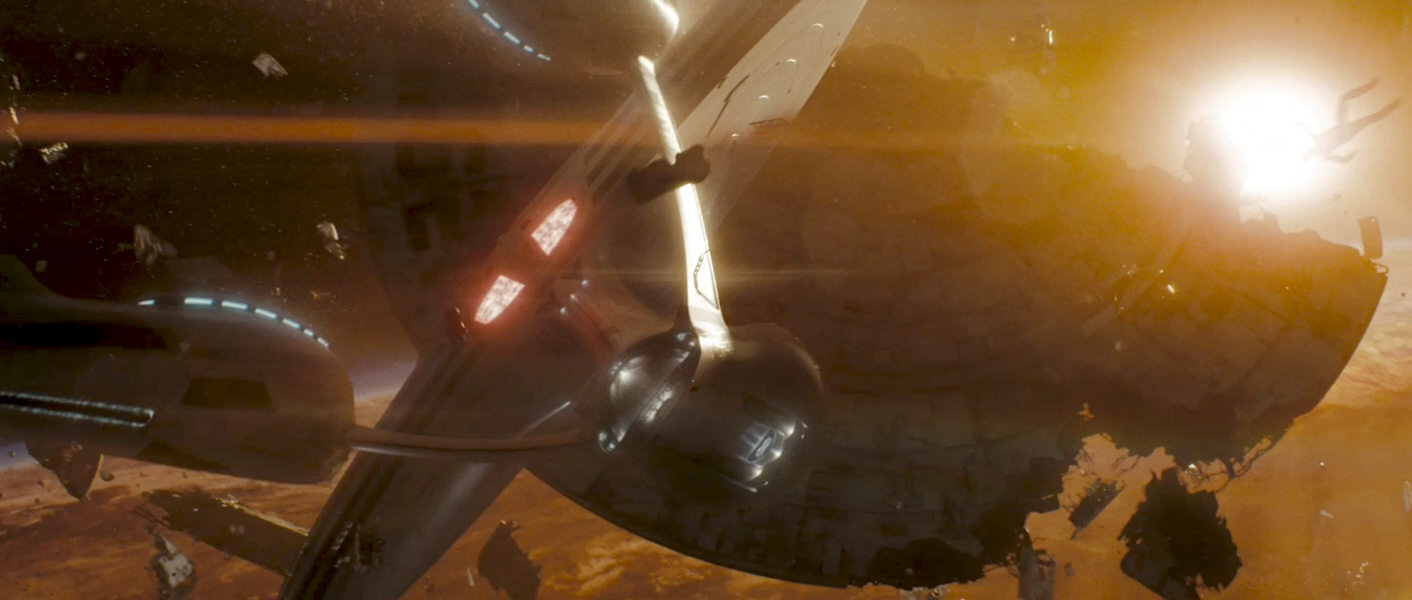
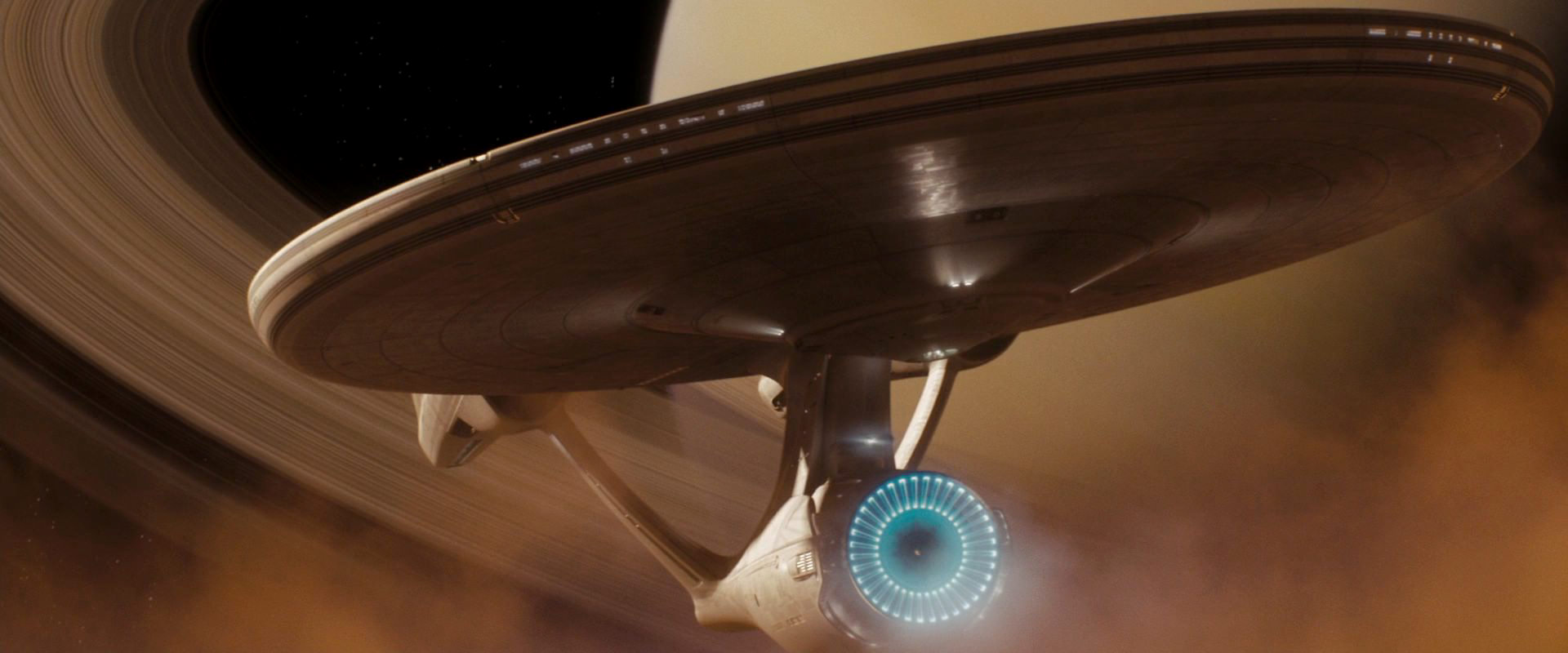
It's interesting on this point that the movie is so casual with things like planets and civilizations themselves, despite the use of Saturn: no fundamental break is seen between humanity on Earth and humanity in space, between the stars. And this brings me, finally, to Spock and black holes themselves--the real enemy of the movie. These puncture space and take away representation (though they also weirdly--because the plot needs to begin--seem to allow passage from the alternate Trek universe... such clunkily inconsistent physics doesn't even pose a problem for the movie but seems all the more to tie things together without really doing so--the typical formal postmodernist move), and they only work if space has become so very thick and bodily such that we can see this as threatening, sad, or profound. So back on the level of content (that is, form), within the plot, this is precisely what gives Spock himself something new, something only somewhat interesting: trauma. While this makes Spock into a different character altogether, this seems to me to be the most hackneyed way of doing so, since the non-representation of the death of of six billion people and their entire civilization in all its rich complexity seems more a formal requirement of the film--given its pure aim to be different--than anything really thought-provoking for either the character or us. Or maybe it provokes some thought, but this thought is about representation itself rather than any of the more substantial things (legacy, memory, social structure, the alien--remember, Vulcan was the first alien contact humans had, according to the canon) that might appear in further movies (and again, this minimal affirmation is all that the movie is after here). Here, they seek to give new meaning to the old Vulcan dilemma itself, as if it weren't rich enough (with all its racial overtones) beforehand, and this makes such a complex exploration of what this all means take the mere form of yet another prelude to action (big statues, once signifying something, are more interesting because they come crashing down on a poor figure as Spock rescues the Vulcan High Council).
In the end, if you think that this overcomplication does indeed invest the movie with some less formal content, you might be right. It certainly ends up, through all these maneuvers used to extricate itself without extricating itself from the canon and series, as perhaps a more complex meditation on revisiting older aspects of franchises than some of the more recent comic book restart movie-epics. But then again, it also doesn't, in some sense, since this is again all tied up much too neatly: one has to ask whether one wants this affirmation to be so minimally and formally represented--and there only by absence--rather than played out in a richer plot integrating the achievements at the level of the medium itself. And this not in a future film, but in the future of this present one.
Thursday, December 25, 2008
A Charlie Brown Christmas
 It's been said a lot that the adventures of Charlie Brown are existentialist in nature. No doubt that's right on, but I just want to reflect a little on some other aspects that make A Charlie Brown Christmas such a successful and appealing existentialist vision of Christmas. Apologies in advance for inconsistencies: I've had a bit of nog.
I look here at the Christmas special not only because it's Christmas Eve, but because ultimately I find it more interesting than the comic strips--as good as they are. And I do this because I think others feel the same way. Why, though? I think it is because the extended narrative allows Charlie Brown to come into focus more than he can in the strips. The plot revolves so intensely around what Charlie Brown is, what he is about, that it becomes much more intriguing and hilarious than if it remained as disconnected and jokey as the strips are. What I'm getting at is that this Christmas special, which has captivated people for so long, is so interesting because it has enough room to make its narrative identical to the life of a character. Or rather, since comic strips do this already, playing characters off of each other, the specials allow a character's life to become narrative.
But here is the crucial thing. The special does this not by making the Charlie someone in need of development, as is so common in larger narrative structures (think of Dickens' Scrooge), but by making him a void, a nothingness, that pulls through the story and fundamentally stages its having no basis. That is, the narrative reduplicates the problem that will be eventually attributed to Christmas but which is really one of the transfer from a comic strip to a more life-like (because more narrative, more flowing, more progression-based, more cinematographic) medium: why make the transition? Why, that is, not just remain disconnected? Why try to achieve coherence? Things have no intrinsic meaning, so why search for them out there? What is gained? There is no meaning to it, at bottom, and its progression, its life-likeness, is only one that can be based on this fact!
What I'm saying is that the narrative is ironic--it has some distance to itself, and this is caused by its inserting a void in the middle of it. Taking away its own basis for being, it is. The movie then dramatizes this ungrounding of its own unfolding: first and foremost by encountering psychoanalysis. The scene at the doctor's booth with Lucy is infamous, of course. But what is less remarked about is how actually helpful Lucy's advice is. I mean the first advice, before she suggests "involvement." This advice is labeling the problem: "if you have a problem, we can label it," she says. Now, one can hear this mockingly: all psychoanalysis or therapy in general does is give you a name for something--it pretends to give you something more than a name but it just leaves you empty-handed. But what this does not factor in is how a name can be precisely without content, and therefore allow you to deal with structuring your experience rather than engaging with it directly--exactly what Charlie Brown needs, since he approaches experience from this ironic distance. In other words, a name can serve to structure what you feel might, in the end, either have or not have an essence, a meaning behind it: it structures this indeterminacy itself by giving you something that you can approach it with, instead of having your indecision about it infect everything you are doing. Charlie refuses to compartmentalize in this way, of course. But I have not heard any better description of the theraputic value of structuralism than what Lucy says here.
Next is the play. What is interesting here is that one really does begin to identify with the other characters: Charlie brown does look like an annoying idiot in his reading out of the "director's signs" or whatever they are. One understands more acutely that the problem he has is not just one of depression, but one of ideals: there is nothing left to do properly, since it is all meaningless--and yet he denies that anything can be done about this indeterminacy except substituting other meanings. He doesn't see, that is, the structuralist way out of this problem. He doesn't have to take this route that we're forcing on him, of course--and indeed his denial keeps him tied more honestly to his sense of being a void. But here, at the play, you see suddenly and more viscerally than before the consequence of this: what you see is that this squanders the real excitement everyone has for Christmas, even if they do not understand its meaning or lack of meaning, even if they remain noncommittal or ambivalent to it when pressed hard. One sees that the search for meaning, even when carried out ironically, can overlook some things, which might indeed have more value than the plight of your tiny ego (no matter how big your round head is). In short, holding on so seriously to this search can make you a blockhead.
Then there is the selection from 2 Luke of Linus, at the point at which the play totally breaks down for Charlie:
And there were shepherds living out in the fields nearby, keeping watch over their flocks at night. An angel of the Lord appeared to them, and the glory of the Lord shone around them, and they were terrified. But the angel said to them, "Do not be afraid. I bring you good news of great joy that will be for all the people. Today in the town of David a Savior has been born to you; he is Christ the Lord. This [hoc] will be a sign [signum] to you: You will find a baby wrapped in cloths and lying in a manger." Suddenly a great company of the heavenly host appeared with the angel, praising God and saying, "Glory to God in the highest, and on earth peace to men on whom his favor rests."
It's interesting: I always found this part of the movie a bit heavy handed, mostly just because of the fact it was from the Gospel in general--in a movie that's already a bit too Christian. But over the last year or so, when I've seen it, I've been much more intrigued about the choosing of this particular passage rather than any other. What's odd to me is that Linus doesn't quote anything more definite, since he seems quite content in his belief. But on a certain level, the passage makes sense: interpreted quickly, is precisely about non-meaning and belief, the being terrified in front of an event, and yet the continuance on in spite of the terror towards worship. It is precisely about terror in the face of what should be believed, precisely because it should be believed, and the grace that enduring this moment restores to you in the form of a sign. The angel gives a sign, and it gives one in return for merely standing in front of it, enduring its presence. Thus meaning comes out of non-meaning, in the end: this is the meaning of the appearance of the host, which then basically figures how everything becomes seen in terms of the sign, the sign that is now belief. (It's a real question to me how deep this belief goes: whether one needs yet another sign of something in a religion proliferating with signs--Christianity--seems questionable. Freud investigated this in Moses and Monotheism: signs in Christianity have the function of restoring the minor and animistic gods in pagan religions to monotheism. So they essentially remain superfluous, extra, when compared with the core of the religion, which has a few master-signs in which real representation is at issue: the cross, for example. One could derive the significance of the birth of Jesus from this master-sign--he will end up being the crucified Savior--but that derivation is precisely the proliferation of the sign that restores the pagan and weakens both the sign and the belief that the diluted sign calls into question. More on this later.)
Thus the phrase that sticks in Charlie Brown's head is not one of belief in dogma (although this, like much in Christianity and as I've just noted, becomes dogma thereby), but the bit about a sign--again, nothing intrinsic, nothing that is not arbitrary or ungrounded. For the sign itself has no real referent, I think. One can say that in "For this will be a sign to you," the "this" refers to Jesus, or, at one remove, the "great joy." But the this, the hoc, isn't really clarified enough to say this definitely. And this reduplicates what is going on in the passage: allowing this non-determinate non-meaning to appear, allowing it to appear despite one's disbelief in it, or terror in front of it, foregrounds the belief itself and then imbues everything with proper meaning. And indeed this is what happens to Charlie when he recalls the phrase, even though the word "sign" still doesn't refer to anything. The arbitrariness is made to function for belief precisely in its arbitrariness. (I'll clarify this more in a few days.)
But then this all collapses when the tree falls over. And indeed, it would be too neat if things were just in terms of this interpretation. What has to happen is that this personal narrative must become social: this is the real meaning of the end, in which they kids dismantle the decked-out house and then put it all on the fallen tree. For me, though, this doesn't really remain a positive call for social change, a sort of wide acceptance of what in essence is Christian, even in an existential way. What is more interesting to me is the failure of this individual adventure of Charlie Brown in terms of his feeling like he knows the arbitrariness of the "sign." That is, what I think we get at the end is not a call for everyone to find out their own relation to Christmas like Charlie Brown did--which is, I think, Schulz's intention--but a real refiguring of how even the form we think the sign will take can be mistaken. The form of the sign, for Charlie Brown, was not something individual: it was not something personal, as he said before he decorated the tree, now expecting it to give him meaning out of its non-meaning ("Linus was right, I'll show them it can be a beautiful tree" or something to that effect). The meaning will end up, unexpectedly, being a social one--that's the form (one unexpected form) the sign can take. So the upshot is not that we have to all undergo this existential journey, conquering the meaninglessness by seeing it itself as meaningful, but by figuring out how prolific, how expansive the other forms this meaningfulness can be--in short, how we can't expect them, and how primarily they can be in the form of the people looking out for one of its members.
Again, apologies for the nog-writing, but I'll clear this up in the next few days. These points have been made often, of course, but I just wanted to direct them in certain ways, in case this was interesting. Also perhaps in a little bit I'll put something up about Festivus! Regardless, Happy Holidays!
Monday, December 22, 2008
Burn After Reading: a reading
 I'm surprised that so many reviews I've seen of Burn After Reading mistake it for, in the normally quite discerning words of Manohla Dargis, "a shaggy sendup of ...the espionage flick." I find it to be a rigorous, and hilarious, examination of heterosexual men's sexuality. It isn't just that I've been reading a lot of Freud lately, right? George Clooney's character constructs a dildo machine for his wife, for Christ's sake! And yet the closest I've seen a critic come to this is in saying the film is a meditation on the loneliness of being single and growing old.
For me, though, this is a film about being paranoid about your penis and the masculine sexual demands that heteronormative culture says it implies. This demand is twofold and a cliche: 1) fulfill your partner, 2) don't let this fulfillment sap your potency. One could see it as almost as a rehashing of Freud's "On the Most Universal Form of Degradation in Erotic Life." But in a way the film deals with the fact that this demand is, precisely, getting a bit old. Ergo paranoia: what do you do when your only scheme for dealing with your masculinity, of making sense of it, is verging on rejecting reality?
And this cliche, this getting old of the thing, is caused of course simply by the existence of women--women who, from the men's perspective, "know" it, who are getting tired of it, who are playing off of it. Thus the men feel the demand not only of the demand, but the need to get over the demand to actually deal with the women, who know. In reality, the women perhaps simply have desires of their own. But this desire itself is figured by the men as knowledge of their crisis, a knowledge that makes them paranoid and unable to see that this desire could be satisfied quite simply--perhaps (!) in a way that is actually unrelated to their crisis. This is the genius of Frances McDormand's acting, which appears narcissistic only because it expresses the simplicity of the goal--to have a desire of their own, even if it is superficial and aimed towards being attractive to men--a simplicity that men, wrapped up with their dicks, can't recognize. In this respect, it's shocking that Dargis would be so blind to (or, rater, identified with) the male gaze of the film, and verge on misogyny in describing McDormand's character as "a cruelly unflattering character whose narcissism is matched only by her witlessness."
Perhaps this is due to the way we perceive--now--anything dealing with U.S. national security: pretty much asexually. We can see the difference if we look at the old (or even new) Bond flims, which we wouldn't describe as movies about "intelligence" (though the extremely boring seriousness of their sex--from the point of view of its heterosexual male gaze, since, lord knows, Daniel Craig provides other possibilities for many people--is also, I think, an indication that anything even coming close to national security is viewed less sexually). Intelligence in combat is for us lacking in libido: it still doesn't make sense for us--though perhaps it should, and perhaps it's beginning to be possible--to say that a terrorist attack is brought about because of a (sexual) desire. But here is where, I think, the film comes in most interestingly. The film sees the intelligence community itself as men's solution to this problem of woman's desire. That is, the bureaucracy acts not unlike Harry's (Clooney's character, which I think is just a Zizek-impression) dildo machine for his wife: a way of dealing with women, a way of getting them to finally just shut up about their desires. It isn't surprising that the film ends with McDormand's character taking money (for cosmetic surgery) from the bureaucracy, in return for a promise to "sit on it"--i.e. not disclose any of the intelligence communities' blunders that her desire has created. We have to hear this old phrase differently after seeing the machine. All in all one could say that the film is a blistering critique of people clinging to the last vestiges of heteronormativity--which I think includes many of these critics who want to pass it off as a spy-spoof! For it also isn't a mistake that the film ends with this precise non-knowledge about what it's own activity is about: the J.K. Simmons' character, a CIA superior, closes the file reflecting on "what we've learned." His answer is not surprising once we know who this "we" is: "nothing." The positive structure produced out of this paranoia over women's desires, the CIA itself, doesn't in the end know what Frances McDormand's character wants, except to, when offered the right money, "sit on" what she knows. Nothing, he says, therefore, but adds something else: "nothing, except not to do it [which for us now means, heteronormativity] again."
One final note on Brad Pitt's brilliant, hilarious, and infinitely charming performance: one reason we love him is that he is the only person to escape all these dynamics. Ironically--and therefore--he is one of the most confidently (not paranoid) male characters there (John Malkovich's character comes close to this at times, but I won't get into that). But--not to give away too much--there are prices to be paid for this: we can't really say he escapes anything, in the end. However, it is interesting to note that basically he retains the same disposition as McDormand's character, and yet we heap upon her--not him, who is probably equally guilty of them--the charges of narcissism and witlessness, and interpret what happens to him as the crucifixion or sacrifice of a hero instead of the justice appropriately meted out to a co-conspirator. To me, this seems the most concrete confirmation that this is a film about men's heterosexual desire, and more generally about sexuality, which can only be misrecognized if you see it as a spy-spoof.
Monday, November 17, 2008
"No third person"
"In Treatment," the new show on HBO based on the amazing Israeli show "Betipul," transforms what we who study narrative understand by "character." It does this because it allows us, to an impressive and perhaps unheard of degree, to be the "third person" that Freud dreams up in the following passage from The Question of Lay Analysis: Freud, trying to familiarize someone who has never really dealt with psychoanalysis legally with what psychoanalysis does, thinks up a short cut, as it were:
It is to be regretted that we cannot let them be present as an audience at a treatment of this kind. But the "analytic situation" allows no presence of a third person. Moreover the different sessions are of very unequal value. An unauthorized listener who hit upon a chance one of them would as a rule form no useful impression; he would be in danger of not understanding what was passing between the analyst and the patient, or he would be bored. For good or ill, therefore, he must be content with our information [that is, a theory of what psychoanalysis does which Freud will present in the coming pages], which we shall try to make as trustworthy as possible.
-The Question of Lay Analysis, 3
That is, it is regrettable that those who have to make a legal decision about the status of psychoanalysis in Austria in 1926 (whether to allow it to be practiced only by certified medical professionals or not) can't simply go and watch a psychoanalytic session or two. This would give them firsthand experience with what they are legislating about. But this can't be so, because psychoanalysis forbids the third person, the witness to analysis, and tries to close off the dissemination of its proceedings as little as possible. This is not because it is inherently something that happens in secret: it is because, as Freud emphasizes, that it is a process that takes place over many many sessions, connecting together, as it were, very many disparate fragments over a long period of time. One can't just stop in on a session and actually be witness to anything--and if they are, it is probably because this witness misconceives the nature of what he is seeing (what he sees would make a different sense if it were placed back in the whole, where it belongs).
In "In Treatment"--and I think this might be less the case with "Betipul," for cultural reasons (that is, the status of therapeutic discourse in the US compared to Israel)--in this show, we get this shortcut. That is, we get to be the third person Freud talks about. And, moreover, we get the full danger that Freud speaks about here which comes with being this third person: we actually only get to witness the fragments of a process that takes a long, long time.
Now, obviously, the show tries to remedy this by following up these patients from session to session. Moreover, it tries to reconstitute the therapist's own experience by airing every day for a whole week, each time with that day's patient. But fundamentally, we are only getting fragments of a longer chain each time we sit down to watch the show. This means that each time we watch it, we are exposed to the danger--and this is the danger itself--of taking one of these fragments as representative of the whole. In other words, each time we sit down to watch the show, we have to accommodate the "very unequal value" that Freud ascribes above to the sessions, not unlike the therapist himself.
What this means, though, is that we can't make the sort of judgments we normally make about character in television shows. That is, we can't ask ourselves questions like we do when we watch "Friends," say (or, in a more dramatic and recent mode, "Lost"), which wonder whether we really "like" Chandler or Joey better (or "trust" Kate or Sawyer). In short, we can't "like" a character in the way we normally do. This also has its obverse: we can't hate a character that we normally would hate. In short, we have to suspend our judgement.
Or, better (because suspension is only a negative phenomenon), we have to judge the characters according to a completely different set of criteria. So in the show that I have posted above, I would normally hate Alex. He is overbearing and intense, and tough to listen to for roughly twenty-five minutes. But, at the same time, I can't (and don't) do this, because I know that his utterances are in question as to whether they really want to be made or not: Alex comes to therapy for the reason that he doesn't, at some level, trust himself, or loves or hates himself too much or too little--so it doesn't make sense to try and once more to hate or love him, or trust or distrust him, because he himself is already at this remove from himself. Thus everything being said, even though it is forceful and unnerving, has this particular provisionality to it because in the analytic setting, character itself comes into question: one doesn't have a character that one likes or dislikes, because the treatment is precisely trying to correct that character. Something is wrong, in other words, and this makes character less something someone is as something one performs. And if it is performed--to state it yet another way--what sense does it make to say you like it or not?
One can only have this sort of judgement over the course of many weeks, and even then it will not be a judgement about the particular character, but about the course this character's analysis has taken. This is the odd phenomenon that the third person produces in analysis, and what, at some level, exempts therapy from the sorts of evaluations that the law, for example, will make about its status. Or at least this is what Freud is getting ready, with this passage, to claim. But what is interesting is that treatment is also exempted from the narrative standards of the medium through which we are able to witness it in the first place--this is what "In Treatment" brings about. In other words, what is interesting is that if there were any third person (that is, even if he weren't connected with the law, but were, as he is with this new show, just an average TV viewer), there could be no judgement at all about the session, either. I might expand on this later, but I think it is really interesting, and makes the episode above a particularly interesting one to watch (as this is the first time you are introduced to this character). In "In Treatment" this particular disruptive feature of the witness to analysis is brought out even more by the fact that the therapist (Paul) is also analyzed (we are witness to this too), and so we can't even judge him unless we do it in this more holistic sense--that is, where we judge how his analysis (and all the analyses he himself is carrying out) as a whole is progressing, not him himself.
Everything, to sum this all up, suddenly has "unequal value."
Sunday, March 23, 2008
The future on film: Blade Runner and Children of Men
I find it extremely odd that Alfonso Cuarón would say that he wanted Children of Men to be, in the style of the future world that it depicted, the "anti-Blade Runner," and that he had to keep rejecting his art-department's drawings because they looked too "futuristic." This goes along with the revulsion against a fetishization of the fantastic and the futuristic that we find in Cuarón's films (even in his Harry Potter, where it is extremely refreshing), but I don't think that the opposite of this, in the world of sci-fi, would be Blade Runner.


While Blade Runner did go to Syd Mead and got extremely stylish and "fururistic" designs back, Ridley Scott's integration of the designs into the movie is arguably almost a thorough as Cuarón's. I think Cuarón would explain his approach as purely against the Blade Runner aesthetic or style primarily because he wants to have his films be more immediately relevant and political. But what this overlooks is that Blade Runner was and is still felt as extremely immediate and relevant, and even in some of the issues that Children of Men perhaps thinks that it is broaching. Overpopulation, immigration, environmental degradation and biotechnology (in the forms of grafting, cybernetics of course, organ farming, and even reproduction) all are crucial to the film, and get placed into its world almost as thoroughly.
Of course, there aren't any neon umbrellas in Children of Men. But to think that the aesthetic of the two worlds are contrary is a mistake, and perpetuates a sort of willing ignorance and indifference to the history of films that depict the future and participate in that genre we call science fiction--as if a sci-fi film can only be immediately relevant if it opposes its own depiction of the futuristic. This seem to fetishize the effort of Cuarón more than any of his attempts to resist this with his alleged verité: one can think that one is entering a newer depiction of the future than any other if one watches it with his comment in mind. Thankfully, one doesn't have to: and this is what makes Children of Men a triumph. What the film loses in its alleged immediate impact on issues that are "relevant" (terrorism, overpopulation, etc. etc.), it gains in contributing to the genre. This isn't the case in every film of course or even perhaps in most, but it is here.
Why? Because, as Blade Runner shows, a sci-fi film like this will be relevant anyway. This is because the genre has a closer relation to time and historicity than perhaps any other: even if a sci-fi film is placed in the past, because it contains a marked and explicit alterity with respect to our world (I say "marked and explicit" because of course any film's world has some otherness by virtue of its constructedness), the constitution of its environment will pose the question "what if our history were different so as to be like it?" This goes also for anything supposedly occurring in the present day.
By virtue of the mistaken assumption (taking Cuarón at his word) that it was going to resist the genre, Children of Men exemplifies with stunning brilliance the effect of one of the genre's innermost principles. This is because the toning down of the "futuristic," while perhaps producing greater contemporary relevance, the side-effect is produced of prompting a greater integratedness of the film in the world that it is depicting and exemplifying its historicity more. In other words, the verité, toned-down nature of the depiction does not necessarily produce relevance, but most definitely produces a sort of fullness of depiction of the everydayness of its world. This brings out that alterity more with respect to time, because the time in the film itself, its own history, is constituted with a greater density. Thus the modest quality of the futuristic details (the graffiti, the style of advertisements about getting fertility tested--which is similar to some you see now--the degradation of the trees by acid rain, etc.), and the high degree of the preservation of current technologies in the film (the London buses have the current interiors, and London itself is largely unchanged in architecture, etc.), have the wonderful effect of being able to do a lot of the traditionally sci-fi work in the movie: again, like Blade Runner, not because they help the movie become more immediate or closer to our present, but because they make it interact with our present with that historicality that is most characteristic of the depiction of alternate worlds in science fiction.
Friday, December 7, 2007
Postscript to the post on Arrested Development
 Ah! I forgot the most important thing I was going to say this morning regarding the show: I'm sure it can be pulled off, but just try and picture for yourself an Arrested Development movie! This is being thrown around as a possibility lately, thanks to the frustration and infinite love of the show in Jason Bateman, but, in the end, do you think it could have the same effect? The jokes are built up over long, long periods in the series, and seeing them recur in installments is one of the satisfactions of watching it unfold! Could this happen in a movie? Formally, I'm suggesting, it would have to just be different: and this necessity is the indication that the show really grasped something crucial about the structure of the TV program when it was on.
Arrested Development and the form of TV
 I'll develop this more some time, but one can say that Arrested Development was so amazing precisely because it grasped the form of the television show more precisely than any other program, ever. What I mean by "grasped" is that it did not just combine the sitcom and the drama, Seinfeld and Larry Sanders, but internalized it, made the tension of the two the motor of its humor. Just look at the following exchange:
Gob: Busy?
Michael: Actually, I'm--
Gob: Check this out, my lips don't move. You call me up to the stand, say something like, "Who's this little friend," and he'll say:
Franklin (outfitted with Judge Reinhold magazine-ad-recording-device): My name is Judge.
Gob: Who's name is Judge?
Franklin: My name is--
Gob: That's a silly name!
Franklin: Judge. My name--
Gob: Yes I am judging your name! It am silly!
Franklin: Is--
Gob: Oh! Now you're correcting my grammar!
Michael: Gob, not gonna put Franklin on the stand. And you're lips are moving just a little bit.
Franklin: Judge.
Gob: He's right. His name is Judge now.
What's so amazing about this--besides Will Arnett's acting, which is absolutely unbelievable--is that all we get is the same sentence repeated different ways. But not in the form: in the content. This is what is so striking, and so hilarious, and so typical of Arrested Development: here we have in miniature how the program picks up where it leaves off and yet always repeats itself, how it gets caught in (or catches itself up in) a logic of repetition that actually manages to go nowhere.
To be a bit clearer, what the sitcom or the drama always plays off of is that the show repeats with a difference the plot and the characters and the general look of the show with each new episode. In this repetition, jokes are made or, if it is a serious drama, character development or emotion gets enacted. But what we get here is the logic of the dialogue, the humor, the jokes, mirrors the logic of the sitcom and drama itself--it internalizes this form to the utmost and then throws it back at us, or rather at the program, and becomes the rule of its development. Everything has been repeated even before it comes on the scene, so that when it appears, it only enacts a pas de thèse, a thesis, a positing of something, that at the same time as it takes this step, has already consigned itself to not take a step. Out of this stepping/not-stepping, this running in place, we get the humor of the show.
If I used a Derridian play on a phrase, pas de thèse, to describe this, it is because this is a Derridian show more than any other. He was famously asked whether Seinfeld exhibited deconstruction, because it was ironic, to which Derrida responded with a no. Indeed, as he said, no television show is deconstruction--what an absurd question to ask!--but there is a logic within the text of a show that can enact certain structures that one finds characteristic of Derrida's work--particularly his work on Hegel. The auto-affection or running in place of the continual repetitiveness in Arrested Development might be a form of Derridian dialectic. I think at least trying to pair the two in an effort to show why exactly (in a Freudian way, similar to his book on jokes) Arrested Development is absolutely hilarious can indeed illustrate the general tenor of certain things he gets at.
This all revolves around the simple question of how we could actually get a new show each week, given the fact that in each show, a lot of it of it is watching previous shows!
Thursday, November 22, 2007
Zapruder and Benjamin
 A great new article by Max Holland on the film documenting the Kennedy assassination made by Abraham Zapruder suggests that the first bullet fired at Kennedy (of three bullets) was shot within a gap in Zapruder's filming. Zapruder began filming before Kennedy's Lincoln had made it onto the main road. He turned it off and then, according to Holland, the first shot (that missed) was taken. Turning it back on, we then see the two other shots fired at Kennedy. Most viewings of the film just pick up the tape at the point where Zapruder turned the camera back on. Holland concludes:
If this belated revelation changes nothing from one perspective — Oswald still did it — it simultaneously changes everything, if only because it disrupts the state of mind of everyone who has ever been transfixed by the Zapruder film. The film, we realize, does not depict an assassination about to commence. It shows one that had already started.
The "transfixing" that goes on when we look at the Zapruder film, is then directly linked to the assassination being a structural part of the film--and, one could say, the structure of any film in general. What is so interesting about documentary films like that of Zapruder's is the fact that they always are viewed like evidence. The film here itself betrays this general quality of film because it was itself used for evidence.
This is similar to what Benjamin has to say about the structure of anything filmed or photographed: photos are photos of a crime. That crime, for Benjamin, is always murder--or assassination. Why? Because photos always document the death of experience, and thus are always already photos of dead people. To be a little more precise: photos and film always capture an experience that is staged for the camera. This doesn't mean that people in films and photos are always posing for the camera--Kennedy in this instance obviously is not--but that reality is becoming filmable and not what the camera is supposedly supposed to capture: "authentic" experience. This experience, then, always lies outside the filmable--in the Zapruder film, experience (and specifically the real experience of the assassination) lies within the gap in the filming. In the end, this is what is appealing to Benjamin about the  photos of Atget--as he says in "The Work of Art in the Age of its Technological Reproducibility" they display unabashedly the structure of the photo as the death and murder of experience:
The cult of remembrance of loved ones, absent or dead, offers a last refuge for the cult value of the picture. For the last time the aura emanates from the early photographs in the fleeting expression of a human face. This is what constitutes their melancholy, incomparable beauty. But as man withdraws from the photographic image, the exhibition value for the first time shows its superiority to the ritual value. To have pinpointed this new stage constitutes the incomparable significance of Atget, who, around 1900, took photographs of deserted Paris streets. It has quite justly been said of him that he photographed them like scenes of crime. The scene of a crime, too, is deserted; it is photographed for the purpose of establishing evidence. With Atget, photographs become standard evidence for historical occurrences, and acquire a hidden political significance. They demand a specific kind of approach; free-floating contemplation is not appropriate to them. They stir the viewer; he feels challenged by them in a new way.
One could easily see that Benjamin would have similar things to say about the Zapruder film and how it challenges us, transfixes us. If this all sounds a bit too "theoretical," ponder this: isn't that which is fascinating about the Zapruder film the fact that the camera is only one of the devices that is pointed at Kennedy at this moment, tracking his movements? That is, that what gets viewed (from a different perspective, of course) in the scope of a rifle pointed at Kennedy would look the same way as the film?
Subscribe to:
Posts (Atom)