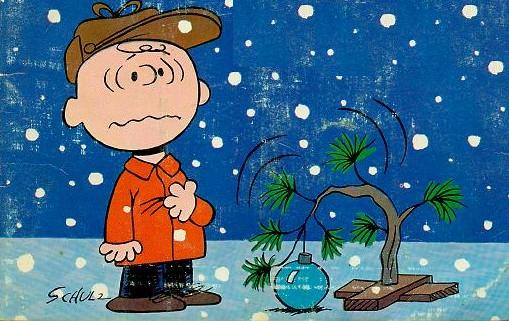
 It's been said a lot that the adventures of Charlie Brown are existentialist in nature. No doubt that's right on, but I just want to reflect a little on some other aspects that make A Charlie Brown Christmas such a successful and appealing existentialist vision of Christmas. Apologies in advance for inconsistencies: I've had a bit of nog.
I look here at the Christmas special not only because it's Christmas Eve, but because ultimately I find it more interesting than the comic strips--as good as they are. And I do this because I think others feel the same way. Why, though? I think it is because the extended narrative allows Charlie Brown to come into focus more than he can in the strips. The plot revolves so intensely around what Charlie Brown is, what he is about, that it becomes much more intriguing and hilarious than if it remained as disconnected and jokey as the strips are. What I'm getting at is that this Christmas special, which has captivated people for so long, is so interesting because it has enough room to make its narrative identical to the life of a character. Or rather, since comic strips do this already, playing characters off of each other, the specials allow a character's life to become narrative.
But here is the crucial thing. The special does this not by making the Charlie someone in need of development, as is so common in larger narrative structures (think of Dickens' Scrooge), but by making him a void, a nothingness, that pulls through the story and fundamentally stages its having no basis. That is, the narrative reduplicates the problem that will be eventually attributed to Christmas but which is really one of the transfer from a comic strip to a more life-like (because more narrative, more flowing, more progression-based, more cinematographic) medium: why make the transition? Why, that is, not just remain disconnected? Why try to achieve coherence? Things have no intrinsic meaning, so why search for them out there? What is gained? There is no meaning to it, at bottom, and its progression, its life-likeness, is only one that can be based on this fact!
What I'm saying is that the narrative is ironic--it has some distance to itself, and this is caused by its inserting a void in the middle of it. Taking away its own basis for being, it is. The movie then dramatizes this ungrounding of its own unfolding: first and foremost by encountering psychoanalysis. The scene at the doctor's booth with Lucy is infamous, of course. But what is less remarked about is how actually helpful Lucy's advice is. I mean the first advice, before she suggests "involvement." This advice is labeling the problem: "if you have a problem, we can label it," she says. Now, one can hear this mockingly: all psychoanalysis or therapy in general does is give you a name for something--it pretends to give you something more than a name but it just leaves you empty-handed. But what this does not factor in is how a name can be precisely without content, and therefore allow you to deal with structuring your experience rather than engaging with it directly--exactly what Charlie Brown needs, since he approaches experience from this ironic distance. In other words, a name can serve to structure what you feel might, in the end, either have or not have an essence, a meaning behind it: it structures this indeterminacy itself by giving you something that you can approach it with, instead of having your indecision about it infect everything you are doing. Charlie refuses to compartmentalize in this way, of course. But I have not heard any better description of the theraputic value of structuralism than what Lucy says here.
Next is the play. What is interesting here is that one really does begin to identify with the other characters: Charlie brown does look like an annoying idiot in his reading out of the "director's signs" or whatever they are. One understands more acutely that the problem he has is not just one of depression, but one of ideals: there is nothing left to do properly, since it is all meaningless--and yet he denies that anything can be done about this indeterminacy except substituting other meanings. He doesn't see, that is, the structuralist way out of this problem. He doesn't have to take this route that we're forcing on him, of course--and indeed his denial keeps him tied more honestly to his sense of being a void. But here, at the play, you see suddenly and more viscerally than before the consequence of this: what you see is that this squanders the real excitement everyone has for Christmas, even if they do not understand its meaning or lack of meaning, even if they remain noncommittal or ambivalent to it when pressed hard. One sees that the search for meaning, even when carried out ironically, can overlook some things, which might indeed have more value than the plight of your tiny ego (no matter how big your round head is). In short, holding on so seriously to this search can make you a blockhead.
Then there is the selection from 2 Luke of Linus, at the point at which the play totally breaks down for Charlie:
And there were shepherds living out in the fields nearby, keeping watch over their flocks at night. An angel of the Lord appeared to them, and the glory of the Lord shone around them, and they were terrified. But the angel said to them, "Do not be afraid. I bring you good news of great joy that will be for all the people. Today in the town of David a Savior has been born to you; he is Christ the Lord. This [hoc] will be a sign [signum] to you: You will find a baby wrapped in cloths and lying in a manger." Suddenly a great company of the heavenly host appeared with the angel, praising God and saying, "Glory to God in the highest, and on earth peace to men on whom his favor rests."
It's interesting: I always found this part of the movie a bit heavy handed, mostly just because of the fact it was from the Gospel in general--in a movie that's already a bit too Christian. But over the last year or so, when I've seen it, I've been much more intrigued about the choosing of this particular passage rather than any other. What's odd to me is that Linus doesn't quote anything more definite, since he seems quite content in his belief. But on a certain level, the passage makes sense: interpreted quickly, is precisely about non-meaning and belief, the being terrified in front of an event, and yet the continuance on in spite of the terror towards worship. It is precisely about terror in the face of what should be believed, precisely because it should be believed, and the grace that enduring this moment restores to you in the form of a sign. The angel gives a sign, and it gives one in return for merely standing in front of it, enduring its presence. Thus meaning comes out of non-meaning, in the end: this is the meaning of the appearance of the host, which then basically figures how everything becomes seen in terms of the sign, the sign that is now belief. (It's a real question to me how deep this belief goes: whether one needs yet another sign of something in a religion proliferating with signs--Christianity--seems questionable. Freud investigated this in Moses and Monotheism: signs in Christianity have the function of restoring the minor and animistic gods in pagan religions to monotheism. So they essentially remain superfluous, extra, when compared with the core of the religion, which has a few master-signs in which real representation is at issue: the cross, for example. One could derive the significance of the birth of Jesus from this master-sign--he will end up being the crucified Savior--but that derivation is precisely the proliferation of the sign that restores the pagan and weakens both the sign and the belief that the diluted sign calls into question. More on this later.)
Thus the phrase that sticks in Charlie Brown's head is not one of belief in dogma (although this, like much in Christianity and as I've just noted, becomes dogma thereby), but the bit about a sign--again, nothing intrinsic, nothing that is not arbitrary or ungrounded. For the sign itself has no real referent, I think. One can say that in "For this will be a sign to you," the "this" refers to Jesus, or, at one remove, the "great joy." But the this, the hoc, isn't really clarified enough to say this definitely. And this reduplicates what is going on in the passage: allowing this non-determinate non-meaning to appear, allowing it to appear despite one's disbelief in it, or terror in front of it, foregrounds the belief itself and then imbues everything with proper meaning. And indeed this is what happens to Charlie when he recalls the phrase, even though the word "sign" still doesn't refer to anything. The arbitrariness is made to function for belief precisely in its arbitrariness. (I'll clarify this more in a few days.)
But then this all collapses when the tree falls over. And indeed, it would be too neat if things were just in terms of this interpretation. What has to happen is that this personal narrative must become social: this is the real meaning of the end, in which they kids dismantle the decked-out house and then put it all on the fallen tree. For me, though, this doesn't really remain a positive call for social change, a sort of wide acceptance of what in essence is Christian, even in an existential way. What is more interesting to me is the failure of this individual adventure of Charlie Brown in terms of his feeling like he knows the arbitrariness of the "sign." That is, what I think we get at the end is not a call for everyone to find out their own relation to Christmas like Charlie Brown did--which is, I think, Schulz's intention--but a real refiguring of how even the form we think the sign will take can be mistaken. The form of the sign, for Charlie Brown, was not something individual: it was not something personal, as he said before he decorated the tree, now expecting it to give him meaning out of its non-meaning ("Linus was right, I'll show them it can be a beautiful tree" or something to that effect). The meaning will end up, unexpectedly, being a social one--that's the form (one unexpected form) the sign can take. So the upshot is not that we have to all undergo this existential journey, conquering the meaninglessness by seeing it itself as meaningful, but by figuring out how prolific, how expansive the other forms this meaningfulness can be--in short, how we can't expect them, and how primarily they can be in the form of the people looking out for one of its members.
Again, apologies for the nog-writing, but I'll clear this up in the next few days. These points have been made often, of course, but I just wanted to direct them in certain ways, in case this was interesting. Also perhaps in a little bit I'll put something up about Festivus! Regardless, Happy Holidays!

1 comment:
I realize I'm late as the Holidaze are now over but reading this brought about enlightening to this special. I love this special and now I understand a new way in which to see it. Thank you for bringing to light the hidden ideas & identity of signs. -Peanuts fan
Post a Comment