
While Blade Runner did go to Syd Mead and got extremely stylish and "fururistic" designs back, Ridley Scott's integration of the designs into the movie is arguably almost a thorough as Cuarón's. I think Cuarón would explain his approach as purely against the Blade Runner aesthetic or style primarily because he wants to have his films be more immediately relevant and political. But what this overlooks is that Blade Runner was and is still felt as extremely immediate and relevant, and even in some of the issues that Children of Men perhaps thinks that it is broaching. Overpopulation, immigration, environmental degradation and biotechnology (in the forms of grafting, cybernetics of course, organ farming, and even reproduction) all are crucial to the film, and get placed into its world almost as thoroughly.
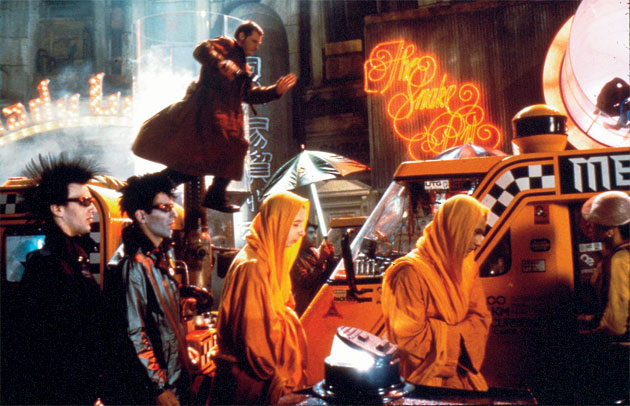
Of course, there aren't any neon umbrellas in Children of Men. But to think that the aesthetic of the two worlds are contrary is a mistake, and perpetuates a sort of willing ignorance and indifference to the history of films that depict the future and participate in that genre we call science fiction--as if a sci-fi film can only be immediately relevant if it opposes its own depiction of the futuristic. This seem to fetishize the effort of Cuarón more than any of his attempts to resist this with his alleged verité: one can think that one is entering a newer depiction of the future than any other if one watches it with his comment in mind. Thankfully, one doesn't have to: and this is what makes Children of Men a triumph. What the film loses in its alleged immediate impact on issues that are "relevant" (terrorism, overpopulation, etc. etc.), it gains in contributing to the genre. This isn't the case in every film of course or even perhaps in most, but it is here.
Why? Because, as Blade Runner shows, a sci-fi film like this will be relevant anyway. This is because the genre has a closer relation to time and historicity than perhaps any other: even if a sci-fi film is placed in the past, because it contains a marked and explicit alterity with respect to our world (I say "marked and explicit" because of course any film's world has some otherness by virtue of its constructedness), the constitution of its environment will pose the question "what if our history were different so as to be like it?" This goes also for anything supposedly occurring in the present day.

By virtue of the mistaken assumption (taking Cuarón at his word) that it was going to resist the genre, Children of Men exemplifies with stunning brilliance the effect of one of the genre's innermost principles. This is because the toning down of the "futuristic," while perhaps producing greater contemporary relevance, the side-effect is produced of prompting a greater integratedness of the film in the world that it is depicting and exemplifying its historicity more. In other words, the verité, toned-down nature of the depiction does not necessarily produce relevance, but most definitely produces a sort of fullness of depiction of the everydayness of its world. This brings out that alterity more with respect to time, because the time in the film itself, its own history, is constituted with a greater density. Thus the modest quality of the futuristic details (the graffiti, the style of advertisements about getting fertility tested--which is similar to some you see now--the degradation of the trees by acid rain, etc.), and the high degree of the preservation of current technologies in the film (the London buses have the current interiors, and London itself is largely unchanged in architecture, etc.), have the wonderful effect of being able to do a lot of the traditionally sci-fi work in the movie: again, like Blade Runner, not because they help the movie become more immediate or closer to our present, but because they make it interact with our present with that historicality that is most characteristic of the depiction of alternate worlds in science fiction.

No comments:
Post a Comment