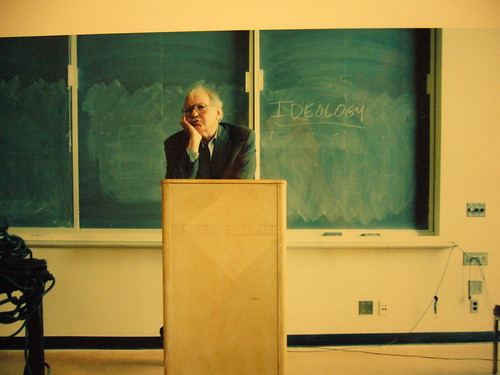
 Fredric Jameson has an excellent article in the Spring (2008) issue of Critical Inquiry which I just got around to reading, and it makes a lot of points that I have been trying to orient myself towards accepting here on this blog. While the article "How Not to Historicize Theory" responds mainly to Ian Hunter, its concerns actually never leave that of Jameson's continuing task: trying to extend the theses advanced in his work on postmodernism and utopia into the most pressing concerns of theory at this moment. This culminates in an amazing look at Bourdieu and a clear-headed rebuttal of the impetus behind pragmatism (which is anything but pragmatic).
If I have been hard here occasionally on people like Spivak and deconstruction, on the one hand, and, on the other, people like Jerome McGann or Stanley Fish and historicism (and the people don't exactly have a direct relationship to the movements here--as I will explain), it is because they all end up arguing from within theory for less of it, a position that Jameson shows here to be quite wrongheaded. This position is not wrongheaded because it is contradictory or hypocritical, as I have (I now see somewhat mistakenly) put it. It is wrongheaded because it makes theoretical endeavors attempt to do away with the types of conversation that theory valuably has started. In other words, this position is pragmatic, if not nihilistic. Now, I don't mean that pragmatism is nihilistic--far from it (I think its one of the most idealistic discourses). I mean that pragmatism--which can be summed up crudely as an effort to find and work within limits, to refine discourse by disabusing its pretensions to truth as correctness--too quickly gets confused with a nihilistic bent which is not pragmatic that nevertheless underwrites pragmatism's efforts. To be a bit clearer: what is desired by people like Spivak or Fish is, at the same time, to set an effective limit for discourse beyond which it is fanciful and has no relation to forceful, meaningful activity (including its own), and to somehow counteract the tendency in theoretical discourse to extend itself out into those fanciful areas. The first effort is pragmatic, the second is nihilistic. And while it is not necessary at all that the second effort occurs at the same time as the first--Rorty is a good example of someone who rigorously keeps the two separate--it usually, in the area of theory, does. It is no mistake that all these recent conferences on "The Death of Queer Theory" or "The Death of Post-Colonialism," in seeking primarily to limit a discourse healthily cannot do so except by talking about its being over with, its being ineffective--and not in the sense of being simply inaccurate, but somehow not even worth anyone's letting it exist anymore. Jameson distinguishes between these two well I think by calling this pragmatism conspiracy theory, and this nihilism cynical reason. The two have a methodological commonality, which is a hermeneutics of suspicion: they think that the effort of interpreting actions or documents or whatever boils down to looking for the pretension to truth at work. This pretension is what gets limited by conspiracy theory or taken away to be killed off by cynical reason.
The threat that makes these people and these discourses do this, as Jameson makes clear, is historicity, or what he calls historicizing. This should be rigorously distinguished from historicism, which tends to be in Jameson's eyes (but does not have to be, like deconstruction) one of those pragmatic conspiracy theories. When a discourse becomes capable of having its conversation recede into the past, and has to confront the fact that it has contributed to the larger structures of the institutions and fields that constitute the position from which it speaks--that is, when it begins to have to take into account how it ensures for itself the right to a discourse, it becomes very skeptical as to whether it can still remain pure. What is problematic for both historicism and deconstruction is that their purity was ensured by their anti-intellectual stance--that is, their critique of the continuous and homogenous narratives and knowledges that dominated their discipline before they arrived. Historicism's solution to this is to generally fall back upon the disciplinary framework itself--which usually makes it appear less cynical or nihilistic than it is--while deconstruction's solution is to insist more and more on the rigor of its method or the radical nature of its politics--which is the same thing as falling back upon the disciplinary framework. Now, this isn't as simple as merely claiming that these discourses are getting a taste of their own medicine--which is to say, that they are confronting the fact that they as discourses only have impetus because they are founded on what they oppose. It is showing that faced with a contradiction, both these discourses don't think that expanding their theoretical practice more and more would produce anything worthwhile--namely, a collective discussion. In short, Jameson's claim is that both these positions have the effect of advocating a sort of resurgence of the individual intellectual, the scholar-hero, the expert. Now, there is nothing wrong with being an expert, except that in the effort to diligently become one, the expert or hero sacrifices the collective interest, the fact that scholarship is also about discussion. That is, what is advocated by these positions is that each of us recede back into our own projects and confront each other when we are done with them, which is, in Jameson's view (and I agree with him wholly here), precisely what is not needed in scholarship that will have to confront the 21st century and its demands. What we need is some sense that we are all speaking, as a discipline, some similar language. What both of these discourses--and mostly these people at the front of them (we should be sensitive to the fact that at this level there are so many exceptions to anything anyone says that the generalizations are usually always unfair--though I don't think this renders them illegitimate, precisely for the reasons I'm outlining now)--what both of these discourses advocate is stepping back into our own private vocabulary.
And this is what is really confusing about them as positions and what makes them more than just instances of hypocrisy or self-hating or getting-a-taste-of-one's-own-medicine. For these discourses started out closer to the pragmatism of conspiracy theory. As such, they usually took the form of identifying large collective interests at work in individual decisions or in the determination of the individual. What this allowed was some sense that there were larger forces at play in all our actions. Thus, there was a hope at least that one could work at the level of this larger collective interest to make things better. The exposure of a collective interest was made in the spirit of changing collective interest. What happens in the sort of cynical use of pragmatism is that we think that we can critique these collective interests by ourselves. Indeed, these acts of exposure (deconstruction, historicism) were, it is now clear to us, not themselves disinterested. So why not face up to the fact that the best work we can do is going to be on the level of individual interest, dictated by the demands of the profession we have now--alas--shaped in our direction? This is what Jameson is describing in his conclusion:
Insofar as conspiracy theory celebrates... collective dynamic and seeks to replace the categories of individual agency with collective ones, it marks the first imperfect step in that direction. Cynical reason, meanwhile, while seeming to strip acts and events of their appearance of disinterestedness, might well pave the way for some ultimate awareness of collective self-interest as such.
-"How Not to Historicize Theory," Critical Inquiry, Spring 2008, 582.
This is not a happy prospect. It describes a crisis. For we should not have to recede back into our own individual works of scholarship in order to see that, in the end, what we really need is some sense of collectivity. This is why we need more theory, precisely in the time in which theory itself is being historicized. We can discuss, together, the historicization, which would give us a sense of where we are. The idea that theory is confused is probably a myth still perpetuated by cynics: it has an immense vocabulary to deal with all sorts of novel ideas--and if there is confusion, why can't it be discussed? Or at least, why not risk that this is the case? We have to dispel, perhaps, first and foremost the idea that theory is muddled. That it is not rigorous, that it is not a legitimate way to think about things. It presupposes precisely that we are all speaking languages no one else can understand. Or at least these misunderstandings, this muddledness itself, would not be able to take place collectively and prove to be useful. The time of wondering whether theory is legitimate or rigorous--of finding ways of making it seem so--has been long over with. To dispel this myth that we're muddled and to rid ourselves of this fear of becoming muddled seems actually more in the spirit of pragmatism, in fact, as well as in the spirit of anti-professionalization--one that does not take up at the same time a crass anti-intellectualism or a discourse against the university itself or indeed the (very) beneficial aspects of professionalization. It would be in fact, as Jameson says, more of a rebellion of professionalization against the commodification of knowledge that the sciences have suffered and yet continued to collude with--that is, the joining of research to R&D departments of businesses--and, which, in the future, will surely pose a threat to all intellectual life at the university whatsoever (who will look justified then?). Ultimately, what is not needed is the idea that theory is done with and we now need to wait for the next new approach to research and writing that will unify us. The unification must be brought about by us--and probably is easier to accomplish than everyone thinks since, actually, most of us are already on the same page.

7 comments:
Hi Mike,
This was an interesting post, and helped me to understand Jameson's position a bit better. (I'd previously blogged about this same article, mostly taking FJ up on what seem to me his misunderstandings of Bourdieu: http://letsreadandfindout.blogspot.com/2008/07/jameson-on-bourdieu.html).
I'm particularly interested in what you say about professionalization, since this is something I'm working on with regard to my dissertation. I feel like a lot of the burden of Jameson's project is the attempt to make the profession into a community, a group of scholars who are essentially (let's face it) in competition with each other into a body of likeminded intellectuals with a shared program and shared interests. For better or worse, he's committed himself to theory as the agent of this collective transformation. And this is why the professionalization of theory is such an ambivalent matter for him.
It seems to me that what's happening to theory right now, and what Jameson is responding to here, is that the logic of professionalism that allowed it to develop in the first place is now turning against it. Insofar as professionalization means cultivation of intellectual tendencies, and those tendencies are (still) in the main leftist and oriented toward radical social change, Jameson is for it; insofar as it necessarily entails staking out positions and marking distinctions — which include, now, historical distinctions, and charges of general methodological outmodedness or irrelevance — he dislikes and distrusts it as an anti-collective force.
As I see it, there are at least two separable professional questions in play here: (1) how theory can legitimate itself and (2) how it can become "unified." And it seems to me that Jameson has the same answer for both of them: more theory. I think it works much better as an answer to (1) than (2). He's quite right to say that we shouldn't accept a professionalist judgment of theory as "muddled" as an argument for abandoning it, or historicizing it out of existence; rather, if we have a commitment to what is valuable in theory at all, we should resolve the muddle to the best of our ability, or explain why the muddle is productive. But I see this as in itself a professionalized gesture: in refusing to give up on the merits of our particular muddle, we are defending our field qua field, a discursive terrain in which our positions have meaning largely in regard to others' positions.
So while I may or may not agree with Jameson, against Fish and Spivak, that we should not import postivist/pragmatist/sociological paradigms in the attempt to bring order to the theory universe (I really haven't decided yet), I definitely disagree that keeping things as they are puts us on any road to unification or collectivity — or that more (or, for that matter, less) theory will help in getting us there.
Hmm. Does that make sense? I'd be happy to discuss this more with you, as it helps me define what I think myself. The logic of professionalization!
Hey Evan! Woo hoo! Go Princetonites!
I'm glad you liked the post--I was writing it more under the influence of Frances Ferguson's interpretation of Jameson that she gave this year in her class, which is a bit different than what I'm used to. So if you want a bit more coherent view than mine that goes along similar lines, perhaps ask her!
But insofar as I can respond, well, I'll respond. I think that your characterization of Jameson on professionalization (pro-Left professionalism = good, the rest = questionable) is right on. You are even more correct to say that he feels ambivalent about the professionalization of theory--something that does not exactly follow from the previous point.
But I think that this is the distinction at work in the essay and that guides your choice of the two interests of professionalizing theory (1. legitimation, 2. unification--I'll return to these in a sec): fundamentally, there might be a difference between the political argument he is making regarding professionalism and the professional argument he is making regarding theory. The first is actually an argument about anti-intellectualism. I think its important to revisit what he says:
The problem with the anti-intellectualism of intellectuals, at least when it comes from the Left, is that it plays directly into the agenda of the Right, whose attribution of revolutionary troublemaking to Left intellectuals we have already noted. Meanwhile, this essentially probusiness agenda has the additional benefit of appealing to the anti-intellectualism of populists and anarchists, not only a popular position today among younger intellectuals, but also, particularly in a country like the United States, a more widely shared and instinctive conviction in the population generally. In that sense, anti-intellectualism is as American as violence or apple pie and worth distinguishing from the social-democratic traditions of Europe as well as of the other Anglo-Saxon countries. In this country, then, it becomes easy to divert and displace political indignation with big business and its governments with a no less politically operative rage at (liberal) intellectuals and the (big) government they are supposedly imposing on us. In short, anti-intellectualism is not, for the Left in this country, a very intelligent strategy (569).
The distinction between the populist conviction of the US and the social-democratic tradition here is the most important. But back to the point. The second professional argument about theory is a bit different because it is about how the work we produce feeds into this anti-intellectualism. In other words, while the first argument is about the traction of anti-intellectualism in the US, the second is really about professionalism and its duties to resist appealing to this traction.
Insofar as the first is a political argument about the place of the intellectual, it is about professionalism in a certain broad sense. The intellectual is a professional, and so it is stupid for him to be anti-intellectual because if he wanted to really be one, he'd mobilize himself professionally against his profession: anti-intellectualism would turn into anti-professionalism immediately. What the difference preserves, however, is the force of a sort of "positivist censorship:" being anti-intellectual without really taking any anti-professional steps works to entrench a particular position more professionally against others because then it can look more rigorous, more concerned with producing facts. Or something of that sort, perhaps.
But I've already moved into the territory of the argument about the professionalization of theory--proof this is a poor and probably false distinction, but also proof that this is a pretty muddled essay itself, one I have a hard time dealing with. Ultimately I see the first argument being more about anti-professionalism and professionalism, while the second has to deal with actually incorporating theory into history--the fact that we're now occupying positions in universities based on theory. The first reproduces, I think, points of Stanley Fish about professionalism, but displaces them into an argument about anti-intellectualism: a pretty bold move, if I'm right about this. Anyway, back to the second point.
This is all about the sort of material that we produce professionally: Hunter is arguing for facts and Jameson for interpretation:
Sociologism and the history of ideas are not then more rigorous substitutes for the alleged idealism of theory, if only because the individuals that are for them the basic intelligible units and building blocks of their interpretive operations are ideological figments and the elements of a whole mythology of individualism as such (573).
The point of this quote is really in the last sentence: there is no individual except as an ideology. And this is where Jameson hits hard, and, I think, hits at those two interests you specified: since there are no individuals, it makes no sense to think of professionalism as the effort to unify, just as much as it makes no sense to discern the operation of professionals in theory (as Hunter does) by looking back at those individuals and isolating their actions as facts. The unity, in other words, is not that of a community contrasted with a set of individuals so much as a unity that is more visible to itself as a collective.
This is something I didn't understand in my post at all, but which I hoped I was getting towards with my language of "making visible:" Jameson's goal seems to be similar in my mind to that of Bourdieu's as you (wonderfully) describe him:
This isn't in the service of undermining intellectual debate, but of making the conditions under which it is conducted more visible to its participants.
The whole effort is to try and make the conversation that we're already having not more rigorous but more standardized--though not homogenous. Theory then is the great thing that does this: it talks in the vernacular of several disciplines all at once. But what this means I guess is that professionalism in this more restricted sense is something that merely adds to the unity already present, for Jameson. I'm moving too quick, so I'll backtrack and be clearer:
We're already working on the level of the collective, so the question of professionalism and theory is not one about how theory was (as it is for Hunter) a set of professionals-qua-individuals gaining because of the traction of that thing they were talking about. Thus the solution to dealing with theory is not to see us as individuals all of a sudden doing this crazy thing called theory--something that Hunter thinks should bring us back to rational thinking--and bring us back to his sort of professionalism, which is precisely falling back upon the profession as individuals with the faith that it (the field) will hold you all together. The question of professionalism and theory is, instead, one of what we're doing collectively and why we're not as able to recognize where we are going with it as we should be. The professional question with theory is about recognizing more that our collective interest is already established. This is the force behind what he says in the following:
The displacement of “pure” science by “applied” science today, for example, has widely been noted; what is less often remarked is that theory today flourishes in proportion to its distance from such commodification (571).
This is not becoming more unified or concerning yourself about legitimacy--what you said was the first clear professional interest for theory. As Jameson sees it, theory is already legitimate--simply because it is there and it is something that flourishes by bringing discourses together in one confusing language. The task is to begin to direct this flourishing, I think, and this is what he is advocating. This is why the challenge is to make it visible, not to unify. And this is why he says we need more theory: precisely because it won't be more of the same when we are directing it with a little more clarity.
The sense that now we have things a bit more visible--this is precisely when doing more theory would allow us to keep a historicized eye on what we're doing. Not in the sense that we'd be more self-consious about it, but, like Bourdieu, more effects would be visible--we wouldn't be as much in the dark, we'd have more to interpret about our own position. We'd also lose the sense that we're illegitimate.
The main thing is that I think "more theory" is precisely not keeping things as they are, in Jameson's eyes. More theory means not doing what we are doing now, which is waiting for the next big thing to come along, which looks to be not historicism but real anti-hermeneutics and the sociology of literature a la Moretti and, indeed, Bourdieu--something I personally like a lot. The point is to open up these projects of more "distant reading" up to precisely their theoretical limits, so at the same time as we create a graph, map or tree, we also are testing the assumptions of the whole framework and moving it forward.
Does this make sense? I think what happens in this essay is not that you get any clearly discernible ideas about professional interests as such: you get a diatribe against anti-intellectualism which feeds into issues of the profession, and then what is actually the diagnosis of a threat--the threat that either we will recognize this unity we already have in theory and its potential to be expanded with a greater degree of historical self-awareness, or--and this is what the cynicism of Hunter, he says, will bring about--the recognition that we once had a collective interest that we now need to restore after the fiction of individualism has destroyed it all.
In the end what this means is that I think your worry about whether this is a professional gesture of Jameson is assuaged: when you say "in refusing to give up on the merits of our particular muddle, we are defending our field qua field, a discursive terrain in which our positions have meaning largely in regard to others' positions"--well, I think that doesn't get at the sense of unity that Jameson feels about theory:
theory is itself a form of thinking (and writing) that aims to focus the relationship-in-difference of the various autonomous fields (580).
Insofar as this is the case, we're all speaking a similar language and inhabiting a collective position much more than we think. But what is the point of this is that at a certain point the question of the field itself that we inhabit drops out. Our unity wouldn't be one of defending the field, but of constituting the field from the inside, from those positions alone that you speak of. And what this involves actually is the risk of the unity of the field. More theory, from what I gather from this essay, risks losing what professional basis we've established for ourselves already--and I think this is what Jameson is actually for. In other words, sitting and waiting for the next thing would not do anything professionally. Creating a profession is, for him, about risking the profession: unless there's something at stake, what we're doing is falling back into a stale conservatism. But this also makes the profession as a sort of field irrelevant or superfluous only. At least this is all my solution to what I think are the great problems you bring up--and I don't know if I'm at all clear or on the mark. What do you think?
Hi Mike,
Thanks for your long response! Here’s one in return! This conversation is really useful for me, because I’ve been thinking a lot lately about Bourdieu and professionalization and am beginning to think about Jameson (he’s speaking at the MSA conference in November). You continue to help me get (I think) what Jameson is on about, and the more I understand it the less I think it’s a satisfactory answer to Bourdieu.
First, I take your point about the difference between Jameson’s political (might one even say “pragmatic”?) argument about anti-intellectualism and a probusiness agenda, which is not to be confused with his more theoretical justification of the professionalization of theory. This was something I addressed in my post on Bourdieu when I wrote that Jameson’s argument “is not really a criticism of Bourdieu himself but of his potential bad influence on other, presumably young and impressionable, intellectuals” (like us, I guess). I, along with I suppose anyone else who sees value in the last twenty-five years of literary scholarship, share his concern, but I don’t think it’s a very respectable position to refuse criticism on the grounds that the less enlightened will use it against you. This is in fact exactly the kind of thinking that characterizes elites worried about the effects of intellectual leveling. I’m thinking maybe Jameson should go back and reread Raymond Williams’ "Culture and Society."
Jameson’s strictly theoretical position is a lot more interesting to me, probably because I don’t fully understand it. If he’s just basically being anti-positivist, arguing, as you say, for “interpretation” rather than “facts,” then I think that’s fine, and I think it’s a justified objection to Hunter if not to Bourdieu/Moretti (wonder what FJ thinks of Moretti, by the way?). But he seems to reject just what I said Bourdieu was intent on making visible, viz. admitting facts about those who _make_ and _receive_ the interpretations into critical discussion. This resistance is what really does seem idealist to me, and even stipulating the Althusserian-sounding charge that “individuals are … ideological figments” doesn’t explain why we might not want as much data on the ideological figments as the theories (or artworks) they produce. Is this just the New Critical anti-biographical bias rearing its head, or what?
OK, next: Jameson’s idea that theory has already unified the field, as much as it needs to be unified for us to forge on into the utopian future. You say: “The whole effort is to try and make the conversation that we're already having not more rigorous but more standardized--though not homogenous. Theory then is the great thing that does this: it talks in the vernacular of several disciplines all at once. But what this means I guess is that professionalism in this more restricted sense is something that merely adds to the unity already present, for Jameson.” When you put it this way it does sound attractive, and as a matter of academic practice, I think it’s certainly true: as things currently stand, graduate students should be well trained in the history of theory if only because it’s the language in which interdisciplinary intellectual discourse in the humanities is largely conducted: it’s like knowing French in the eighteenth century, it helps you get around. But I don’t think it follows from this that theory, as a common language, is helping us arrive at more of a collective intellectual self-interest. Instead, what about this: what if the relative unity of the academic vernacular is actually _disguising_ the fact that there is much more disagreement among the members of the university “community” than it appears? I like your metaphor of “the conversation we’re already having,” but the thing to realize is that this conversation — though undoubtedly real — is sustained largely by mutual misunderstandings, and motivated by individual attempts to move the goalposts of their own disciplines. Doesn’t mean we should stop having the conversation, and retreat to our respective common rooms, but it _does_ mean we should think about what the conversation does, what expressing ourselves in this language accomplishes besides allowing us to communicate. Doesn’t it, as much or even more than this, mark us as an individual capable of communicating in this way and on this level? I agree that more theory — especially if that means more philosophy — will quite likely improve the quality of this interdisciplinary discourse, but it will do so by limiting the number of participants capable of taking part in this “collective” discussion and by demanding an intellectual competence which is outside any of the specific disciplines in play (except, maybe, philosophy).
Furthermore, even within this limited circle, pushing theory’s concerns further will likely result in splintering rather than cohesion. Unless, of course, we’re talking about more than simply talking to each other: “As Jameson sees it, theory is already legitimate--simply because it is there and it is something that flourishes by bringing discourses together in one confusing language. The task is to begin to direct this flourishing.” Directed by whom? To what end? I admit that, in practice, I’m having trouble imagining Jameson’s goal as being anything other than the myriad intellectual concerns developed by theory being subsumed under the larger heading of historical Marxism. That’s always been his dream, right — postmodernism, whatever it says, is really just the intellectual and cultural manifestation of late capitalism?
“The point is to open up these projects of more ‘distant reading’ up to precisely their theoretical limits, so at the same time as we create a graph, map or tree, we also are testing the assumptions of the whole framework and moving it forward.”
That I certainly agree with — though Jameson doesn’t really say it, you did. Moretti, and even Bourdieu, are great but they also tend to be very schematic, and to beg as many questions as they answer. I also think it’s inevitable that their analyses will be expanded, challenged, built on: that’s the way the academic/intellectual field works. But what I don’t see is that this philosophical “opening up” of sociologism will tend to produce a collective, or a totality, or anything other than a new field, with new specializations and distinctions and canons and so on.
“Does this make sense? I think what happens in this essay is not that you get any clearly discernible ideas about professional interests as such: you get a diatribe against anti-intellectualism which feeds into issues of the profession, and then what is actually the diagnosis of a threat--the threat that either we will recognize this unity we already have in theory and its potential to be expanded with a greater degree of historical self-awareness, or--and this is what the cynicism of Hunter, he says, will bring about--the recognition that we once had a collective interest that we now need to restore after the fiction of individualism has destroyed it all.”
It makes a lot of sense, and it’s really helpful as an analysis of Jameson’s argument. Again, though, I don’t accept the postulate that “theory = unity.” I don’t think, historically, that this was ever the case: I think it’s only a deliberately limited social purview that allows Jameson to believe that the imaginary totality that he calls “theory,” in whatever period — late 60s/early 70s, 80s, 90s, or now — ever constituted a real collective interest, apart from its academic use-value as a generator of specializations. Which is not to say it was all for nothing, or should be destroyed, or forgotten: but there’s no danger in its being contextualized and rationalized, as every intellectual current and tradition has been. (Indeed, paradoxically, these illegitimate contextualizations and rationalizations — even when partially hostile — will be one of the ways theory accomplishes its reproduction.)
OK, one more:
“'theory is itself a form of thinking (and writing) that aims to focus the relationship-in-difference of the various autonomous fields' (580).
Insofar as this is the case, we're all speaking a similar language and inhabiting a collective position much more than we think. But what is the point of this is that at a certain point the question of the field itself that we inhabit drops out. Our unity wouldn't be one of defending the field, but of constituting the field from the inside, from those positions alone that you speak of. And what this involves actually is the risk of the unity of the field.”
On this last point I’m not exactly sure I follow you. Where is this “certain point” at which the “question of the field drops out” — on Jameson’s account, or on yours? Is it a future historical juncture we’re striving toward, or a recurrent phenomenon that tends to happen when people “talk theory”? If it’s the former, I think we’re dealing with a Hegelian pipe dream; if the latter, I think Bourdieu would counter that when the constraints of the academic field drop out of scholarly discourse, seemingly leaving us free-falling into collective theoreticism, there will be another structure there to catch us, namely the habitus (our shared social norms and determinants, or lack of them). That might, in a certain sense, be a more real conversation — but I don’t think it would be a more productive one, and I don’t think it’s what Jameson has in mind.
Whew! This is getting exciting. What Jameson texts would you recommend I read to get a better handle on his sense of things? Oh and also, could you point me toward a particular essay or locus classicus by Fish on professionalization? I’ve heard this referred to before — by Susan Stewart, I think — but I’m not so familiar with SF’s work and so don’t know where to look.
Yes yes yes--I agree totally with a lot of what you say. This is all very interesting... I'll reply more in detail tomorrow, if that's okay, since I need some time to think! But I just wanted to make clear now that I totally agree with you and particularly with the sociological "counter" that you say Bourdieu provides: I love Bourdieu and I personally don't understand why Jameson is so against him here. It doesn't look like the sociology of literature can be used in the way history was to be all suspicious and angry at the texts we're reading, which I think is the prime target of Jameson's critique here and in fact everywhere recently. And actually my suspicion is that he's really more on the side of Bourdieu than perhaps either of us think. That may sound crazy, but I think he's using Bourdieu here simply because he wanted to talk about Bourdieu (your point about discussing only the famous texts is right on), and also because he wanted to make Hunter seem like a weak-ass version of a real opponent. As evidence that he's not totally against him, read again the last sentence--in the end I think that Bourdieu for him is someone who is merely a "conspiracy theorist," one who actually has potential to bring about some good, while the cynic pragmatists like Hunter are the real threat. That at least was the sense of where the essay in general was coming down--being too interested in how badly he got Bourdieu (and I agree its a pretty standard reading) might distract from the way in which it is really functioning for him. This is why Jameson is such a puzzle to me and is always so dissatisfying on some level--I never know what the hell he's getting at.
But I don't want to respond yet: I need to think about all this. In the meantime here are the books you requested:
For Fish, read the essay "Anti-professionalism"--its in the Blackwell Fish Reader and probably somewhere else I think. Its really good. But if you really, really want some fun, check out the original article in TLS. It's TLS from December 10, 1982, and its part of a forum on "Professing Literature:" its got Paul De Man, Raymond Williams, Rene Wellek, Fish and more all talking about theory and its invasion of literary departments precisely as it was becoming what it did--its really, really interesting to contrast what is said there to now.
And as for Jameson, I don't totally know--I'm not as well versed in what he's done at all. His best book for me was Marxism and Form, but that's so early I don't know if anything in it applies to any of this. It's an unbelievable book though--wow. But, back to the point: I remember liking the Political Unconscious, and wanting to reread it lately, precisely because I want to get a handle on what he calls the symptom and symptomal reading, this I think is outlined a bit in Postmodernism. He recently gave a lecture in New York on Symptomal Reading and the hermeneutics of suspicion, and if you get your head around that (or get your hands on it in whatever form--I am looking around for it), I think, and how he's resisting this hermeneutic, you might see how he's closer to being pro-sociology than you might think. Reading for him seems to be less about positions than about marking out structures or fields of force, indeed something closer to Raymond Williams--or at least that's how Ferguson taught him. But the key would be to look at exactly how he treats the unconscious in the Political Unconscious: if its something deep underneath the text that needs to be brought out, well then I'm confused--he'd be a "conspiracy theorist" after all. But if its something more like a Foucauldian discursive formation, or, better, a distribution of power, which actually is not totally a hermeneutic, I think we'd be closer to where Jameson thinks he is in the whole scheme of interpretation. As you're seeing, I don't really have much of an understanding of the guy at all. I have a glimpse though, thanks to Frances, and I'm trying to follow it up. Ultimately, the real key would be to understand what the hell he means by "dialectic," which comes up in all of his works, but also here in this article. Go back and see what that means and why for him it is weirdly what seems to be the only feasible position of reasoning, and also why its detachable from Hegel himself, and you'll have answered a lot of my questions about Jameson as well. This at least is my sense of where to look--I don't know any particular texts though: Sand Avidar-Walzer might, since he wrote on Jameson for Ferguson's class last year--maybe email him and ask too. But in the meantime I think you'll find Fish amazing though--go find that article ("Anti-professionalism!") and actually read a whole bunch more of Fish and you'll be really happy! (Also go talk to Kenneth Chong, who has actually read almost everything by Fish, he says, and is a real expert on him--he'll be able to tell you more!) I'll think more about where to read in Jameson and get back to you when I address the awesome response!
Great, I look forward to your (further) response. And thanks for the tips on Fish and the TLS piece.
Ok, let's see. I'll try and be a bit more economical here than I was yesterday. I'll start with a thesis: I think, oddly, Jameson is more on your side than you think. Why? Because he's not being as optimistic about theory as I am. You hit the essence of the matter in your response when you say "That I certainly agree with — though Jameson doesn’t really say it, you did." This is so if only because you get the impetus behind what I'm doing, which is to fudge the difference between what Jameson says and a certain optimistic view about "more theory." Now, I do this only because I think it fundamentally gets at something very hard to see behind Jameson's words--that is, unless you precisely begin to think upon what you (with Bourdieu) are arguing is useful, the "facts about those who _make_ and _receive_ the interpretations into critical discussion:" simply the fact that Jameson is a theorist. That is, he must see some place for himself and his theorizing--which one could call a theoretical critique of theory, that is, a historicizing--in the future, despite the state of theory now. What I'm getting at is that Jameson's words tend usually to be much more damning of theory than laudatory--especially in the Postmodernism book. And what I found so interesting about this article was that it came out as very pro-theory. I took this to be a good opportunity to highlight something that is present throughout Jameson's work: precisely the fact that I spoke of above--that while he is very against certain positions in theory, he is still somehow very pro-theory. I continually find this fact contradictory, but I know, on some level, for Jameson it is deeply not so. What is that level? Which means, what is this historicizing theoretical critique of theory that he is doing? Why does he continually view his position as powerful and useful? And what relationship does it have to precisely what makes it up--that is, theory itself? Thus I color him as a bit more of an optimist than he probably is in order to perhaps bring out this odd aspect of him: it can't be just that he thinks his theory is just better than other people's. For indeed, this is where the notion of dialectic, as he uses it, probably comes in.
I'll pretend I'm smarter than Jameson right now and just say something: perhaps Jameson just continues to lack the language for what he wants to express--the fact that theory doesn't have to be what it was. In other words, theory can be closer to the efforts of his heroes, those in the Frankfurt school (in this respect, Marxism and Form is enlightening, for it tries to show the virtues of the approach of many of the Institut's players--though in "How Not to Historicize Theory" he says what lent this mode of thinking its power was also a certain distance from capital, cf. 571): this doesn't mean that it would be perfect, nor that it would actually model itself on the critiques of those like Adorno, but that it would somehow carry a force of thought that is similar to that. And less similar to what was theory in the 70-s, 80's, and especially 90's: the hermeneutical effort to expose a conflict or (even better) a prejudice (hopefully political) in the text that determined it, fixed it, made its idea of truth or (better) its claim to truth seem determined and unproblematic, and had the effect not of bringing out something interesting from the text, but primarily of legitimizing the act of reading and of theory. This hermeneutic of suspicion (Ricoeur's term, which I find handy: there's actually a great discussion of it in Eve Sedgwick's Touching Feeling--"Paranoid Reading and Reparative Reading"--which, even though its critical of Jameson, Ferguson actually aligned with the concerns of Jameson in her class) which became coextensive with theory itself (take the particular lens of a theorist and apply it to the text to legitimate the lens = "doing theory") really was a misinterpretation of precisely what the French (and other) people that the theoryheads were applying were indeed talking about--though it had something similar in its impetus to do away with the old canons, etc (and this shouldn't be overlooked). Jameson sees this (he sees it in the Postmodernism book already), and wants to say that this isn't what theory should be about. In this sense I think he actually is very much on your side: insofar as this theory continues--well, we're only going to misunderstand each other and use it, as you say, to disguise the disagreement that pervades among us perhaps just as much as any agreement.
Why he would not then, at that point, admit facts as something useful to show how theory is not this way, then, seems odd to me--and I agree with you totally. But perhaps this betrays that he isn't actually lacking a language--and this is what I am willing to gamble (in short, that he's smarter than even I pretend to be). To be more specific: Jameson thinks that to describe what is wrong with theory in the way I just did is to effectively do nothing to bring out its potential--or, if you take the other side, end it thoroughly. To do this would be merely self-aggrandizing and, for that matter, cynical. In short, you'd be Hunter--fighting, as Jameson says, all the old battles over again, but just to fight (not to do anything with the things that are battling). Jameson, therefore, would never say "theory doesn't have to be what it was." For this, as you see from the language ("what it was"), presupposes a certain interpretation of history, of the past. And that is I think where his whole notion of historicizing comes in, along with the dialectic--and why, of course, this essay "How Not to Historicize Theory" bears the title that it does.
He's outlining this when he says that treating historical dilemmas (like that of the status of theory, which is what in question here really, since Terry Eagleton is who is at issue) in the manner of Hunter presupposes something about the nature of the history involved--namely, that it is closed, that a dilemma is unproblematic as soon as it is seen as history. Or, even better, that the dilemma can be shown to be merely a symptom, a reflection of a fact. Hunter is looking at Eagleton and says that Eagleton's position vis-a-vis culture "can be treated as a routine symptomatic expression" of a historical conception of man Foucault outlined in The Order of Things (an "empirico-transcendental doublet," 574). Look at how Jameson moves here. He shows (actually not in this part but in setting it up) this claim about Eagleton is first of all a bit historically odd, applying as it does something that pertained to the late 18th-19th century to Eagleton's 20th century conception of culture (a misunderstanding of Foucault's way of understanding the origin of this idea)--and claiming that the conception of culture is reducible to this conception of man specifically (wouldn't it be more related to a 18th/19th century conception of culture?). Then he opens up Hunter's claim that this conception of Eagleton's is reducible to something historical to show it can also be reducible to this historical problematic as it gets developed not just in the 18th and 19th century but earlier--if we're going to go back into history to find what Eagleton's conception is an expression of, why not go back further? Where does the limit announce itself? Why not call it then, as he does next, metaphysical dilemma itself, one which could express "all dualisms of human history?"
Doublet indeed! Have we really solved this problem, which runs from the mind-body dilemma through Cartesian and Spinozan dualisms all the way down to base and superstructure if not the mechanical-materialist mirage of the cognitive brain itself ? The traces of this metaphysical raw nerve are to be found in all the dualisms in human history, not least in Hunter’s favorite opposition between the material followers of civic philosophy (the juridical discipline) and the obnubilated spiritualists of university metaphysics (574).
(By the way, "obnubliated" is my new favorite word). This is the problem with the fact, as Hunter uses it. It's of course a basic Marxist point that Jameson I'm sure delights in championing: that facts themselves are historical. Thus the dilemma (the "doublet") that Hunter points to is something that, while not being ahistorical itself (that is, not being due to a particular metaphysics), is indeed something ahistorical when one conceives it as over with, as something that people like Eagleton can simply "express" in a "routine symptomatic" manner:
The metaphysical dilemma is not itself, however, a metaphysics; but it certainly becomes one when one supposes that it can be or has already been resolved (574).
Now, the point is not that the fact is in itself something questionable: this is not what is meant by that Marxist point about facts being historical (at least as Jameson sees it). It is that it is too easy to point to as something that things merely express. Again, this doesn't mean that there is only indeterminacy, that there are no facts and only interpretations: and this is what I think you (rightly) fear about Jameson, what you (rightly, if what you fear is true of him) call idealist. But let's follow what he says immediately after this:
I am tempted to find persuasive Colin McGinn’s argument that it is the impossibility of representing consciousness that is at the heart of these unresolvable dilemmas; on the other hand, his agnosticism would seem to be little more than another way of resolving them.
He finds thinking there are only interpretations to be a dangerous agnosticism as much as you. But how he claims it (via McGinn) is interesting: he's making a move towards the center of the dilemma that Hunter was saying Eagleton's idea of culture was merely reflecting, and discussing it in and of itself. In fact, he goes on to solve it, though this doesn't resolve anything, as he says:
The only truly original solution, which does not claim to resolve anything but rather to incorporate the dilemma of oppositions and binaries into its very structure and method, remains the dialectic, which posits a permanent gap between subject and object within all our thoughts as well as in reality itself (herein lies its kinship with Lacanian analysis as well as its foundational and inextricable relationship with Marxism itself).
Now, though this is not about Hunter's gesture so much as about the problem of subject-object/mind-body/etc., we might say that it illumines a bit the critique of Hunter. What Hunter thinks he is talking about is a fact. But Jameson has expanded it into a problematic in and of itself. In doing this, I think he is making a claim that facts are themselves something split. In other words, history isn't something that you can point to unproblematically, for Jameson. This doesn't mean that history happens somewhere elsewhere than in the facts, in the things you can point to: it means that facts themselves don't act as the ground for history--they don't simply reflect the structure of the pointing (the interpretation) that you're doing. The fact isn't, in the end, proof--which is actually what Hunter's interpretation makes it into. The fact is, rather, what makes up an event.
Now, what you need to argue to oppose Jameson, it seems to me, is that the particular fact of someone like Bourdieu, say, is different than the type of historicist fact that Hunter uses. And, frankly, I think that this is the case: the type of evidence that Bourdieu uses isn't so much evidence as the element of a structure, of a tendency. And insofar as this is the case, I don't think Jameson has anything really to say to it.
How does this mean that more theory is better? Jameson says he wants to emphasize the following:
the function of what I prefer to call theoretical writing as an attempt to foreground the ideological nature of philosophical positions, an impossible attempt which seeks to evade its own ideological motivation without falling into the trap of objectivity or of antiphilosophical empiricism (580).
In other words, its a way of pointing to things that does not seek to ground itself in them--that is, it is a way of analysis that does not seek to stop at the level of fact. Which means the fact is something more than simply evidence for it. Something in this must be bound up with that effort "to focus the relationship-in-difference of the various autonomous fields" that he also defines theory as and in the name of which he calls for more of it:
its vocation to resist the heterogeneity of autonomous professional languages and practices also offers an excellent occasion for arguing why today we need, not less, but
more theory (580).
I'm inclined to think that they are related somehow in the failure of theory's effort to evade its own ideological motivations--which is what the entire sentence that I only partially quoted above makes clear:
the function of what I prefer to call theoretical writing as an attempt to foreground the ideological nature of philosophical positions, an impossible attempt which seeks to evade its own ideological motivation without falling into the trap of objectivity or of antiphilosophical empiricism, something it must perpetually fail to do—not because the theorist is outside the world, as Hunter supposes, but for quite the opposite reason.
What does this mean? That the fact that the theoretical analysis of facts is always polarized because it can't refer to its facts as its ground. This, it seems, would be the strength of theory. What becomes clear, I guess is that I am actually interpreting Jameson wrong here: we don't need more theory because it is unified or because it would unify, but because it offers a way to interpret facts that strives towards objectivity but checks itself short of ever being satisfied with it. Why this means we need more theory, then, becomes a claim I am beginning to be confused about: if it isn't to unify, it must be because its resistance to the heterogeneity of autonomous professional languages is what keeps it from ever being settled with a fact. This indeed means it risks a hermeneutics of suspicion, but only in the sense that whatever evidence it produces for itself will be polarized and taken up again so it doesn't disappear into neutrality. We need more theory, then, because we need to keep moving history along, to keep resisting a hermeneutic of suspicion that would be even worse than the suspicion of theory: that which simply stops with facts. Is that what Jameson is saying? I think it might be--since the view of theory there is no solution to anything, which is what I was tempted to read it as. Still, doesn't the sociological view of things seem a bit more brighter, compared to this? Is Jameson saying that we just need to keep pouring out crap in order to resist even stupider versions of analysis? I'll leave things there for now, a bit befuddled.
One more thing to mention: the book Frederic Jameson--Live Theory which just came out might be good. They're a pretty neat introductory series that I've had good experience with in the past, and might answer some of our questions, or at least give us a sense of where to go with them!
Thanks Mike, that's (once again) really helpful and makes me want to read Jameson more. And I'm even sorrier now that I didn't take that Frances Ferguson class. Ah well…
I don't know that I have anything more to say about this particular set of issues without knowing more about the parties involved — and besides, this dissertation's not gonna write itself. But this has been an edifying experience.
Post a Comment