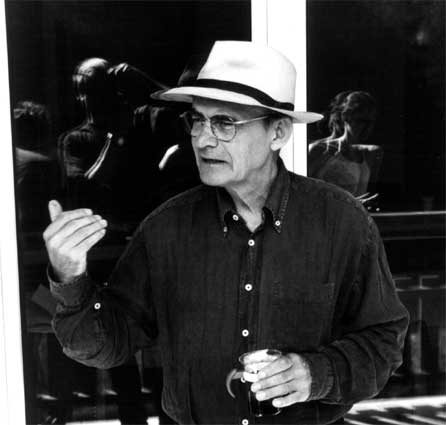
Friday, January 25, 2008

Derrida and the crypt, continued: notes from "Fors"

Here, continuing from last time, are some notes on the logic of mourning outlined in Derrida's essay "Fors."

The secret of the crypt is exiled from exchange above ground but not simply to the underground, because it is exiled from there too:

...a secret interior within the public square, but, by the same token, outside it, external to the interior.

Derrida then moves to a logic of the secret, which will reappear crucially in The Gift of Death:

The crypt can constitute its secret only by means of its division, its fracture. "I" can save [also in the sense of "make an exception of"] an inner safe [a crypt, le for intérieur] only by putting it inside "myself," beside(s) myself, outside.

This complicated sentence means that I can save or make an exception of what is a crypt (an inside/outside outside of the outside [or inside] and outside of the inside) the secret within the space of the crypt, only by putting it inside what is already outside, a performance of myself--and this without regard to this self or any self or even in spite of it. I can only have a secret by showing it, as Derrida will say in The Gift of Death: this does not mean that the only secrets are open ones (i.e. non-secrets), but rather that keeping a secret will make it take its place somewhere in the open. In other words, secrets, if they are secrets, only constitute an interiority elsewhere. If an other learns a secret, then, this only exposes an exterior or something outside the subject to that other. The secret is encrypted to others and--this is the crucial point--for others. It becomes indecipherable for the subject whose secret it is, and always able to be decoded in such a way that the other will misread its contents.

Derrida begins to show that the crypt, the locus of the self, is erected because of "the contradiction springing up from the incorporation itself" of any thing that would serve to become that within the space of the self:

The crypt is always an internalization, an inclusion intended as a compromise [between the desires in incorporation, that for pleasure and that for rejecting/submitting to a prohibition, reality], but since it is a parasitic inclusion, an inside heterogeneous to the inside of the Self, an outcast in the domain of general introjection within which it violently takes its place, the cryptic safe can only maintain in a state of repetition the mortal conflict it is impotent to resolve.

Introjection and incorporation are seen as what mourning lies between. That is, Freud defined mourning as a setting up of a relationship with the lost object. In order to clarify the way in which the relationship could occur, it was postulated that 1) the other could be taken up as a part of one's self, to integrate the memory of the lost (for example) into a self-memory or a selfhood--this is "normal" mourning"--or 2) this whole taking-in could be mimed or played out, to refuse that the other is dead and still a part of me. The first is introjection, the second is incorporation. In either situation there is an attempt to de-cathect the object and place the cathexis somewhere else in the self--the second option offering a quicker way to do this than the first.

At this point Derrida raises a key question:

The question could of course be raised as to whether or not "normal" mourning preserves the object as other (a living person dead) inside me.

Incorporation and introjection seem to blend into each other here, because incorporation in its miming of introjection must at some point refuse to continue, still leaving the other in me still (since it wasn't the other dealt with in the first place, but the mimed object of introjection):

...a foreign body [is then] preserved as foreign but by the same token excluded from a self that henceforth deals not with the other, but only with itself. The more the self keeps the foreign element as a foreigner inside itself, the more it excludes it.

Failed incorporation (which is also doubly failed introjection), then, is the source of the crypt:

What the crypt commemorates, as the incorporated object's "monument" or "tomb," is not the object itself, but its exclusion.

Derrida later elaborates this in the following way:

The cryptic place is also a sepulcher... The inhabitant of a crypt is always a living dead, a dead entity we are perfectly willing to keep alive, but as dead, one we are willing to keep as long as we keep it, within us, intact in any way save as living.

This means the following:

Cryptic incorporation always marks an effect of impossible or refused mourning (melancholy or mourning)... but at the same time the incorporation is never finished.

Why? Looking back at "Mourning and Melancholia," we see that melancholia gets rid of the object or other by killing its ambivalent relation to the subject in its decathecting. If the object or other won't die for the subject as a loss, as in "normal mourning," Freud supposes, it must be made to be lost. One would think that this would then send the other off to the process of mourning. But no, because the object or other has only died in the subject, ideally, fantastically, as a process of substitution for an actual loss that could be introjected. This is why incorporation refuses to be done and return to introjection and to mourning: it has already given up the possibility of having an actual loss to mourn in its attempt to kill off the other so that it could lose it. The other's death cannot be taken over or repeated as a loss once it is killed. Incorporation is, actually, the avoidance of loss. The other's death can never be taken over by me. This is a thesis we find in Heidegger. But at the same time the other's death is what I must integrate or take over. This is a thesis we find in Levinas. This double demand is the space of mourning for Derrida.

Monday, January 21, 2008

"Des engins à donner la mort:" Technical Responsibility in The Gift of Death


I'll be posting a paper I wrote for a class last semester in several installments. Here is the first:

In the third section of The Gift of Death Derrida explains how the Biblical sacrifice of Issac, the paradigmatic event of responsibility, takes place every day. He also explains that the three monotheisms’ war over its interpretation, “themselves sites of bloody, holocaustic sacrifice,” also continues every day. As if to sum up this last point, he says the following: “Countless machines of death wage a war that has no front.” The sense here seems straightforward, precisely through the intervention of the figure or concept of the machine: David Wills’ translation preserves the gift as a mark of responsibility and the machine as a mark of a lack of responsibility. That is, the word “machine” is used in a pejorative, condemnatory sense. Death occurs mechanically in the waging of war over how responsibility (the sacrifice of Issac) is to be interpreted, or rather over how it is to be reduced to dogma. The machine of the dogmatic interpretation of responsibility kills everywhere and recklessly; that is, in a place “without front,” without any place of opposition or recognition between those that kill and those that are killed. As a result, though this machine causes death, it does not give death or have a relation to death as a gift. This gift, in the sense that Derrida gives it—as we shall see, it is what exceeds any “machinated” program of exchange or retribution, any act of “mechanistic” or rule-governed calculation that would reduce it to something that another act of donation could set to rights—this gift would be a call precisely for the responsible suspension of the machines of dogma, and so could not be related to them. According to this translation, then, the sentence articulates a condemnation of the machine just as much as a condemnation of a dogmatic “interpretation” of responsibility.
Derrida’s French, however, is more complicated: “Des engins à donner la mort sans compter livrent une guerre sans front” (DM, 70). The gift is in fact integral to the operation of machine: “machines of the gift of death” wage this war without front. Thus, rather than renouncing the gift of death, the violent struggle in the name of dogma over the interpretation of responsibility is precisely an instance of death existing in relation to the gift. “Machine” therefore is not being used pejoratively, but in a more complicated way; a way that does not strictly oppose the mechanical to the responsible. But how is this possible? The problem here exceeds that of whether Wills translates the sentence correctly or not, for much more is at stake in the possibility that it can be rendered differently. If the machine itself is not being condemned here, how can Derrida still denounce the mechanical death in this sentence, as he seems to be doing? Furthermore, how would he not contradict the numerous critiques he levies elsewhere of historical atrocities abhorrent precisely in their deployment of gigantic mechanized systems of murder. Only a problem concerning how to register Derrida’s most basic understanding of the machine would bring such questions into play. Thus we must look within The Gift of Death for his interpretation of that more fundamental concept which constitutes what is peculiarly mechanical about the machine: techne—that is, craft or skill, as well as the whole sphere of work, production, and technology.
Derrida explicitly discusses techne or (as we will call it) technics at the beginning of the second section (“Au-delà: donner à prendre, apprendre à donner—la mort”), where he recalls the question posed in the title of the text of Jan Patočka that he is in the process of reconstituting: “as the title of his essay indicates, Patočka asks why technological civilization is in decline” (GD, 35). Though this reflection seems more like a digression or an afterthought (stuck as it is in the small space between the political meditation that concluded the first section and the thought concerning apprehending one’s death and the death of the other that makes up the majority of the second) Derrida here makes quite an expansive claim: far from being what most threatens the history of responsibility that Patočka is in the process of narrating, technics must constitute it. That is, according to the logic of Patočka’s discourse, responsibility only becomes possible alongside and through technics. If we can reconstruct Derrida’s reading of Patočka, we can perhaps locate where and how this possibility functions, and how it encompasses the operation of the machine in his own statement, “des engins à donner la mort sans compter livrent une guerre sans front.” In other words, we might be able to see how a particular form of technical responsibility is the only kind condemned here and, for Derrida, is the only kind that can (and must) be condemned in general.

Nancy on Heidegger

Jean-Luc Nancy has a great comment often repeated by those who study Heidegger but never quite so elegantly, and yet simply rendered, that I thought I'd just reproduce here:

In general, what people have gotten into the bad habit of translating "authentic" but which is, in fact, the "proper" (eigen, Eigentlichkeit), takes place nowhere other than right at the "improper," right at everyday existence--and, what's more, in the very mode of the improper's "turning away" from the proper.
-from "Originary Ethics" in A Finite Thinking

Thinking this "right at," as Derrida often remarks in his On Touching--Jean-Luc Nancy, is the key.