 Two notions of memory, history:
Heidegger's 1941 seminar Grundbegriffe on ontological difference and the fragment of Anaximander:
Being re-members us into being and about beings, so that everything we encounter, whether experienced as present or past or future, each time first becomes and remains evident as a being through the re-membrance of being. Being thus remembers essentially. Being is itself what re-members, is the proper remembrance.
We must indeed consider that being itself is what remembers, not only something about which we remember, to which we can always return as something already familiar in the sense of Plato's άνάμνησις [anamnesis]... We must perceive that being is not an "object" of possible remembrance for us, but is itself what properly remembers, what allows all awareness of anything that comes into the open as a being.
-Basic Concepts, 55-6 (translation modified)
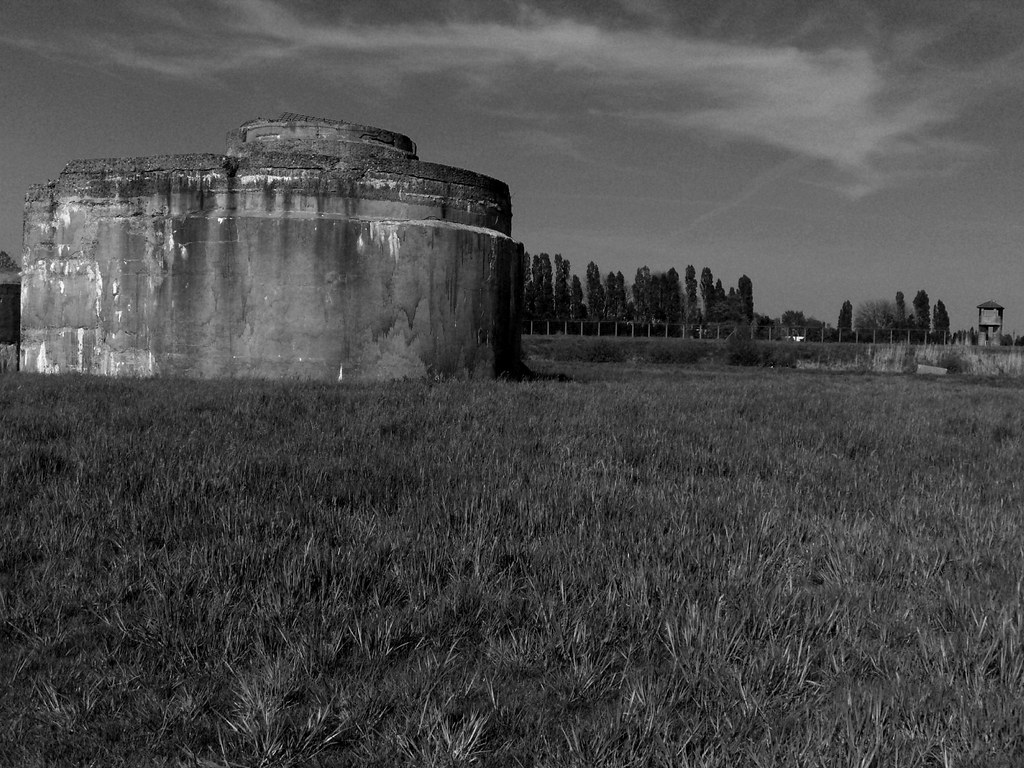
And W.G. Sebald's (narrator's) account of the Fort Breendonk in Austerlitz:
Even now, when I try to remember them, when I look back at the crab-like plan of Breendonk and read the words of the captions--Former Office, Printing Works, Huts, Jacques Ochs Hall, Solitary Confinement Cell, Mortuary, Relics Store, and Museum--the darkness does not lift but becomes yet heavier as I think how little we can hold in mind, how everything is constantly lapsing into oblivion with every extinguished life, how the world is, as it were, draining itself, in that the history of countless places and objects which themselves have no power of memory is never heard, never described or passed on.
-Austerlitz, 24
In the first, the in- or un-human (what is beyond or outside of the "we" that remembers "about" being--though still having a relationship, of course, to the human... cf. the Letter on Humanism of course) is an activity, a reserve of the possibility of meaningfulness--in the sense that it is what provides or provokes memorialized action and keeps that action within itself as always possible qua action. This does not mean that it is a fullness, or that its meaningfulness is the same as any sense "we" may make of it. This is why being remembers "us," rather than the other way around.
But, nevertheless, the stress is not upon the opposite phenomenon which Sebald describes. This is, one could say, the other side of what Heidegger proposes. And yet it is coming from and ultimately returns to a totally different relation to memory and to history. The pressure of that limited nature of what the "we" can remember--this is not some failure to "go beyond," to plunge into the activity or respond to its call. Nor--and this is the more crucial point--is this pressure a function of the decay of the possibility of going beyond the human, into the inuman, into the process of remembrance that is not just about being but that is itself being remembering. In short: the fact that we can only hold so little in our mind, that our memory is not just finite but is not even nearly adequate for the mass of historical meaning that is out there--all this is not just a reflection of how the possibility of being remembered by being is less possible in certain conditions, as Heidegger would say. There is not a devolution or decay of this possibility here, caused by a modernity. It is because Sebald's narrator fundamentally has more respect for what, while not reducible to being human, still falls within the sphere of its everyday activity: that is, the everyday human potentials themselves. This narrator lives in the everyday--and it is here that the significance of his remembering and forgetting lie--not, ultimately (though they may depend on it), in this post-human remembrance that is part of being.
However, there is a commonality about both these statements: the finitude or limitedness of the human mind is due to the fact that there is so much "out there," in the world, and that this world comes at us as something to be remembered. In short, it is because history is also in things, is encrusted or deposited in their walls, foundations, ornaments.

No comments:
Post a Comment