Monday, March 24, 2008

Some notes on Lévi-Strauss

Here are just some notes on various quotes from Lévi-Strauss' oft-read essays "Structural Analysis in Linguistics and Anthropology," in Structural Anthropology, which I myself was rereading. I should note that one probably should not read this particular essay without having ready at hand both Of Grammatology and Between Men.

In our haste to apply the methods of linguistic analysis, we must not forget that, as a part of vocabulary, kinship terms must be treated with linguistic methods in direct and not analogous fashion. Linguistics teaches us precisely that structural analysis cannot be applied to words directly, but only to words previously broken down into phonemes. There are no necessary relationships at the vocabulary level ("Structural Analysis," 36; Lévi-Strauss' italics).

In other words, as Lévi-Strauss explains in more detail later, structural analysis can only proceed by breaking down what is to be analyzed into discrete signifiers. One does not consider the relationship between signifier and signified (the sign or word considered at "the vocabulary level"), but looks at the relationships between signifiers. So when looking at a phenomenon, one must first attend to the representation or signifier: structural analysis proceeds by looking at "symbols," and not the things themselves as he says later. Or rather, it considers the analysis of symbols as the only possible way of getting at the things as they are.

Nothing can be conceived or given beyond the fundamental requirements of its [the "atom of kinship's"] structure, and, in addition, it is the sole building block of more complex systems; or, more accurately speaking, all kinship systems are constructed on the basis of this elementary structure, expanded or developed through the integration of new elements. Thus we must entertain two hypotheses: first, one in which the kinship system under consideration operates through the simple juxtaposition of elementary structures, and the where the avuncular relationship therefore remains constantly apparent; second, a hypothesis in which the building blocks of the system are already of a more complex order. In the latter case, the avuncular relationship [the characteristic trait in the functioning of the four terms of the atom of kinship], while present, may be submerged within a differentiated context (48; my italics).

The key here is that once a structure is constituted (once its atom is specified), one can account for the fact that not all empirical instances will exemplify the atom of the structure via the appearance of its characteristic trait (in kinship, Lévi-Strauss says this is the avuncular relationship caused by the incest-taboo) exactly in two ways. First, as he says, the various terms of the elementary structure can flip around or have different relations, thus producing a different appearance of the trait, thus making it an imperfect exemplification of the atom. Second and more common, the trait will be functionally present but hidden or submerged under the lens of analysis. In other words, the characteristic trait of the structure--as in the case of the avuncular relationship) will disperse itself or hide itself, repressed by the orientation of the structure to only appear in the context in which that structure is situated. In other words, it fades into the background, yet is absolutely constitutive and active within the functioning of the structure. Thus, the empirical instance of the structure will not have the atom form exactly because its characteristic trait will be dispersed.

The idea expressed in the above passage [by Radcliffe-Brown], that the biological family constitutes the point of departure from which all societies elaborate their kinship systems has not been voiced solely by Radcliffe-Brown. There is scarcely an idea which would today elicit greater consensus. Nor is there one more dangerous, in our opinion. Of course, the biological family is ubiquitous in human society. But what confers upon kinship its socio-cultural character is not what it retains from nature, but rather, the essential way in which it diverges from nature. A kinship system does not consist in the objective ties of descent or consanguinity between individuals. It exists only in human consciousness; it is an arbitrary system of representations, not the spontaneous development of a real situation (50; my italics).

This is probably the most general point about structural analysis: the point is that it is supposed to provide an artificial and arbitrary system, a technique or principle around and along which any particular empirical phenomenon would organize itself. Nature and the organic are subtracted, and claims to essentialism resisted. The danger of structural analysis, as Derrida and Sedgwick alledge, is that it can always not thoroughly eradicate nature even though it pretends to accomplish this. I think one of the most interesting ways of dealing with this danger is Derrida's: trying to conceive, not so much the arbitrariness qua play--Derrida himself warns us about taking this particular approach too seriously--but rather the technicity of this system in a more rigorously technical manner, according to Derrida. This means considering it not just as a principle for analysis (a bricolage) but as an infinitely technical, wholly mechanical operation or functioning. This has the effect of bringing back the empirical and the calculable, as Sedgwick does, trying to make the system or structure indeed account for it not clinging to supposedly dispersed or alleged traits as "present," though dispersed.

Sunday, March 23, 2008

The future on film: Blade Runner and Children of Men

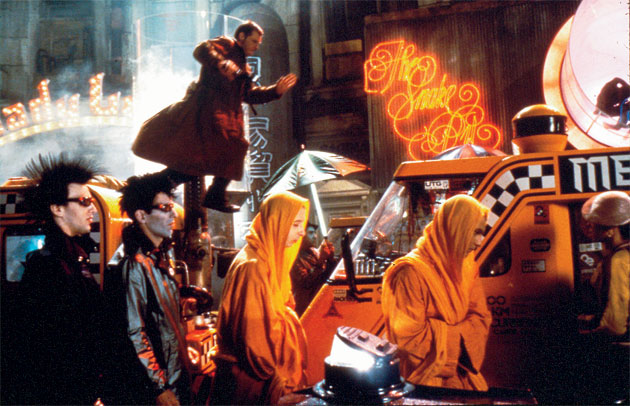
I find it extremely odd that Alfonso Cuarón would say that he wanted Children of Men to be, in the style of the future world that it depicted, the "anti-Blade Runner," and that he had to keep rejecting his art-department's drawings because they looked too "futuristic." This goes along with the revulsion against a fetishization of the fantastic and the futuristic that we find in Cuarón's films (even in his Harry Potter, where it is extremely refreshing), but I don't think that the opposite of this, in the world of sci-fi, would be Blade Runner.

While Blade Runner did go to Syd Mead and got extremely stylish and "fururistic" designs back, Ridley Scott's integration of the designs into the movie is arguably almost a thorough as Cuarón's. I think Cuarón would explain his approach as purely against the Blade Runner aesthetic or style primarily because he wants to have his films be more immediately relevant and political. But what this overlooks is that Blade Runner was and is still felt as extremely immediate and relevant, and even in some of the issues that Children of Men perhaps thinks that it is broaching. Overpopulation, immigration, environmental degradation and biotechnology (in the forms of grafting, cybernetics of course, organ farming, and even reproduction) all are crucial to the film, and get placed into its world almost as thoroughly.

Of course, there aren't any neon umbrellas in Children of Men. But to think that the aesthetic of the two worlds are contrary is a mistake, and perpetuates a sort of willing ignorance and indifference to the history of films that depict the future and participate in that genre we call science fiction--as if a sci-fi film can only be immediately relevant if it opposes its own depiction of the futuristic. This seem to fetishize the effort of Cuarón more than any of his attempts to resist this with his alleged verité: one can think that one is entering a newer depiction of the future than any other if one watches it with his comment in mind. Thankfully, one doesn't have to: and this is what makes Children of Men a triumph. What the film loses in its alleged immediate impact on issues that are "relevant" (terrorism, overpopulation, etc. etc.), it gains in contributing to the genre. This isn't the case in every film of course or even perhaps in most, but it is here.
Why? Because, as Blade Runner shows, a sci-fi film like this will be relevant anyway. This is because the genre has a closer relation to time and historicity than perhaps any other: even if a sci-fi film is placed in the past, because it contains a marked and explicit alterity with respect to our world (I say "marked and explicit" because of course any film's world has some otherness by virtue of its constructedness), the constitution of its environment will pose the question "what if our history were different so as to be like it?" This goes also for anything supposedly occurring in the present day.

By virtue of the mistaken assumption (taking Cuarón at his word) that it was going to resist the genre, Children of Men exemplifies with stunning brilliance the effect of one of the genre's innermost principles. This is because the toning down of the "futuristic," while perhaps producing greater contemporary relevance, the side-effect is produced of prompting a greater integratedness of the film in the world that it is depicting and exemplifying its historicity more. In other words, the verité, toned-down nature of the depiction does not necessarily produce relevance, but most definitely produces a sort of fullness of depiction of the everydayness of its world. This brings out that alterity more with respect to time, because the time in the film itself, its own history, is constituted with a greater density. Thus the modest quality of the futuristic details (the graffiti, the style of advertisements about getting fertility tested--which is similar to some you see now--the degradation of the trees by acid rain, etc.), and the high degree of the preservation of current technologies in the film (the London buses have the current interiors, and London itself is largely unchanged in architecture, etc.), have the wonderful effect of being able to do a lot of the traditionally sci-fi work in the movie: again, like Blade Runner, not because they help the movie become more immediate or closer to our present, but because they make it interact with our present with that historicality that is most characteristic of the depiction of alternate worlds in science fiction.

Tuesday, March 18, 2008

Time and Derrida

Here are two points to grasp about time as Derrida sees it. Perhaps the best way to think of them is phenomenologically, despite the impossibility of this thought from this (or any) perspective. What would the phenomenon of temporality and temporalizing be if we understood time this way? How does one have an intention (let alone a self) in such a time? Or, perhaps taking an less phenomenological approach, we can ask whether there can be any coherence of representations or signifiers (in terms of the self, can there be a self as the faking of an interiority, as mere exteriority, as performance understood without citation, as enacting a self that is simultaneously coherent and stable as an identity over time)? It is obvious that the answer is, for Derrida, no. But let's get to the two incredible, impossible points:

1) Time can "flow" backwards as well as forwards: time for Derrida ceases to be unidirectional. This already is an unbelievably profound, absolutely impossible thought. For it does not mean that time can be "rewound" or that we can re-enact the past. We see the immense differences with Lacan asserting themselves already. For Derrida, time isn't haunted by trauma in a typically Freudian sense. If we are not in the present, it is not because we are repeating some past unexperienced/traumatic moment (or lack thereof--i.e. repeating a lack or what is not there) or that (to put it another way, and, again, quite crudely) that moment has come to usurp our experience of the present, making it (again) a non-present or something. The Lacanian move backward in time here still presupposes the unidirectionality or forward-flowing of time. Or a unidirectionality in general. For Derrida, we don't jump into the past (or have the past return); time flows backwards. The "stream" is simply reversed. Or rather, it is reversed while still moving forward--and of course this makes it less simple. Time flows forwards just as much as backwards, and never "returns" upon itself in the sense that it rewinds and undoes itself, going back to the moment that is not yet. The return indeed is completely different, if you conceive it this way: one has to rethink what "repetition" means (essentially, it cannot be "caused" even by a non-cause, the Real, as Lacan holds: cf. "Tuche and Automaton" in Four Fundamental Concepts). And with respect to Heidegger, this means that time does not temporalize out of the future, or does not do so any more than it according to Hegel temporalizes out of the past (cf. Phenomenology of Spirit, §801-2: "In the Notion that knows itself as Notion, the moments … appear earlier than the filled [or fulfilled] whole whose coming-to-be is the movement of those moments..." etc. etc.). If this is grasped, the second point will need less comprehension:

2) There is no "proper" (eigentlich, "authentic") or primordial (ursprunglich) temporality, or rather this primordial temporality of which Heidegger speaks in Being and Time is precisely only also the everyday calculable time or clock-time that Heidegger says this primordial time alone makes possible. Being and Time, then, is shocked by this fundamental upheaval of one of its most basic theses (William Blattner has much to say about this thesis): in short, authentic time would be, according to Derrida, calculable. This also means, however, that calculable, everyday time is authentic, and not derivatively or in a "falling" (verfallen) way. In other words, the time of mere representation (or the signifier), of mere counting-off of instants (one second, two, three), of a whole life composed perhaps of mere passing the time, of bare life or mere sur-vival, is authentic or proper, is Dasein's ownmost. Indeed, in the later writings of Heidegger, the temporalizing gets thought on the level of the history of being out of the opening up of the different ecstases to begin with (and this thought is indeed right there in Being and Time, just less explicitly thought in this particular way), which is closer to Derrida because (even though priority is still given to it) the future itself is less important as such (cf. On Time and Being)