The post on Derrida and his phrase "To see in secret--what can that mean?" in The Gift of Death, below, is (like many of the posts here) taken from one of my papers for seminars. I've been revising and redoing that paper, and so can now present it more in full. Hopefully it will make more sense:
In the last section of The Gift of Death, “Tout autre est tout autre,” Derrida seems to link visibility and the sense of sight to one of the main ethical, political, and/or religious points he develops throughout the essay: that responsibility only takes place via secrecy, via an act that exceeds calculation or planning. He gathers together seeing and this secrecy in a formulation so basic we cannot but feel they are somehow indissociable. This formulation, given its own separate line in the text, is precisely a question about this indissociability. It is the following: “To see in secret—what can that mean?” Or, in the French: “Voir dans le secret. Qu’est-ce que cela peut vouloir dire?” (The Gift of Death, 88/ Donner la mort, 85)
We understand immediately that this phrase does more than just situate responsibility in the sphere of the bodily, where vision could then somehow play a part in it. In other words, it does not amount to a reiteration of Derrida’s call for an explanation of the terrified, trembling, crying body that he makes in the prior section. “One doesn’t know why one trembles,” Derrida says there, claiming that “we would need to make new inroads into thinking concerning the body, without dissociating the registers of discourse (thought, philosophy, the bio-genetico-psychoanalytic sciences, phylo- and ontogenesis), in order to one day come closer to what makes us tremble or what makes us cry” (55/57). If we were to say that political, ethical, and/or religious acts of responsibility are just bodily or embodied for Derrida, as it is popular to do with other thinkers like Maurice Merleau-Ponty, we would feel that we were not really getting at that seeming link between sight and secrecy here. Nor for that matter would we get at the sense in which Derrida is asking us to make inroads into what makes us tremble or cry—that is, the sense in which this phrase here is a reiteration.
We would feel that this is the case because the force of this simple question does not revolve around either seeing or secrecy as much as it does upon meaning. “To see in secret—what can that mean?” The stress here is upon seeing in secret remaining something questionable with respect to whether it has sense or not. If it were just the assertion of something meaningful about responsibility along with sight it would not take place in a question. Our sense of a link refines itself, then. Seeing and secrecy: these are for Derrida things that are questionable when brought together and (thereby) forced to mean or have sense. Perhaps for Derrida they are only questionable when they are supposed to mean—that is, when they take place within a question as to their meaning. In a way, then, the question seems to enact its question: it wonders whether seeing and secrecy can be questioned with respect to whether they mean in questioning them with respect to whether they mean.
But this stress on whether the link makes sense is also due to how the phrase “to see in secret” is precisely that part of the question not written solely by Derrida: it is from the Gospel of Matthew, as cited at the end of Kierkegaard’s Fear and Trembling, which Derrida analyses before and after this point in the text (cf. 80-1, 97-99). So “to see in secret” is that part of the phrase “to see in secret—what can that mean?” outside of which Derrida seems to stand (as it were) as he writes it, in order to ask it whether it can mean. Indeed, if we take his French more literally, what Derrida asks of “to see in secret” is whether it can be said (qu’est-ce que cela peut vouloir dire?). That is, he asks whether “to see in secret” does not already constitute something that would be beyond his (or anyone’s) ability to submit it to his (or anyone’s) speech as something questionable. Thus, Derrida (or anyone else) could not say, “I see in secret.” Nor could Derrida really ask it his question as to whether it can be said, for “to see in secret” would call itself already into question by itself. Thus, when it came into Derrida’s writing (precisely as the question as to whether it could be said), he would then not be saying it: he would already need to ask whether his writing said or meant anything (and thus he writes his question). The question Derrida asks not only enacts what it questions, therefore: it only enacts this because of the questionability of the link between sight and secrecy that this question, when asked by Derrida (or anyone else), cannot question. The sight of the body and the secrecy in responsibility: these are things that are beyond our ability to question them as to whether they are linked while they still remain questionable—that is, precisely when they are linked by Derrida or by us and thereby forced to mean.
Obviously for us it does not make sense, then, to ask what vision, linked to secrecy only insofar as this link were unquestionably questionable, would be experienced, or would change our sense of life and of the world. Perhaps most of all it would not make sense to ask how it changed our notion of responsibility. For Derrida in this phrase shows us that fundamentally he is in a position similar to ours, if not the very same one: he feels that seeing and secrecy might be linked. And yet, Derrida is also in a completely different position, since asking how vision would be experienced, and responsibility changed thereby, is precisely what Derrida is doing throughout this part The Gift of Death. Somehow, he is able to get across to us precisely that vision and secrecy, while we cannot be sure they are linked, would have to take place precisely in this place where we are not sure of this linkage, in that space where it remains unquestionable in both senses of the word—that is, both beyond his ability to question it, and definitely, certainly, always occurring. Our question, then, becomes one of how Derrida is able to orient himself towards the asking of his (or, as we know now, anyone’s) question qua unquestionable. In other words, our question should concern how he is able to prepare himself for being in the same position as we were with respect to his phrase, and yet better prepare himself than us such that he could also feel like he could continue to ask it, in order to investigate how it changes our experience of sight and of responsibility.
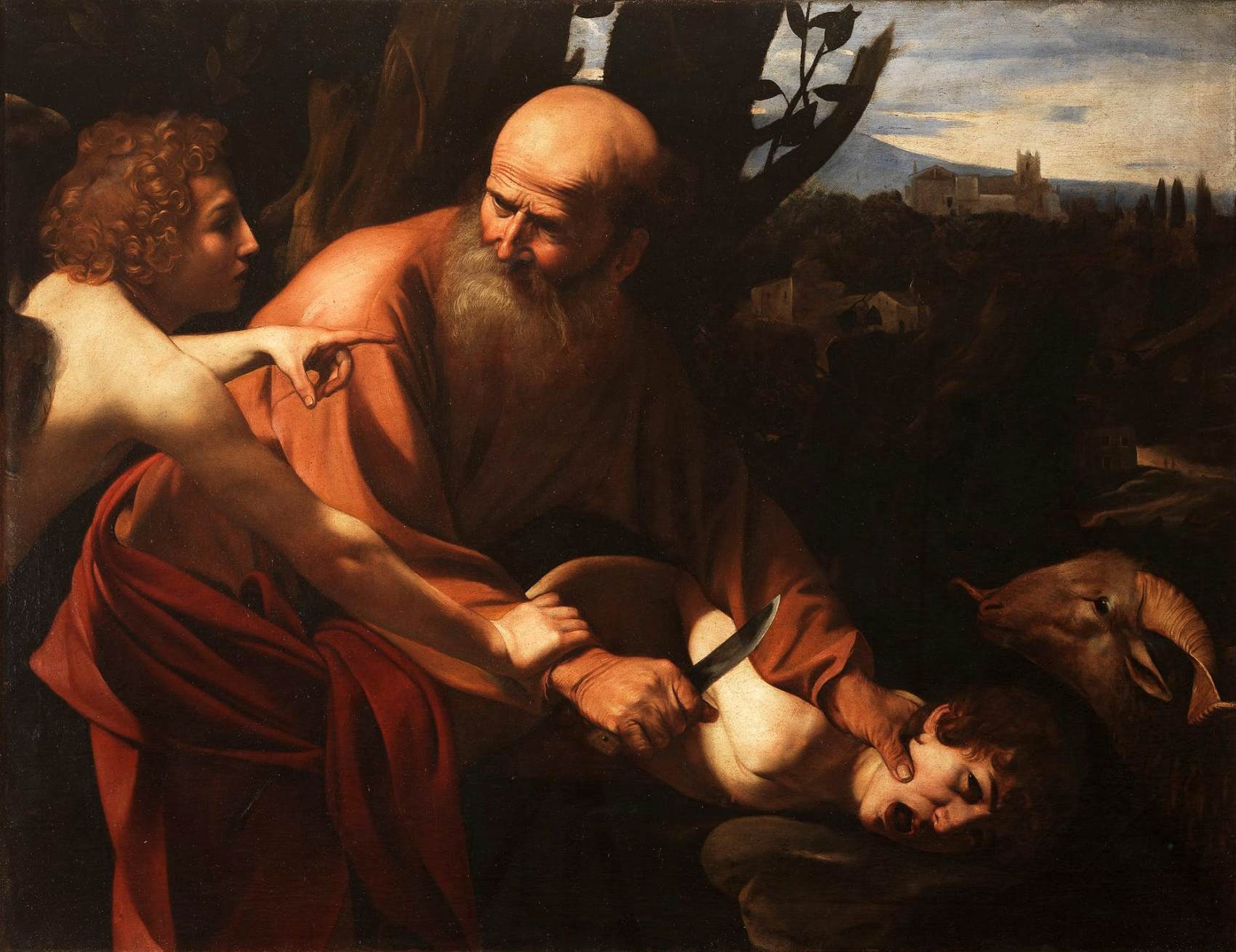
Indeed we are given an indication about how this preparation takes place in the context of Derrida’s question. It is asked as he is testing how far he can extend his reading of Abraham’s sacrifice of Isaac in Kierkegaard. Here, just by bringing vision constantly to the fore in the text either in figures of speech or more explicitly in the content of what he is saying, we see him setting up his question:
The sacrifice of Isaac is an abomination in the eyes of all and it should continue to be seen for what it is—atrocious, criminal, unforgivable; Kierkegaard insists on that. The ethical point of view must remain valid: Abraham is a murderer. However, is it not true that the spectacle of this murder, which seems intolerable in the denseness and rhythm of its theatricality, is at the same time the most common event in the world? Is it not inscribed in the structure of our existence to the extent of no longer constituting an event? (85, italics added)
Children, he says, are constantly sacrificed by society, left to die of hunger or disease because of the way the market is structured and controlled. There are insufficient distributions of funds, of aid, etc. such that a totally preventable sacrifice is made anyway, since the current functioning of this society dictates that these resources be used elsewhere. Thus,
such a sacrifice is not even invisible, for from time to time television shows us, while keeping them at a distance, a series of intolerable images, and few voices are raised to bring it all to our attention. (85-86, italics added).
A link between the way society sees sacrifice—it “actually organizes it” (86)—and responsibility—only possible in the secrecy of a sacrifice—is absolutely pressing for Derrida and for us, then. But because we do not know exactly what the link is between the visible and the secret, sacrifice seems as if it could always be questioned as to whether it took place—though it might be happening everywhere and all the time. Thus, we see why Derrida would need to ask, “to see in secret—what can that mean?” If these are his concerns, the question translates into the following: how could we adapt ourselves to the way this sacrifice is inscribed in the structure of our existence?
What is key about this preparation, however, is that it occurs in a specific way. Derrida is less lamenting that we do not have a theory of the linkage between sight and secrecy as highlighting how secrecy, the condition in which responsibility takes place, does not have such a direct relation to the visible. In other words, he is highlighting how the secrecy in sacrifice required for responsibility is not simply defined as the negation of visibility, or as what is invisible. Indeed, “such a sacrifice” as the one organized by society, “is not even invisible,” as he says, and this is part of the problem. And it is here that we will be able to bring out or reconstitute the way Derrida orients himself so as to be hospitable to the questionability of the linkage he establishes. Here, because in order to make the relationship between secrecy and visibility clearer, Derrida just after the passages on the theatricality of sacrifice and his question on seeing in secret says we might be confusing two ways that this invisibility can be understood:
1. There is a visibile in-visible, an invisible of the order of the visible that I can keep in secret by keeping it out of sight. This invisible can be artificially kept from sight while remaining within what one can call exteriority... what one calls the interior organs of the body—my heart, my kidneys, my blood, my brain—are naturally said to be invisible, but they are still of the order of visibility: an operation or accident can expose them or bring them to the surface; their interiority is provisional and bringing their invisibility into view is something that can be proposed or promised…
2. But there is also absolute invisibility, the absolutely non-visible that refers to whatever falls outside the register of sight… (GD 90).
Now, what is crucial about this passage is not yet the difference between the two and how they are indeed confused, but the seemingly unrelated fact that Derrida makes the same distinction in an introduction or compendium to an exhibition of drawings at the Louvre, later published as Memoirs of the Blind. For it is in this transit between a reflection on responsibility and a reflection on art that our new question about how Derrida prepares or orients himself can be pursued, and not only because there will be minor similarities and differences between the two texts that might indicate something about the work of preparation We will also be able to reconstitute this work to a large degree because both discussions rely upon and cite heavily from Maurice Merleau-Ponty’s account of the visible and the invisible. By looking at Merleau-Ponty’s The Visible and the Invisible, then, with special attention to his two significant essays on art—“Cézanne’s Doubt” and “Eye and Mind” (L’Oeil et l’Esprit)—and doing so in conjunction with a look at Memoirs of the Blind and Derrida’s extensive discussion of Merleau-Ponty in On Touching—Jean-Luc Nancy, we will be able specify a field or a context through which Derrida will move in order to prepare himself for his unquestionable question of the linkage between seeing and responsibility. Or perhaps instead of a field or context—a set of inheritances or a history of ideas—we might, as he says in On Touching, reveal a trend (mouvance) in which he is still “beginning to orient myself.” Thus when, as we shall see, it is on the issue of depth that the two thinkers come extremely close to saying the reverse of what the each claims with respect to vision and the invisible, we will not be trying to indicate that point at which two thinkers fundamentally disagree, as if they were in an argument. Rather we will be feeling our way towards the humble and yet outrageous nature of the task that Derrida is attempting in feeling an impossible link between sight and vision in The Gift of Death, and yet still asking his question, “To see in secret—what can that mean?”
Thursday, April 24, 2008

Sunday, April 20, 2008
"To see in secret"
In the last section of The Gift of Death, “Tout autre est tout autre,” Derrida seems to link visibility and the sense of sight to the ethical, political, and/or religious conclusions he develops through the essay by asking a simple question: “To see in secret—what can that mean? (Voir dans le secret. Qu’est-ce que cela peut vouloir dire?)” (The Gift of Death, 88/ Donner la mort, 85) This echoes (or perhaps responds to) his own call for an explanation of the terrified, trembling, crying body that he makes in the section before—“One doesn’t know why one trembles… We would need to make new inroads into thinking concerning the body, without dissociating the registers of discourse (thought, philosophy, the bio-genetico-psychoanalytic sciences, phylo- and ontogenesis), in order to one day come closer to what makes us tremble or what makes us cry…” (55/57)—so in some sense this question about the body is just a pervading feature of the way he approaches these issues. One could say that the linkage is precisely that political, ethical, and/or religious acts of responsibility—which (and this is a central point of the text, cf. 2-7, 69-71, 108-112) take place only via secrecy—are just bodily for Derrida. But this obviously would not tell us much. This is because the force of this simple question does not revolve around either seeing or secrecy as much as it does upon meaning, upon seeing in secret remaining something questionable with respect to whether it has sense or not. And this is due to “to see in secret” being precisely that part of the phrase not written solely by Derrida, that part outside of which he partly stands and asks it his question: he phrase is from the Gospel of Matthew, as cited at the end of Kierkegaard’s Fear and Trembling, which Derrida analyses before and after this point in the text (cf. 80-1, 97-99). So our sense of a link refines itself. The body’s seeing and the secrecy in which responsibility takes place: these are for Derrida things that are questionable when linked and (thereby) forced to mean or have sense. Indeed, if we take his French more literally, what Derrida asks of “to see in secret” is whether it can be said (qu’est-ce que cela peut vouloir dire?). That is, he asks whether it does not already constitute something that would be beyond his (or anyone’s) ability to submit it to his speech as something questionable. Derrida (or anyone else) could not say, “I see in secret.” Nor could Derrida really ask it his question, as to whether it can be said. “To see in secret” would call itself already into question by itself. Thus, when it came into Derrida’s writing (precisely as the sentences as to whether it could be said), he would then not be saying it: he would already need to ask whether his writing said or meant anything (and thus he writes his sentences). The question Derrida asks not only enacts what it questions, therefore: it only enacts this because of the questionability of sight and the secret that it by itself cannot question. The sight of the body and the secrecy in responsibility: these are things that, when linked, are beyond our ability to question them while they still remain questionable. So the seeming link does not constitute itself in how and when seeing or responsibility (and their relationship) are in themselves so much as how and when, beyond our ability to question them, they are questionable.
Saturday, April 19, 2008
Spivak, Derrida, and "Anglo-U.S. critics," continued

I take back what I said about Spivak reading "carefully" in my last post under this title, which referenced the following comment from A Critique of Postcolonial Reason:
It is my suspicion that Anglo-U.S. critics such as Jameson, Terry Eagleton, and Frank Lentriccia insist so specifically on the de-centering, and on a narrative of de-centering, because the first and last Derrida they read carefully was "Structure, Sign, and Play" and the first chapter of Of Grammatology, where there is some invocation of "our epoch," meaning, specifically, an "epoch" that privileges language and thinks in structures.
-Critique of Postcolonial Reason, "Culture," 322
The word here that makes me retract the characterization "careful" (though I still hold that it is a good summary of some early passages in Derrida) is precisely "suspicion." However, the lumping together of Eagleton and Jameson under the broad heading "Anglo-U.S. critics," a heading which we should insist that Spivak is absolutely under (given the crudeness of her "Anglo-U.S." grouping), which no one who has read Jameson could do so with this ease or with this precise argument (Eagleton is a fraud and doesn't care about anything, Jameson actually tries to read Derrida carefully, if he does make many mistakes in doing so)--this could also be a reason. But "suspicion," is precisely not the attitude with which the Derrida that Spivak so ardently defends would read this "insistence" on the part of the "Anglo-U.S. critics."
Or rather, it is precisely because he does indeed tend to also engage in this suspicion that one must reject both Derrida and Spivak here, the enormous and powerful constellation that the two thinkers have generated. For the injunction to "read carefully," constantly reiterated by Derridians and Derrida himself, should never turn into suspicion--and yet, when this injunction is thrust upon the reader by Derrida and Spivak, they often do not make this corollary clear enough. Derrida at least gestures towards the fact that the lack of suspicion would be coextensive with his writing itself. But that is not the case here, with Spivak, nor is it the case in Of Grammatology when the analysis of Lévi-Strauss becomes ridicule. The ridicule is the function of an injunction to read passing over into mere suspicion.
And it is contemptible, for both thinkers, to engage in this suspicion: not because it is hypocritical, but because they do not gesture towards their failure as a failure of suspicion. Let me be clearer: one only needs to look at how Heidegger is never analyzed like Lévi-Strauss. It does not have to do with the amount of detail the reading goes into. Rather, the difference is marked by how, when Heidegger is analyzed, Derrida constantly remarks that he could just be being suspicious. This is the case in Of Spirit (whose subtitle "Heidegger and the Question" gestures already towards this possibility of suspicion) and in the "Geschlecht" series of essays, as well as in his remarks about Heidegger's Nazi involvement. Attention is called to the failure of the reading--not as the inevitable outcome of the analysis (this gesture--a somewhat different one--is not what we're talking about here, though Spivak and Derrida act as if they are the same), but as an integral part of the approach in this particular case. It doesn't always need to be there, precisely because suspicion does not always have to be the way that one approaches a text. In other words, suspicion will be that which any analysis sinks slowly towards and probably is complicit in, but at that point an effort can be made to make it evident that this is happening. When it is passed off as the moment when the analysis is most in control--as in Of Grammatology, most disgracefully in the apartheid episode in Critical Inquiry, or in his analysis of Walter Benjamin in "Force of Law," to name only a few examples--than one gets the sense deconstruction has passed into mere destruction, and the worst, worst kind: that which passes itself off as responsibility itself!
That is what is happening here in Spivak. The gesture towards "reading carefully" then becomes the oldest academic trick in the book--and does more damage than any "close reading" (with which deconstruction is too often confused with or made to seem commensurate with) could do. Spivak here is no different than Harold Bloom (when he polices culture), or Terry Eagleton when he quotes her sentences (as he does to so many others and all the time, unlike Bloom) out of context, mockingly: she is insisting on a proper Derrida, a Derrida that needs to be read before anyone can say anything about him, and to which she only has access. This is not the case in most of her writing, but it is especially annoying and irresponsible because it is in moments like these that she is precisely functioning as what everybody tries to pin her down as: the person who introduces Derrida to, precisely, "Anglo-U.S. critics." To a) not affiliate oneself with them via Derrida--and this is what is happening here--and b) insist precisely at this moment that there is a better reading that needs to be done... this isn't a defense but an easy way out of a situation in which she herself, as well as Derrida, is absolutely implicated. And it is countered not with a critical awareness respectful of alterity and the subaltern (which is precisely what its tone indicates), but with academic snobbery, in these moments in both of these writers. This, indeed, is a danger of deconstruction: the question remains whether this danger--though not able to be mitigated--can at least be diffused within a larger formation of critical practices. If the utter baseness of some of Derrida's attacks, along with those of Spivak's, can show us anything--for they do not give us knowledge, least of all the deconstruction that they pretend to be in the process of effecting--it is that our critical methods do not need to be more incisive or far reaching or more thoroughly grounded (or ungrounded), but more wide ranging and more explicit. Careful reading can be brought about otherwise--which is precisely what Derrida and Spivak allow us to think in other passages than these (which, we should note, are very few in number and often only a portion of any of the texts here indicated).
And is this analysis itself suspicion? Perhaps. I hope not: I experience it as revision, as a double-take, and also bitterness and indignation at responsibility crossing so quickly over into irresponsibility--it is the experience of reading Spivak's sentences near the end of a book that analyzes quite well and fairly a difficult and pressing condition. But now at least if suspicion exists beyond this experience or at its limits, it too will be able to be read into these words.
Subscribe to:
Posts (Atom)