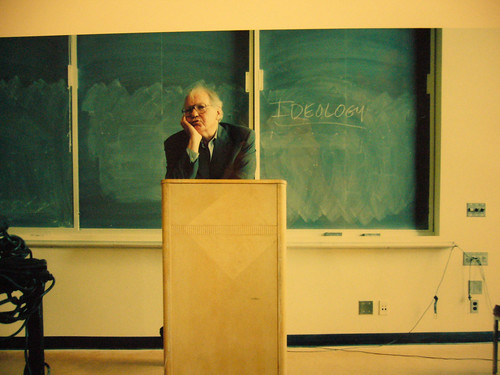
I have always enjoyed the work of Jonathan Lear. His account of Freud, combined as it is with his intense interest in and understanding of Aristotle, is the most vibrant and cogent one I think Anglophone countries have produced in a very long time (compare any one of his books on Freud to those of Anglophone theorists and the difference isn't even funny). Back in Illinois, I had the opportunity to listen to an early version of his new book
Radical Hope in a talk, and the subject as well as Lear's excellent treatment of it have not ceased to be on my mind since. It couldn't be otherwise. Lear's daring and yet sensitive effort to produce a philosophical anthropology of the Crow and their fascinating leader Plenty Coups (Aleek-chea-ahoosh) not only introduces you to an amazing culture and its history, but also confronts contemporary virtue ethics with an immense problem that anyone within the field (or anyone even with an interest in it) is not likely to forget. And now that I have had time to get to the excellent book itself (now
in paperback), I find myself returning to this problem with a better understanding of how Lear is trying to frame it.
This problem is catastrophe: what happens when a culture is faced with its own demise? Reproducing a significant Heideggerian distinction, we might actually call this cultural death, not cultural demise: Lear does not mean that this culture is threatened by biological extinction, and thus must work at preserving its bare life or surviving, but that, as a community, it will not be able to foster individuals that have any relationship to its norms or standards of excellence, that is, foster them ethically on the level of culture--a prospect that, he argues, is just as frightening. Now, this does not mean that cultural death is not related to the threat of biological distinction: just that--and we will come back to this repeatedly later--the ethical action under discussion in the book will tend to locate itself on the level of culture, while more pragmatic but not necessarily ethical action will be directed towards the needs of survival. Now this distinction is not merely me being fascinated once more with Heidegger: Lear's effort is explicitly conducted with the help of the excellent John Haugeland and constitutes a great attempt to reintroduce certain contemporary
ethical assumptions centering around Aristotle back into the Aristotelian framework of Heidegger's thinking. That is, it is (putting it conversely) a work that attempts to bring Heidegger back to Aristotelian ethics.
The impact of the problem of cultural death upon thinking is clear. Once it is comprehended, one has to wonder whether this moment of cultural death is not the death of the concept of virtue ethics as well: unless we have something to say besides
what virtues should be cultivated by a culture, unless we can say something about whether and how, in the face of the annhiliation of its traditional ways, any culture can have and hold onto virtues, we are not going to be on sure ethical ground. This is so not only in the sense that the concept and project of virtue ethics will find a limit. Indeed, some argue that something like this limit should apply, keeping us outside of the sphere of anything encroaching on the meta-ethical, as this problem forces us to do. But even if we accept this, the deeper ungroundedness of ethics would still apply: we would not have a secure basis because, as occasional references of Lear's book make clear, the problem of the death of a culture could perhaps more prevalent than one thinks. Even if we overlook the problems of mass migration caused by various political and economic situations throughtout the rest of the world, in America alone we face the anxieties about terrorism (not necessarily about acts of terrorism but rather how to adjust daily to the possibility of it, like some other cultures do) and certain events like Hurricane Katrina (not in the aspect of its brute destruction of life, again, but in terms of how we adequately can comport ourselves to the cultural devastation any displacement like that required by the disaster would entail). This is so even if we don't admit that this frequency of cultural death or devastation is empirically higher now for some reason: perhaps virtue ethics is haunted in its foundations by this risk--and haunted to a degree that previous philosophers could not register. Lear makes this point about Aristotle specifically: the
Nicomachean Ethics, while it may speak of the acquisition of skills and excellencies, and even their devolution or loss, does not talk about the problems of handing down these virtues--at least in a way Lear feels comfortable advocating. This presupposes a sort of static model of virtue: while we can say culture gets passed down in learning, for example, this is merely to collapse the issue of handing-down or handing-over into something that is assumed will be handed-down or handed-over. What we encounter here is the same problem Heidegger encountered, one that is--I would argue--the most significant one about his entire endeavor and the most pressing for any modern ethical as well as ontological account, given our time and place: the problem of historicity. In order to address historicity, beyond the level of talking about nurturing and education, in order to talk about historicity itself, we must address the possibility of the death of culture as inherent to culture--that is, as inherent to any system or structure of virtues. And unless we address historicity, we will not be able to account for what is ethical in a world where that historicity itself is precisely what is in the balance.
In a few sentences towards the end of the book, Lear brings to the fore the whole problem in just a few sentences, and also the possible response (Plenty Coups's) to it that Lear advocates:
For a vibrant culture, it is traditionally the task of the older generation to adapt the culture's ideals to current challenges and to pass those ideals on to the next generation. But in the period 1870-1940, the Crow tribe went through such a collective disruption that there was no way to pass on those ideals in an unproblematic way. It was in this context that Plenty Coups drew on traditional tribal resources--the [traditional, but somewhat neglected interpretation of] the chickadee--to formulate an ego-ideal of radical hope. That is, he gave the tribe the possibility of drawing on a traditional ideal that would help them endure a loss of concepts.-
Radical Hope: Ethics in the Face of Cultural Devastation, p. 141
But what makes this problem, as Lear frames it,
itself problematic for me is its use of the Heideggerian distinction we discussed above: the difference between the biological demise of a culture, its extinction, and the passing away of the possibility of handing-down culture. For the difference between death and demise seems to be distributed in an odd way when it is extended out beyond that of something like an individual: that is, when one assumes that
culture has a structure like the Dasein
of Being and Time. Are we to think that the realm of culture is separable from biological existence as this account makes it seem? Furthermore, are we to think that attacks against the culture of a community are more prevalent in our world today than attacks upon the existence of these communities? And, fundamentally, are we to think that the possibility of handing-down culture, even though it depends on the possibility of biological existence from one level to the next, acts as if it is indifferent to its bare existence and the threats to it in decision-making, with its eye, as it were, only on the level of culture?
Now, one can see that these objections might risk missing the entire point of Lear's work by asking him to be more radical than necessary. And I think that these objections do indeed miss the point, if one is trying to make them in the service of some hyper-liberal principle that does not settle for anything less than its own ideal, even for the sake of argument. We will encounter one of these ways of objection--or rather, contradiction--in just a moment. But I don't think they do when they are made to try and help Lear address what he is trying to address even more effectively.
For my second point, I think, is the most crucial and would be the most significant for Lear: the fact that his book presupposes that threats to the biological existence of a people are something that do not happen as frequently as threats to culture, or, even if this is not the case (it is not my goal to get into some empirical dispute), the fact that communities do not or should not have as much to do,
ethically, about their biological extinction as opposed to their cultural death.
And to return to the risk of missing what Lear is saying, there is one way to precisely make this point that would be crude. It would be by framing it
in a particular way around the Holocaust. Lear had to face questions about the Holocaust repeatedly, as he says in a footnote:
When I have presented these ideas in lectures, I have regularly been asked about similarities to the Jewish holocaust in World War II (p. 163, note 42). But there is a way of asking it that would make our point only by shutting down the possibility of the discussion of ethics.
Now, I call this way of making our point crude not because it
references the Holocaust--indeed this event does bear upon the discussion--but because this reference to it here would reference it as a
contradiction. To put it another way, it is crude because is a way of putting our question, and a lot of other questions, that misunderstands precisely what is at stake in in it. For Lear may indeed be operating in such a way that he does not think what he is doing can address the Holocaust. That is, he may think that not only are the situations and ethical demands different in the two cases, but also that the first case is ethically relevant for him while the second needs a different set of resources to be dealt with. To extend this line of argument to its extreme, Lear might not think that the ethical sphere in which he is working (perhaps even virtue ethics itself) has any ability or, what's more, any need to address the Holocaust.
And all these possibilities
are good reasons, I'd like to think--that is, if they are all not, on some level, also completely legitimate. For what is crude is assuming these objections ultimately have no reason behind them because the Holocaust must
always be addressed by them. This is not something even Derrida--who thought there was no ethical position that would be fully able to legitimize itself--would hold. He would acknowledge that there are indeed reasons for granting ethical thought a certain sphere of operation: even if it were to be deconstructed, the point for Derrida is precisely not to make demands of this sphere that discount its
reasons for operating that way (one must discount, instead, its reason
ability, that is, its legitimacy, if anything is to be in fact discounted). And I call attention to the example of Derrida here because he indeed felt that the Holocaust needed to be and was being addressed nearly always--it was that important, that massive of an event. But the point is that using the Holocaust as an example here is one way to make unreasonable demands on a sphere which indeed, if it weren't subjected to an attack with this event, might be willing and able to extend itself to address it. It is a way to cut through all the complications of these levels in which ethical action may be operative but still unable to face up to this monstrosity--a level which could indeed apply to people who are indeed facing up to it, or, more likely, to those who are learning how to face up to it. I bring up this way of putting the question because it is a common form of
contradiction in some circles, and, as I noted above repeatedly, my objection here will run up against, but hopefully distinguish itself from, that way of contradicting.
In the end, comparing the case that Lear bases his study upon to the Holocaust passes over the fact that, even if Lear is only operating on a level that refuses to address the Holocaust, a level that thinks it passes beyond where ethics has anything to say to it of significance, within these protocols of his discourse Lear seems to foreclose what he himself demands: that culture have some relationship to the
maintenance of life or survival of a people. In other words, as we said above, putting the question of the difference between the extinction of a people and cultural death in terms of whether the Holocaust, as an
extinction of people, can matter to Lear's argument--putting it this way simply misplaces the question's proper emphasis. The emphasis should be on how culture cannot separate itself from survival too much, otherwise the whole point of being concerned about the death of a culture becomes pointless.
Now we can look at the rest of the footnote, for
this is actually what it seems to say with respect to the Holocaust: not that the Holocaust is something too extreme for the book to handle, but that it is an event where culture has been so separated from existence that any concern about culture seems actually, as far as decision-making is concerned, to be less relevant--either it will survive or it won't:
Crow concepts [or conceptions of virtues] could, I think, have survived their own holocaust. A more relevant analogy therefore seems to be the destruction of the Temple. With that destruction certain traditional forms of orientation--e.g. toward a priestley caste, toward the Temple, toward sacrifice--became impossible. There were no longer viable ways of so orienting oneself. Unlike the Crow, the Jews had their Book; and the rabbis were able to use it to construct a liturgy that would be specifically applicable in conditions of exile and diaspora. In this context, Plenty Coups's decision to tell his story to a white man so that it might be written down and preserved as a traditional story takes on added significance.-
Radical Hope, p. 163, note 42.
What's in question in the Holocaust is life, not culture. Now, in saying that this makes culture less relevant to decision-making, I don't mean to claim that, for Lear, culture in this moment becomes superfluous. It means that the thrust, the force of ethical decision is directed not towards the cultural aspect of a people but towards how they can survive. All the ethical resources of a people, all their virtues, are marshaled in that direction. Culture is still a big part of this effort and indeed decisions as to the preservation of culture do get carried out: but as far as ethical decision making goes, these concerns are not at the forefront. What would bear upon ethical decision-making is if culture itself had such a relationship to communal survival that destruction aimed at culture alone (here, the Temple) could cause havoc.
This may or may not be good reasoning. But one certainly sees the uniqueness of Lear's argument begin to come out into the open: what is so significant about the Crow as a historical example is that the destruction of their culture alone was enough to bring about particular forms of intense suffering. Lear thereby constructs an ethics that addresses adequately those forms of suffering, the suffering that can be caused by (let's call it) the mass displacements of a people alone--something very prevalent throughout history and indeed in our time--without having it also have to address the aspect of genocide that may or may not occur during this displacement. In short, a whole field of ethical action is opened that is not reducible to that of a people faced with biological annihilation. This avoids the ethical pitfall of having to have a people be threatened on the level of their bare life in order for various ethical questions to come to the fore: we should not be demanding, Lear seems to say, that a holocaust be necessary for these types of ethical questions to come up. In a way, then, it is
precisely a discourse directed towards addressing the Holocaust. At the very least, Lear seems to be saying that it would be a mistake to insist that we interpret this field of actions immediately as those of a people faced with biological extinction. It would be just as much a mistake to interpret things this way as it would be to say that this people was in a
normal ethical situation: there are many more ways ethical action understands itself and occurs.
But still, I think, the distinction Lear is making is still questionable: can we really separate off concerns for survival from concerns for living well--that is, from the concerns of this radical ethics? Even in the case of the Crow, whose concerns are--as Lear seems to argue--not directed towards coping with the biological? This is essentially the question Derrida poses to ethics, following Levinas, and he does so along precisely the Heideggerian line of thought that Lear is utilizing. I won't pursue Derrida's conclusions, but I think reduplicating some of his concerns here about Heidegger will allow me to come to my own.
For the problem is, as we said, the sort of analogy at work here: at a certain point, Lear seems to be thinking of a culture like Heidegger is thinking about Dasein. The problem is not exactly that of analogy itself, but the implications that it has for the terms involved, particularly culture. Now, Lear bases his remarks about Heidegger on his colleague John Haugeland's supple interpretation of
Being and Time, an interpretation which specifies that Dasein should not be understood as a person but as a way of life, as a collection of actions or tendencies to action. And while this is a very good interpretation of Dasein--Dasein is most definitely something closer to Foucault's care of the self (a set of applied rules and norms in practice that become subjectivised only on the basis of this set) than a psyche, even if it is not totally conscious--when it is applied analogously by Lear the functioning of a culture must be interpreted accordingly as a certain way of life, as a certain set of norms and tendencies and actions.
And while this does not sound problematic in itself--what else is a culture except a set of norms and tendencies?--it becomes so when we introduce the problem of cultural death and extinction. For on the level of Dasein, acting in accordance with one's possibility of death--that is, being-to-death or being-towards-death--is more easily bound up with demise, Dasein's possibility of bare biological extinction. Now, this has been a problem for Heideggerians right from the start: being-towards-death often looks too much like being-towards-one's-demise, so that we constantly fear when we are thinking about what Heidegger means by being-towards-death that we will mistake our biological extinction for the event or phenomenon that Heidegger is getting at. When explaining Heidegger, one has to rigorously distinguish between the two, citing often that sentence in
Being and Time that declares Dasein often comes to its demise or extinction before it has really come towards its death.
Now, since on the level of culture there is, it would seem, a greater difference between the phenomenon of the extinction of a whole people and the phenomenon of a cultural displacement--indeed Lear himself in the above footnote is precisely trying to hit home that there is, that we perceive it in fact often--this would seem to argue
for the analogy. If we can tell a cultural Dasein's death apart from its mere demise
more clearly than that death of which Heidegger himself speaks, we should have an easier time than the Heideggerians with getting a grasp on death and what to do about it. But I actually think this is not the case.
According to the logic of Lear's argument, the more robust a tradition, the more it is a part of not just the basic needs of a people but an expression of their potentials, their excellencies, which are not directed towards those needs. Despite the fact that one could point to many cultures whose robust traditions are directly related to--if not integrated in--practices of survival, if we assume what Lear seems to be saying, if we think that cultural activity separates itself off more and more from the basic function of survival, would this not demand that survival be necessarily presupposed by culture more and more? That culture become ever more complacent with its ability to survive, such that the cultural activities which develop become ever more dependent upon survival? Especially when they are handed-down? According to Lear's argument, it is obvious that a community cannot pass on through generations a highly refined culture--that means, a culture highly separate from the duties of communal survival--unless survival still is, on some level, active and possible. But if all this is the case, then what one thought was easier to distinguish suddenly becomes more difficult: survival, mere biological existence, though it would not be directly the matter or content of cultural practice, would become coextensive with cultural activity itself. That is, cultural activity would so presuppose survival that this activity, instead of being completely dissociated from it, would become intertwined with and dependent upon it intimately.
But this is not what Lear thinks. From the fact that culture, given his definition of it, does not presuppose its survival to be the
matter of its activity, from the fact that survival would not be what cultural activity is constantly directed towards, Lear seems to think cultural activity is indeed separated from the activity of survival. What this means is that any threat to the community's survival will not be seen as a threat to its culture in the first instance. And the ramifications of this assumption are very extensive--indeed, wider in scope than how far we suppose a culture can get infected, as it were, by concerns for the community's survival; that is, whether it can or cannot change its content at all according to the demands placed upon it by the threat to its survival. What Lear seems to think is that survival does not become something
that can be anticipated at all
culturally. Only on the level of the basic functioning of a society--the level of resources--would there be a response to this threat, would there be any ethical decisions regarding how to deal with what is to come on the level of survival. In other words, even if culture addressed the threat to the survival of the society on its own proper (that is, cultural) level, this would only in fact be the devolution of culture. Culture that addressed biological survival would be a
deficient form of culture (which is, of course, something different than saying it would be a
bad form of culture).
And here is where the real problem with the use of Heidegger lies. While Heidegger grounded this assumption--the assumption that biological activity is not what is anticipated by Dasein, except in a derivative or deficient way--while Heidegger grounded this
in the temporality of Dasein and its tendency to fall or be deficient, Lear seems to have this assumption rest on the the bare fact
that it is possible for culture to not be an expression of survival. Simply because there
can be a difference between cultural death and society's demise, this difference
must be maintained for culture to not be deficient.
The problem is greater than whether or not one should really call this a deficiency or not. It is about exactly what one can anticipate. In Heidegger's case, the fact that anticipation is deficient when it deals with the level of biology is coherent, at least. In Lear's case, it isn't. For even if culture anticipates on its own proper level, like Dasein, how can one ever tell that it is not merely anticipating what is best for survival? This is the problem of radical hope and optimism that Lear addresses at length throughout the book.
For obviously there are more reasons for insisting that the difference between culture and acts of survival ought to be maintained than just the bare fact that it
can be maintained. It makes sense to think of any culture worthy of the name as somehow, at bottom, different than a mere function of survival. But what is crucial is that, because cultural action can presuppose survival to such an extreme extent that survival is coextensive with culture as a basic possibility--as I demonstrated above--one will never be able to stop suspecting whether an act of courage at the level of culture is merely a function of survival, whether it is not merely an expedient that staves off the demise of the culture. In the end the distinction then reduces to the mere possibility of the distinction. But nothing in ethical action can ensure that the terms of the distinction will not be so intertwined that actually making it will correspond to or line up with the distinction itself. Lear insists throughout the book that Plenty Coups's act is separated essentially from a merely biologically advantageous action that would get the Crow through the day--what he calls mere optimism as opposed to radical hope. But cannot one always in the end doubt this claim?
I don't mean to question the integrity of the acts of Plenty Coups himself. I merely want to insist that what seems like a clear difference for Lear between a courageous act on the level of culture can be still seen as survival--and precisely because, in the end, Lear does not specify how the temporality of culture ensures this distinction. And it is not clear how Lear would go about this: he makes some headway in saying that cultural time can break across generations, such that Plenty Coups himself, who grew up in a certain culture, can say that after the culture passed, "nothing happened." But what is needed is some account of the
continuity of this discontinuous time that would be able to distinguish itself from what is merely an effect of efforts to survive--and Lear, here at least, does not give us this. For even if cultural time appears to be determined by something beyond the level of mere biological functioning--for instance, the existence of institutions or rituals of education that indeed get transmitted across generations--is this not also explainable as a mere offshoot of reproduction and the demands of raising healthy children? The point is not to prove that the cultural is reducible to the biological, though: it is to show that, given the particular idea of time that Lear supposes works on the level of society, it would not be distinguishable from within that society's culture whether any act was ultimately due to its own effort or the efforts of striving for biological survival. Historicity or the handing-down of culture, in short, however it is attained by culture means, cannot escape the fact that it is also constituted biologically through reproduction.
There is a deeper reason, however, that causes Lear to not be more precise about temporality: it is the idea that culture can ensure itself though focusing upon an empty or enigmatic signifier--a particular ego-ideal, as the portion of the book that I cited first above said. But I'll return to this later, when I expand a little on this post.
The point is that given all this, is it not clear that perhaps what is necessary even in the situation of the Crow could be to respond to survival first, and then any issue of culture? When Plenty Coups takes action to preserve the tribe's land, at the expense of several of the old ways of the culture, could the result not be just as successful if what he was trying to ensure thereby was survival first and foremost?
And could not this also be virtuous? Not in the sense that, in the case of the Crow, there could not have been virtue of a higher kind, but in the sense that there would be in all cases
no higher, purely cultural kind of virtue, no virtue that was not also mere survival. At least it is clear that the ethical cannot be confined to the level of culture as Lear hopes to do. And while, obviously, there are better and worse ways to survive, this opens up the question not of whether these ways are qualitatively different than survival--that is, whether they are really not survival but culture--but whether and how differentiating these ways constitutes an
ethics of survival. That is, what is opened up is a different ethics than an ethics concerned with cultural devastation. I'll leave off here, but will hopefully return to these issues, and the particular question of the ego-ideal in Lear's work, in the future.
 The title of the post here brings out a contrast, a difference made visible by the ambivalence of the additive or supplementary: the comma with the conjunction counting Heidegger, tacking him on like an afterthought, in a set philosophers in which there exists hyperbole. In sum, the title announces a problem, rather than a solution. It is a question about the correctness of its formula, and it is accomplished already in its formulation. Hyperbole, it says, Is it also in Heidegger? Is there hyperbole in Heidegger? And this question, we already know, risks proving something that seems itself hyperbolic: Heidegger never ever used hyperbole. If he did, it was a million times less remarkable than any regular use of hyperbole.