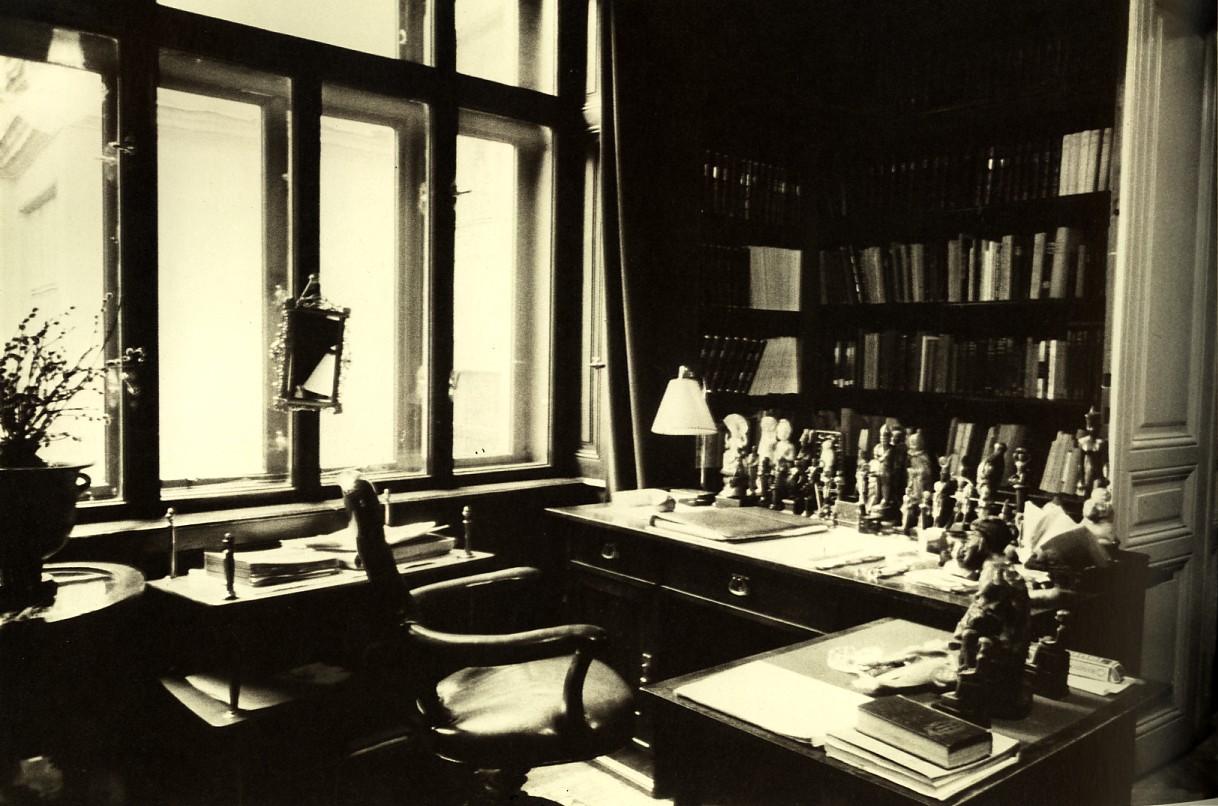
I was surprised by one of the amazing works of Freud I finally sat down and read:
The Joke and Its Relation to the Unconscious (now in a fresh, athletic new translation by Joyce Crick). Surprised, that is, because the upshot of the book is not what I have always heard: that jokes are like dreams arising out of the unconscious. It even says this on the back of my Penguin edition:
Why do we laugh? The answer, argued Freud in this groundbreaking study of humor, is that jokes, like dreams, satisfy our unconscious desires. In short, the joke is like a wish-fulfillment. But this couldn't be farther from the truth. In fact, what is so unbelievable for me, reading this work, is that this thesis is
precisely what is resisted by Freud throughout it.
Jokes do
arise from the unconscious, it is true, but what is more key is that, like the preconscious residues of our day's experiences as we fall slowly into sleep and begin to dream, they
plunge into (as Freud often says) our unconscious. Everything revolves around this change the focus of our analysis takes. That is, everything revolves around a change in the direction of movement that we conceive the psychical activity as most its own within; a change in the way we have to describe its relationship to the unconscious; a change in our vocabulary from
arising from to
plunging down into.
A change in direction, yes, that still occurs along a singular and one-way path also traversed by the dream: one could thus describe what is key as a change of
emphasis from one stage of this path (the first--falling into the ucs, which is followed by the work of the ucs itself) to another (the third--emerging out of the ucs). But a change in direction is more what Freud is looking at since it means jokes and dreams tend towards different things: the joke might seem like it occurs at a different place on the same model (that of dreams), but it does so in such a way that it almost justifies another model of its own at that point, since it
proceeds in a
way that is most its own, and merely accomplishes this procedure
there--at that stage in the model. In short, we say "
change in direction" because it makes the fundamental aim of the book more clearer: to assert that jokes are at bottom not like dreams, which are most themselves when they arise from the unconscious--and that jokes distinguish themselves from dreams
even though the way dreams manifest themselves may seem "jokey."
For as Freud says, this "seeming jokey" of dreams is precisely what got him into the question of jokes in the first place:
If one gives an account of a dream-analysis to someone who is not conversant with such things, in which of course, the curious and -- to waking thought -- repugnant pathways of the allusions and displacements employed by the dream-work is described, the reader is subject to an uncomfortable impression, declares that these interpretations are "jokey," but obviously regards them not as successful jokes but as being forced, and as somehow breaking the rules of the joke.-
The Joke and Its Relation to the Unconscious, 167
Dreams seem jokey, and yet break the rules of the joke as soon as we interpret them as jokes. And this is the structure of the book: interpret the joke as a dream to get at what constitutes "jokiness." Yet the fact that this comparison can go only so far is the upshot, and one can't emphasize it enough: the heart of the comparison of the joke to the dream is precisely to elucidate the dream, not the joke. It is when this comparison breaks down that we genuinely have some contribution to the theory of the joke from Freud.
Thus, interpreting the effort to draw similarities between the joke and the dream as merely an instance of applying the framework developed in the text on dreams to the joke--which is precisely what we do when we say that jokes, like dreams, satisfy desires or are wish-fulfillments--is completely missing the point of the comparison in the first place. Freud is not
applying the same model to expand its legitimacy, but finding its limits by testing things
against the possibility of a convergence between these things and this model. Using the model, he is trying to find that point where the same model will not apply: at that point will be a different logic or set of rules or, in short, a different model--that one which the dream succeeds always in "
breaking."
So saying that the point of the book is to elucidate dreams doesn't mean that that joke itself isn't something similarly unconscious, in the end--that in truth the joke actually
is on a different model than the dream: it is just that the way of going about proving this can only occur for Freud if he finds that the joke indeed has some claim
independent of the dream to participation in unconscious thinking. And the right way to do this is to find the point at which the model or framework of dreams, when applied to another object, no longer serves to elucidate that which inspired the application (i.e. dreams). One opens up to alterity by finding that point where it is already inscribed in acts of opening up onto it.
Thus we may say that
going down into the ucs is the basis of the logic of the joke, while with dreams it constitutes itself in going
out of it: these are two logics inscribed in the same space (I might recall that the going-down of Zarathustra could be important in some way here, especially with his emphasis upon joy and jokes and clowning).
Put a different way, the joke
puts its relation to the ucs
out there, while the dream
hides it (the relation) to the utmost. This is what we mean when we say the joke goes down into or retreats into the ucs: what is not important for it is what manifests itself as a result of the descending. To personify a little too much (though this is sort of inevitable when talking about this stuff): the joke just wants to get there. This is unlike the dream, which must actively dissimulate what manifests itself, because it is the unconscious going
out there. It's goal is to get out, so manifestation is a bigger concern for it. It isn't that the joke and the dream don't both have a manifest content that is different than what they are really getting at: in short, it isn't that the joke doesn't have something to hide like the dream. Both manifest themselves and hide at once. It is simply that for dreams this manifestation carries a risk--as well as an involved psychical process, that of regression--which for jokes does not apply.

This risk is unpleasure. The dream is making its way out there in such a way that it must avoid unpleasure. So, it hides where it came from--the unconscious--because this risk is foremost for it. But it is not that the exposure of the source of the dream would be that thing which causes unpleasure, as our way of outlining this here would make things seem. Rather, unpleasure is what is risked from the start, in the formation of the dream itself. The avoidance of unpleasure causes the dream: thus the dream takes extra care with its manifestation, precisely because the manifestation is the avoidance of unpleasure itself. This is simply to say: the dream is a wish-fulfillment. It seeks to overcome the possibility of an unpleasure by making it look as if this avoidance was itself the gaining of pleasure. The unpleasure would actually
occur simply if the psyche sat still--so revealing anything behind the manifest content doesn't matter unless one gets at why the psyche is moving or manifesting
anything in the first place.
So rather than saying its manifestation carries a risk the joke doesn't have, we might say that
the dream is the risk that the joke isn't. This means, in short, that rather than an avoidance of unpleasure, the joke is simply an attempt to gain more pleasure. This is why jokes don't care as much about their manifestation--in short, why the technique of the joke, while so sophisticated, doesn't really reveal anything
about the unconscious (what are its desires?) when it is taken apart or undone. This doesn't mean that jokes are simple. It just means that dreams always break a rule of jokes because dreams don't
play by those rules. One could also say, as Freud does in the following which will summarize everything here we have covered, that dreams just don't play by rules
in general:
The dream not only has no need to place any value on intelligibility, it must even guard against being understood, for otherwise it would be destroyed; it can only exist in disguise... The joke on the other hand is the mot social of all the psyche's functions that aim to obtain pleasure... It has to commit itself to the condition of intelligibility; it may not make use of the distortion from condensation and displacement that is possible in the unconscious to any further extent than can be redressed...-
The Joke and Its Relation to the Unconscious, 173
"
To any further extent than can be redressed..." this is what is key. It means that the rules of the joke that the dream busts open are precisely rules--that is, the terms in which it occurs, its situatedness, its context. The dream erupts into reality: this precisely means that even though it does respect a certain technical set of requirements, it occurs to break the context in which it takes place. This makes sense from what we said earlier: the unpleasure that the dream avoids is precisely that which would occur if it stood still--if it remained in its context, that is.
So while we were busy bringing out one of Freud's most radical theses of the book--
that dreams avoid unpleasure while jokes seek to gain pleasure--we have hit upon another: the dream tries to break into the context of reality while the joke, to a degree, respects it. But this is really to say that
the dream tries to make the unconscious into reality, while the joke tries to make reality into the unconscious.
This is the point in saying, as Freud does, that jokes lack regression:
The regression of the train of thought to perception certainly does not apply to jokes...-
The Joke and Its Relation to the Unconscious, 161
For what is clear is that this means dreams seek to move us into a different context or a different reality--they seek to allow the ucs to irrupt into reality itself (veiled, of course)--while jokes preserve the state of the psyche and its relation to reality--playing with it, as it were, only to restore it:
Despite all its practical nullity, the dream maintains a relation to our great vital interests; it attempts to fulfill our needs by the regressive roundabout route of hallucination... The joke on the other hand attempts to draw a small amount of pleasure from the sheer activity, free of all needs, of our psychical apparatus.-
The Joke and Its Relation to the Unconscious, 173
(More to come... sorry to keep you waiting--I'm doing this in bits and pieces while traveling...)
 ...Playing with one's own name, putting it in play, is, in effect, what is always going on and what I have tried to do in a somewhat more explicit or systematic manner for some time now in certain texts. But obviously this is not something one can decide: one doesn't disseminate or play with one's name. The very structure of the proper name sets this process in motion. That's what the proper name is for. At work, naturally, in the desire--the apparent desire--to lose one's name by disarticulating it, disseminating it, is the inverse movement...

