Wednesday, December 10, 2008

A few thoughts on "Circumfession"

In “Circumfession” Jacques Derrida seems to be coping with that thing that happens when we start writing or talking about ourselves, which is to start to explain ourselves as well. With surprising rapidity, relating something about oneself becomes something like self-justification, as if my actions could also have been mistakes. Explaining oneself, then, gets pulled closer and closer to confession: suddenly everything that I relate looks like it is something I am guilty of committing and for which I need forgiveness—especially if I then try to justify my right to a story that isn’t taken as justification, as Paul de Man captured well in the last chapter ("Excuses") of Allegories of Reading. In short, another way one can confess (besides walking into the confessional) is by guiltily relating a story about oneself; a story, that is, which makes one look and feel guilty.
But I don’t think Derrida is as interested with what all this does to the mental coherence of that self that is then related. The more crucial question for Derrida throughout “Circumfession” is what this guilty story does to others. For when we end up explaining ourselves, we also have the tendency to try and get ourselves off the hook by turning the people in our lives into determining causes of our faults. In our explanation, they aren’t themselves, but words, gestures, actions that will add to our self-justification—more like fictional characters. Another way to put this is in the terms used earlier in our seminar: this story that seeks its forgiveness because it feels guilty, confession, cannot produce testimony with respect to others. While I can produce testimony about a historical event that was caused by another—about something that was caused by her words, gestures, or actions—my confession will stop short of testifying to something about her herself, in her singularity. It will have to remain confession, a story of guilt about oneself, with respect to each of these others.
This is only a problem for Derrida, though, insofar as he is unable to be sure that his confession will not, despite everything, still actually testify for another. At least this is what I think he claims when he says the following after remembering something about his mother (who is hanging on to life in a hospital, and at any moment as he writes may already be dead):

I stop for a moment… over the admission I owe the reader, in truth that I owe my mother herself for the reader will have understood that I am writing for my mother, perhaps even for a dead woman and so many ancient or recent analogies will come to the reader’s mind even if no, they don’t hold, those analogies, none of them… (p. 25, #4).

The problem here is not just that a justificatory writing makes him distort his mother to make her fit his story. The problem is not just that, at the moment she appears in what he says, she can appear like almost any other mother we can read about (e.g. Augustine’s Monica) except herself. The problem is also that she herself could, despite this, actually remain just this “distortion.” Effectively under the pretense of distorting another for his own benefit, then, Derrida might still be saying something accurate. But this testimony then would appear for all the wrong reasons—which would make it just as irresponsible to the other as any distortion. This is what he claims when he says he writes for his mother: in one movement, he is speaking in the place of his mother, instead of her, as well as risking actually addressing her herself by speaking in the place of her. He condenses this into the following axiom: one always confesses the other.
To put this axiom a different way, the problem is how the fate of someone else can still depend on what it is impossible for one’s confession to produce, insofar as it is mine, insofar as I (or an I) have (or has) control over it: this impossibility being the chance that it produces testimony. And by saying this is a problem, I don’t mean that it is lamentable. It is, throughout “Circumfession,” precisely that which Derrida believes he must engage. To engage his confession here, in this problematic sphere beyond its being merely his confession, in a place not unlike that where he has to deal with a circumcision he himself had no control over or even knowledge of—to engage his confession in this sphere beyond his own guilty story is what he sees as the task and responsibility of confession.


Sunday, December 7, 2008

Punctuated without a period: "Circonfession"

(Derrida's library)

"Circonfession"–one of Jacques Derrida's more unbelievably masterful texts–I just found out was read by the Derrida and recorded, and is available on 5 CDs or tapes. Hearing the recording, one is instantly made aware of the possibilities of the long, comma-studded sentences, which can modulate in their grammar and meaning depending on how the voice takes them up. That is, one sees how Derrida could describe his writing in this text in a later interview with the following words: he says he would stop his particular reflection only "after the breathing space of a rhythmic sentence, which did have punctuation, as if rippling with commas, but was uninterrupted, punctuated without a period, if you like..." ("The Word Processor." In Paper Machine, Stanford UP, 1995. p. 22). That is, the commas turn into periods, and the periods into commas, as the text turns around and consolidates, with and against the inertia of its desire to speak, the possibilities of its expressiveness. (And, I'll note, this is a mode I also believe wholeheartedly is at play or work in many other texts of Derrida's besides this one, and we should consider them as such–that is, read them more like we read "Circonfession.") Here, below, in French, is the first of these reflections–what are called in the title and in the text "periods and periphrases" (périodes et périphrases). You can hear the text read by Derrida (thanks to the great Derrida en castellano site) by clicking on this link here.

Le vocable cru, lui disputer ainsi le cru, comme si d'abord j'aimais à le relancer, et le mot de "relance", le coup de poker n'appartient qu'a ma mère, comme si je tenais à lui pour lui chercher querelle quant à ce que parler cru veut dire, comme si jusqu'au sang je m'acharnais à lui rappeler, car il le sait, cur confitemur deo scienti, ce qui nous est par le cru demandé, le faisant ainsi dans ma langue, l'autre, celle qui depuis toujours me court après, tournant en rond autour de moi, une circonférence qui me lèche d'une flamme et que j'essaie à mon tour de circonvenir, n'ayant jamais aimé que l'impossible, le cru auquel je ne crois pas, et le mot cru laisse affluer en lui par le canal de l'oreille, une veine encore, la foi, la profession de foi ou la confession, la croyance, la crédulité, comme si je tenais à lui, pour lui chercher dispute, en opposant un écrit naïf, crédule, qui par quelque transfusion immédiate en appelle à la croyance du lecteur autant qu'a la mienne, depuis toujours d'une autre langue, d'une langue toute crue, d'une nom à demi fluide aussi, là, comme le chant, et j'entends ricaner, pauvre vieux, t'en prend pas le chemin, c'est pas demain la veille, tu sauras jamais, la surabondance d'une crue après le passage de laquelle une digue devient belle comme la ruine qu'elle aura toujours au fond d'elle-même emmurée, la cruauté surtout, encore le sang, cruor, confiteor, ce que le sang aura été pour moi, je me demande si Geoff le sait, comment saurait-il que ce matin-là, un 29 novembre 1988, telle phrase est venue, de plus loin que je ne saurai jamais dire, mais une seule phrase, à peine une phrase, le mot pluriel d'un désir vers lequel tous les autres depuis toujours semblaient, la confluence même, se presser, un ordre suspendu à trois mots, trouver la veine, ce qu'un infirmier pouvait murmurer, une seringue à la main, la pointe dressée vers le haut, avant la prise de sang, lorsque par exemple dans mon enfance, et je me rappelle ce laboratoire dans une rue d'Alger, le peur et la vague d'un glorieux apaisement s'emparaient à la fois de moi, me prenaient aveugle dans leurs bras à l'instant précis où par la pointe de la seringue s'assurait un passage invisible, toujours invisible, pour l'écoulement continu du sang, absolu, absous en ce sense que rien ne semblait s'interposer entre la source et l'embouchure, le dispositif assez compliqué de la seringue n'étant introduit à cette place que pour laisser le passage et disparaˆtre en tant qu'instrument, mais continu en cet autre sense que, sans l'intervention maintenant brutale de l'autre qui, décidant d'interrompre le flot une fois la seringue, toujours dressée, retirée du corps, repliait vivement mon bras vers le haut et pressait le coton à l'intérieur du coude, le sang eût pu inonder encore, non pas indéfiniment mais continûment jusqu'à m'épuiser, aspirant ainsi vers lui ce que j'appelai: le glorieux apaisement.
-"Circonfession." In Jacques Derrida, by Jacques Derrida and Geoffrey Bennington, Éditions du Seuil, 1991. #1, p. 7-12

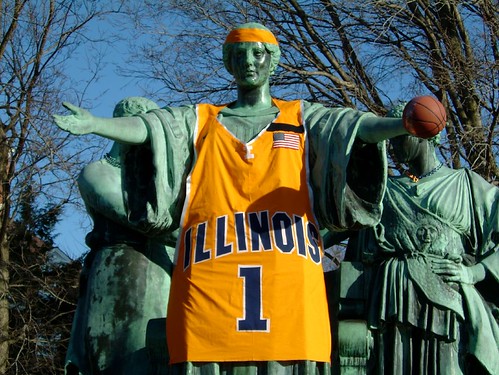
For alma mater...

What lurks at the horizon... is the nightmarish prospect of a society regulated by a perverse pact between religious fundamentalists and the politically correct preachers of tolerance and respect for other's beliefs: a society immobilized by the concern for not hurting the other, no matter how cruel and superstitious this other is and in which individuals are engaged in regular rituals of "witnessing" their victimization. When I visited the University of Champaign in Illinois, I was taken to a restaurant where the menu offered Tuscany fries. When I asked friends about this they explained that the owner wanted to appear patriotic apropos the French opposition to the U.S. attack on Iraq, so he followed the U.S. Congress and renamed French fries "freedom fries." However, the progressive members of the faculty (the majority of his customers) threatened to boycott his place if freedom fries remained on the menu. The owner didn't want to lose his customers, but still wanted to appear patriotic, so he invented a new name, "Tuscany fries." This had the added advantage of sounding European, and also echoing the vogue of idyllic films about Tuscany.
-Slavoj Zizek, Violence, p. 130