 ...or on Memoirs/Memories of a Blind, as it perhaps should have been translated (Derrida too can be seen as blind in the book, as he himself shows).
At the beginning Derrida advances a double hypothesis, which he traces through the spectacular movements of the book. Here they are:
1. The draftsman always figures the blind, always draws the blind.
2. The draftsman himself is this blind one: thus all drawing is a self-portrait.
The second hypothesis intertwines and reconfigures the first however to produce two amazing conclusions:
a. If the draftsman is drawing the blind which is himself, he himself is drawing blindly, is blind to his drawing ("one draws only on the condition of not seeing," 49). Derrida shows that this is the case in the most banal incident in drawing: putting the pencil on the paper covers the point at which the actual trace would be visible ("the inscription of the inscribable is not seen," 45).
b. In still another twist, what becomes of the self-portrait then is not a self-portrait, since it is impossible to be drawn while blind (how could one ever see what is to be drawn if one is blind?): the self-portrait can only appear as a ruin, a prompting to recall what was never truly there (the work remains a constant "failure to recapture" a presence "outside of the abyss into which it is sinking," 68)
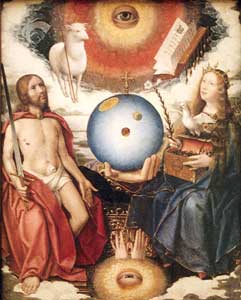
These all culminate an an exquisitely haunting phrase which Derrida asserts is synonymous with this double hypothesis: "Blindness does not prohibit tears" (127). For what Derrida sketches is that the self-portrait is a drawing that enacts a subject position between the call of the Other and yet also to the Other as the self: one stands in front of the self-portrait as the painter painting from the same position as the other for whom the painting is destined. But this other is already oneself--because one must inhabit its position in order to paint for this other, for their point of view or perspective--and at the same time what is being painted for this other (now as this other and oneself as both spectator and painter) is the painter. Thus, in front of the self-portrait (like in front of Jan Provost's allegory, pictured here), Derrida says,
the desire for self-presentation [of the author, of the blind] is never met, it never meets up with itself, and that is why the simulacrum [the ruin of the picture] takes place. Never does the eye of the Other recall this desire more sovereignly to the outside and to difference, to the law of disproportion, dissymetry and expropriation. And this is memory [what supplements the ruin] itself (121).
In other words, the viewer cannot ask the other to present himself in the picture, nor see the picture as a fully constituted reproduction of the absent other, its traces and ruins as the presence of an absence and thus present themselves. Thus the spectator/author, blind, cannot continue seeing, but in agony and in supplication has tears well up in her or his eyes. Thus, "deep down, deep down inside, the eye would be destined not to see but to weep" (126-7). This is what our blindness in seeing a self-portrait, which constitutes vision (if only because it should be the easiest for sight to see), can teach us. Not that weeping is proper to the eye, what we should continue to forever do with it, but that the subject position revealed in weeping before a self-portrait is that position from which we start viewing, from which anything is visible as such. In order to see at all, the tears must be wiped away from one's eyes.

No comments:
Post a Comment