A reading of "Bauen, Wohnen, Denken," which proceeds roughly along the path of the introduction and first part of the essay, with general comments meant to make Heidegger a bit more accessible interpolated. Thanks to my friend and colleague Emily for giving me the opportunity of writing this finally! I hope it is a little bit helpful:
Building (
Bauen: constructing, structuring, to house something) and dwelling (
Wohnen: residing, living, to stay with somebody) are the terms of the question. The question focuses upon building. It asks: If our inquiry "
traces building back" into the place where we can see it working in the way that is most proper to it qua building, if we trace the way it looks like it works back into this "
domain" (
Bereich), then does this place, this domain, this original coherence of the phenomenon of building have anything to do with another sort of place that we call a dwelling? Looking into the way building is properly building, which means looking at the way it
is building (that is, looking at it ontologically, in its be-ing building), does this resonate with how dwelling is properly dwelling? Does this building
be-ing building resonate with dwelling being dwelling?
To understand this, we will ask 1) What is it to dwell, or how does dwelling be? and 2) How does building resonate with [gehört] or belong with dwelling?
To put it in more simple terms, Heidegger looks at a phenomenon: as Merleau-Ponty would describe it, the way that something coheres as it appears to us, its structured appearance to our lives (so like, a room appears to us as a usable space before it appears as a rectangle we inhabit, to the extent that the space of the room warps around the objects in it. Sartre said once a room taken phenomenologically is a lot more like how a blind person "sees" it: the room is a set of objects for him to use--the fact that it has corners is really irrelevant because they're hard to touch, nothing he needs is there, etc.). Thus what will follow is a phenomenology of building or construction. But his phenomenologies are phenomenological ontologies: they look at the coherence of something appearing precisely as how it exists, in its being (taken intransitively, as be-ing or is-ing: Levinas said helpfully once that Heidegger's contribution to philosophy is in restoring an intransitive character to being). So the being of building is a sort of coherence, its remaining proper to itself as a phenomenon--but doing so not in the aspect of how it looks or feels, say, but in how it exists, how it just remains there in its activity as an activity, how it "just works" as we like to say, implying some process but at the same time implying that it just does this process in being typically itself. So he's looking at the way building is properly being building. This is why he contrasts what he's doing to some aesthetic, architectural treatise on construction to giving rules or architectural ideas: this couldn't be further from looking at the being of building (for him--for me, this move in Heidegger is always suspect, because its dickish, as if his way of doing things is the only real way). He's also going to do this phenomenological ontology with dwelling, or, translated a little less pompously, "living in" something (his translators are also pompous sometimes). In fact, he's going to look at this first, to try and see if living in something is going to end up having any relation to constructing something. This makes sense because, of course, we live in the things we build. But the uniqueness of Heidegger is to pose this banality in ontological terms. Part I:
At first it looks to us like we can only reach (
gelangen, get to, as in: get to that place where there is)--it looks like we can only get to dwelling, or what dwelling is,
through building,
by means of building, or what building is. This is why we asked what dwelling is first--to try and work against the way things seem when we don't see them as structured appearances or as phenomena (and chiefly when we don't see them as appearances structured by their being, as ontological phenomena). In fact, we work against this because the mode of our presentation of building looks like it informs our way of considering it. That is, if we do look at things in this mistaken way, we'll think that dwelling is merely an end of building. This makes dwelling look like it is just having shelter in something, in being located inside a place that is reserved by building for this purpose. But this is not right: just because we fulfill the purpose of something doesn't mean that we are properly dwelling, that we are, in our being, in our remaining what we are, dwelling. In fact, I can dwell by precisely not fulfilling the purpose of something. To look at building as a means, and dwelling as an end--and thus to look at dwelling through building--is to avoid the question. We'll come to this below in how the question about housing problems is brought up.
For Heidegger, thinking about a dwelling in terms of its ability for us just to be located within it is, like thinking about the room as a rectangular box in space, to miss the phenomenon, is to miss how it is structured. It's no mistake that this is how science, in the use of physics in engineering and architecture, thinks about a dwelling (according to Heidegger). What's interesting is that for him this is reflected in how the problem of living-in something or dwelling in it is usually approached. His resistance to this approach will govern the structure of the rest of the essay: it especially governs what will happen next--his turning to language. When Heidegger does this, he supposes several things that are a bit farfetched and which I tried to bring out below: 1) that language itself can give us the phenomena if we hear it right, 2) the right language in which we hear this is German (here he is in serious danger of becoming a Black-forest patriot and/or Nazi) and that this is the case because, 3) like Hegel, he believes that German has a relationship to the way that the Greeks, the proper thinkers, thought (also a Nazi conception, but again, Hegel thought it too, so what this means is, on a certain level, tough to say). What he is trying to do, though, is significant: he's trying to think of construction or building not as a means, which means thinking of it not as something involving machines and technology. So he tries to pull that back out of the language. What he's claiming though is pretty profound: because we think of a dwelling through construction, this means of presenting it itself makes construction a means. In other words, the way of presenting the problem duplicates the way we consider the terms of the problem. However, if we look at language, the German language, the language proper to thinking and in which nothing less than the spirit of the West, as it was handed down from the Greeks, is preserved as such, then to build,
bauen, is already to dwell: that is, dwelling has a relationship to building that is not of a means-end nature. For building, in German, in this proper language, especially if we go back and look at its older meanings, in fact looks a lot like it simply means being, which is preserved in the German word for "am:"
bin. When I say I am (ich bin), I mean "
the way in which... I am." That is, I mean: I have cultivated myself, constructed myself, taken care of myself in this particular way. I have precisely not *made* myself or manufactured myself, as if I were a performance. "Here building, in contrast with cultivating, is a constructing." Cultivation is an art, but is not something technical: it is closer to the art of trimming vines and shaping a plant. In short, building itself is not properly something technical, precisely because--for reasons we state most clearly in "The Question Concerning Technology" but which we'll get to below--the technical is not technical: the technical is much closer to this cultivation, to this taking-care-of, to this sort of protection, which we'll come back to. Building is not properly manufacturing, it is cultivating.
We have not yet answered how this cultivating is dwelling, but we can see that this view of building as a sort of manufacturing is precisely what the means-end view of building and dwelling has done to our thought. It has turned us away from all that in building already could mean something else. (This means that, in truth, it has turned us away from Germany, from German language.) It has turned us away from how building and constructing can mean something like cultivating, and cultivating in a pure, proper, German sense: that is, without recourse to an idea of cultivation as performance, as fakery, as tricks, as technique and art that is a technology in the vulgar sense. To think of cultivating as something other than a manufacturing, to hear it even in our language itself: this is what being attentive to the phenomenon, rather than reducing it to a means-end relationship, had allowed us.
So perhaps we can look at our German language again, this time precisely at dwelling, and see whether it too could mean something like cultivation. Then there would be a relationship that would not be one of means-end. It would remain then for us to inquire into what the nature of this other relationship would be. But first let's get to dwelling now without building, without going through building: which we now know means, without seeing building as something that has an end.
We don't hear that
wohnen, dwelling, means cultivating
directly. That is, we have to take a detour in order to hear cultivation in dwelling. (It will take us to what we will call the fourfold.) For like building, it means remaining as something, but it means this more immediately, in terms of preserving and guarding, not cultivating. In fact, it means something closer to freeing-up. When I say I dwell, what I really mean is that I am free to do whatever. It does not mean, like cultivating, a sort of gathering together and holding together as protection, but a setting loose, a sort of freeing up. So we have gathering on the one hand and a setting free on the other—but we will come back to this opposition.
What we should note now is that if dwelling means being free,
a dwelling would therefore be something like an object that is set free so that it can exist within this type of freedom. In fact, this freeing up of the thing is a lot like saving it from becoming a mere end, something that is just an object located within a techno-scientific or objectivized space. It is, as we will see, to really treat it as a thing, before it becomes an object, a point in space. This is not just a change in terminology that will oppose something good (a thing) to something bad (an object), although we will indeed exploit this opposition. What we are getting at is more fundamental: a dwelling is a freed object, or a thing that is more originary, more proper than an object because it is free. When something is left to its own, it is dwelling: “
to dwell means… to remain at peace within the free sphere that safeguards each thing in its essence,” that is, to its being properly itself.
To clarify: what Heidegger is doing is distinguishing something that is objectivised and scientific from something that, he says, is more basic, more properly itself. To call the dwelling a thing here means the same as regarding the room not as a rectangle but as a livable space. This will come back more explicitly in the second part. But this distinction allows him to launch himself into a meditation on how the world looks when it is full of things, not objects, and how the dwelling fits into this world made up of these things. Put differently, dwelling is when something’s thingness takes precedence before its objecthood because, as we said, dwelling is precisely this freeing.
A dwelling is only a concatenation of dwelling itself, therefore, which is a setting free, a making free, an allowing of what surrounds me to come before me unburdened by how it logically is supposed to fit into my business. Dwelling is more free than the space in which I carry out my business. In fact, it fits into a whole world that is more properly itself than the space of my business, the space of technical and scientific objecthood. In this non-technical world, the dwelling is on top of the earth, before this earth is considered a set of resources, a set of minerals. It is also under the sky, before it is considered the space of physics. It is on top and below these, in this world, which also remains in front of gods and the holiness that pervades the phenomenality of things as such. And in this world are mortals, who is capable of being properly himself in his being-towards-death, in his dying qua dying, as we explained in
Being and Time.
Each of these obscure terms—earth, sky, mortals, gods—all these are essentially what we see around us considered phenomenologically: that is, with concern for their being properly themselves, grounded or structured by their being. They are not just the things that we see but the larger “regions,” as Heidegger occasionally will call it, in which more specific things can appear. They are like the ur-phenomena, in which the things appear. Something coming out of the sky will appear to us as a sort of sky-phenomena: for Heidegger the phenomena of the sky include the length of the day and time, basically time-management. Something from the earth appears to us as an earth-phenomenon: it is that out of which we create things and make things. The gods or divinities are the realm in which we try and relate to both earth- and sky-phenomena as such: something from this region appears to us as our expectation about a thing. The sphere of mortals or men is where we live out our lives, where the phenomena like the continuity of one’s self-history appears. This continuity is ensured by death—but that is an issue I can’t get into here because it takes too much time: one has to summarize a lot of Being and Time, in which it is first fleshed out. Regardless, you see what is going on. What is being explained here by looking at the regions in which phenomena appear is that the coherence of the world, which is the world being properly itself as a world, and which he in a vatic manner describes as its oneness—this coherence is only possible if man dwells in it, in the sense of dwelling that this essay is pursuing. For dwelling will fit together these ur-phenomena or regions. That means that man takes up the earth, the sky, the holiness of the world as well as his own mortality, and makes them actively fit together, gain the structuredness that is proper to them as phenomena, through his own dwelling. The world could indeed take up space without man, but only man can give it the significance of a phenomenon: that is, an appearance that is structured and meaningful insofar as it is. Each of these four aspects or regions of the world fits together, to borrow a metaphor we used in
Basic Concepts. But this fitting together, this oneness of the four, can only take place if there is dwelling, and if man, the mortal, is the one who does this. How is this possible? Well, it is possible in that the fitting-together is precisely what is allowed by a sort of setting-free of the things within these regions. If you set something free, it is set free so that it can find its proper place, so that it can find where it can most be itself, so that it can fit together with its most proper situation. This, we know, is precisely what dwelling does: it sets a thing free.
So we now understand the ramifications of this setting-free of the thing. To set a thing free, to keep its freedom, is to allow it and other things to find their proper situation. This situation is one that occurs within one aspect of the fourfold. And insofar as it is free, it allows the fourfold to fit together, to become one or have a oneness—a oneness that simply is the world being properly the world. But we also understand how dwelling is cultivation, as building is. For to allow all these regions, all these fourfold, to fit together, is to care for the whole world through the setting free of the things. Indeed, dwelling might deal immediately with things, with the setting free of things—but this setting free is a way to ultimately cultivate the world as such, to preserve and save and nurture the world as its proper self. And insofar as this is so, we understand how Dwelling is building: “
dwelling, insofar as it keeps or secures the fourfold in things”—that is, sees things as part of the fourfold, of the world itself—“
insofar as it keeps or secures the fourfold in things, is, as this keeping, a building...”
 If the old photograph rendered its subject spectral, as Walter Benjamin never tired of emphasizing, and which the spirit photographers of the late 19th century literalized, I feel like the average little digital photos we take now on our simple digital cameras (preferably on a night out) show us (again?) that this spectralization was always filtered through the technical. Put more clearly, while the spirit photos of the late 19th century literalized the spectrality of a technology, the pleasure we take in many digital photos now is one of literalizing the technical nature of this spectrality. This is a pleasure that will probably disappear very soon with the advancing sophistication in digital cameras, but still remains most visible in pictures of the night.
 Here I just want to call attention to the fact that we might be almost at the end of this interesting period in photography--as I'm sure many people more specialized in the field than me have probably noted. It is not unlike the end of the era of 8-bit images, which we now nostalgically look back at. These are, incidentally, captured well by Michael Wolf in his monumental The Transparent City: the grid-like structures provided by buildings (which were much more oppressive in his The Architecture of Density)
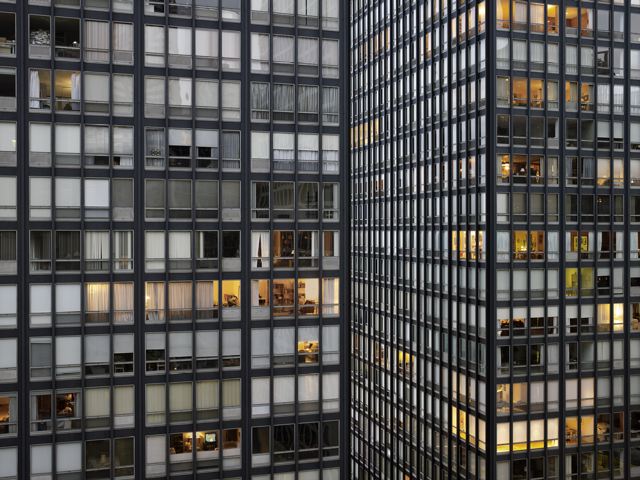 here are able to be filled in, just like in any little 8-bit graphic. Accordingly the detail shots of the people who inhabit these buildings are extremely pixelated:
 The particular inability of the digital image to capture phenomena, however,--and especially at night--which produces a clearer image in some parts and a longer-image exposure in other areas, along with the play of light and even the iridescent vein-like outlines and scale-like squares of compression will perhaps be gone soon too, only to make a comeback. The pictures allow us the sense that the disoriented feeling, that ghostlike feeling, of life is not just due to the fact that death inhabits it--this was spirit-photography's point. What digital photos allowed was the sense that this death in life was technical, was due to the immense amount of mediation that our experience has undergone in the last few years.
 In the digital photos the texture is, because it originates in the back and forth in the algorithms and not in the actual mechanisms of the camera, more tightly imbricated with the particular objects photographed. The texture, the surprise, is more in the things than in the medium. And what's more, its totally without pretension, without setup. (The use of the flash gets rid of this effect sometimes while keeping, or perhaps even emphasizing, the hand-held nature--American Apparel figured this out, taking it, of course, from amateur porn. The processing of the camera that is involved without the flash seems to take longer and be more involved, thus becoming more and more technical. Flash brings back the surface, in other words.)
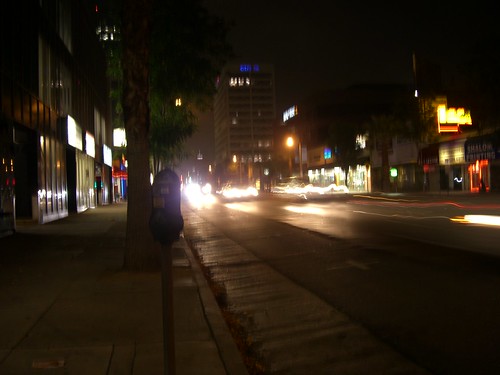
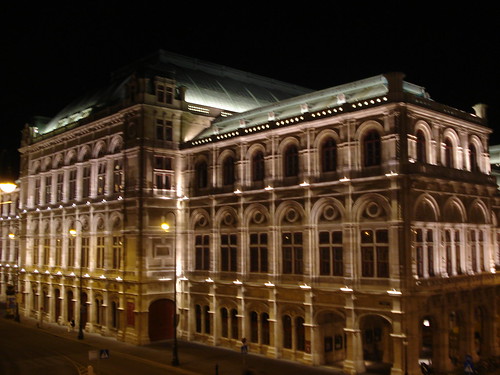
 will remain my favorites long after the stabilization techniques overtake our ability to work against them (and with them) manually, thus making all the images of night fixed and clear.