 If the old photograph rendered its subject spectral, as Walter Benjamin never tired of emphasizing, and which the spirit photographers of the late 19th century literalized, I feel like the average little digital photos we take now on our simple digital cameras (preferably on a night out) show us (again?) that this spectralization was always filtered through the technical. Put more clearly, while the spirit photos of the late 19th century literalized the spectrality of a technology, the pleasure we take in many digital photos now is one of literalizing the technical nature of this spectrality. This is a pleasure that will probably disappear very soon with the advancing sophistication in digital cameras, but still remains most visible in pictures of the night.
 Here I just want to call attention to the fact that we might be almost at the end of this interesting period in photography--as I'm sure many people more specialized in the field than me have probably noted. It is not unlike the end of the era of 8-bit images, which we now nostalgically look back at. These are, incidentally, captured well by Michael Wolf in his monumental The Transparent City: the grid-like structures provided by buildings (which were much more oppressive in his The Architecture of Density)
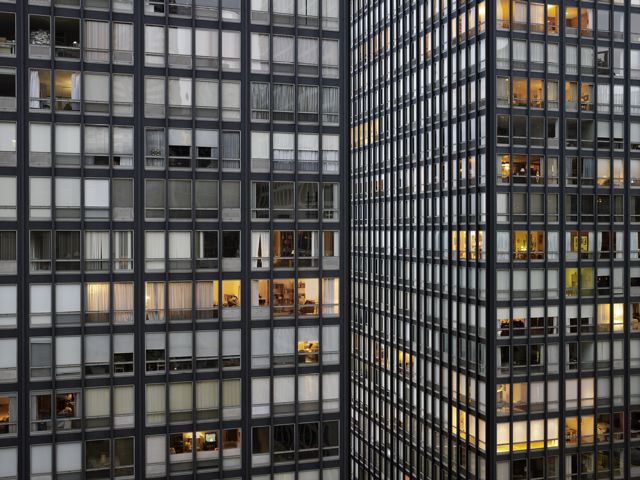 here are able to be filled in, just like in any little 8-bit graphic. Accordingly the detail shots of the people who inhabit these buildings are extremely pixelated:
 The particular inability of the digital image to capture phenomena, however,--and especially at night--which produces a clearer image in some parts and a longer-image exposure in other areas, along with the play of light and even the iridescent vein-like outlines and scale-like squares of compression will perhaps be gone soon too, only to make a comeback. The pictures allow us the sense that the disoriented feeling, that ghostlike feeling, of life is not just due to the fact that death inhabits it--this was spirit-photography's point. What digital photos allowed was the sense that this death in life was technical, was due to the immense amount of mediation that our experience has undergone in the last few years.
At least this is the only way I can explain the amazing fact that over the years as the technology has gotten better these phenomena of the digital photo became more fun to see. As cameras adjusted the image already as you were taking it to stabilize it and prevent problems of underexposure and blurring, one began to take pictures in such a way that one was negotiating with the camera, working with and against it, in an extremely organic way. The pleasure you took in the odd blurred photo then (which was only blurred in certain areas to a certain degree), was in the fact that something could escape and emerge out of this dance. But the fact was that at the same time what emerged would have to be even more technical, or produced by the errors and creativity in the technology. That is, taking pictures became more than ever relating to the abstractness of the machine which actually performed it. The surprising over-exposure, or underexposure, or blur, would be brought to you the more arbitrarily and randomly the you manipulated the device. In short, what is special to to this particular digital image, I think, is that the texture of the photo is brought out, often, but not on the surface, like it is in wonderful gritty (and undersaturated) photos of New York, for example, in the 70's.
 In the digital photos the texture is, because it originates in the back and forth in the algorithms and not in the actual mechanisms of the camera, more tightly imbricated with the particular objects photographed. The texture, the surprise, is more in the things than in the medium. And what's more, its totally without pretension, without setup. (The use of the flash gets rid of this effect sometimes while keeping, or perhaps even emphasizing, the hand-held nature--American Apparel figured this out, taking it, of course, from amateur porn. The processing of the camera that is involved without the flash seems to take longer and be more involved, thus becoming more and more technical. Flash brings back the surface, in other words.)
Perhaps this is due to the fact that what was being integrated into these photos was not the eye, but the hand--digital photography became, as it became more handheld (like it did with the 35mm cameras of old), a more bodily experience. This would correspond with the notion that the technical mediation of experience was everywhere, or is at least more tactile, and therefore not just in the eye. Regardless, photos such as the one above--someone else's experiences in Paris that I just stumbled upon randomly--and some like the following
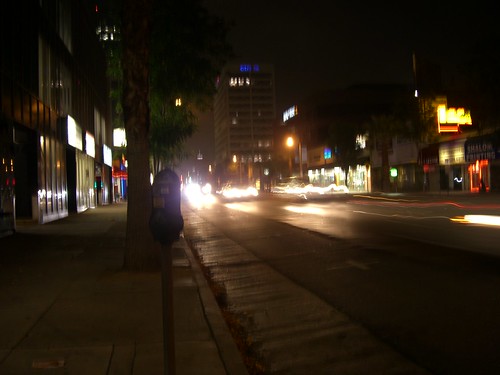
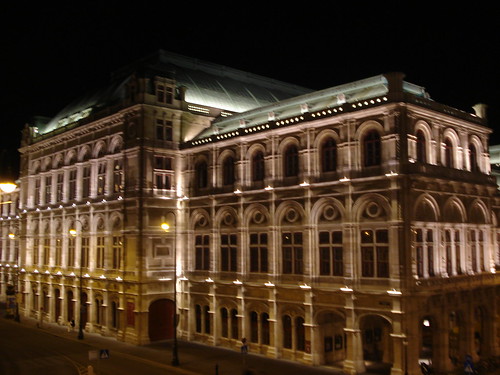
 will remain my favorites long after the stabilization techniques overtake our ability to work against them (and with them) manually, thus making all the images of night fixed and clear.

No comments:
Post a Comment