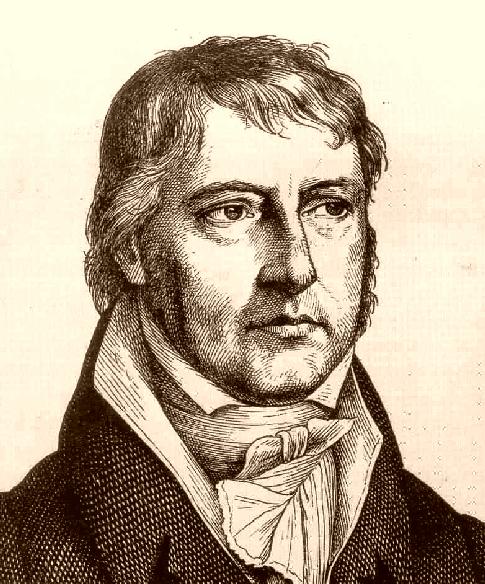
 I’m just going to tease out what Hegel says in the Phenomenology of Spirit in three phrases. Each is representative of a separate concern that consistently takes place throughout the Phenomenology as a whole, and also in the unbelievably rich history of the interpretation of Hegel. But I’m not going to be so concerned with what is asserted and where and why it is said so much—i.e. the particular arguments within each of them—so much as with the general way of thinking about things or general point of view that could allow something like these phrases to be written:
1. “It is clear that the dialectic of sense-certainty is nothing else but the simple history of its movement or of its experience, and sense-certainty itself is nothing else but just this history” (§109). Here we are concerned generally with history and experience and its relation to the dialectic (of sense-certainty, but also the dialectic qua dialectic).
2. “The Here pointed out, to which I hold fast, is similarly a this Here which, in fact, is not this Here, but a Before and Behind, a Right and Left… The Here, which was supposed to have been pointed out, vanishes in other Heres, but these likewise vanish. What is pointed out, held fast, and abides, is a negative This, which is negative only when the Heres are taken as they should be” (§108). Here we are generally concerned with the negative and negativity being what something is when it is taken as it “should” be.
3. “If they actually wanted to say ‘this’ bit of paper which they mean, if they wanted to say it, then this is impossible, because the sensuous This that is meant cannot be reached by language, which belongs to consciousness” (§110). Here we are concerned about language and how it cannot reach the “This” of sense-certainty, which Hegel says early on is the immediate.
If we can say something about each of these and how they enunciate the larger themes of the work and of Hegel’s thought in general, we might be able to connect them together.
Let’s first orient ourselves. You’ve probably heard “the dialectic” described as thesis, antithesis, synthesis. This interpretation has some foundation in Hegel, but it’s much more helpful, and much more complex (richer and more deeply problematic when indeed it proves problematic), actually, if we look at the dialectic as a movement between two terms Hegel uses a lot, terms you can easily trace in the movements of the Phenomenology: the immediate and the mediated (Unmittlebare, Mittelbar)—defined loosely, what has not gone through a process of some sort, and what has gone through that process. Sometimes it is good to think of the immediate as the undetermined or indeterminate, and the mediated as the determined. If we restrict our view to the movement of these two terms (and not yet considering exactly what “process” the mediated goes through and the immediate refrains from undergoing), the dialectic can be roughly characterized as the movement whereby what is immediate shows itself to be only properly immediate, only properly itself, when it is mediated, when it undergoes mediation (or becomes determined). To put it a better way, dialectic can be said to appear when anything taken immediately shows that if it is to be taken as what it is, it has to be taken as mediated (as determined).
Here in the chapter on sense-certainty, Hegel is dealing with something that is immediate—namely, sense-certainty itself (sense certainty is “immediate knowledge itself,” §90). We can presume, then, that if the Phenomenology structures itself around something called “dialectic,” as we usually think is the case with Hegel’s works, sense-certainty will show itself to be properly immediate only when it is mediated. Let’s take a step back and orient ourselves further to understand what all this means.
What is Hegel doing in the Phenomenology as a whole? Hegel has a lot to say on this, but his exact meaning is very confusing, and any way you reduce the confusion gives you a radically different interpretation of Hegel. I’ll just note this so you can get a different story than the one here if you want—go to some of the people on the handout. Put simply, however, Hegel is trying to think about what he calls Spirit (Geist). Spirit in its structure is something like the freedom (the determined indeterminacy) of thought or knowing in action—considered on a world-historical scale but never reducible to what we would call history or even freedom in its historical manifestation (Introduction to the Philosophy of History, III, “freedom is the only truth of Spirit”). It is a governing, proscriptive, disciplinary force in thought that also, like ideology or like a government, arises and is constituted by the actions of people. In short, Spirit is something like “the spirit of the times.” Hegel is trying to think about this Spirit, but, in the Phenomenology, not this Spirit itself, in its internal, determinate structure, in its being determined as freedom—this is only an indirect effect of Hegel’s primary concern.
This primary concern is in the Phenomenology is, rather, Spirit in its difference from itself, in its not being determined yet as itself, in its becoming-itself—in short, Spirit when it is not itself. When Spirit is itself and it returns to itself from out of the state of not-being determined as itself, the Phenomenology is over. Hegel can only then describe the logic of that Spirit, its internal structure in its completeness—this is why his next book after the Phenomenology is the Science of Logic. So, the Phenomenology describes or outlines or thinks about what Spirit is in its process of becoming-determined-as-Spirit, in a state in which it cannot be accurately described as a determinate structure, but in how it seems when it is not yet itself, when it is indeterminate. In short, the phenomenology describes the appearance and not the structure of Spirit: we can see now why and, more important, in what sense it is called a phenomenology—the phenomenon is what Spirit does and is when it remains in its difference from itself… it appears, and is appearance, the appearance of the structure (logic) of Spirit (which is freedom). (It should be clear that it is nothing Husserl would describe with his “phenomenology.”)
The form of the resistance of Spirit to becoming-itself, the phenomenon, Hegel understands as consciousness. This makes sense: if the freedom of thought or knowing in action is what we defined Spirit as, then there would have to be a mode of thinking in action that is not yet as free. Consciousness is that type of knowing: it is not as free for Hegel primarily because it takes everything from the subject-object point of view. Thinking things beyond the subject-object point of view is another way of saying that Spirit has returned to itself, that a mode of knowing or thinking exists that is free in its action. As we have been saying, this is the thought of the logic of Spirit, that takes place in the Science of Logic, but we should also note that from the perspective of the Phenomenology it is what Hegel calls “Absolute Knowledge,” a knowing that is fully Spiritual or free knowing/thought, a thought beyond consciousness or consciousness in its “absolute” form.
Now we know generally what sense-certainty is: it is a type of consciousness, a type of knowing that is the appearance of that free knowing or thought that is Spirit in its not-being itself, in its becoming-itself, in its resistance to Absolute Knowledge. If Hegel wants to describe what this consciousness is, because he wants to get at Spirit in the state of not-being itself, he will then only be able to describe it insofar as it remains this resistance to becoming Spirit.
But in doing this, in suspending the becoming-itself of Spirit, describing sense-certainty will have to end up effectuating by itself the intrusion of Spirit into this consciousness, the lifting up of sense-certainty into the process of the becoming-itself of Spirit, simply because sense-certainty will not be anything that seems to be something, but will be something, will be seen as described. It cannot remain a phenomenon, it cannot seem. In other words, if this form of Spirit is to be taken as what it is, as not-Spirit, it has to become Spiritual. Put differently, it has to become a part of the movement not of the difference of Spirit from itself but of the structure of Spirit as it is described.
Now we have fully oriented ourselves: we see the connection between this wider view we took that explains what Spirit must be, and the more narrow characterization of the dialectic that we set out with. In other words, we see how Spirit is immediate and how it is mediated: it is immediate in its not-being Spirit, in its becoming-Spirit, in forms of consciousness like sense-certainty, and it is mediated when it is as itself, as the freedom of thought in action. But according to the schema of the dialectic that we laid out earlier, immediacy is itself when it is mediated. This means that Spirit is immediate, is fully the becoming-Spirit of Spirit, when it has indeed become Spirit, when it has become itself. On a more local level, sense-certainty will be itself when it is described, when it is seen to be not itself, to already be beyond itself, to already be another form of consciousness (namely, what Hegel calls perception).
Let’s be a little clearer, and think about why this is so. Given what we said about Spirit as a phenomenon when it is not itself, we can see what Spirit itself, beyond the Phenomenology proper (or at the end of it, in the chapter on “Absolute Knowledge”), would have to be described as, from the point of view of a study that only traces what Spirit is not (the Phenomenology). Spirit would have to appear as, and be described as, the fully mediated itself, as what has gone through a process. This also means that becoming Spirit is that “process” which the mediated qua mediated goes through and the immediate holds off. But if beyond the Phenomenology (or in the consideration of “Absolute Knowledge”) this is the case, this means that the immediate is what makes up that Phenomenology. But at each stage of this Phenomenology, if what is to be described is the immediacy as it is itself, it must be mediated, it must show itself as immediate in its being mediated or undergoing mediation.
Thus we have oriented ourselves fully, because we see how Spirit is the result of the dialectic. With this, we can look at the first quote, and see how it is possible for Hegel to say this simply because he is saying just something like this: “the dialectic of sense-certainty is nothing else but the simple history of its movement or of its experience”—this means simply the movements of sense-certainty in how we try to describe how it knows exactly correspond to the dialectical way of considering it, because, essentially (remember we’re not considering the real content of these phrases, just how they are able to assert something like what they are saying), describing will have to show the Spirit in it, and this means describing its immediacy as itself in mediatedness.
But this gets proven when we consider what sense-certainty is again. It is, as we said, the immediate. But we also said it was consciousness. It is, then, the most immediate sphere of the development of immediacy into mediation, but also what it contains is immediate: it is just that type of immediacy that has a relation to itself (to itself as subject-object) as immediate. In other words immediacy is in sense-certainty, and (on a more general level) as sense-certainty. Thus throughout the section Hegel shows what is immediate about sense-certainty in particular and in doing so shows what is immediate about consciousness in general by mediating them. We’re taking the quote above as referring to consciousness in general, but this is also true of sense-certainty in particular, like the third quote, to which this leads us.
This third quote is essentially about the impossibility of grasping immediacy at all outside of a dialectical structure: the sensuous “This” is the immediate in sense-certainty, not sense-certainty as immediate, but of course this applies too: “the sensuous “This” that is meant cannot be reached by language.” In general, the immediate as immediate cannot be reached in description if we want it to be different than what is being described—in the case of consciousness, as what is part of a mediating movement of Spirit. In short, the immediate can’t be seen to be something totally apart from the mediated: it is what is is only as mediated, as determined—there is no total indeterminacy.
The second quote is the most crucial, but also the most vague considering what we have done. “What is pointed out, held fast, and abides, is a negative This, which is negative only when the Heres are taken as they should be…” We know that if something is taken as it should be, it should be mediated. What this indicates is that there is an affinity between negation and mediation, that allows one to be what one is, that allows Spirit to return to itself. We can indicate one way in which we have already seen this. Immediacy, we said, was immediate only when it was mediated. Another way we can describe this is that immediacy can only be itself when it is its negative, when it is its negation, when it holds fast within its negation as itself. In this sense, mediation comes about through the death of the immediate: it is the holding fast within death of the immediate itself. Now we see that the mediated and the immediate are not different, but both are just two sides of the phenomenon of negation: when negation surfaces, we don’t see them as different—they are mediation.
This connects the three quotes together roughly, and hopefully it has helped to make Hegel’s general approach in this confusing book clear.

No comments:
Post a Comment