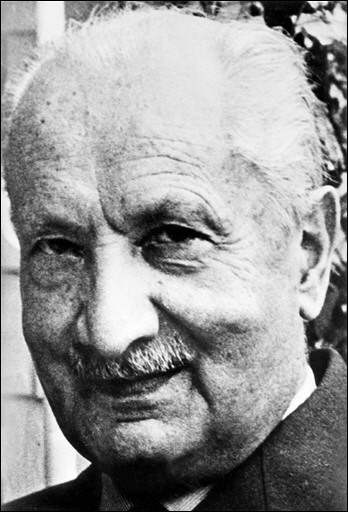
On my Kierkegaard post below, a reader (Sean) posted a great comment:
Do you side with Kaufmann or Dreyfus? To what degree is Heidegger indebted to Kierkegaard? Does it really stop at thrown-ness? Or, can you trace all of Heidegger's existentialism back to 'Religiousness A' (a secularized version)? Isn't the real distinction exactly what anxiety reveals, is it the value of finite existence, or does is reveal an infinite - a sort of flipside to finite existence - as well?
I was prompted to respond with the following, which is way-too-long--especially for a real non answer! Hopefully others have something to say besides this--which I invite you to do! Please excuse typos, etc:
As to Kaufmann or Dreyfus, I'm not so familiar with the arguments of the former relating to Kierkegaard and their opposition to Dreyfus' readings: I think Dreyfus has a great interpretation of Kierkegaard though, and though I haven't listened yet to his lectures on death, guilt, and resoluteness in the Heidegger course this semester, I plan to--they should localize at least some of these problems within the Heidegger. I will say that I think Dreyfus is a little too quick perhaps to characterize Kierkegaard as merely the "existential" influence of Heidegger, as if all of Heidegger's concern with death and guilt were to stem from a concern that is able to be distinctly separated from his more Aristotelian concern in Division I. I'm not the first to criticize him in this way though: Blattner is the best at it, though perhaps going too far in the other direction and making the concerns of temporality and finitude (finitude being really what death is all about for Heidegger), the sole organizing theme of the book. Heidegger sees being as finite, and this is probably one of the central theses of the book: furthermore, he sees Aristotle saying the same thing long ago. He must elaborate how this is able to be so--and so that leads him to posit a Division I that will merge with the concern of Division II, death etc.
Kierkegaard figures there also because he breaks with Hegel--that should be noted. Hegel is Heidegger's archenemy--so anyone able to say that there is a nothingness and a freedom in nothingness, a possibility for a finite subject to relate to infinite possibility (whether God or not), possibility en abyme (as Derrida likes to say) or, conceived probably less rigorously, as drive and repetition of desire (which Lacan says and this is how I formulate it above), would not escape him in his reading of Aristotle. A great helpful book on this is actually Levinas' God, Death and Time--it is really clear and outlines certain concerns about infinity and finiteness in Heidegger and elsewhere that you touched on. Whatever you think of him, too, reading the section on Kierkegaard in The Gift of Death by Derrida is helpful, because he outlines pretty much a standard reading of the suspension of the ethical in relationship to death and shows how at this point one can relate it to concerns of finiteness and infinity. But I'm talking too much--what do you think?
One more thing... with regard to thrown-ness... of course it doesn't stop there, but I think that's the structure that is the best to think about with all this Kierkegaard stuff (as I say in later posts, though unsuccessfully--I stopped all this because it was getting too tough to think)... the real question is how this possibility beyond possibility that is experienced in the dread of nothingness *already exists or is factical* in Dasein. How possibility or futurity (to talk about it in temporal terms) is already within Dasein so that Dasein is thrown back upon it in its existence, so that it is thrown back upon its factical existentiality in its being-existential or projecting itself forward into nothingness, how projecting oneself forward into nothingness is throwing oneself back to the fact of one's nothingness (this all takes place in some remarks on nothingness that are really weird in Being and Time and have a lot to do with Hegel)--this relay, when conceived with respect to its facticity, is the real tough thing to think. Projection is easy--thinking facticity is the real tough stuff. And to Dreyfus' immense credit (I don't know how many people congratulate him on this--but everyone taking his course or exposed to his writings probably should, it is so so vital for understanding anything in Being and Time), this is what he thinks best and why he lays so much emphasis on Division I: it's there that we get a structure that is somehow, in its being structureed that way, already there (da), albeit falling and distracted, etc. This might answer your last question--why I actually don't think that it is so much about the what anxiety reveals. It is about the nature of this revealing as such that is the key for Heidegger. Others like Levinas will change what is revealed and then go back and read it into the structure of Dasein that Heidegger elaborates and show how it cannot be that way (this is what he does in the book I referred you to--but of course not with the rest of his philosophy, which is much more thought out [precisely with regard to what facticity would then have to be] than this one lecture). But for Heidegger, finitude or infinitude would have to announce itself before it is revealed in the revealing itself--the real trick is not deciding then whether revealing that is done in Dasein is finite or infinite, but by trying to let Dasein itself point the way towards answering this, which only then will take us to what is revealed. This leads, however, to the hermeneutic circle Heidegger points out famously. But, again, this is all too much: I'll post this as a separate new post, so it might be easier to find--and also so that others can perhaps get in on what you asked!

6 comments:
I think I agree with your point, as I understand it, but let’s look at this point and see if we get anywhere from it. Looking at the main influences in Heidegger's thought such as his belief that all thought stemmed from Greece, the Husserlian phenomenology, and Aristotelian rereading will only bring about a scientific inquiry into existence. If we assume that Heidegger had it as his mission to get at the question of being from the very beginning, then he must have been aware of the various contradictions and inadequacies of this type of inquiry – especially since he loathed Hegel – almost as much as Kierkegaard. Jaspers and Heidegger's friendship turned Heidegger onto Luther, Dilthy, and Kierkegaard. This is what gave Heidegger the type of insight he needed to get at the question of being – the insight into the human condition, which was primarily a theological study. I would say that Anti-Climacus says that possibility of possibility is really only possible after the first sin. Confining first sin to an understanding is much like that of Sartre’s idea of responsibility – with a religious tint. With Christianity, there is a beginning to everything. In addition, a series of Retroactive happenings. Such as the death of Christ – because Christ existed outside of the history of the race all of his effect is on the wholeness of time. Christ posits the spirit; this is the third component of the essential thesis-antithesis-synthesis of human existence. Nevertheless, man begins his existence in innocence where there is a dreaming spirit – due to a psychical qualification – and this spirit’s dream takes the form of a projection of its own actuality; which is the temptation of possibility – an intimated nothing – the possibility of possibility. The possibility of possibility begets anxiety, which is brought about through an essential task of the dreaming spirit (this is the how of the revealing). The task is to grasp at its own actuality but it fears it and loves it therefore it cannot run away or grasp it. This is all before the first sin – which every individual must commit on his own because every individual is essentially the same and only quantitatively different (they are thrown to different existences, yet the being of all Dasein is essentially the same). Before first sin, man was psychically qualified as being harmoniously related with the body; afterwards the spirit became the qualifier and combined the psychical and the physical in a dialectical synthesis to create the individual that permeates temporality in the eternal moment. For Kierkegaard the how of possibility of possibility already existing in the individual is posited. So there is not an already – there is a change. Man is not man until he has sinned. There is no being during innocence. What I’m having trouble with is the “already there” for Heidegger. How is this structure already there? I know Being and Time will make sense of some revelation of a certain dizziness that I feel when the world around me stops spinning – but how am I supposed to get at this revelation clearly when the only way is to experience it when I’m being-in-the-world. Remove myself and involve myself.
What Dreyfus says (at least as far as I understand) is that Heidegger read the Concluding Unscientific Postscript and latched onto Religiousness A - removed god and replaced him with nothing. Dreyfus seems to be giving Kierkegaard credit for a lot, which may or may not be Kierkegaard’s doing. Coming after Kierkegaard means that Heidegger could have come up with the concepts just the same. However, this will not stop me from showing the way that Heidegger adapted the educative properties of Anxiety - based on the infamous endnote in Being and Time about Kierkegaard’s anxiety. I’m not sure of Kaufmann’s standpoint either, although I’m sure he would have applauded Heidegger for any and every attempt to remove God from anything. After about 10 pages of Critique of Philosophy and Religion, I decided his polemical work was a bit lacking of clarity for his very broad claims. I assumed you were talking from his book From Dostoevsky to Sartre because of your Kierkegaard quotation. My tiny school does not feature any classes that go past the existentialist movement, and so I’ve never read any Derrida – but I’ll check it out – sounds useful for my thesis.
Kierkegaard’s approach to the development of the individual I through increasing concern/ comprehension of the infinite was partially appropriated by Heidegger, in so much as it Heidegger’s concept of Dasien set out a schema for the evolution of personality through a succession of choices in the face of chaos, death and uncertainty; the difference the two approaches to what is essentially the same problem is Heidegger’s description of this process is given from the standpoint of ontology and Kierkegaard’s is given from the standpoint of theology. They are like two travelers approaching the same city form different roads. I think I agree with the professor, Heidegger’s thoughts on these issues are essentially a secularized version of Kierkegaard.
But what does "secularization" mean? That's the question I start with here: you seem to be making the mistake of tracing an intellectual genealogy along the lines of causation: Kierkegaard causes Heidegger's thought in this particular area--Heidegger merely reproduces Kierkegaard, "secularly." And yet at the same time you're saying that they hit at the same thing from two different perspectives. How are both of these things possible? Here is the ultimate ramification of this question, in more particular terms: if we take Hegel as the representative of a secularization of theological notions--insofar as for him the theological had to reflect exactly the development of what happened on the level of human action, individual, cultural, and world-historical: that is, insofar as world historical action was only God's action studied from a different side--well, how do we interpret any act of secularization that Heidegger might attempt, given--as I remark in the post--Heidegger's genuine attempt to break with Hegel? Wouldn't the meaning of "secularization" have to change here? It can't be one that reduces Kierkegaard to the area of world-historical events, that is. There has to be a difference, and that difference is brought about by precisely how Heidegger approaches and does not reproduce Kierkegaard. You seem to be saying he repeats him with a difference--what is that difference? And how, granted the difference, can they be hitting at the same thing?
In answer to the first question, I used the term secularization to mean that Heidegger’s presentation of the process of the development of authentic individuality seems very much removed from the Christian theological cannon. Heidegger maintains an almost Shakespearian ambivalence towards the concept of “God” (in the Christian sense) throughout the portion of his work with which I am familiar. Heidegger brings his reader right up to the border between ontology and metaphysics, then points and says “there it is”, and leaves it to the reader to go further.
Kierkegaard exposition of the development of the individual through increasing awareness of God is describing the same movement of consciousness as Heidegger, but Kierkegaard's description is wholly grounded in the metaphysics of Christianity and Lutheran theology. Kierkegaard’s presentation begins in the realm of Christian metaphysics and works its way back to a quasi-Ontology (transfigured Ontology?).
Another big difference I see is a difference of tone. Heidegger speaks with an aura of extremely serious academic authority. Kierkegaard is always the poet, always the ironist, and much of his work seems to have been written with an impish half smile.
There is no question that Heidegger’s presentation of the process is more polished, worked out, and he employs that certain classically German precision in the fine details.
In answer to the question of how Heidegger can reproduce Kierkegaard, I first must say that I wasn’t as precise with my language as I should have been.
I don’t think that Kierkegaard work “caused” Heidegger’s. I meant that from the standpoint of the reader, the two bodies of work are strikingly similar in their answers to the same question, with the most important difference being the adherence to the Christian ethos in the one, versus the ambivalence to the same in the other. Because Kierkegaard work is historically precedent to Heidegger’s, and because it is documented that Heidegger read and respected Kierkegaard, I think that Heidegger’s thought on the development of the authentic individuality can be viewed as a secularization of Kierkegaard’s views, but this "secularization" is my third party observation not Heidegger's subjective intent; I’m not accusing Heidegger of plagiarism, repetition or intellectual laziness.
Ah, now I totally understand--and I totally agree: I was never concerned with plagarism or whatever--that's obviously not what you're saying--but rather that we got the structure of the thing that both Kierkegaard and Heidegger were working out--as you rightly put it--correctly into words. I think your most important point is on irony: this is what for me is so very interesting about Kierkegaard and what keeps him from approaching this thing phenomenologically, in Heidegger's way. I think "secularization" is a good way to precisely characterize *this* in particular: in a way the God of Kierkegaard is so close, so familar to Heidegger (which does not mean he is a believer) that he cannot even be ironic when discussing him (having that half-smile)--in other words the distance (i.e. irony) that Kierkegaard's phrases are able to acquire with respect to their meaning, their true intent, there ability to reflect something about the divine, is not the same type of distance that Heidegger could possibly have. This leads one to say that for Heidegger, Kierkegaard's God is close--but of course precisely because it means less. This does not rule out, however--and one has to be extremely careful about this, this was the only reason I questioned "secularization" so thoroughly in response to what you wonderfully wrote here--that Heidegger has some conception of God very thoroughly worked out, something that would not replace Kierkegaard's God but be something different with respect to it. He talks a lot, actually, about gods and God, and to categorize him as an atheist is to undercut how weird and confusing it actually is as a situation. This is also why I called your reasoning a bit too causal, though this was not good as I didn't really explain what was going on in my view: the idea that they are both getting at the same phenomenon means that, from this perspective, God is one and the same thing with respect to them, in some way--if not God, well, then "the religious." And though this is the case on a certain level, Heidegger wishes to some degree to break with any previous notion of God precisely in the same gesture as he breaks with ontotheology. What this would mean... well, that's a real question (God without being is the short answer, God beyond being), but it is clear that the space in Heidegger's discourse where Kierkegaard comes into play might be less related to what Kierkegaard is getting at than anyone (you or me, cause I think the same as you about this) might think: everything in Heidegger's Being and Time that seems Kierkegaardian might be more related to Ereignis, in short, than we might think. With respect to this, it is a thinking of what in a sense destines being, not about what Dasein can do to access or understand it. This is all too schematic and confusing, but I like the direction you are going: I'm just trying now to open it up a bit with some odd thought experiments--if only because I think you're right! Right because, in the end, one must question whether the determination of being in the light of temporality, or in terms of presencing, which is the real task of Being and Time and the other work, one must ask whether this is still ontotheology. While Heidegger claims it isn't, to a certain extent you can just as well assert that he does. Derrida in particular ends his book Of Spirit with this confusion: it's really quite interesting and gets at the heart of what you're saying--in the end Heidegger might be more interested in what Kierkeegard had to say than Kierkegaard (precisely because, to echo what I said above, God means less to Heidegger and not to Kierkegaard, who can even be ironic when discussing Him).
Post a Comment