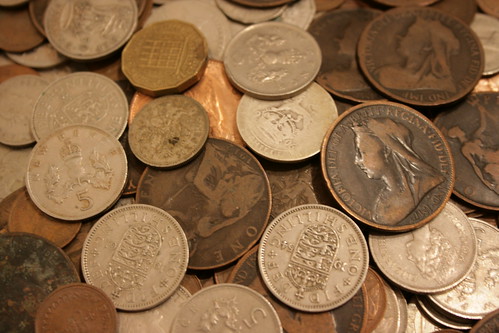
 Addison's "Adventures of a Shilling" is part of a sub-genre of stories that were extremely popular in the 18th century that we now call it- or thing-narratives: tales of a thing (here a coin), told from the perspective of that thing. A more modern example--though without a voice given to the thing itself is the soap in Blooms's pocket in Ulysses (except in Circe, if I remember right, when nearly everything gets a voice).
What is amazing to me about these stories is the emergence within them of narrative as plot: that is, the emergence of a linkage (which is metonymic or combinatory, to use formalism's terms) of discreet events that are never quite reducible to those events (and their narration) themselves. This is because plot is all about the flow of the events, so to speak, and the horizons of anticipation and retrospection that this flow engenders.
Austen brings about this flow of plot on the other end of the 18th century, in one of her most entertaining bits of juvenaila, "The Beautiful Cassandra:" a whole book of twelve chapters that fits on one page. I'll put it the first seven chapters here just so you can see what is going on:
Chapter the First
CASSANDRA was the Daughter & the only Daughter of a celebrated Millener in Bond Street. Her father was of noble Birth, being the near relation of the Dutchess of ——'s Butler.
Chapter the 2d
WHEN Cassandra had attained her 16th year, she was lovely & amiable, & chancing to fall in love with an elegant Bonnet her Mother had just compleated, bespoke by the Countess of ——, she placed it on her gentle Head & walked from her Mother's shop to make her Fortune.
Chapter the 3d
THE first person she met, was the Viscount of ——, a young Man, no less celebrated for his Accomplishments & Virtues, than for his Elegance & Beauty. She curtseyed & walked on.
Chapter the 4th
SHE then proceeded to a Pastry-cook's, where she devoured six ices, refused to pay for them, knocked down the Pastry Cook & walked away.
Chapter the 5th
SHE next ascended a Hackney Coach & ordered it to Hampstead, where she was no sooner arrived than she ordered the Coachman to turn round & drive her back again.
Chapter the 6th
BEING returned to the same spot of the same Street she had set out from, the Coachman demanded his Pay.
Chapter the 7th
SHE searched her pockets over again & again; but every search was unsuccessfull. No money could she find. The man grew peremptory. She placed her bonnet on his head & ran away...
...you get the idea. This is a virtuoso performance (and a hilarious one at that) of what I'm getting at: Austen understands that the linkage of narrated events is so able to be carried by a larger structure that she is able to put whole chapter breaks between the telling of these events-- an act which, by the way, completely grasps the function of chapters as merely larger divisions or markers of those divisions already between narrated events in the novels.
But back to Addison. We can in fact put what we're getting at (and what Austen here understands) the other way around--and this is what these thing-narratives like Addison's do the best: what emerges in them is a way of manipulating the short sentences, the short narrated events, in terms of a larger arc. The trust Addison puts in these larger shifts makes him write small sentences that just document the exchanges of the shilling (much like how Austen is able to write little pointless circular events like that in chapter five of Austen's novel).
So at a certain point in the "Adventures," here is what we're getting:
I was sent to the apothecary's shop for a pint of sack. The apothecary gave me to an herb-woman, the herb-woman to a butcher, the butcher to a brewer, and the brewer to his wife, who made a present of me to a nonconformist preacher.
The speed with which the shilling is able to tell of what happened to her/him--through the use of small, quick sentences, is a function of the burden of the storytelling being shifted to the larger connective (i.e. plotty) structures. They're a blast to read for this reason. Why? To lay it all out would be more than I can really do right now, but it involves how this larger plot-structure allows a personal (singular) set of adventures to emerge, which in turn allows narrative capability to be lent to things that aren't normally allowed to enter into narrative. In short, it would involve explaining how this emergence of narrative into plot allows the whole story to be told from the perspective of the shilling, and perhaps on a larger level how--instead of seeing plot emerge as a function of narrative, as we've been outlining here--how the narrative is really a function of something like plot, how narrative emerges from plot. But since I don't know how to express this well, I'll just let the shilling speak:
I was born (says he) on the side of a mountain, near a little village of Peru, and made a voyage to England in an ingot, under the convoy of Sir Francis Drake. I was, soon after my arrival, taken out of my Indian habit, refined, naturalized, and put into the British mode, with the face of Queen Elizabeth on one side, and the arms of the country on the other. Being thus equipped, I found in me a wonderful inclination to ramble, and visit all parts of the new world into which I was brought. The people very much favoured my natural disposition, and shifted me so fast from hand to hand, that before I was five years old, I had travelled into almost every corner of the nation. But in the beginning of my sixth year, to my unspeakable grief, I fell into the hands of a miserable old fellow, who clapped me into an iron I chest, where I found five hundred more of my own quality who lay under the same confinement. The only relief we had, was to be taken out and counted over in the fresh air every morning and evening. After an imprisonment of several years, we heard somebody knocking at our chest, and breaking it open with a hammer. This we found was the old man's heir, who, as his father lay a dying, was so good as to come to our release : he separated us that very day. What was the fate of my companions I know not: as for myself, I was sent to the apothecary's shop for a pint of sack. The apothecary gave me to an herb-woman, the herb-woman to a butcher, the butcher to a brewer, and the brewer to his wife, who made a present of me to a nonconformist preacher. After this manner I made my way merrily through the world; for, as I told you before, we shillings love nothing so much as travelling. I sometimes fetched in a shoulder of mutton, sometimes a play-book, and often had the satisfaction to treat a Templar at a twelvepenny ordinary, or carry him, with three friends, to Westminster Hall...

No comments:
Post a Comment